


Are you manually pulling sales data from Shopify into a spreadsheet just to compare it against your Xero financials? This isn’t a sign you’re doing something wrong; it’s a clear sign your business is ready to scale. The answer isn’t more spreadsheets—it’s bringing in expert data integration consultants who can build the bridges between all your disconnected software and finally unlock insight-led decision-making.
Is Your Business Drowning in Data Chaos?

If you’re an SMB owner or operator, chances are you spend way too much time wrestling with siloed data. You’ve got invaluable information trapped inside your CRM, your accounting software, and your e-commerce platform, but no way to see it all in one place.
This constant, manual data wrangling is not just frustrating; it’s risky. Imagine making a critical inventory decision based on a sales report that doesn’t account for your latest marketing spend. It’s a recipe for disaster. This nagging doubt in your numbers turns strategic planning into little more than educated guesswork and holds back your ability to scale smart.
The True Cost of Siloed Data
The pain point goes far beyond wasted hours. When your data is fragmented, it creates serious operational friction and puts a hard ceiling on your growth.
Some of the biggest headaches we see with our clients include:
- Delayed Reporting: Critical decisions on cash flow or performance get stuck in limbo for days while your team painstakingly compiles reports by hand in Excel.
- Inconsistent Metrics: Your sales team reports one revenue number for the quarter, while the finance team has a completely different figure. This erodes trust and causes endless confusion.
- Missed Opportunities: Without a unified view of customer behavior across all your platforms, you’re blind to valuable trends that could drive upsells or improve your forecasting models.
Data integration isn’t just a technical task to check off a list. It’s a strategic move to create a single, trustworthy view of your entire business. It’s about turning chaos into clarity so you can finally make decisions with confidence.
To really get the most out of their data, smart businesses are adopting new Digital Transformation Best Practices, where solid data integration is a core pillar. This guide will give you a clear path to finding the right expert to untangle this complexity and build a data foundation that will support your company’s future. For a deeper dive, check out our guide on achieving data mastery for SMEs.
What a Data Integration Consultant Actually Does

Many founders know they have a data problem. What they’re often unsure about is what a real solution actually looks like. The role of a data integration consultant goes way beyond just “connecting systems”—they are the architects of your business’s data ecosystem.
Think of them as a trusted advisor who maps your company’s information flow. They trace how data is moving (or getting stuck) between your sales, marketing, and finance tools. From there, they design a robust “data plumbing” system to get everything moving correctly. A huge part of their job is to automate business processes that are currently draining your team’s time.
The end goal is to ensure clean, reliable information moves seamlessly into a powerful reporting engine like Power BI. This isn’t a small fix; it’s about eliminating manual errors and delays for good.
From Data Janitor to Strategic Partner
A truly great consultant doesn’t just connect the pipes; they help you decide what should be flowing through them in the first place. Their work is a blend of the highly technical and the highly strategic, all focused on turning your messy data into a tangible asset.
This strategic partnership typically involves a few key activities:
- Data Cleansing and Transformation: They take the raw, often messy, information from different sources and standardise it. This makes sure that “revenue” means the exact same thing in your CRM as it does in your accounting software.
- Building a Central Data Hub: They’ll create a single source of truth, often in a simple data warehouse. This is the foundation for making sure all your reports are accurate and consistent.
- Defining Meaningful KPIs: A good consultant will work with you to identify the key performance indicators (KPIs) that actually drive business growth, not just vanity metrics that look nice on a chart.
- Designing Actionable Dashboards: The final step is building visual dashboards in Power BI that don’t just display data but answer your most pressing business questions at a glance.
The ultimate goal here is to transform your data from a frustrating liability into your most valuable strategic asset. A skilled consultant builds a system that empowers you to make insight-led decisions confidently and quickly.
The demand for these experts is exploding for a reason. The global data integration market is projected to jump from USD 15.22 billion to USD 25.69 billion by 2029, driven by a massive need for better data quality and governance. This surge underscores why expert data integration consulting is no longer a luxury—it’s a core business necessity.
Defining Your Project Needs Before You Hire
Thinking about hiring a data integration consultant without a clear goal is like setting sail without a map—you’ll burn through your budget and end up nowhere fast. Before you start looking for experts, you need to nail down exactly what you want to achieve. This way, you lead the conversation from the very first call.
Getting this initial prep work right is probably the single most important thing you can do. It helps you get accurate quotes, find a partner who has worked with your software stack before, and gives everyone a clear finish line. The best way to start? Ask your team a few direct questions.
The Essential Pre-Hiring Questions
To put together a brief that a consultant can actually work with, get answers to these core questions first.
- Which reports are the biggest time sinks? Get specific. Is it the weekly sales summary that takes someone half a day to pull together? Or the monthly financial close that’s an all-hands-on-deck manual nightmare? Pinpoint the exact reports that eat up the most hours.
- What business questions can’t you answer right now? Think about the critical business questions that are currently impossible to figure out. A classic example is, “What’s our true customer acquisition cost when we factor in both ad spend from Google Ads and salaries from our CRM?”
- Which systems are the highest priority? You don’t have to connect everything at once. In fact, you shouldn’t. List the top three systems—maybe it’s your CRM, accounting software, and e-commerce platform—that would deliver the biggest win if they could talk to each other.
This simple exercise turns a vague feeling of “our data is a mess” into a concrete, solvable problem. When a consultant sees a clear scope, they can focus on delivering a quick win that immediately cuts down on manual work and shows real, tangible value from the get-go.
Your Pre-Hiring Data Integration Checklist
Use this checklist to define your project scope before speaking with any consultants.
| Key Question | Example Answer | Why It Matters for Your Project |
|---|---|---|
| What’s the main business problem? | “We waste 20+ hours a month manually creating sales reports.” | This defines the core pain point and helps a consultant measure the project’s ROI. |
| What does success look like? | “An automated dashboard that shows daily sales vs. marketing spend, updated every morning.” | A clear success metric gives everyone a target to aim for. No ambiguity. |
| Which systems must be connected? | “Salesforce, QuickBooks Online, and Shopify.” | Naming the specific platforms helps identify consultants with relevant experience. |
| Who will be the project lead internally? | “Our Head of Operations, Sarah.” | Establishes a clear point of contact, which is crucial for smooth communication. |
| What is the ideal project timeline? | “We’d like the initial dashboard live within 60 days.” | Sets expectations around timing and helps the consultant scope a realistic project. |
Walking into a conversation with answers to these questions shows you’re a serious partner and helps a consultant scope a project that will actually deliver a return.
A well-defined problem is halfway to a solution. Approaching a consultant with a clear brief helps them scope a project that delivers maximum ROI from day one.
The image below gives you a good look at the typical workflow a data integration consultant will follow.
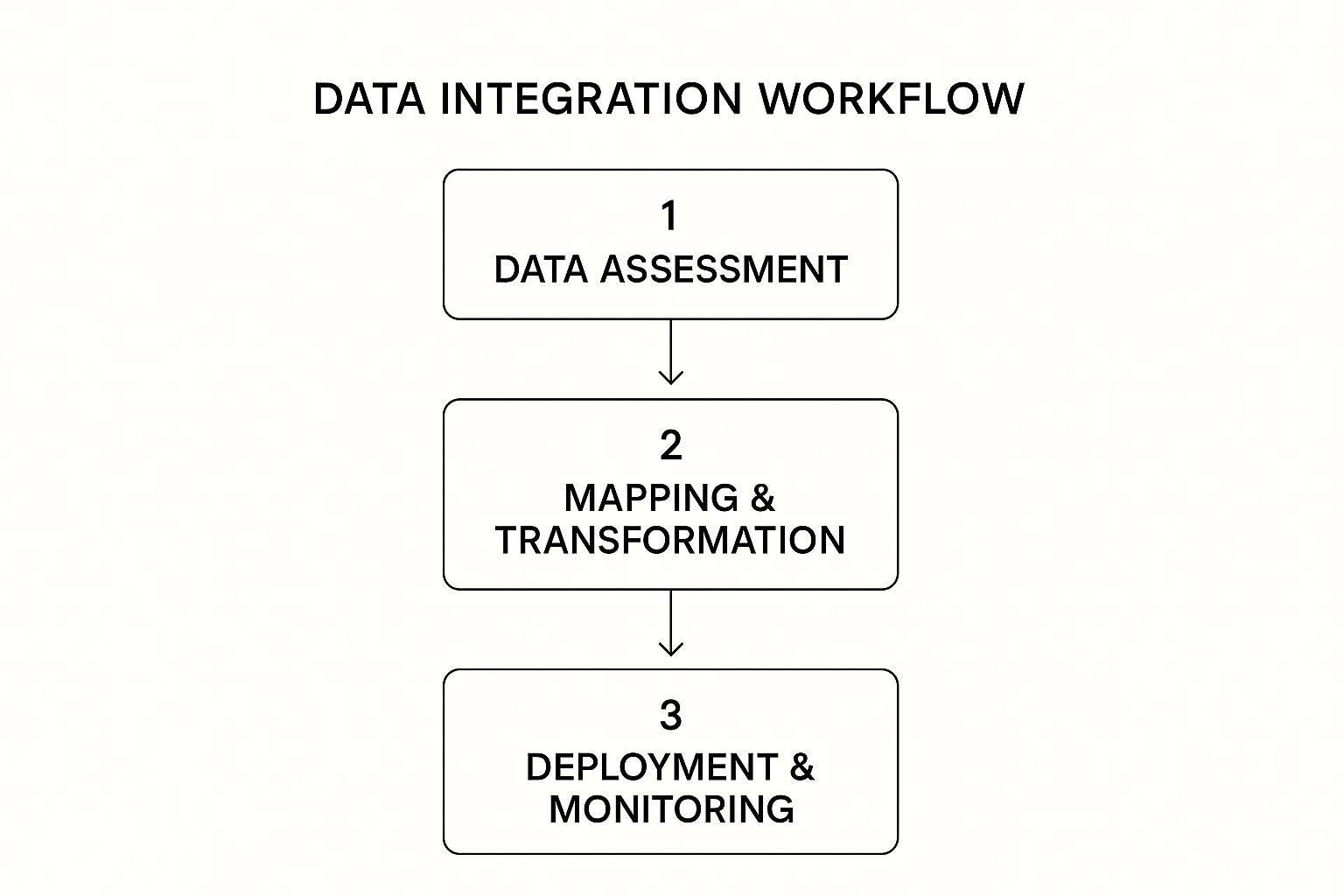
As you can see, that initial assessment and mapping phase is the foundation for everything else that follows, all the way through to deployment and long-term monitoring.
How to Find and Evaluate the Right Consultant

Finding the right data partner is about so much more than just ticking a technical skills box. You’re looking for a strategic fit—someone who gets your business. The market for data consulting is absolutely booming; it’s part of a big data industry expected to hit USD 33.36 billion by 2034. You can discover insights on the big data consulting market to see just how fast it’s growing.
This growth means you have plenty of options. But it also makes finding the right one that much harder.
For most SMBs, big enterprise firms aren’t the answer. Boutique consultancies are often a much better fit. These smaller, specialized teams live and breathe the tech stack you’re actually using. They understand the budget constraints, they know the tools, and they’re built to be more agile and responsive.
Asking the Right Questions on the Discovery Call
That first call is your chance to vet a potential partner properly. You have to get past the sales pitch and find out what they can really do.
Don’t go in cold. Have a few pointed questions ready to go that will tell you everything you need to know:
- “Can you show me a case study for a business our size where you integrated similar systems?” This question cuts right to the chase. If they don’t have a relevant example, they probably don’t have the right experience for you.
- “What’s your process for understanding our business goals before you even touch the technical side?” The best partners care more about your business outcomes than the names of your data fields.
- “How do you handle project communication and updates?” You need a partner who keeps you in the loop clearly and consistently, without drowning you in technical jargon.
A consultant who jumps straight into talking about APIs and data schemas without first asking about your revenue goals or operational bottlenecks is a massive red flag. A true partner starts with your vision, not their tools.
Red Flags to Watch For
Knowing what to look for is just as important as knowing what to ask. Keep your eyes peeled for these warning signs.
Be very cautious of any consultant who:
- Hides behind jargon: A great consultant can explain complex ideas in simple terms. If they can’t, they either don’t understand it well enough themselves or they aren’t focused on what you actually need.
- Pushes a cookie-cutter solution: Every business is unique. Be wary of anyone pitching a solution before they’ve taken the time to really understand your specific problem.
- Isn’t curious about your business: The best data integration consultants are intensely curious. They should be asking you more questions than you ask them.
At Vizule, we always lead with your business goals. Our free discovery call is designed to understand your vision first, so we can build a data strategy that actually gets you there.
Unlocking Long-Term Value from Your Data
The project isn’t really “over” just because the new dashboards are live. A successful handover is what turns a one-off project into a lasting capability for your business, ensuring you see a return on your investment for years to come.
This is where expert data integration consultants shift their focus from building things to empowering your team. The final phase should always include clear, easy-to-digest documentation and hands-on team training. Your consultant should walk everyone through the new automated reports, explaining how to interpret the data and—more importantly—how to use those insights to make smarter, faster decisions.
The goal is to weave data-driven thinking into your company’s DNA, not just make it a task for one analyst.
The Future State of Your Business
Imagine your finance and operations teams being perfectly aligned because they’re finally working from a single source of truth. Picture yourself spotting a new market trend in your Power BI dashboard weeks before your competitors even have a clue.
This is the kind of transformation that expert data integration delivers.
The real value isn’t just in the slick, automated reports; it’s in the strategic clarity they provide. You’ll waste less time pulling manual reports and spend far more time on high-impact strategy and growth.
Of course, this future has to be built on a solid foundation. For any data integration project, security is paramount. Learning about robust API security best practices can help ensure the long-term integrity and trustworthiness of your data assets.
This secure, scalable data foundation becomes even more critical as your business grows. Much of our work focuses on building robust systems that support business intelligence for finance teams as they scale.
It’s precisely these kinds of projects that are driving massive market growth. The global data integration market, valued at USD 15.24 billion in 2024, is expected to nearly triple by 2034. As companies lean more heavily on data, building a lasting capability isn’t just an advantage—it’s essential for survival. You can explore more about the data integration market’s rapid expansion and what’s coming next.
Got Questions About Hiring a Data Consultant?
Even when you know you have a data problem, pulling the trigger on hiring a consultant can feel like a big leap. As a business owner, you’re rightly protective of your time and your budget. Let’s tackle some of the most common questions we hear from founders and operators just like you.
How Much Does a Data Integration Project Cost?
This is usually the first question, and the honest answer is: it varies. But it’s almost always more accessible than you’d imagine. Most boutique data integration consultants don’t have enterprise-level overhead, so they offer project-based pricing or flexible retainers that work for SMB budgets.
The real key is to stop thinking of it as a cost and start seeing it as an investment. What if you could save your team 10-20 hours of manual work every single week just by automating one critical report? The ROI on that alone is massive. A good consultant will always give you a transparent scope and a clear quote after a quick discovery call.
Will I Need a Full-Time Tech Team to Manage This Afterwards?
Absolutely not. In fact, that’s the opposite of our goal. A successful data integration project should build you an automated, low-maintenance system that works for you, not the other way around.
A skilled consultant will build a solution that hums along quietly in the background. It will automatically pull, clean, and pipe your data into easy-to-read dashboards in a tool like Power BI. The job isn’t done until your team is trained and empowered to use the new insights, not saddled with another technical chore.
The best data solutions are the ones you don’t have to think about. They just work, delivering the right insights to the right people at the right time.
Isn’t This Just Buying Another Piece of Software?
This is a critical distinction, so I’m glad you asked. Buying another off-the-shelf tool often just creates one more data silo, digging the hole you’re already in even deeper.
Data integration is the opposite. It’s the strategic work of making your existing software stack finally talk to each other. A consultant is like a data plumber, building the pipes that connect your CRM, accounting software, and operational tools into a single source of truth. The result isn’t more software to manage; it’s getting exponentially more value out of the tools you already pay for.
How Long Does a Typical Project Take?
For most small and medium-sized businesses, a well-defined project is a matter of weeks, not months. The timeline really depends on two things: how many systems you’re connecting and how messy the data is.
Any consultant worth their salt will start with a ‘quick win.’ They’ll tackle your most painful manual report first to show you tangible value as fast as possible. At Vizule, we scope projects in phases so you see results early and often. We can talk through your specific timeline and goals on a free, no-pressure discovery call.
Ready to stop wrestling with spreadsheets and start making decisions with confidence? Vizule can help you connect the dots in your data. Book your free BI consultation today to see how we can automate your reporting stack and finally help you trust your data.


