


Are your business reports always out of date? Is your most critical data trapped in separate systems like your CRM, accounting software, and a dozen different spreadsheets? This chaos leads to shaky reports and big decisions made on little more than a gut feeling. Data integration consulting is what fixes this, connecting all those scattered dots to create one, reliable source of truth for your entire business.
At Vizule, we specialise in helping SMB operators and founders move from this state of frustration to one of confidence. This guide will show you how.
From Data Chaos to Confident Decisions
For most founders and operators, the daily grind involves a constant battle with data. You might pull sales figures from your CRM, check them against financials from Xero or QuickBooks, and then painstakingly plug it all into an Excel model. It’s not just a time sink; the whole process is fragile and a breeding ground for errors.
This disconnected setup—what we call working in "data silos"—is a classic growing pain for small and medium-sized businesses. It traps you in a state of data chaos where reports are instantly out-of-date, and you can never be 100% confident in the numbers you're presenting. Key performance indicators (KPIs) become moving targets, and getting your finance and ops teams on the same page feels like an impossible task.
The Strategic Shift to a Single Source of Truth
The real issue isn't a lack of data. It’s the lack of a central hub where all that information can come together and tell a single, coherent story. This is where data integration consulting stops being a technical fix and becomes a genuine strategic advantage.
Think of it as bringing in an expert architect to design a modern, efficient information workflow for your business. Instead of you manually hauling buckets of data from room to room, the architect builds smart plumbing that connects everything automatically.
Data integration isn't about piling on more software. It's about designing a system where your existing tools—your CRM, accounting platform, and marketing apps—all talk to each other seamlessly. The result is a single source of truth that you can actually trust.
This guide is your roadmap for making that shift. We'll show you how to move from reacting to data emergencies to proactively building growth. By putting a solid data foundation in place, you can automate financial reporting, get real-time visibility into performance, and finally give your team the power to make confident, insight-led decisions.
Ready to see how Vizule can help you connect your data and automate your reporting? Book your free BI consultation and let our experts design a solution for your business.
What Data Integration Actually Means for Your Business
Let's cut through the jargon. "Data integration" is simply the process of getting all your business data out of its separate boxes and into one central, organised place. Think about it: you have your accounting software like Xero, your CRM like HubSpot, and marketing data from Google. Each one is an island of information.
Without integration, you’re stuck rowing a boat between these islands, grabbing bits of data and trying to piece the puzzle together back on shore. It's slow, painful, and dangerously easy to get wrong. Data integration consulting is all about building permanent bridges that connect these islands automatically.
This isn't some abstract theory. It’s about making the valuable information you already have start working for you. For any growing business, the impact is immediate and very real.
From Disconnected Data to Actionable Insight
Imagine you’re trying to figure out your true Customer Acquisition Cost (CAC). To get an accurate number, you need marketing spend from your ad platforms, sales data from your CRM, and maybe subscription revenue from your payment system. When this information lives in different places, you're forced into a messy spreadsheet nightmare that’s just asking for human error.
Data integration fixes this fundamental problem. It connects the pipes, allowing your marketing costs to be measured directly against the revenue they bring in, all in one dashboard.
The goal of data integration is to create a single, reliable view of your business. This allows you to stop debating whose numbers are "right" and start having strategic conversations about what the numbers actually mean for your growth.
This unified view is the bedrock for building powerful, automated reports in tools like Power BI. Instead of relying on static, instantly outdated spreadsheets, you get dynamic dashboards that refresh themselves.
A Real-World E-commerce Example
Let's take an online store. They sell products through Shopify, manage inventory with another system, and run ads on Google and Facebook. The founder is wrestling with some critical questions:
- Which marketing campaigns are actually driving profitable sales, not just clicks?
- Are we about to run out of stock on our best-selling items?
- What's our real profit margin after we account for ad spend, shipping, and returns?
Answering these means trying to connect three different data sources manually. A data integration consulting project would build a system to automatically pull data from each platform into a central hub.
Once unified, the data paints a complete picture of business performance. The results are game-changing:
- Marketing Clarity: The founder can finally see a true Return on Ad Spend (ROAS) for every campaign, calculated with real-time sales and profit data, not just surface-level traffic metrics.
- Operational Efficiency: Automated inventory alerts can be set up in a Power BI dashboard, flagging products that need reordering long before they sell out.
- Financial Control: A real-time Profit & Loss (P&L) statement becomes a reality, showing true profitability every day, not just once a month after the fact.
This is the practical power of data integration. It turns fragmented information into a clear, actionable roadmap for your business.
Want to automate your reporting and finally trust your data? Book a free call with our BI consultants today.
How Data Integration Consulting Unlocks Strategic Growth

It’s one thing to understand what data integration is, but the real question for any business owner is simple: "Why should I care?" The answer is about making a fundamental shift from just managing data to actually using it for genuine strategic growth. Investing in an expert's guidance isn't about buying fancy software; it’s about finally unlocking the value that’s already hidden right inside your business.
The most immediate return from data integration consulting is the elimination of hundreds of hours wasted on manual reporting. Just imagine reclaiming all the time your team spends copying and pasting numbers between spreadsheets, fixing broken formulas, and chasing down the latest figures. Automating this drudgery frees up your best people to focus on analysis and action, not mind-numbing administration.
This focus is becoming absolutely critical. The global data integration market, valued at around USD 15.24 billion, is projected to explode to approximately USD 47.60 billion by 2034. This isn't just a trend; it's a clear signal that businesses are racing to consolidate their data for sharper, more competitive operational insights.
Building a Scalable Foundation for Growth
For any growing business, today’s manageable "Excel chaos" quickly snowballs into tomorrow’s major operational bottleneck. A well-designed data foundation built by a consultant is scalable by its very nature. It’s engineered to grow with you, easily plugging in new data sources—like a new e-commerce channel or marketing platform—without shattering your entire reporting stack.
This proactive approach saves you from costly mistakes down the road. Decisions made on flaky or incomplete data lead to real-world problems like poor inventory management, misallocated marketing budgets, and completely missed growth opportunities. Having a single, unified view of your business health ensures every strategic choice is grounded in reality.
The true ROI of data integration consulting isn't just in the time you save. It’s in the expensive errors you avoid and the confident, forward-looking decisions you're empowered to make.
When you align your entire team around one set of validated numbers, you put an end to departmental friction. Finance, sales, and operations are no longer arguing about whose data is correct. Instead, they’re collaborating on what the data means and how to act on it, building a true culture of data-driven decision-making.
Transforming Data Into Your Most Valuable Asset
Ultimately, the right consulting partner acts as a translator. They turn a complex, technical process into direct, bottom-line impact. They connect the dots between your various systems to deliver not just data, but intelligence.
This intelligence shows up in several powerful ways:
- Unified Business View: See the complete picture of your financial and operational health in a single Power BI dashboard, updated in real time.
- Predictive Insight: Move beyond just looking at what happened last month. Start building forecasting models that help you anticipate cash flow, manage inventory, and plan for what's next.
- Team Alignment: Ensure everyone from the C-suite to the marketing intern is working from the same playbook, with clear, consistent KPIs.
This is the transformation that turns raw, fragmented data into your company’s most valuable strategic asset. It equips you with the clarity and confidence you need to navigate challenges and pounce on opportunities, ensuring you’re not just surviving, but scaling smartly.
Our Map–Model–Mobilise Framework for Data Success
Any complex technical challenge can be tamed with a proven methodology. Over years of guiding founders and operators from data chaos to genuine clarity, we’ve boiled our approach down to a transparent, three-stage framework. Our Map–Model–Mobilise process is the engine behind every single successful data integration consulting project we take on.
We designed this process specifically for business leaders, not just IT teams. Each phase has a clear purpose and defined deliverables, and it’s all built to deliver tangible value fast. You’ll see real progress without getting bogged down in technical jargon. Think of it as our commitment to making the journey to data-driven leadership as straightforward as it is effective.
Phase 1: Map Your Data and Define Your Goals
The first step has nothing to do with technology. It’s all about your business. We kick things off with a deep-dive discovery session to get to the heart of what you want to achieve. Are you wrestling with inconsistent cash flow reports? Do you need a single, reliable view of your sales pipeline? Or are you trying to finally align your financial and operational KPIs?
Once we’ve got a handle on your goals, we meticulously map out your entire data landscape. This means identifying every critical data source—from your accounting software like Xero and your CRM to various marketing platforms and the spreadsheets holding everything together. We chart how information currently flows (or more often, fails to flow) between them.
The result of this phase is a crystal-clear blueprint. You get a complete inventory of your data assets and a strategic roadmap that draws a straight line from the integration project to your most important business objectives.
Phase 2: Model the Engine for Your Insights
This is where we get our hands dirty and build the powerful, automated core of your new data ecosystem. The "Model" phase is all about constructing the technical infrastructure that will become your single source of truth. We design and build the data pipelines that automatically pull information from all the sources we mapped in Phase 1.
This raw data is then cleaned, structured, and organised within a central data warehouse—a secure and orderly home for all your business information. Using this pristine data, we construct robust financial and operational models, typically inside Power BI. These aren't just glorified spreadsheets; they are dynamic, driver-based models that form the logical heart of your entire reporting system.
Think of this phase like building the engine of a high-performance car. We're not just assembling parts; we're engineering a perfectly tuned system designed for one purpose: to turn raw fuel (your data) into powerful, reliable performance (your insights).
Phase 3: Mobilise Your Data with Interactive Dashboards
The final phase, "Mobilise," is where all the hard work becomes visible and valuable to your entire team. We bring the modelled data to life through intuitive, interactive dashboards. This is the moment your investment in data integration consulting pays off with daily, actionable insights.
This is the point where we move from the back-end build to the front-end experience, delivering insights that are not just accurate, but directly relevant to your team's day-to-day needs.
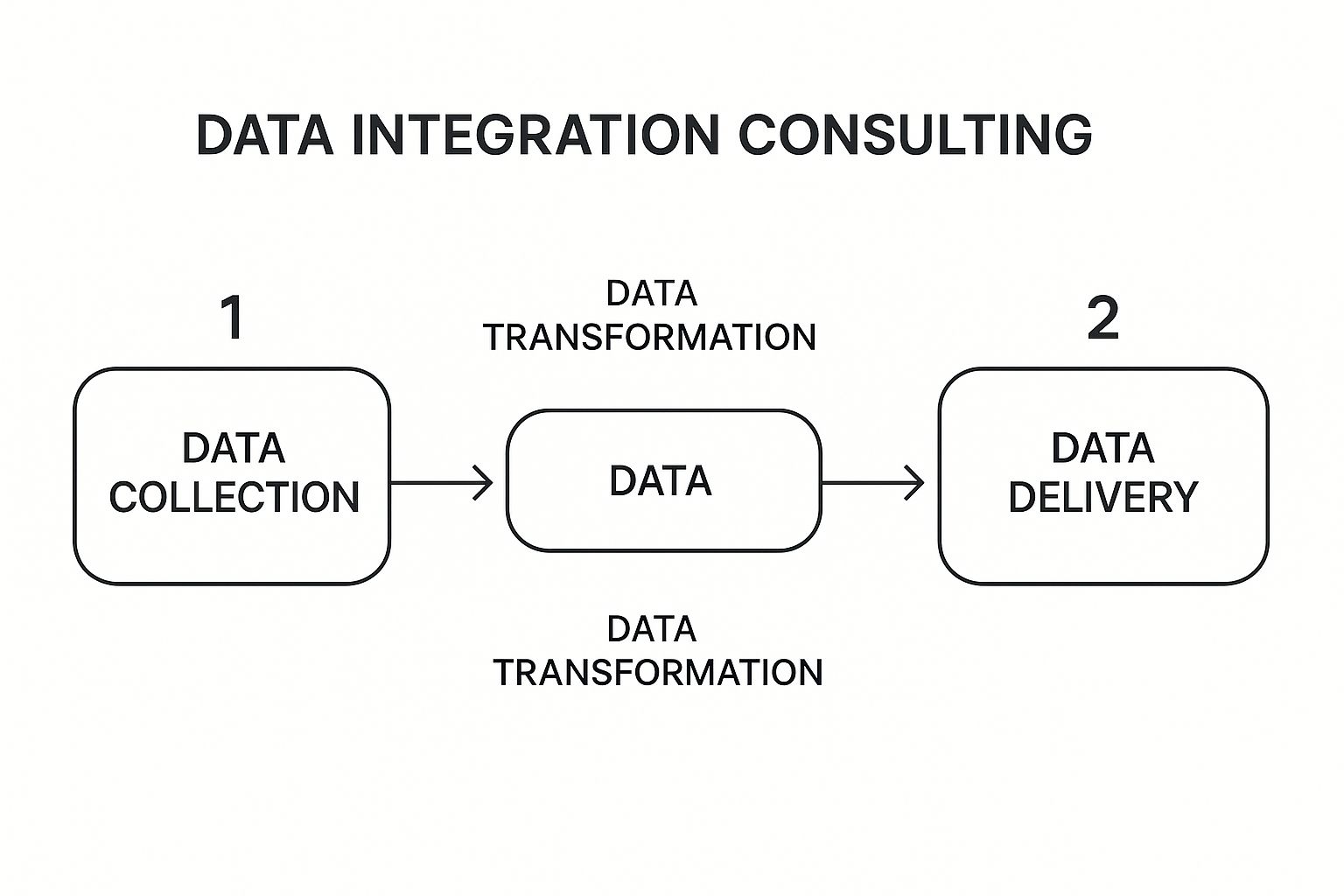
We build custom reports and dashboards in Power BI that are tailored to your specific KPIs and business questions. These are living tools, not static reports. Your team can use them to:
- Explore Data: Drill down into numbers, filter by date ranges, and segment by product or region to uncover hidden trends.
- Ask Questions: Interact with the data to find answers on their own, fostering a culture of curiosity and self-service analytics.
- Find Answers: Get immediate clarity on business performance without waiting for manual updates or sending requests to an analyst.
This final step is about empowerment. It’s about letting your team stop chasing data and start using it to make smarter, faster decisions. It’s the moment your data finally starts working for you, not the other way around.
To give you a clearer picture, here’s a simple breakdown of how our process works.
Vizule's Map–Model–Mobilise Framework
A step-by-step breakdown of our consulting process, showing how we turn data chaos into actionable insights.
| Phase | What We Do | What You Get |
|---|---|---|
| 1. Map | We hold deep-dive discovery workshops to understand your goals, then identify and document all your critical data sources. | A strategic roadmap connecting the project to your business objectives and a complete inventory of your data assets. |
| 2. Model | We design and build automated data pipelines, a central data warehouse, and the core financial and operational models. | A fully automated, reliable "single source of truth" for all your business data, ready for analysis. |
| 3. Mobilise | We create custom, interactive dashboards and reports in Power BI, tailored to your team's specific needs and KPIs. | Intuitive, self-service dashboards that provide daily, actionable insights and empower your team to make data-driven decisions. |
This structured, business-first approach ensures the solution we build isn't just technically sound—it's a genuine asset that drives your business forward.
Ready to see how the Map–Model–Mobilise framework could transform your operations? See how Vizule can help automate your reporting stack and build a data foundation that scales with your ambition.
Choosing the Right Data Integration Partner
Picking a partner for your data integration consulting project is one of the most important calls you'll make. Get it right, and you accelerate your growth. Get it wrong, and you’re looking at a wasted budget and months of pure frustration.
Not all consultants are cut from the same cloth. For a growing business, the difference between a massive enterprise firm and a focused, boutique consultancy is everything. The partner you choose should feel like an extension of your own team—a trusted advisor who’s just as invested in your business outcomes as you are. They should be asking about your commercial goals long before they ever mention a piece of technology.
Business-Focused vs. Technology-Focused
Here’s a key distinction to watch for: the consultant's core philosophy. Many large firms lead with technology, showing off a huge toolkit of complex, expensive platforms. This often leads to solutions that are completely over-engineered and overpriced for what an SMB actually needs.
A business-focused consultancy, on the other hand, starts with your pain points. They want to hear about your reporting headaches, operational bottlenecks, and strategic goals. Their success isn't measured by the tech they roll out, but by the business problems they actually solve.
A great data partner doesn't sell you software; they sell you outcomes. Their first questions should be about your business, not their tools. This approach ensures the solution is built to serve your strategy, not the other way around.
This difference is critical. You need a partner who can translate technical jargon into clear commercial advantages, ensuring every dollar you invest is tied directly to improving your bottom line.
What to Look For in a Data Partner
As you start evaluating potential partners, here’s a practical checklist to keep in mind. The right consultant will tick all these boxes, proving they get the unique environment of a founder-led business.
- Demonstrable SMB Experience: Have they actually worked with businesses like yours? Ask for case studies or examples where they’ve connected systems you use, like Xero, HubSpot, or Shopify.
- A Collaborative, Transparent Process: They should be able to clearly explain their methodology (like our Map–Model–Mobilise framework) in a way that makes sense to a non-technical leader. No black boxes.
- Expertise in Your Core Tools: Deep knowledge of platforms like Power BI is completely non-negotiable. This is the only way they can build the kind of interactive, automated dashboards that will actually empower your team.
- A Focus on Financial Intelligence: The best data integration consulting projects are tied directly to the financial health of the business. Check if they understand how to model things like cash flow and profitability—a key part of our work in business intelligence for finance teams.
The huge growth in data integration reflects this hunger for deeper intelligence. The global data intelligence and integration software market, currently estimated at USD 18.85 billion, is projected to hit USD 71.74 billion by 2033. This explosion is driven by the simple need for better analytics to guide operations. You can read the full research about this market expansion to see where things are headed.
Choosing a boutique firm like Vizule means you're not just another client. You're partnering with a team that speaks your language. We get the resource constraints, the need for speed, and the intense focus on ROI that defines a growing business. We blend technical excellence with the commercial sharpness needed to turn your data from a source of chaos into your most powerful asset for growth.
Connect with us to design your financial dashboard in Power BI and see firsthand how a business-focused approach makes all the difference.
Your Next Step Toward Data-Driven Leadership
Imagine starting your week with a single, automated report that gives you a complete and totally accurate view of your business performance. What strategic moves could you make with that kind of clarity? This is the reality that expert data integration consulting delivers.
At Vizule, we solve the core, frustrating pain of siloed data and the soul-crushing drag of manual reporting. Our job is to build the solid data foundation that lets you focus on strategy and growth—not on chasing down numbers and fixing broken spreadsheets. This isn't just about getting better data; it’s about fundamentally changing how you lead.
Taking the First Step
Deciding to bring in a partner is the single most important move you can make. It’s an admission that your team’s time is better spent using insights, not wrestling with the plumbing required to get them. This is especially true now, as the tools for data integration become more powerful than ever.
Modern approaches are leaving the old, rigid frameworks in the dust. Companies are quickly shifting to cloud-native platforms that support real-time data processing, event-driven architecture, and simple API connections through low-code tools. Industries like retail and banking absolutely depend on integrating diverse datasets to stay ahead—a trend you can explore in more detail on MarketsandMarkets.com. For a small or medium-sized business, this means you can finally access enterprise-grade capabilities without the enterprise-level headaches.
Taking the first step towards a unified data strategy is the most important one. It's a commitment to building a business that runs on facts, not guesswork, creating a foundation that will support your growth for years to come.
This step allows you to finally trust your numbers, get your teams aligned, and build a resilient, data-driven culture. It’s your chance to move from being reactive and putting out fires to being a proactive, strategic leader.
Ready to see what your business is truly capable of? The path to clarity starts with a single conversation.
Book your free, no-obligation discovery call with our BI consultants to talk through your unique goals and see how we can help you automate reporting and build a single source of truth for your entire business.
Frequently Asked Questions About Data Integration
We get it. Investing in something like data integration consulting can feel like a big leap. Founders and operators often come to us with a similar set of worries—cost, complexity, and the time it'll take away from running the business.
Let's tackle the most common questions head-on.
How Much Does Data Integration Consulting Cost?
This is always the first question, and the honest answer is: it depends. The price is tied directly to the complexity of your data setup and what you're trying to achieve. A simple project connecting Xero and your CRM to a Power BI dashboard will naturally be a smaller investment than a complex web of e-commerce platforms, inventory systems, and ad networks.
But here’s a better question to ask: what’s the return on investment (ROI)? Think about the real cost of not integrating your data. Wasted hours building manual reports, costly mistakes made from bad numbers, and missed growth opportunities. A good consultant doesn't just give you a price; they show you a clear path from the project's cost to solving these expensive problems. At Vizule, our goal is to deliver a solution that pays for itself, fast.
How Long Does a Typical Project Take?
Many business owners are rightly concerned that a "data project" will drag on for months and disrupt everything. That's exactly why we developed our Map–Model–Mobilise framework—to get you value, quickly. While a full-scale transformation can be an ongoing partnership, we focus on getting your first set of automated, actionable dashboards live in weeks, not months.
The initial 'Map' phase can be done in just a few workshops. From there, the 'Model' and 'Mobilise' stages can start showing real results in as little as 30-60 days. We aim for tangible, early wins to prove the value and build momentum.
Do I Need to Be Technical to Work with You?
Absolutely not. In fact, our ideal client is a sharp, commercially-minded leader who knows their data is a mess but isn't a tech expert. That's our job. We're the translators.
We handle all the heavy lifting behind the scenes—building the data pipelines, structuring the data warehouse, and getting Power BI humming. We explain what we’re doing in plain business terms, so you always understand the plan and, more importantly, why it matters. If you're curious, our guide on achieving data mastery for SMEs breaks down these ideas for non-technical leaders.
You don't need to know how the engine works to drive the car. Our role is to build you a high-performance engine and hand you the keys, showing you how to get where you want to go.
Can We Start Small?
Yes, and we almost always recommend it. There’s no need to try and boil the ocean. A fantastic data integration consulting engagement often starts by tackling your single biggest, most frustrating reporting headache.
- Example 1: An e-commerce brand could start by simply connecting Shopify and Google Ads to get a true, real-time picture of their Return on Ad Spend (ROAS).
- Example 2: A B2B service company might integrate their CRM and accounting software first to build an automated, reliable cash flow forecast.
Starting with a focused, high-impact project is the best way to see a clear return, build confidence in the process, and then expand from a place of strength.
Ready to stop wrestling with spreadsheets and start leading with clarity? At Vizule, we connect the dots in your data so you can focus on what you do best—growing your business.
Book your free BI consultation
