


Let's cut through the jargon. At its heart, business intelligence analytics is the process of transforming your raw business data into actionable insights. For a small or medium-sized business owner, it’s the strategy and technology you use to stop guessing and start making informed, data-backed decisions that actually move the needle.
Think of it as the difference between staring at a massive, messy spreadsheet and seeing a clear, interactive story about your business performance. One is noise; the other is a roadmap for growth. If you're frustrated with Excel chaos and out-of-date reports, understanding BI analytics is your first step toward clarity.
Your Business Has a Data Story—Are You Listening?
Every small and medium-sized business is sitting on a goldmine of information. It’s tucked away in your accounting software like Xero, buried in your sales platform like Shopify, and scattered across countless operational spreadsheets. But data without insight is just noise. It’s a constant source of frustration for founders and operators who feel overwhelmed by numbers but starved for real answers.
Many businesses are stuck in what we at Vizule call the "Excel Chaos Trap." This is the all-too-familiar grind of manually exporting data, copying and pasting it into brittle, complex spreadsheets, and spending hours trying to piece together a coherent report.
The worst part? By the time you’re finished, the data is already out of date, and you’re no closer to understanding what’s really driving your performance.
Beyond Manual Reporting: The Path to Clarity
This is where understanding what BI analytics is becomes a game-changer. Imagine your business data is a puzzle box with thousands of pieces. Without the picture on the lid, you’re just looking at a jumble of shapes and colors. BI analytics is the process of systematically putting those pieces together to reveal the complete, clear picture of your business's health.
As data consultants, we believe BI is not just about creating charts; it's about creating clarity. It’s the bridge between what your data says and what your business does next.
Instead of reactive, manual reporting, BI offers a proactive, automated approach. It connects directly to your various data sources—like Xero, Shopify, or Google Analytics—and brings all that information into one unified place. This gives you a single source of truth you can finally trust.
From this solid foundation, you can build dynamic, interactive dashboards that visualize key metrics in real-time. This isn’t about static reports; it's about exploring your data to answer the questions that keep you up at night:
- Which of our products actually have the highest profit margins?
- What is our true customer acquisition cost, and how does it stack up against lifetime value?
- How is our cash flow trending, and what does our runway look like for the next six months?
The shift from manual Excel chaos to a modern BI approach is night and day.
The Shift from Manual Reporting to BI Analytics
| Challenge | Traditional Method (The Excel Chaos Trap) | BI Analytics Solution (The Clear Insight Path) |
|---|---|---|
| Data Access | Manual exports from multiple systems (CRM, accounting, etc.) | Automated, direct connections to all data sources. |
| Reporting Process | Hours spent copying, pasting, and building formulas in spreadsheets. | Real-time, interactive dashboards that update automatically. |
| Data Accuracy | High risk of human error, outdated information, and broken formulas. | A single source of truth with reliable, up-to-the-minute data. |
| Decision Speed | Decisions based on old data, leading to reactive strategies. | Proactive, data-driven decisions based on current performance. |
| Team Focus | Valuable time spent on manual data wrangling and report building. | Time is freed up to focus on strategic analysis and growth initiatives. |
By automating this process, you reclaim countless hours and empower your team to focus on strategy, not spreadsheets.
The Four Pillars of Business Intelligence Analytics
To really get what business intelligence analytics is all about and how it creates value, it’s helpful to break the process down into four essential pillars. Think of these as the fundamental stages that turn a mess of raw, scattered data points into your most powerful strategic asset.
Each pillar builds on the last, creating a structured path from data chaos to crystal-clear decision-making.
1. Data Consolidation
The journey kicks off by bringing all your puzzle pieces to one table. For most businesses, critical data is spread out across separate, disconnected systems. Your sales numbers live in a CRM, your expenses are tucked away in Xero, your operational metrics are in a dozen different spreadsheets, and your web traffic is siloed in Google Analytics.
Data consolidation is the crucial first step of connecting these different sources. It’s all about creating a single source of truth—often a central system called a data warehouse—where all your information is automatically pulled together. This step alone kills the soul-crushing, error-prone task of manually exporting and mashing together CSV files, which is exactly where most reporting processes fall apart.
2. Data Transformation
Once all your data is in one place, the next challenge is to make sure it speaks the same language. This is data transformation, and it’s where you clean, standardize, and structure your information to make it accurate and consistent. It’s like flipping all the puzzle pieces face-up and sorting them by color and shape before you even think about putting them together.
This process tackles common—and incredibly frustrating—data issues, such as:
- Standardizing Formats: Making sure that dates like 'Jan 1, 2024', '01/01/24', and '2024-01-01' are all understood as the same thing.
- Cleaning Inconsistencies: Fixing typos, filling in missing values, and unifying names (e.g., treating "Ltd." and "Limited" as the same company).
- Creating New Metrics: Combining raw data to calculate crucial key performance indicators (KPIs) that don’t exist in your source systems, like customer lifetime value or a true forecasting model for your cash flow.
Modern tools like Power BI are built with powerful data transformation capabilities, letting you set up repeatable rules that clean your data automatically every time it’s refreshed.
This infographic shows how these pillars support the core benefits of business intelligence analytics for any organization.
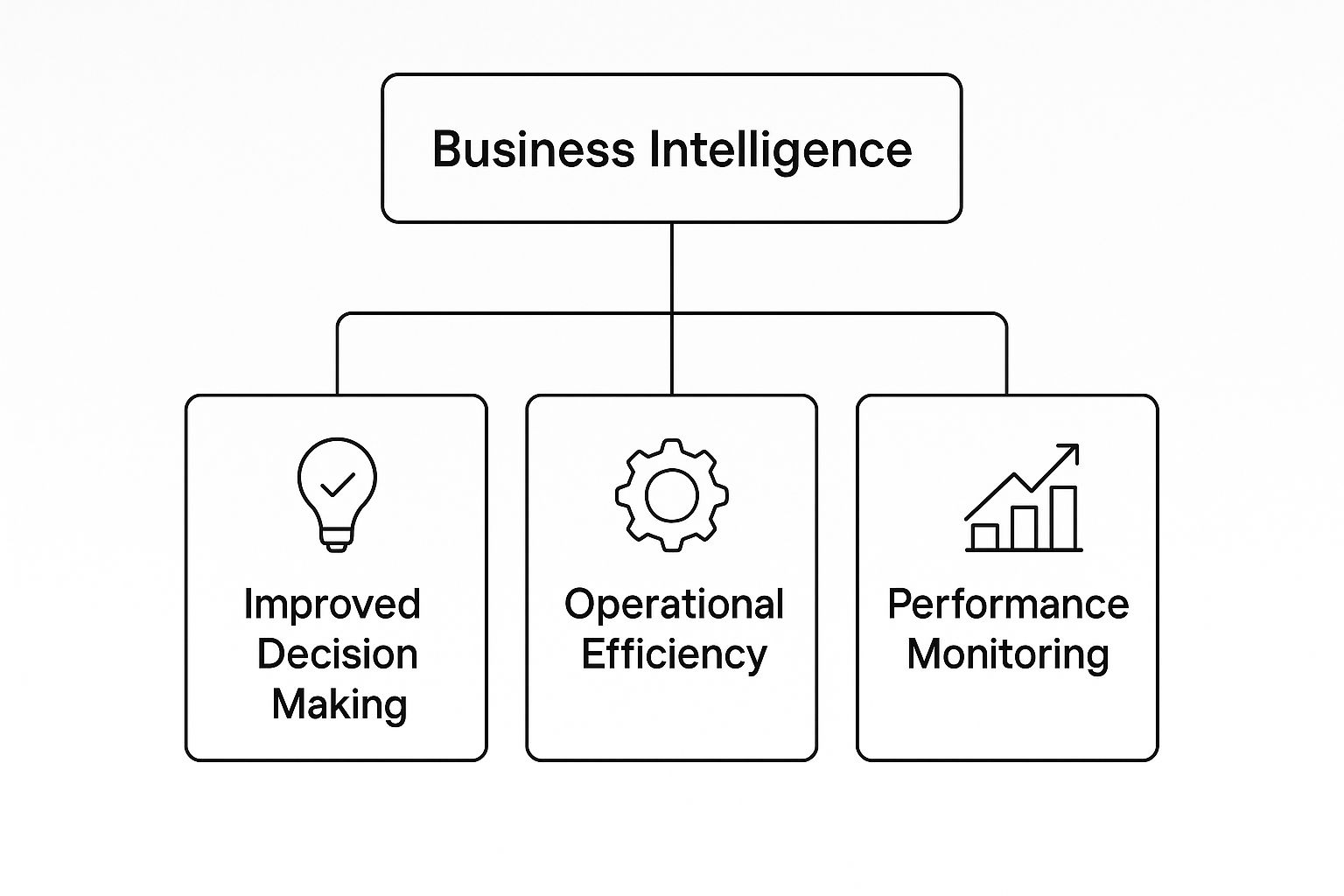
As you can see, it all leads to better decisions, improved efficiency, and the ability to track performance continuously.
3. Data Visualization
With clean, consolidated data, you can finally start assembling the puzzle. Data visualization is the art and science of turning rows and columns of numbers into intuitive, interactive reports and dashboards. This is the moment where trends, patterns, and outliers that were once buried in spreadsheets suddenly jump out at you.
But effective visualization isn’t just about making pretty charts. It’s about presenting information in a way the human brain can process in seconds. A well-designed dashboard lets you move beyond static reports and actively explore your data by filtering, drilling down, and cross-referencing information to answer deeper questions on the fly.
A great dashboard doesn't just show you what happened; it invites you to ask why it happened. This is where you move from passive reporting to active analysis.
4. Insight Generation
This final pillar is the destination: the "aha!" moment. Insight generation is the ultimate payoff of the entire BI process. It's where you use the consolidated, transformed, and visualized data to uncover meaningful truths about your business and decide on your next move.
Instead of just reporting on historical facts (descriptive analytics), you can start understanding the drivers behind those facts (diagnostic analytics). For example, you go from knowing what your sales were last quarter to understanding why they shot up—perhaps identifying that a specific marketing campaign drove a surge in high-value customers.
That’s the difference between looking in the rearview mirror and having a GPS for the road ahead. This process empowers you to answer critical strategic questions and take decisive, informed action.
Why Modern BI Is a Game-Changer for SMBs
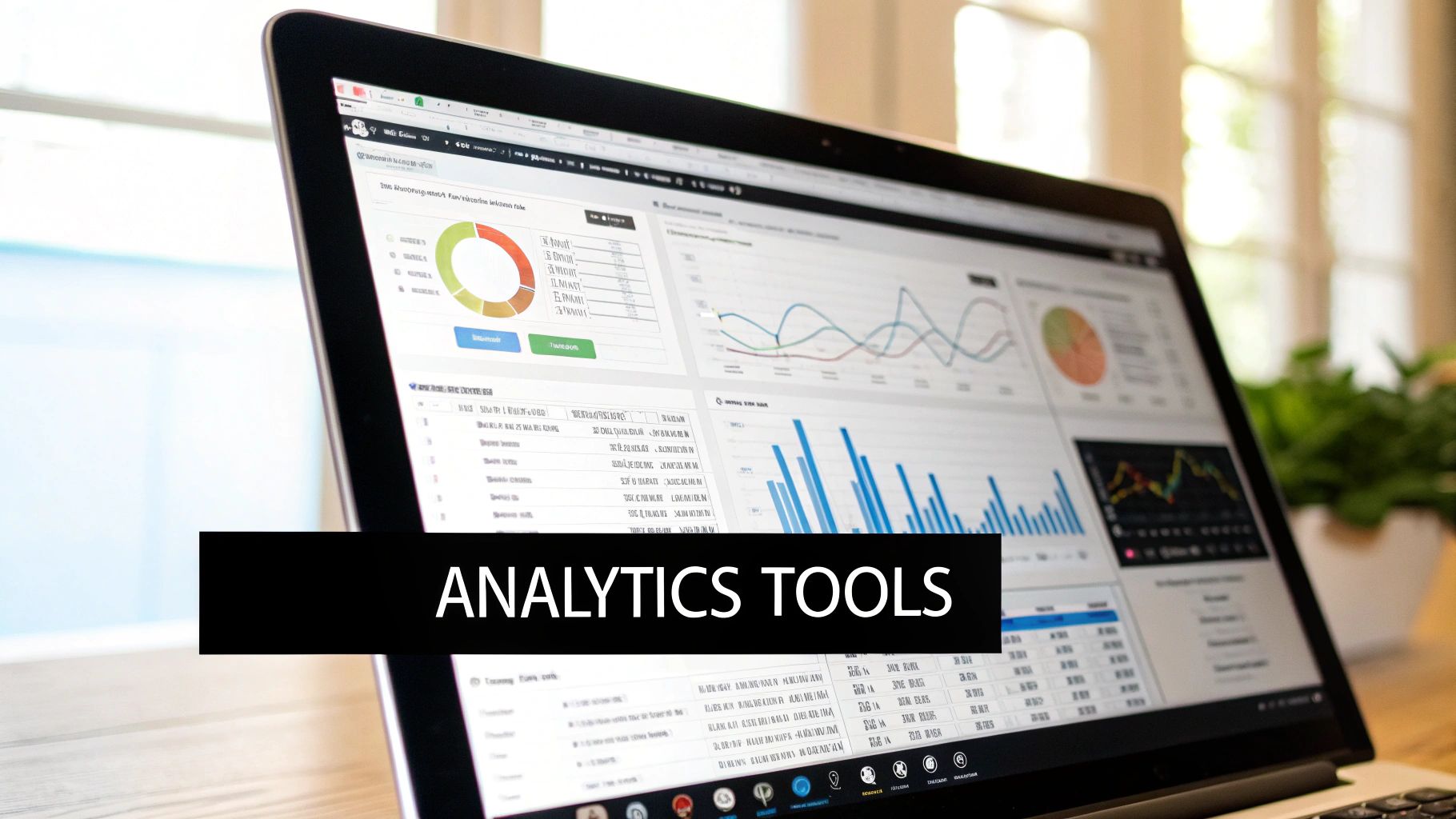
For years, powerful business intelligence was a luxury reserved for massive corporations with huge IT budgets and teams of data scientists. That game is over. The rise of user-friendly, cloud-based platforms has completely leveled the playing field, making sophisticated analytics both accessible and affordable for small and medium-sized businesses.
This shift has been huge for SMB founders and operators. You no longer need an army of specialists to figure out what your data is telling you. Modern tools like Microsoft Power BI are built for business users—not just data experts—empowering you to finally move from frustrating guesswork to confident, evidence-backed decisions.
The global business analytics market is on track to grow from USD 96.6 billion in 2024 to USD 196.5 billion by 2033. This surge isn't just happening in enterprise boardrooms; it's being driven by ambitious SMBs who want to scale intelligently.
From Cost Center to Profit Driver
For an SMB, the magic of business intelligence isn't about complex theories; it’s about tangible, everyday impact. It’s about reclaiming your most valuable resource—time—and pointing it toward actual growth.
Think about the hours your team currently burns on manual reporting. A BI system automates that entire painful process. Instead of your finance lead wasting a full day every month wrestling with spreadsheets for board reports, they can focus on strategic financial planning. This is especially true when you apply business intelligence for finance, where automation can completely transform core processes like cash flow reporting and profitability analysis.
BI transforms data from a tedious administrative burden into your most valuable strategic asset. It's about spending less time reporting on what happened and more time deciding what to do next.
Tangible Benefits for SMBs and Founders
For a growing business, the return on investment from a well-implemented BI solution is direct and measurable. It solves the exact problems that keep founders staring at the ceiling at 3 AM.
Here’s what modern BI actually delivers:
- Automated Financial Reporting: Kill the soul-crushing cycle of exporting data from Xero, your CRM, and other platforms. A BI dashboard plugs directly into these sources, giving you a live, accurate picture of your financial health without any manual legwork.
- Real-Time Visibility into Performance: Stop waiting until the end of the month to find out how you’re doing. You can track KPIs like cash flow reporting, sales pipeline velocity, and customer acquisition cost as they happen, letting you jump on opportunities and stamp out problems instantly.
- Aligning Finance and Ops: When your sales, ops, and finance teams are all looking at the same trusted data, everyone finally starts pulling in the same direction. You can align sales goals with operational capacity and ground your financial planning in reality, not wishful thinking.
- Evidence-Based Decisions: Swap gut feelings for cold, hard proof. A dynamic dashboard lets you drill down into the numbers to understand why things are happening, giving you the confidence to make bold moves backed by solid data.
Ultimately, modern BI provides the control and clarity you need to navigate growth without flying blind. It’s no longer a question of if an SMB should adopt BI, but how fast you can get started.
Real-World Examples: From Excel Chaos to BI Clarity
Theory is great, but the real magic of business intelligence analytics happens when you see it solve expensive, real-world problems. Let's step away from the abstract and dive into how a modern BI approach—specifically with a tool like Power BI—completely changes the game for founders and operators.
These aren't just hypotheticals. These are the kinds of stories we help create every day at Vizule. In every case, the business owner trades reactive, manual chaos for proactive, automated clarity.
Scenario 1: The E-commerce Founder
Picture an e-commerce founder with a booming online store. Before BI, her week kicked off with a soul-crushing routine: manually pulling sales data from Shopify, ad spend from Google Ads, and shipping costs from a separate logistics platform. She'd then lose hours wrestling with a monster spreadsheet, just trying to figure out her true profit on each product.
The process was slow and riddled with copy-paste errors. By the time she got an answer, the data was a week old. She could see revenue climbing, but a nagging fear kept her up at night: was she actually losing money on her best-selling items once all the costs were factored in?
The Transformation with BI Analytics:
By plugging Shopify, Google Ads, and other data sources directly into Power BI, her entire reporting process went on autopilot. Now, she has a live dashboard that answers her biggest questions in an instant.
- Automated Profitability Tracking: The dashboard automatically calculates metrics like customer acquisition cost (CAC) and customer lifetime value (LTV).
- Clear Performance Metrics: She sees, at a glance, which products have the highest profit margins after accounting for ad spend, shipping, and transaction fees.
- Strategic Decision-Making: Armed with this clarity, she confidently shifted her ad budget away from low-margin products and funneled it toward her true money-makers. The result? A significant boost to her bottom line without just chasing empty revenue.
Scenario 2: The Service Business Operator
Now, let's look at an operator running a service business—think of a small agency or consultancy. His team was brilliant at delivering for clients, but figuring out project profitability was a nightmare. They tracked time in one system, managed project finances in Xero, and kept project notes in another tool.
Every month, the operator would burn days trying to stitch this all together to see which clients and projects were actually profitable. It was a time-suck, often inaccurate, and made it impossible to quote new work with confidence or spot which clients were quietly draining resources.
The Transformation with BI Analytics:
A well-designed BI solution changed everything. By integrating his time-tracking software with his financial data in Power BI, he unlocked a single, unified view of his operation's performance.
This shift moved his focus from asking, "How much time did we spend?" to answering, "How profitable was that time?" This is the core of what business intelligence analytics delivers—not just data, but meaningful context.
Now, his dashboard visualizes the metrics that truly matter:
- Profitability by Client: Instantly see which clients are the most profitable and which are barely breaking even.
- Project Margin Analysis: Drill down into specific projects to understand the true cost of delivery versus the amount billed.
- Resource Allocation: Identify where his team’s time generates the most value, letting him optimize assignments and scope future projects far more accurately.
This is a sample Power BI dashboard, illustrating how different data sources can be combined into a single, interactive view for analysis.
This kind of visual interface lets leaders filter, slice, and explore their data to pull out insights that would stay buried forever in a spreadsheet.
Scenario 3: The Startup Founder
Finally, imagine a startup founder walking the tightrope between growth and cash flow. Her financial planning was pinned to a static spreadsheet model that was perpetually out of date. Updating her cash runway forecast meant manually pulling the latest sales numbers and expense reports—a process that was both tedious and anxiety-inducing.
She was forced to make critical spending decisions based on a financial picture that was always looking in the rearview mirror. This made it tough to plan for new hires or marketing campaigns with any real certainty.
The Transformation with BI Analytics:
By setting up a dynamic BI dashboard, she connected her financial model directly to her live sales and expense data. Her static spreadsheet was instantly obsolete, replaced by a living, breathing view of her company's financial future.
This new forecasting model allowed her to:
- Visualize Cash Runway: See an up-to-the-minute forecast of her cash runway that adjusts automatically as new sales come in and expenses are paid.
- Run Scenarios: Easily model different scenarios. What's the impact of a new hire? A major marketing campaign? She could now see the effect on her runway and make smarter spending decisions.
- Align Finance and Operations: She finally bridged the gap between her operational data (what's happening now) and her financial plan (what will happen next), ensuring her growth strategy was grounded in reality.
These scenarios are the everyday realities for founders who choose to move beyond spreadsheets. If you see your own frustrations in these examples, it’s a clear sign that you’re ready for a better way.
Want to automate your reporting and finally trust your data? Book a free call with our BI consultants today.
Our Roadmap from Data Chaos to Decision Clarity

Understanding what business intelligence analytics is and seeing its potential is the easy part. The real challenge? Charting a course to actually get there. For founders and operators drowning in spreadsheets, the journey from data chaos to decision clarity can feel overwhelming. It doesn't have to be.
At Vizule, we've refined a consultative roadmap that guides businesses like yours through this process. A successful BI implementation isn't about just handing you a piece of software and wishing you luck. It's a partnership focused on solving your specific challenges. We break it down into clear stages that start delivering value right away.
1. Discovery and Goal Setting
It all starts with a conversation. Before we touch a single data source, our first job is to listen. We need to get inside your business, understand your unique context, your biggest operational headaches, and your most ambitious goals.
Are you wrestling with cash flow visibility? Trying to finally get finance and operations on the same page? Maybe you just want a clear picture of which customers are actually profitable. By defining what success looks like for you upfront, we ensure the entire project is laser-focused on the outcomes that really matter.
2. Data Audit and Strategy
Once we know where we're going, we map out the terrain. This is where we conduct a thorough audit of your entire data ecosystem—from your accounting platform and CRM right down to the critical spreadsheets that run your day-to-day operations.
We pinpoint the essential data points and then design a practical blueprint for consolidating them into a single source of truth. This is a vital step that lays the foundation for all future reporting, ensuring it's not just pretty, but accurate and trustworthy. You can dig deeper into the nuts and bolts by reviewing our guide on business intelligence best practices.
3. Custom Dashboard Development
This is where our Power BI experts roll up their sleeves. First, we build the robust backend data model that automatically pulls, cleans, and connects all your information. Then, we design and develop the intuitive, user-friendly dashboards your team will actually want to use every day.
We build for people, not just for data scientists. Our goal is to create dashboards that are not only powerful but also so easy to use that they become an indispensable part of your daily workflow.
4. Insight Delivery and Training
Our job isn't done when the dashboard goes live. The final—and arguably most important—step is turning your powerful new tool into a catalyst for action. We don't just hand over a login. We walk you and your team through the insights it reveals, showing you not just what the data says, but why it matters. We train you to explore, ask deeper questions, and make confident, evidence-backed decisions.
This hands-on, collaborative approach is why enterprise adoption of BI is surging. The global BI software market, valued at around USD 41.74 billion in 2024, is on track to explode to over USD 151.26 billion by 2034. This growth isn't just about software; it reflects a clear demand from businesses for guided expertise that turns data into a genuine competitive edge. You can learn more from this market growth forecast.
Stop Drowning in Data and Start Driving Growth
Let’s pull this all together. Business intelligence analytics is the bridge that connects your raw, often messy data to smart, sustainable business growth. The days when powerful analytics were exclusively for giant corporations are long gone. Modern tools like Power BI have made these capabilities accessible to every SMB operator and founder.
The benefits go far beyond just fancy charts; they drive fundamental improvements in efficiency, profitability, and strategic clarity. We started this discussion by talking about 'Excel chaos'—a familiar and costly pain point for far too many growing businesses. The path forward is to trade that frustrating, manual work for automated, reliable insights you can actually trust.
Your Path to Clarity
The global business intelligence market was valued at roughly USD 32 billion in 2024 and is on track to nearly double by 2032. This explosive growth, kicked into high gear by the pandemic's impact on supply chains and consumer demand, points to one clear trend: businesses that use data to adapt are the ones that win. You can dig into more business intelligence statistics on market trends and projections.
But adopting BI isn't just about getting better reports. It's about fundamentally changing how your company operates by embedding data-driven decision-making into its very DNA.
The real goal of BI analytics is simple: to give you the confidence to act. It’s about replacing gut-feel assumptions with data-backed conviction, allowing you to focus your time and capital on the initiatives that will actually move the needle.
If you’re ready to stop wrestling with spreadsheets and start unlocking the powerful story hidden in your financial and operational data, it's time to take the next step. Your business has a story to tell—we can help you finally hear it.
Ready to automate your reporting and finally trust your numbers?
Book your free BI consultation with Vizule today.
Your Questions About BI Analytics, Answered
Even after seeing what’s possible, it’s natural to have practical questions about what it really takes to get started. We hear these all the time from founders and business owners. Here are some straightforward answers to clear things up.
How Much Does a BI Solution Cost for a Small Business?
This is usually the first question on everyone's mind, and the answer is better than you think. Forget the old days of needing a six-figure budget just for software.
A modern BI solution really breaks down into two parts: the software itself and the expertise to make it work for you.
- Software: A powerhouse tool like Microsoft Power BI Pro is incredibly affordable, often just a few pounds per user per month. This puts top-tier analytics firmly within reach for almost any business.
- Expertise: This is where the real value is unlocked. Instead of the high fixed cost of hiring a full-time analyst, partnering with a consultancy like Vizule gives you a team of experts for a fraction of the cost. We ensure your BI stack is built right from day one, focused on solving your specific business problems.
How Long Does It Take to Implement a BI System?
This isn't a massive, multi-year IT headache. A solid BI system can start delivering real value in a matter of weeks, not months. Our approach is about getting you quick wins and building from there.
Typically, we focus on tackling your most urgent problem first. We aim to get a core financial or operational dashboard built and into your hands within 4-6 weeks. From there, we can expand, adding more complex reports and connecting more data over time. It’s all about continuous improvement, not one giant, stressful launch.
Do I Need to Have Perfect Data to Start?
Let's be crystal clear on this: nobody has 'perfect' data. Thinking you need pristine, perfectly organized data before you can start with BI is one of the biggest myths holding businesses back.
A huge part of any BI project is the data cleanup and transformation process we talked about earlier.
Waiting for perfect data is like waiting for all the traffic lights to be green before starting a journey. A key value-add of working with a partner is our ability to clean, connect, and standardize your messy, real-world data into a reliable source of truth.
What Is the Difference Between Business Intelligence and Business Analytics?
The terms are often used interchangeably, but there's a simple way to think about the distinction as a business owner.
It really boils down to this:
- Business Intelligence (BI) is focused on looking at your past and present data to tell you what happened. It’s descriptive. It gives you that clear, accurate picture of your performance through dashboards and reports (e.g., "What were our sales last month?").
- Business Analytics (BA) takes that historical data and uses it to figure out why it happened and what might happen next. It gets more into statistical models and forecasting to find deeper patterns and predict future outcomes (e.g., "Which marketing channel will give us the best ROI next quarter?").
Modern platforms like Power BI are blending these two worlds together. You can seamlessly shift from looking at historical reports to running predictive analysis, all in the same place.
Ready to get clear, practical answers tailored to your business? The team at Vizule is here to help you map out your journey from data chaos to decision clarity.
Connect with us to design your financial dashboard in Power BI
