

Tired of conflicting spreadsheets, reports that just don't add up, and teams arguing over whose numbers are "right"? You’re not alone. This is data chaos, and it’s a sign that your business needs a single, reliable playbook for its information. This is where data governance consulting services come in, turning your data from a source of constant frustration into your most valuable strategic asset.
What Is Data Governance for a Small Business?
For a growing business, "data governance" can sound like an intimidating IT term meant for massive corporations. But in reality, it’s a practical solution to a problem every founder knows intimately: not being able to trust your own numbers.
Think about it. Your finance team pulls one revenue number from your accounting software, while the sales team has a totally different figure from their CRM. Who’s right? Who decides? Data governance provides the answers. It’s not about locking things down with restrictive IT rules; it's about everyone agreeing on a single source of truth for your most important metrics.
Creating Your Data Playbook
A data governance consultant helps you create a clear, shared playbook for your company's data. It’s all about establishing and writing down the rules of the game so everyone is on the same page.
This playbook defines critical business terms, answering questions like:
- What exactly is an 'Active Customer'? Is it someone who bought something in the last 30 days, 90 days, or the last year?
- How do we calculate 'Monthly Recurring Revenue (MRR)'? Are we including one-time setup fees, or just pure subscription costs?
- Who owns customer contact information? Does it fall to sales, marketing, or a central operations team to keep it clean?
Getting everyone to agree on these definitions is the first step to eliminating the confusion that breeds inaccurate reports and shaky, gut-feel decisions.
To help illustrate, here’s a quick look at how a solid data governance framework transforms common data headaches into real business clarity.
From Data Chaos to Business Clarity
| Common SMB Data Problem | How Data Governance Solves It | Direct Business Benefit |
|---|---|---|
| Teams use different definitions for the same metric (e.g., "customer"). | A data dictionary is created to establish one official definition for every key term. | Consistent, reliable reporting across all departments. |
| Reports from different systems (CRM, accounting) show conflicting numbers. | "Single Source of Truth" systems are designated for specific data domains (e.g., Salesforce for sales data). | Faster decision-making with confidence in the numbers. |
| Unclear who is responsible for data quality, leading to outdated or incorrect info. | Data ownership and stewardship roles are assigned to specific people or teams. | Improved data accuracy and accountability. |
| New employees struggle to find the right data or understand its context. | A data catalog is built, making it easy to find and understand available data assets. | Reduced onboarding time and fewer data-related errors. |
As you can see, the goal isn't to create bureaucracy. It's about building a reliable foundation so you can move faster and smarter.
Why It's a Foundation for Growth
For small businesses needing to build this foundation, leveraging outside expertise through services like Managed IT Services for Small Business can provide the technical backbone. But the impact of governance ripples far beyond the IT department.
A solid data governance framework is the bedrock of scalable growth. Without it, every new employee, software tool, or sales channel just adds another layer of complexity and potential error to your reporting.

Ultimately, data governance is about creating a culture of trust and accountability around your data. It means that when you look at a Power BI dashboard, you know the numbers are solid, reliable, and ready to inform your next big move. This process is a crucial part of building a wider data strategy. You can learn more about how we connect these pieces at data strategy and governance.
Why Data Governance Is a Growth Strategy, Not an Expense
For many business owners, "data governance" sounds suspiciously like a corporate buzzword for an expensive new project. It’s often seen as a set of restrictive rules that just slows everything down—a luxury for massive enterprises, not for a growing business where speed is everything.
But that perspective misses the bigger picture entirely.
Viewing data governance as just another cost is like calling a pilot's pre-flight checklist an unnecessary delay. That checklist is precisely what guarantees a safe and successful journey. In the same way, strong data governance isn’t about putting the brakes on; it's about enabling confident, accelerated growth by getting rid of the drag that bad data creates.
The Hidden Costs of Data Chaos
The real expense isn’t putting governance in place; it's the daily, grinding cost of not having it. Just think about the hours your team wastes trying to reconcile two different spreadsheets that are supposed to show the same thing. Or the opportunities you’ve missed because nobody could fully trust the forecast.
These aren't just minor headaches. They hit your bottom line.
I remember a founder in the e-commerce space who ran into this exact problem. Her marketing team was looking at Shopify data, saw a product flying off the shelves, and decided to crank up the ad spend. At the same time, her finance team was looking at inventory data from their ERP and saw a totally different sales velocity.
The result? A huge, costly over-purchase of inventory based on a skewed forecast. It tied up critical cash flow right before their slow season. This wasn't a software bug; it was a complete governance failure.
Without a clear, agreed-upon definition of "sales velocity" and a single source of truth for reporting, two well-meaning teams made conflicting decisions that cost the business dearly. This is the tangible price of data chaos.
This kind of thing happens in businesses every single day, leading to bad calls on everything from inventory and hiring to marketing spend. Investing in data governance consulting services is the strategic move that stops these expensive, unforced errors before they happen.
Fueling Growth with Trustworthy Data
Once you build that foundation of trusted, reliable data, you start to unlock real business value that feeds directly into growth. The return on that initial investment becomes incredibly clear.
- Improved Forecast Accuracy: When your financial models are built on solid ground with consistent data, your forecasts become dramatically more accurate. This is absolutely critical for managing cash flow, making smart investment decisions, and even securing funding.
- Automated Manual Reporting: Good governance is the engine that powers automation. With clean, structured, and reliable data, you can build Power BI dashboards that update themselves. This frees your team from spending dozens of hours every month manually pulling reports together. By improving data quality and access, governance programs are a direct contributor to AI for operational efficiency improvement, especially with the rise of AI-driven tools.
- A Scalable Foundation: As your business grows, your data complexity explodes. A proactive governance strategy makes sure your systems can handle that flood of new information without cracking under the pressure. It’s about future-proofing your operations so you can scale without creating more chaos. A cornerstone of this is establishing a single source of truth for your data, which is the heart of any scalable system.
It's no surprise the market for these services is growing. The global data governance solutions market is on track to hit a valuation of around $15.8 billion by 2034, jumping from a $3.8 billion baseline in 2025. This explosion shows just how many businesses are finally recognizing its strategic importance. You can explore more about this trend and discover more insights about the data governance solutions market size.
At the end of the day, data governance is the difference between growing smart and just getting bigger. It gives you the clarity and confidence to make the bold, insight-driven decisions that will actually propel your business forward.
Inside a Data Governance Consulting Engagement
So, what does getting your data house in order actually look like for a small or medium-sized business? It’s easy to picture some complex, drawn-out process that costs a fortune. But in reality, a good consulting partner cuts through the noise and turns data chaos into clarity with a structured, manageable plan. The whole point is to get you tangible results, fast—results that a business leader can see and use, not just the IT team.
At Vizule, we run a proven three-phase process: Map, Model, and Mobilise. This isn't some theoretical exercise from a textbook. It's a hands-on engagement designed to build a solid data foundation and solve your most pressing commercial challenges.
Phase 1: Map Your Data and Define Your Goals
First things first: we start with a deep dive into where you are right now. We don't come in talking about new software or complicated frameworks. We just listen.
We’ll sit down with you and your key people to understand what you want to achieve, your biggest reporting headaches, and the critical questions you simply can't answer with the data you have. This discovery phase is all about:
- Stakeholder Interviews: We talk to your finance, sales, and operations teams to hear firsthand about their data pain points and what they need to succeed.
- Data Source Auditing: We figure out where all your important data lives. Is it stuck in your CRM? Scattered across spreadsheets? Hiding in your accounting software or Shopify?
- Business Goal Alignment: We connect the dots between your data needs and your commercial goals, whether that's nailing your cash flow forecast or boosting customer lifetime value.
This initial mapping gives us a clear picture of what’s working, what's broken, and what a "win" actually looks like for you. It anchors the entire project in real-world business outcomes from day one.
Phase 2: Model Your Governance Framework
Once we have a clear map of your data landscape, the next step is to design a governance framework that's both practical and lightweight. Think of this as creating the "playbook" for your data. The focus is on simplicity and sustainability, not creating red tape that slows everyone down.
Here’s what happens in this phase:
- Defining Key Metrics: We work with your team to build a data dictionary. This is just a simple, single document that clearly defines your most important metrics, like "Monthly Recurring Revenue" or "Active User," so everyone is speaking the same language.
- Assigning Ownership: We help you identify who owns what. Assigning clear data governance responsibilities means everyone knows who is accountable for keeping specific datasets clean and accurate. You can learn more in our guide on key data governance responsibilities.
- Tooling Recommendations: Based on your specific needs and budget, we'll suggest simple, effective tools. Often, this means getting more out of the systems you already have and maybe introducing a tool like Power BI to pull everything together.
The 'Model' phase is all about creating simple rules of the road that everyone can understand and follow. It's not about complex policies; it’s about agreeing on the fundamentals so your team can finally trust the numbers.
This structured process shows the clear return on investment you get when you move from unreliable data to a governed system that actually fuels growth.
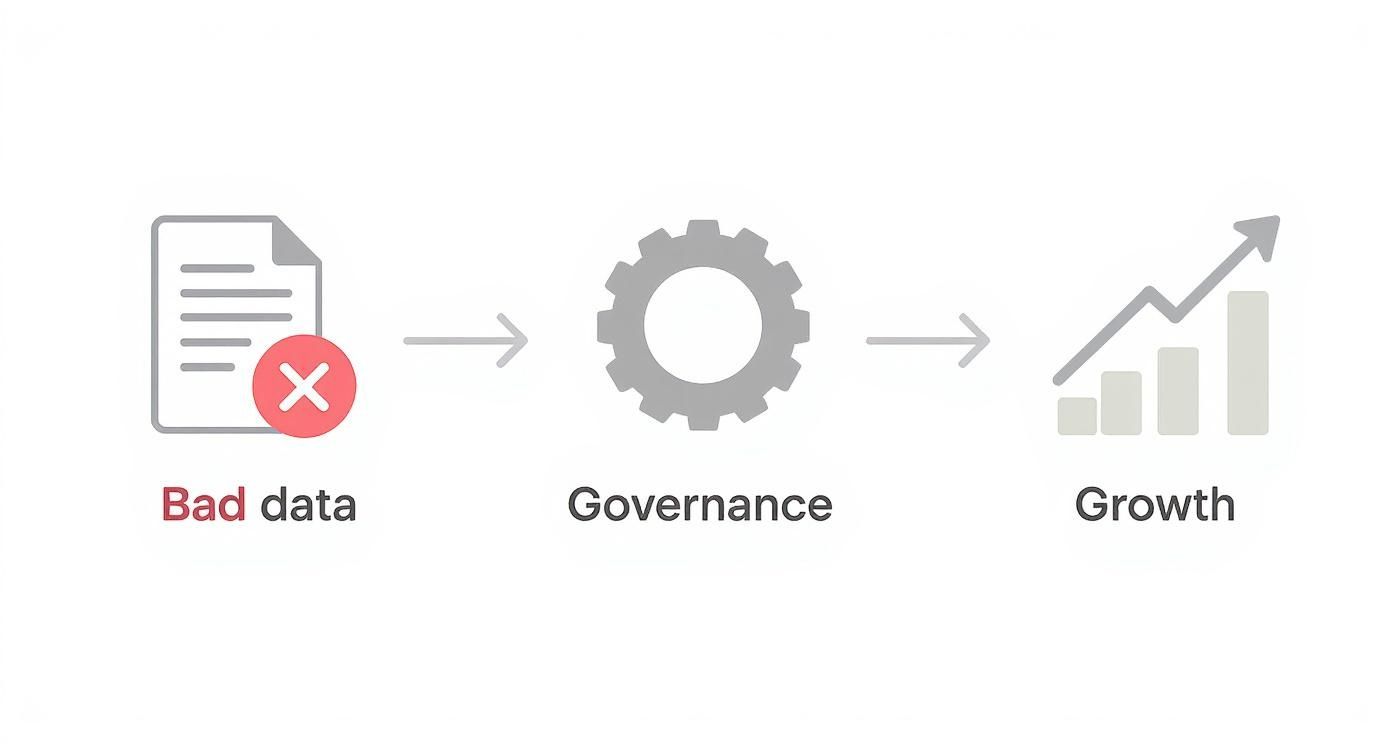
This visual shows the direct path from fixing bad data through governance to achieving tangible business growth.
Phase 3: Mobilise Your Data and Empower Your Team
This is where the plan becomes a reality. We implement the framework, build your reporting engine, and train your team to use data with confidence. We don’t just hand you a strategy document and wish you luck—we build the solution with you and make sure your people know how to use it.
The implementation stage involves:
- Building Your Master Dashboard: We connect your newly organised data sources into a central Power BI dashboard. This creates a single source of truth for your most critical KPIs.
- Automating Reports: Say goodbye to mind-numbing manual reporting. We build automated data pipelines that feed your dashboard in near real-time.
- Team Training: We run hands-on training sessions so your team understands the new framework and knows how to use the dashboards to make smarter, faster decisions.
This final phase is what makes the investment worth it. It turns a plan into a tangible asset that saves time, cuts down on errors, and drives real strategic clarity. The global market for data governance consulting services is exploding for this very reason. It's set to grow from around $5 billion in 2025 at a compound annual growth rate of 15% as more businesses realise they need to turn their data into a reliable advantage. You can learn more about data governance market growth and its drivers.
Choosing the Right Data Governance Partner
Picking a partner to help guide your data strategy is a massive decision. Get it right, and you can fast-track your way from data chaos to genuine clarity. Get it wrong, and you could end up with an over-engineered, expensive solution that simply doesn't fit how you actually run your business.
For small and medium-sized businesses, the stakes are even higher. You need someone who gets your commercial reality, not a team selling a one-size-fits-all enterprise package designed for a Fortune 500 company. It’s about finding a partner who speaks your language and understands that success isn't measured by complex frameworks, but by trustworthy reports and smarter decisions. You're not just hiring a technician; you're bringing on a trusted advisor.
Boutique Firms vs. The Big Guys
The world of data governance consulting services is pretty diverse. On one side, you have the massive, global firms offering sprawling, enterprise-level solutions. They can be a great fit for huge corporations with layers of IT and complex compliance demands, but they're often total overkill for a growing business.
On the other side, you'll find boutique firms like Vizule. We live and breathe the challenges that founders and operators like you face every single day. We know the pain of Excel hell and the urgent need for a single source of truth because we’re in the trenches with our clients solving these exact problems.
A boutique consultancy is typically:
- More agile and hands-on, working directly with you and your team to build practical, real-world solutions.
- Focused on business outcomes, like cutting down the time it takes to close the books or nailing your sales forecast.
- Cost-effective, delivering tailored solutions without the hefty overhead of a giant firm.
- Highly specialised, often with deep expertise in specific tools like Power BI and a relentless focus on aligning financial and operational data.
This sharp focus allows a smaller firm to act like a true extension of your team, building something that actually fits your budget, your resources, and your specific growth ambitions.
Key Questions to Ask a Potential Partner
When you're vetting a consultant, you need to cut through the jargon and get to the heart of their approach, their experience, and how they define a successful project. It's less about the tech and more about the practical impact on your business.
The table below is a quick guide to help you figure out if a potential partner truly gets what a business like yours needs.
Key Questions to Ask a Data Governance Consultant
| Evaluation Category | Essential Question to Ask | What to Look for in a Good Answer |
|---|---|---|
| Relevant Experience | "Can you show me examples of data governance work you've done for businesses my size and in my industry?" | They should provide specific, relatable case studies—not just big-name logos. A great answer will detail the business problem they solved, not just list the tools they used. |
| Business Focus | "How do you measure the success of a data governance project in concrete business terms?" | Listen for answers that go beyond IT metrics. Strong responses will mention things like "reduced time spent on manual reporting," "improved forecast accuracy," or "increased team confidence in the data." |
| Methodology | "What does your engagement process look like, and how do you ensure it doesn't disrupt our daily operations?" | A good partner will describe a clear, phased approach (like our Map, Model, Mobilise process) that prioritises collaboration and delivers value quickly without creating unnecessary bureaucracy. |
| Tool Agnosticism | "What's your approach to technology? Do you recommend specific tools, or do you work with our existing stack?" | The best partners are tool-agnostic, focusing on the right solution for your problem. They should aim to get the most value out of what you already have (like Excel or your CRM) before pushing for new software. |
Asking these questions will help you find a partner who is truly aligned with your business goals and can deliver a practical, effective solution that sticks. This approach is fundamental to building a solid data foundation.
To see how this fits into a bigger picture, take a look at our complete guide on data strategy consulting.
Measuring the Success of Your Data Program
So, you've invested in a data governance program. How do you actually know if it's paying off? It’s a perfectly fair question for any business owner.
The answer isn't buried in complex IT metrics. It’s measured by tangible, bottom-line business outcomes you can see and feel every single day. Success isn't about ticking boxes on a compliance checklist; it's about making your business faster, smarter, and more confident.
The real value of data governance consulting services shows up in reclaimed hours, sharper forecasts, and a newfound trust in the numbers you use to run your company.
Moving Beyond Gut Feel to Quantifiable Wins
A well-executed data governance initiative delivers concrete results. Instead of just "feeling" like things are better, you can point to specific, measurable improvements. These are the key performance indicators (KPIs) that truly matter to a founder or operator.
The most common signs of a successful program usually boil down to a few critical areas:
- A huge drop in manual reporting time: Just track the hours your team wrestles with spreadsheets each month. A massive win is seeing that time slashed by 50% or more because automated Power BI dashboards have replaced the soul-crushing copy-and-paste routine.
- A measurable jump in forecast accuracy: Compare your sales or financial forecasts before and after the project. Success is a dramatic increase in accuracy, giving you the confidence to make the right calls on hiring, inventory, and cash flow.
- A spike in team confidence: This one feels more cultural, but it's just as important. You've won when your teams stop arguing about whose numbers are right and start collaborating on what the numbers actually mean for the business.
These outcomes aren’t just nice-to-haves; they directly boost your operational efficiency and strategic clarity. A key part of this is defining your standards. For a deeper dive, check out our guide on how to improve data quality.
Before and After: A Real-World Scenario
Let's walk through a common scenario for an e-commerce business. Before getting their data in order, the founder was constantly tearing her hair out over conflicting revenue numbers. Her Shopify dashboard showed one figure, her accounting software another. Month-end closing was a nightmare of manual reconciliations, and no one was ever truly sure if they were profitable.
Here’s how a data governance engagement created a clear "after" picture:
Before: The team was burning over 20 hours every single month just trying to make the Shopify and accounting numbers match. Big decisions on marketing spend were constantly delayed because no one trusted the reports, which meant missed opportunities.
After we helped them implement a governance framework, we designated the accounting system as the single source of truth for recognised revenue. Then, we built an automated data pipeline into Power BI that pulled data from both systems, aligned the definitions, and presented one unified, trustworthy view in a single dashboard.
After: The monthly reporting process became fully automated, freeing up 20+ hours of the team's time. The founder could now see a single, reliable revenue number in real-time, letting her make faster, more confident decisions that directly improved the bottom line.
This is the tangible ROI of data governance. It’s about moving from a state of constant doubt to one of absolute clarity. The market reflects this value, too—one analysis projects it to grow from $3.8 billion in 2025 to $7.1 billion by 2033, driven by businesses just like this demanding clear returns on their data investments.
Your First Steps Toward Trusted Data
Feeling a bit overwhelmed by the thought of a full-blown data governance project? That’s perfectly normal. But the good news is you don’t need some monumental, complex strategy just to get started.
You can actually start pinpointing your biggest data headaches in the next ten minutes. All it takes is a simple, practical exercise. This has nothing to do with technology or complicated frameworks; it's a straightforward diagnostic to show you exactly where your communication and processes are failing.
Think of it as a quick health check for your company’s data.
A Simple Three-Step Action Plan
Ready to go from data chaos to clarity? Just follow these three steps today, and you'll see precisely where your governance gaps are hiding.
-
Pinpoint One Critical Report: Start by picking a single, high-stakes report that your team relies on but doesn't fully trust. Maybe it's the monthly sales forecast, the cash flow statement, or your customer acquisition cost (CAC) report. Choose the one that always seems to spark the most debate.
-
Ask One Simple Question: Now, walk over to at least three different people on your team—someone from finance, another from sales, and maybe one from operations—and ask them the exact same question: "Where do the numbers in this report come from?"
-
Listen for the Different Answers: Pay close attention and jot down what they say. Does everyone point to the same database? Do they describe the same steps for a calculation? Or are you getting three completely different stories, revealing that everyone is working from their own "version of the truth"?
This quick exercise will immediately shine a light on the root cause of your data chaos. Those varied answers you just heard? That’s the direct result of not having an agreed-upon playbook for your data.
When your team can't agree on where the numbers come from, you can't make decisions with confidence. This isn't a people problem; it's a systems problem—and it's exactly what data governance is designed to fix.
Once you’ve seen the problem with your own eyes, the next step becomes obvious. It’s time to get everyone on the same page.
Want to automate your reporting and finally trust your data? Book a free call with our BI consultants today.
Frequently Asked Questions
Even with a clear picture of the benefits, I get that diving into data governance consulting services can bring up some practical questions. Many of the founders and SMB owners I talk to wonder if it’s the right move for them, right now.
Here are a few of the most common questions that land in my inbox, along with some straight-talking answers.
How Much Does Data Governance Consulting Cost for an SMB?
This is always the first question, and the honest answer is: it depends. But it's almost never a massive, one-time expense. A good consultant who actually understands the SMB world will map out a flexible, phased approach that respects your budget and gets you some quick wins.
Think of it less as a cost and more as an investment. What’s the real price of making a major inventory decision on bad data? Or the hours your finance team burns every month trying to make two different spreadsheets agree with each other? The hidden expense of data chaos almost always outweighs the investment in a proper governance program—one that pays for itself in reclaimed time and smarter decisions.
Is My Business Too Small for Data Governance?
This is a classic misconception. The truth is, the best time to build good data habits is while you’re still small and nimble. It's infinitely easier—and cheaper—to build a solid foundation early on than it is to untangle years of data spaghetti after you've scaled up.
Starting now means you define your most important metrics and lock in clean processes from the get-go. This prevents huge operational headaches down the line. It ensures that as you grow, your reporting grows with you, instead of holding you back. It’s all about being proactive, not reactive.
Establishing a data governance framework early is like pouring a solid foundation for a house. You wouldn't wait until the walls are up to realise the base is uneven. Building it right from the start ensures everything that comes later is stable and secure.
Can't I Just Buy New Software to Fix My Data Problems?
It’s tempting to think a shiny new piece of software is the magic bullet, but technology is only one part of the puzzle. A powerful tool is only as good as the processes, rules, and data you feed into it.
I like to use this analogy: buying a new, state-of-the-art oven won't fix a bad cake recipe. The oven can bake perfectly, but if your ingredients are wrong or the instructions are a mess, you're still not getting a good cake. In the same way, fantastic software like Power BI can't produce trustworthy reports from chaotic, undefined, and unreliable data. Data governance is your recipe for success; the software is just the tool that helps you execute it.
Tired of reports that don't add up and making decisions based on guesswork? At Vizule, we help businesses like yours build a single source of truth to drive growth with confidence.
Ready to see how a clear data strategy can transform your business? Book your free BI consultation today and let’s connect the dots in your data.
