


Are you drowning in Excel spreadsheets, struggling to forecast sales, customer churn, or cash flow? The constant cycle of manual reporting creates a reactive environment where you're always looking in the rearview mirror. But what if you could reliably predict what’s next for your business? This is where predictive modeling techniques come in.
These powerful methods, when integrated into a modern business intelligence (BI) system like Power BI, transform your historical data from a confusing jumble into a strategic asset. By understanding and applying these techniques, you can move from gut-feel decisions to data-driven strategies, automating your financial reporting and gaining a crucial competitive edge. This guide demystifies the 10 most impactful predictive modeling techniques, explaining how each works in plain English and providing practical use cases for small-to-medium business owners. We'll show you how to start your journey from Excel chaos to predictive clarity, unlocking the insights needed to scale your operations intelligently.
1. Linear Regression: The Foundation of Forecasting
Linear Regression is the quintessential starting point in the world of predictive modeling techniques. It establishes a simple, straight-line relationship between a dependent variable (what you want to predict) and one or more independent variables (the factors influencing the prediction). For an SMB owner, this could mean forecasting future sales based on your advertising spend, offering a clear, quantifiable link between your marketing efforts and revenue.
While it's one of the simpler models, its strength lies in its interpretability. You can easily explain to stakeholders that for every £1,000 increase in ad spend, sales are projected to increase by £5,000. This clarity provides a solid baseline for more complex financial models and helps move your business away from guesswork towards data-informed decision-making.
When to Use Linear Regression
This technique is ideal when you need to understand the direct impact of one business lever on another.
- Sales Forecasting: Projecting future sales based on historical data, seasonality, and marketing budgets.
- Inventory Planning: Estimating future product demand based on pricing, promotions, and past sales figures.
- Resource Allocation: Forecasting project hours based on project scope and team size.
Implementation Tips
To ensure your model is accurate, start with a solid foundation.
- Check Assumptions: Before building, confirm a linear relationship exists between your variables by visualising them on a scatter plot.
- Scale Your Features: Standardise numerical inputs (like ad spend and website traffic) to a similar scale for more reliable performance.
- Validate with Residuals: Examine residual plots after building the model. A random, patternless plot indicates the model's assumptions hold true.
- Manage Multicollinearity: Use the Variance Inflation Factor (VIF) to ensure your independent variables aren't highly correlated with each other, which can distort the model's results.
2. Logistic Regression: Predicting Yes or No
Where Linear Regression forecasts a continuous value (like sales), Logistic Regression predicts a binary outcome. It’s one of the most fundamental predictive modeling techniques for classification, answering "yes" or "no" questions by calculating the probability of an event happening. For an SMB, this could mean predicting whether a customer will churn or stay, or if a sales lead will convert into a paying customer.
Despite its name suggesting regression, its core function is classification. It uses a logistic (or sigmoid) function to squeeze the output probability between 0 and 1. This gives you a clear percentage likelihood, for instance, "there is an 85% probability this lead will convert." This moves your operational decisions from reactive to proactive, allowing you to focus resources on the highest-potential opportunities and mitigate risks before they impact the bottom line.
When to Use Logistic Regression
This technique is your go-to model when the outcome you want to predict falls into one of two categories.
- Customer Churn: Identifying which subscribers are most likely to cancel their service.
- Lead Conversion: Predicting whether a new lead will become a paying customer.
- Credit Risk: Assessing the probability that a new client will default on their payment.
Implementation Tips
To get reliable binary predictions, careful setup is essential.
- Handle Imbalance: Use class weights or sampling techniques if one outcome (like churn) is much rarer than the other.
- Scale Features: Just like in linear regression, standardising your numerical inputs helps the model perform better.
- Set Your Threshold: The default 0.5 probability threshold isn't always optimal. Adjust it based on your business needs, for example, lowering it to catch more at-risk customers even if it means more false positives.
- Use Regularization: Apply L1 or L2 regularization when dealing with many features to prevent overfitting and improve model generalisability.
3. Decision Trees: Mapping Out Your Next Decision
Decision Trees are among the most intuitive predictive modeling techniques, creating a flowchart-like structure to map potential outcomes. The model splits your data into smaller and smaller branches based on specific criteria, making sequential decisions until it arrives at a final prediction. For a business operator, this is like creating an automated, data-driven checklist for complex decisions like customer segmentation or lead qualification.
Their real power lies in their transparency. Unlike more complex "black box" models, you can visually trace the path from input to outcome, understanding exactly why a specific prediction was made. This makes it incredibly easy to explain the decision logic to non-technical stakeholders, building trust in your data-driven processes and financial models.
When to Use Decision Trees
This technique is perfect when you need a model that is both predictive and easy to interpret.
- Lead Scoring: Building a clear, rule-based system to prioritise sales leads based on their source, engagement level, and company size.
- Customer Segmentation: Grouping customers into distinct segments (e.g., high-value, at-risk) based on their purchasing behaviour and demographics.
- Operational Risk: Predicting potential supply chain disruptions by creating a decision path based on supplier location, order volume, and lead times.
Implementation Tips
To get the most out of Decision Trees, focus on controlling their complexity.
- Prune Your Trees: Prevent overfitting by setting limits on the tree's growth. Use parameters like
max_depth(maximum levels in the tree) ormin_samples_split(minimum data points required to create a new branch). - Balance Your Data: If you're predicting a rare event (like a high-value sale), your model can become biased. Balance your classes before training to ensure the tree learns from all outcomes equally.
- Visualize the Logic: Always plot your final tree. This helps you validate the model’s decision-making process and spot any illogical splits or rules.
- Consider Ensemble Methods: For higher accuracy, use Decision Trees as the foundation for more advanced techniques like Random Forests or Gradient Boosting, which combine multiple trees to improve predictive power.
4. Random Forest: The Power of the Crowd
Random Forest is a powerful ensemble learning method, one of the most popular predictive modeling techniques for both classification and regression. It operates by building a multitude of decision trees during training and then outputting the mode of the classes (classification) or the mean prediction (regression) of the individual trees. Think of it as seeking advice from a diverse group of experts; the collective decision is almost always better than any single expert's opinion.

For a business owner, this means creating a highly accurate and stable model that avoids the common pitfall of overfitting. By introducing randomness through bootstrap sampling and feature selection, each tree is unique. This diversity makes the overall model robust, capable of handling complex datasets without getting lost in the noise. Its versatility makes it a go-to for tasks ranging from customer churn prediction to advanced financial modelling.
When to Use Random Forest
This technique excels when you need high accuracy and a model that is robust to outliers and noise.
- Customer Lifetime Value (CLV): Predicting the total revenue a customer will generate over their lifetime.
- Demand Forecasting: Creating more accurate sales predictions by analysing a wide range of factors.
- High-Value Lead Identification: Pinpointing which leads are most likely to become major clients.
- Predictive Maintenance: Identifying patterns that lead to equipment failure in manufacturing or logistics.
Implementation Tips
To get the most out of your Random Forest model, focus on tuning and validation.
- Start with Defaults: The default parameters in libraries like Scikit-learn often provide a strong baseline performance.
- Tune Tree Count: Increase the number of trees (
n_estimators) for better accuracy, but note that performance gains diminish after a certain point (often around 500). - Use OOB Score: Leverage the out-of-bag (OOB) error for model validation. This clever feature uses the data points left out of each tree's bootstrap sample to test its accuracy, removing the need for a separate validation set.
- Analyse Feature Importance: Use the model's built-in
feature_importances_attribute to identify which variables are most influential, helping you simplify your model and gain business insights.
5. Gradient Boosting Machines (GBM): The Precision Powerhouse
Gradient Boosting Machines (GBM) are an advanced ensemble technique where models are built sequentially to correct the errors of their predecessors. Unlike methods that build models in parallel, a GBM learns from past mistakes, with each new decision tree focusing on the data points that previous trees misclassified. This iterative approach makes it one of the most powerful and accurate predictive modeling techniques available.
For a founder or operator, this means moving beyond simple forecasts to highly precise predictions, such as identifying high-risk transactions or predicting customer lifetime value with exceptional accuracy. Its power comes from this step-by-step refinement, turning a series of weak learners into a single, highly accurate predictive model that can capture complex, non-linear patterns in your financial and operational data.
When to Use Gradient Boosting Machines
This technique excels in scenarios where prediction accuracy is the highest priority, even if it means sacrificing some model simplicity.
- Financial Fraud Detection: Identifying subtle, complex patterns in transaction data to flag fraudulent activity.
- Customer Churn: Predicting which customers are most likely to leave based on their usage patterns, support interactions, and demographic data.
- Dynamic Pricing: Developing sophisticated models to predict optimal pricing based on demand, competition, and customer behaviour.
Implementation Tips
Careful tuning is critical to harnessing the power of GBM without overfitting your data.
- Start with a Low Learning Rate: Begin with a small learning rate (e.g., 0.01 to 0.1) and a higher number of trees, then adjust as needed.
- Use Early Stopping: Monitor the model's performance on a validation set and stop training when performance no longer improves, preventing overfitting.
- Tune Tree Depth: Keep individual tree depth low (typically between 3 and 8) to prevent individual models from becoming too complex and to improve generalisation.
- Leverage Modern Implementations: Use optimised libraries like XGBoost or LightGBM, which offer significantly faster training times and enhanced performance over traditional GBM.
6. Neural Networks (Deep Learning): Unlocking Complex Patterns
Neural Networks are advanced predictive modeling techniques inspired by the human brain, designed to recognise intricate patterns in vast datasets. They consist of interconnected nodes, or "neurons," layered together, allowing them to learn complex, non-linear relationships that other models might miss. For a business leader, this means moving beyond simple forecasting to tackle sophisticated challenges like image recognition, natural language processing, and advanced fraud detection.

Deep Learning, a subset of neural networks involving many layers, excels where traditional methods fall short. It powers the recommendation engines at Netflix and the speech recognition in Alexa. While complex to build, the power of these models can provide a significant competitive advantage by unlocking insights from unstructured data like text and images, which are often the most abundant and underutilised assets in a business. As these models become more accessible, they offer new frontiers for data-driven strategy.
When to Use Neural Networks
This technique is ideal for complex pattern recognition tasks where the relationships between variables are not straightforward.
- Image Recognition: Identifying products in images for inventory management or detecting defects in manufacturing.
- Natural Language Processing (NLP): Analysing customer feedback from reviews or support tickets to gauge sentiment.
- Advanced Fraud Detection: Pinpointing subtle, complex fraudulent transaction patterns that evolve over time.
Implementation Tips
Successfully deploying neural networks requires careful setup and monitoring.
- Start with Pre-trained Models: Use transfer learning to leverage models already trained on massive datasets, saving significant time and resources.
- Prevent Overfitting: Implement dropout and regularisation techniques to ensure your model generalises well to new, unseen data.
- Normalise Your Inputs: Scale all numerical features to a similar range to help the model train faster and more reliably.
- Use GPU Acceleration: Training deep learning models is computationally intensive; use GPUs to drastically reduce training times. For more on advanced techniques, you can explore the Vizule guide to data science applications.
7. Support Vector Machines (SVM): Mastering Complex Classifications
Support Vector Machines (SVM) are powerful supervised learning models used for complex classification and regression tasks. The core idea is to find an optimal hyperplane or decision boundary that best separates data points into distinct classes with the widest possible margin. For a growing business, this could mean classifying customer support tickets as "urgent" or "non-urgent" based on their text, ensuring high-priority issues are addressed first.
What makes SVM one of the most effective predictive modeling techniques is its use of the "kernel trick." This allows the model to handle non-linear relationships by mapping data to higher-dimensional spaces where a clear separation becomes possible. The model focuses only on the data points closest to the boundary (the "support vectors"), making it memory-efficient and robust in high-dimensional spaces, even when the number of data points is smaller than the number of features.
When to Use Support Vector Machines
This technique excels in scenarios requiring high accuracy for complex, non-linear classification problems.
- Text Classification: Categorising articles, emails, or analysing customer sentiment from reviews.
- Image Recognition: Identifying objects in images, such as handwritten digits on a form or detecting faces.
- Quality Control: Classifying products as 'pass' or 'fail' based on sensor data in a manufacturing line.
- Cybersecurity: Detecting network intrusions by identifying anomalous patterns in network traffic.
Implementation Tips
To get the most out of your SVM model, careful preparation and tuning are key.
- Always Scale Features: SVMs are highly sensitive to the scale of input data. Standardise or normalise your features before training to prevent features with larger ranges from dominating the model.
- Start with the RBF Kernel: For non-linear problems, the Radial Basis Function (RBF) kernel is a robust default choice. It's effective in a wide range of scenarios.
- Tune Hyperparameters: Use grid search or random search to find the optimal values for key parameters like
C(which controls the trade-off between a smooth decision boundary and classifying training points correctly) andgamma. - Manage Imbalanced Datasets: If one class has significantly more data points than another, use the
class_weightparameter to give more importance to the minority class during training.
8. K-Nearest Neighbors (KNN): Predicting by Proximity
K-Nearest Neighbors (KNN) is an intuitive and powerful predictive modeling technique that operates on a simple principle: you can predict something's characteristics by looking at the data points closest to it. Instead of building a complex internal model, KNN stores your entire dataset and, during prediction, identifies the 'k' most similar existing data points (the "neighbors") to make its forecast. For a business, this could mean identifying which customer segment a new lead belongs to based on their similarity to your existing 'high-value' customers.
Its strength lies in its simplicity and lack of assumptions about the underlying data distribution. This "lazy learning" approach makes it highly adaptable. For business owners, it offers a straightforward way to classify transactions or assess credit risk by comparing a new case to historical ones, providing a transparent and easily explainable prediction based purely on proximity to known outcomes.
When to Use K-Nearest Neighbors (KNN)
This technique is excellent for classification and regression tasks where context and similarity are strong predictors.
- Customer Segmentation: Grouping new customers into segments like 'loyal', 'at-risk', or 'high-potential' based on their purchasing behaviour and demographics.
- Recommendation Engines: Suggesting products or services to a user by finding other users with similar tastes and recommending what they liked.
- Competitor Pricing Analysis: Estimating a competitor's product price based on its similarity to other products in the market.
Implementation Tips
To get reliable results from KNN, data preparation and parameter selection are key.
- Always Scale Features: KNN is highly sensitive to the scale of data. Standardise your numerical inputs (like customer lifetime value and purchase frequency) to ensure distance is measured fairly.
- Optimise Your 'k' Value: Use cross-validation to find the optimal number of neighbors. A small 'k' can be noisy, while a large 'k' can be computationally expensive and less precise.
- Use an Odd 'k' for Binary Classification: To avoid ties when classifying between two categories (e.g., 'will churn' vs. 'will not churn'), always choose an odd number for 'k'.
- Apply Dimensionality Reduction: For datasets with many features, use techniques like Principal Component Analysis (PCA) to reduce complexity and improve the model's performance and speed.
9. Naive Bayes: Probabilistic Speed and Simplicity
Naive Bayes is a powerful probabilistic classifier based on Bayes' theorem. It operates on a 'naive' but effective assumption: that all features contributing to a prediction are independent of one another. For an SMB, this means you can quickly classify text-based data, such as customer feedback, by treating each word as a separate, unrelated clue to its overall sentiment.
Despite its simplifying assumption, this technique is remarkably fast and effective, particularly in text analysis and real-time prediction. Its efficiency allows businesses to build fast, scalable models without significant computational cost. This makes Naive Bayes an excellent baseline among predictive modeling techniques, offering a quick way to gauge a problem's difficulty before committing to more complex solutions.
When to Use Naive Bayes
This technique is a go-to for classification tasks where speed and efficiency are paramount, especially with text data.
- Spam Filtering: The classic use case, classifying emails as spam or not based on word content.
- Sentiment Analysis: Categorising customer reviews, social media comments, or support tickets as positive, negative, or neutral.
- Document Categorisation: Automatically sorting articles, reports, or internal documents into predefined topics.
- Real-time Bidding: Making quick predictions in ad-tech about whether a user will click an ad.
Implementation Tips
To get the most out of this surprisingly robust model, focus on data preparation and choosing the right variant.
- Handle Zero Probabilities: Use Laplace smoothing to avoid issues where a feature doesn't appear in the training data for a specific class.
- Choose the Right Variant: Select Gaussian Naive Bayes for continuous data (like financial metrics), Multinomial for count-based data (like word frequencies), and Bernoulli for binary features (like yes/no responses).
- Pre-process Text Data: Convert text into numerical format using techniques like TF-IDF or count vectorization for optimal performance.
- Consider It a Baseline: Use Naive Bayes as a quick and efficient first model to establish a performance benchmark before exploring more resource-intensive algorithms.
10. Time Series Forecasting (ARIMA/Prophet)
Time series forecasting is a crucial predictive modeling technique used to predict future values based on previously observed, time-ordered data points. This method excels at analysing data with inherent temporal structures, like daily sales or monthly web traffic. It encompasses classical statistical models like ARIMA (AutoRegressive Integrated Moving Average), which captures dependencies within the data, and modern libraries like Prophet, which is designed to handle business data with strong seasonal patterns, holidays, and missing values.
For a growing business, this means moving beyond simple year-over-year comparisons to build dynamic models that forecast inventory needs or project cash flow with greater precision. By understanding the underlying patterns of trend and seasonality, you can anticipate future demand, optimise resource allocation, and make proactive strategic decisions.
When to Use Time Series Forecasting
This technique is essential when your data's chronological order is a key component of its predictive power.
- Cash Flow Forecasting: Projecting future cash balances to manage working capital effectively.
- Sales and Revenue Forecasting: Predicting future sales to set targets and manage inventory.
- Website Traffic Planning: Estimating future website traffic for server capacity planning or marketing campaigns.
The following visual breaks down the core components that time series models analyse to make accurate predictions.
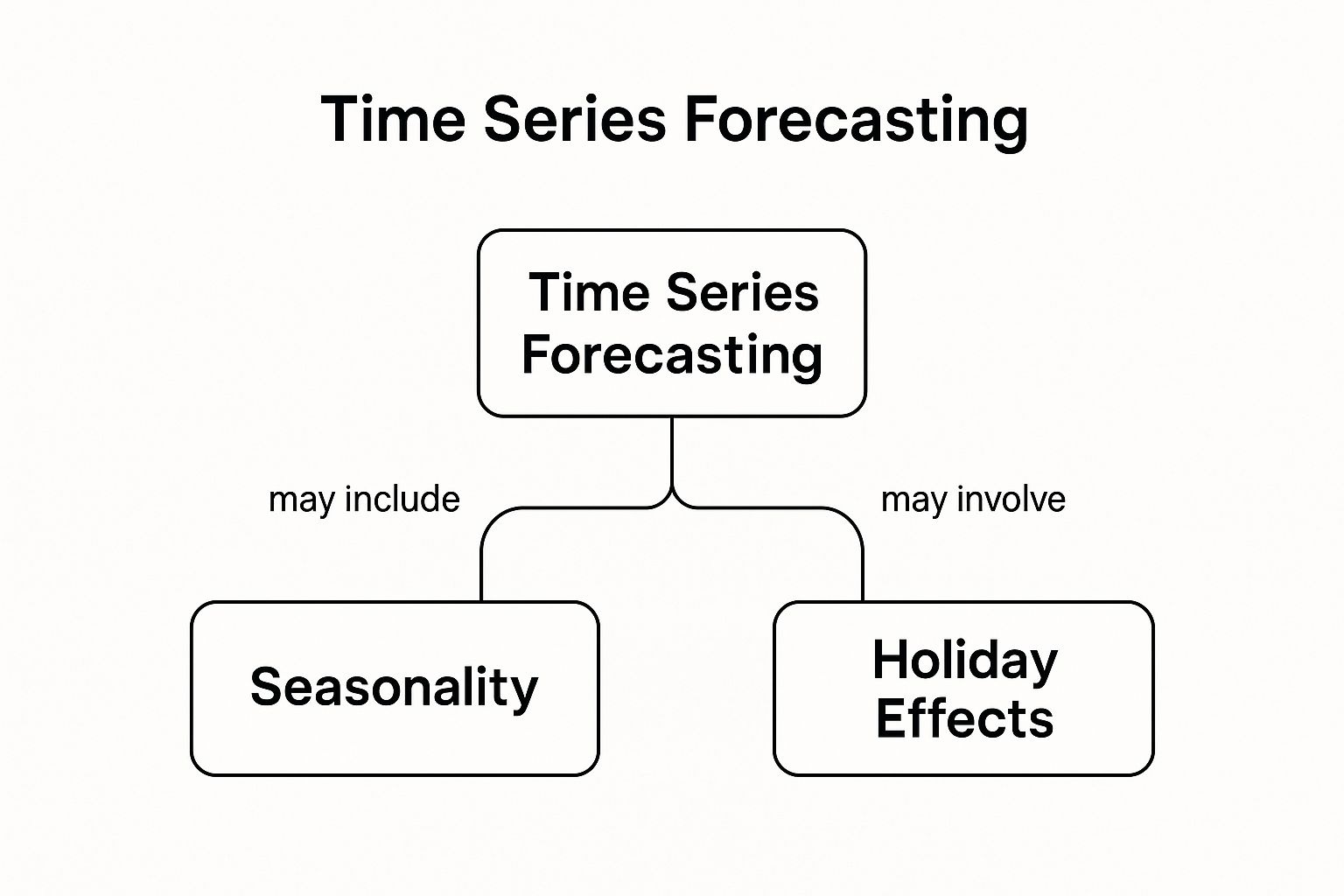
This map highlights how time series forecasting decomposes data into its fundamental parts: the long-term Trend, predictable Seasonality, and irregular Holiday Effects, which are all crucial for building a robust model.
Implementation Tips
To get reliable forecasts, a systematic approach to model building is necessary.
- Ensure Stationarity for ARIMA: Before using ARIMA, check if your data's statistical properties (like mean and variance) are constant over time using an Augmented Dickey-Fuller (ADF) test.
- Define Special Events for Prophet: When using Prophet, explicitly define a custom list of holidays and company-specific events (e.g., promotional periods) to improve model accuracy.
- Use Chronological Data Splits: Unlike other models, time series data must be split chronologically for validation. Use an earlier period for training and a later period for testing to simulate a real-world forecasting scenario.
- Validate with Walk-Forward: Implement walk-forward validation, where the model is retrained with each new observation, to get a more realistic measure of its performance over time. To learn more, explore these techniques on how to improve forecast accuracy on vizule.io.
Predictive Modeling Techniques Comparison
| Model | Implementation Complexity 🔄 | Resource Requirements ⚡ | Expected Outcomes ⭐ / 📊 | Ideal Use Cases 💡 | Key Advantages 💡 |
|---|---|---|---|---|---|
| Linear Regression | Low 🔄🔄 | Low ⚡⚡ | Predicts continuous outcomes ⭐⭐📊 | Linear relationships, interpretability, baseline models | Simple, interpretable coefficients, fast training |
| Logistic Regression | Low to Moderate 🔄🔄 | Low to Moderate ⚡⚡ | Binary classification with probabilities ⭐⭐📊 | Binary classification, probability estimation, interpretable | Probability estimates, interpretable odds ratios |
| Decision Trees | Moderate 🔄🔄🔄 | Moderate ⚡⚡ | Classification & regression with interpretable rules ⭐⭐📊 | Interpretability, feature interaction, exploratory analysis | Easy visualization, handles mixed data, no scaling needed |
| Random Forest | Moderate to High 🔄🔄🔄🔄 | High ⚡⚡⚡ | High accuracy, stable predictions ⭐⭐⭐📊 | General-purpose prediction, mixed feature types | Robust to overfitting, feature importance, high accuracy |
| Gradient Boosting Machines (GBM) | High 🔄🔄🔄🔄🔄 | High ⚡⚡⚡ | State-of-the-art accuracy ⭐⭐⭐⭐📊 | Structured data with focus on maximum accuracy, competitions | Captures complex patterns, flexible loss functions |
| Neural Networks (Deep Learning) | Very High 🔄🔄🔄🔄🔄🔄 | Very High ⚡⚡⚡⚡ | Exceptional on complex, high-dimensional tasks ⭐⭐⭐⭐📊 | Image, text, speech, large datasets | Learns hierarchical features, highly flexible |
| Support Vector Machines (SVM) | Moderate to High 🔄🔄🔄🔄 | Moderate to High ⚡⚡ | Effective classification with max-margin ⭐⭐📊 | High-dimensional data, clear margin separation | Works well with few samples, strong theoretical basis |
| K-Nearest Neighbors (KNN) | Low 🔄🔄 | Moderate to High ⚡ (prediction heavy) | Simple classification/regression ⭐⭐📊 | Small-medium datasets, irregular decision boundaries | No training phase, adapts easily, simple to implement |
| Naive Bayes | Low 🔄🔄 | Low ⚡⚡ | Fast probabilistic classification ⭐⭐📊 | Text classification, real-time systems, limited training data | Extremely fast, handles high-dimensional data |
| Time Series Forecasting (ARIMA/Prophet) | Moderate to High 🔄🔄🔄🔄 | Moderate ⚡⚡ | Forecasts with trends & seasonality ⭐⭐📊 | Business metrics, financial series, seasonal data | Interpretable components, handles missing data (Prophet) |
Ready to Connect the Dots in Your Data? It's Time to Act.
You've just explored a powerful lineup of predictive modeling techniques, from the straightforward logic of Linear Regression to the complex power of Gradient Boosting. We've journeyed through decision trees, random forests, and time series models, each offering a unique way to see your business's future. Understanding these methods is the critical first step, but the real transformation happens when you move from theory to application.
The core challenge for most SMB owners and operators isn't a lack of data; it's the overwhelming effort required to turn that data into forward-looking intelligence. The endless cycle of manual reporting in siloed spreadsheets consumes valuable time and often produces insights that are already out of date. This is where the practical application of predictive modeling, integrated directly into a Power BI dashboard, changes the game entirely.
From Reactive Reporting to Proactive Strategy
Mastering these concepts is about more than just building a model. It’s about building a smarter, more resilient business. Imagine being able to:
- Forecast Cash Flow with Confidence: Use time series models automated within Power BI to move beyond simple historical analysis and accurately predict future cash positions.
- Identify Your Most Valuable Customers: Apply classification models like Logistic Regression or Random Forest to pinpoint which leads are most likely to convert or which customers are at risk of churning.
- Optimize Operations and Inventory: Leverage regression or gradient boosting techniques to predict demand, helping you manage stock levels, reduce waste, and improve supply chain efficiency.
Shifting from reactive reporting to a proactive, predictive strategy provides the clarity needed to align your entire organization. When finance and operations are working from the same unified, forward-looking data, strategic planning becomes a collaborative exercise, not a contentious debate. This is how you stop looking in the rearview mirror and start steering your business toward its goals with confidence.
Your Next Step: From Insight to Implementation
You don't need to become a data scientist overnight to harness the power of these predictive modeling techniques. The key is to find a partner who can bridge the gap between these powerful algorithms and your specific business challenges. The goal is to build a practical, automated system that delivers actionable insights directly to your dashboards, empowering you to make faster, more informed decisions every day. This transition unlocks the true potential hidden within your data, turning it from a historical record into your most valuable strategic asset.
Ready to move beyond chaotic spreadsheets and manual reports? At Vizule, we specialize in implementing these advanced predictive modeling techniques within Power BI to build automated reporting and financial forecasting systems for founders and SMBs. Let's connect the dots in your data and build the BI foundation you need to scale with confidence.
