


If you're an SMB founder drowning in spreadsheets, you know the feeling. The answers you need are buried somewhere in your data, but you're too busy manually pulling reports to find them. This is exactly where business intelligence consulting services come in—to shift you from reactive reporting to proactive, insight-led decisions that actually move the needle.
Think of a BI consultant not as a chart-builder, but as the architect for your company's entire data ecosystem. They connect the dots between your finance and operations, automate the manual grind, and build a single source of truth you can finally trust to scale your business with confidence.
From Data Chaos to Strategic Clarity

For most small and medium-sized businesses, "reporting" is a painful weekly ritual. It involves hours spent exporting data from different platforms, wrestling with VLOOKUPs in Excel, and manually pasting charts into a PowerPoint deck that's outdated the moment it's sent.
This is more than a time-suck; it's a strategic bottleneck. It's prone to human error, and it only gives you a static snapshot of the past. You might see what happened last month, but you rarely get the full picture of why it happened or what you should do next.
Business intelligence consulting flips this dynamic on its head. A BI consultant is a strategic partner who connects the dots between all your data points—from sales and marketing to finance and operations—and builds an automated system that works for you.
Building Your Single Source of Truth
At the heart of any BI project is creating a single source of truth. Imagine all your crucial data—from your CRM and accounting software to your Shopify store and marketing platforms—flowing into one central, reliable hub.
This isn't magic; it's a methodical process:
- Connecting Disparate Systems: First, we pull data from all the different tools you use. This breaks down the data silos that lead to conflicting reports and friction between departments.
- Cleaning and Structuring Data: Raw data is often messy. A huge part of the service is transforming inconsistent information into a clean, structured format you can actually trust for cash flow reporting and forecasting.
- Building a Robust Data Model: This is the engine room. We build a logical data model, often in a tool like Power BI, that defines your business rules and relationships. It ensures metrics like "customer lifetime value" or "net profit margin" are calculated the exact same way, every single time.
This solid foundation puts an end to the endless debates over whose spreadsheet is right, aligning your entire team around one set of numbers everyone trusts.
A consultant's job isn't just to build dashboards; it's to build a scalable data foundation that grows with your business, so you never have to start from scratch again.
Automating Reports and Unlocking Insights
Once that foundation is built, the real value begins.
Instead of spending hours building reports by hand, you get automated, interactive dashboards that refresh daily. This is the leap from reactive analysis to proactive strategy. The goal is to answer your most critical commercial questions with just a few clicks:
- Which of our marketing channels is delivering the highest ROI?
- What are the early warning signs that a customer is about to churn?
- How is our cash flow trending against our forecast for the quarter?
Ultimately, business intelligence consulting services bridge the gap between just having data and actually using it to make smarter, faster decisions. It’s about turning operational noise into the clear signals you need to scale your business with confidence.
Want to automate your reporting and finally trust your data? Book a free call with our BI consultants today.
The Hidden Costs of Manual Reporting
The real cost of spreadsheet chaos isn't your Office 365 subscription; it's the invisible anchor dragging down your company's growth. As a founder, you know the feeling—that low-level hum of inefficiency from manual reporting. You might write it off as "the cost of doing business," but the cumulative damage is far greater than you think.
This reliance on manual processes creates tangible costs that hit your bottom line. They are drains on your resources, your time, and your potential.
The True Cost of Wasted Hours
Think about the hours your team bleeds each week on mind-numbing, low-value tasks like copying and pasting data, manually checking numbers, and wrestling with report formatting. It’s not trivial; research shows employees can spend up to 80% of their time preparing data instead of actually analyzing it.
For a small, agile team, this is a killer. Every hour an analyst spends fighting an Excel formula is an hour they aren't spending on strategy, sales, or keeping customers happy.
The true expense isn't just the salary you pay for that wasted time; it's the lost opportunity. It’s the growth projects that never get off the ground and the critical insights that are never found because your best people are stuck in the operational weeds.
This lost time adds up to a massive opportunity cost. An investment in business intelligence consulting services flips this dynamic, automating the grunt work so your team can focus on what actually moves the needle.
The High Price of Human Error
Beyond the time sink, manual reporting is a breeding ground for costly errors. One misplaced formula, a copy-paste slip-up, or a single incorrect data entry can send ripples across your entire business. These aren't just small typos; they can lead to major strategic blunders.
Imagine placing a critical inventory order based on last week's sales figures, only to find out later the data was wrong. Or picture setting your annual budget with a P&L that has a calculation error. These scenarios are terrifyingly common and lead to real-world consequences:
- Financial Loss: Ordering the wrong amount of stock, misallocating marketing budgets, or making poor hiring decisions based on faulty revenue projections.
- Damaged Credibility: Presenting incorrect numbers to investors or your board can instantly erode their trust and confidence in your leadership.
- Operational Chaos: Inaccurate data creates friction between departments, sparking arguments between finance and ops over which set of numbers is the "single source of truth."
The Drag of Delayed Decisions
Finally, manual reporting forces you to operate in the past. By the time you’ve compiled last month's report, the data is already stale. In today's market, making decisions based on outdated information is like trying to drive forward while looking only in the rearview mirror.
This delay means you’re always reacting to problems instead of proactively jumping on opportunities. You might spot a negative trend weeks after it started, long after you could have done something about it. This constant lag time is a serious competitive disadvantage.
Moving away from this grind isn't just about getting prettier charts. It’s about fundamentally changing the speed and accuracy of your decision-making. An automated BI system delivers trusted insights daily, allowing you to operate with clarity and confidence.
Ready to eliminate these hidden costs? See how Vizule can help automate your reporting stack.
Our Proven Framework for Data Clarity
Jumping into business intelligence consulting services can feel like a big leap, especially when you're staring down messy data. We get it. To take the guesswork out of the equation, we stick to a straightforward, three-stage framework built for SMBs and founders.
This isn't about just plugging in software. It's a disciplined process that turns your scattered data into an automated engine for better decisions, moving from high-level strategy right through to hands-on implementation and team adoption.
Here’s how it works.
Stage 1: Map Your Data and Define Success
Before we touch a single line of code, we start with a strategic deep dive. The 'Map' stage is all about discovery and aligning with your commercial goals. This is less about data and more about what you want to achieve as a business.
During this phase, we’ll work with you to:
- Clarify Business Objectives: We help you nail down the critical questions you need answered. Are you trying to get a better handle on cash flow forecasting? Pinpoint your most profitable customers? Or cut down on operational waste?
- Audit Your Data Landscape: We take a full inventory of your data sources—your accounting software, CRM, Shopify store, and those dozens of operational spreadsheets. This gives us a clear picture of what you have, where it is, and what shape it's in.
- Create a Precise Roadmap: With your goals and data audit in hand, we build a detailed project plan. This roadmap lays out the exact steps, timelines, and deliverables, so you know exactly what’s coming and when.
Getting this first stage right ensures the final solution is perfectly tuned to your business needs, not just a set of pretty dashboards that don't drive action.
Stage 2: Model Your Single Source of Truth
Once the strategic map is clear, we roll up our sleeves for the 'Model' stage. This is the technical build-out where the real transformation from Excel to Power BI happens. Our main job here is to construct your company's single source of truth—a central data model that becomes the undisputed foundation for all reporting.
We connect all your different data sources into a solid, scalable data model, often using a tool like Power BI. This is where we clean, structure, and standardise all your information to make sure it's consistent and reliable.
This central model is what ends the classic "battle of the spreadsheets," where the finance team's numbers don't match the ops team's. When everyone is working from the same trusted data, you can stop arguing and start making smart, strategic decisions together.
Stage 3: Mobilise Your Team for Action
The final stage, 'Mobilise,' is where the new BI system becomes a living part of your business. A powerful dashboard is useless if your team doesn't use it, so this phase is all about adoption, training, and getting real results.
We deploy intuitive, interactive dashboards designed for non-technical users, making it easy for anyone on your team to explore data and get answers. More importantly, we provide hands-on training built around your specific workflows. We don't just hand over a tool; we empower your team to use it effectively, making sure it fits seamlessly into your daily routines.
Our structured process is designed to turn complicated data problems into clear, actionable insights for your business.
Vizule's 3-Stage BI Implementation Framework
| Stage | Core Focus | Key Activities | Client Outcome |
|---|---|---|---|
| Stage 1: Map | Strategic Alignment & Discovery | Clarify business goals, audit existing data sources (CRM, finance, ops), and develop a detailed project roadmap with clear timelines. | A clear, actionable plan that ensures the final BI solution directly addresses your most critical business needs. |
| Stage 2: Model | Technical Build & Data Centralisation | Connect disparate data systems, clean and standardise information, and build a robust, scalable data model to serve as the single source of truth. | A reliable, unified data foundation that eliminates conflicting reports and ensures everyone works from the same numbers. |
| Stage 3: Mobilise | Team Adoption & Value Realisation | Deploy user-friendly KPI dashboards, provide hands-on team training, and integrate the new BI system into daily operational workflows. | An empowered team that confidently uses data to make smarter, faster decisions, driving tangible business growth. |
This framework ensures our business intelligence consulting services are a strategic partnership that delivers lasting value.
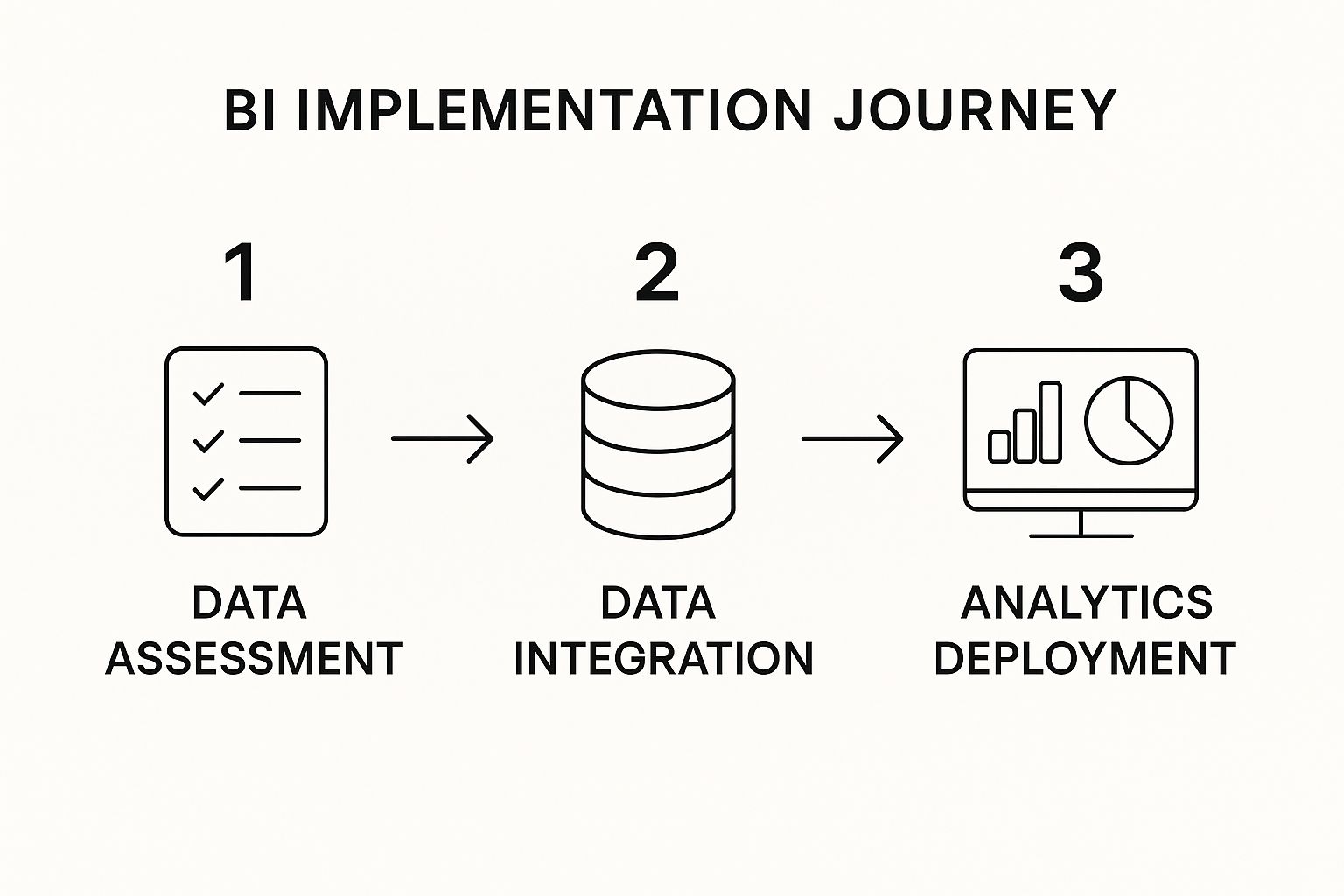
A successful BI project starts with a proper assessment, moves to the technical heavy lifting, and finishes by putting powerful tools in your team's hands.
If you’re ready to move from data chaos to clarity with a process that works, let’s talk. Book your free BI consultation to see how our framework can build the data foundation your business needs to grow.
What Are the Real-World Benefits of BI Consulting?
Beyond the structured process, the real value of bringing in a BI consultant lies in the concrete results you'll see. For founders and operators, these aren't just abstract ideas; they translate directly into more time, higher profits, and smarter, more sustainable growth.
The first win is the automation of your financial and operational reporting. This permanently breaks the painful cycle of manual data wrangling, freeing up your time to focus on strategy and scaling, not spreadsheets.
Build a Single Source of Truth
One of the biggest points of friction in a growing business is conflicting data. We've all been in that meeting where the finance team's revenue numbers don't match the sales team's report. You end up wasting time debating whose spreadsheet is right instead of figuring out how to move forward.
A BI consultant fixes this by building a single source of truth. This is a centralized data model that ensures key metrics are defined and calculated the same way across the entire business. The result? Total alignment and a newfound trust in your numbers.
- Eliminate Data Silos: We connect all your disparate systems—your CRM, accounting software, operational tools—so everyone is finally working from the same unified dataset.
- Boost Team Confidence: When your entire team trusts the data, conversations shift from questioning the numbers to acting on the insights they provide.
Unlock Insight-Led Decision Making
With a reliable data foundation in place, you can finally stop reacting and start being proactive. This is where you move from basic reporting to genuine, insight-led decision-making, answering the critical questions that drive growth.
Instead of guessing, you get definitive answers backed by data that updates daily. With the right setup, you can leverage powerful tools like a Profit and Loss Analyzer to get immediate financial clarity.
You can finally pinpoint which marketing campaigns deliver the highest ROI, identify your most profitable customer segments, or spot operational bottlenecks before they become major problems. This is the difference between running your business and letting your business run you.
This shift is more important than ever. The global BI market, valued at USD 31.98 billion in 2024, is projected to more than double by 2032. This isn't just a trend; it's a fundamental change in how successful companies operate.
Create a Scalable Data Foundation
Perhaps the most crucial long-term benefit is building a data foundation that can actually scale. Many small businesses hit a growth ceiling because their reporting systems—often a tangled mess of spreadsheets—can't keep up. Starting over from scratch is painful and expensive.
Working with a BI consultant ensures the system you build today is designed to grow with you tomorrow. We create robust, flexible financial models in platforms like Power BI that can easily handle more data, more users, and more complexity as your business expands. Our guide on business intelligence for finance dives deeper into how a strong foundation supports sustainable financial management.
Think of it not as a one-off project, but as an investment in your company's core infrastructure. It ensures that as you scale, your ability to make smart, data-backed decisions scales right along with you.
How to Choose the Right BI Consulting Partner
Picking a partner for your business intelligence consulting services is a make-or-break decision. Get it right, and you'll supercharge your growth. Get it wrong, and you're looking at wasted time, a blown budget, and a shiny new system that gathers dust.
The market for BI is booming—projected to hit USD 45.2 billion by 2033—which means you have more options than ever. But more choice can also mean more confusion.

This isn’t about finding the biggest firm or the cheapest quote. It’s about finding a genuine partner who understands the unique grind of running an SMB and has the right toolkit to solve your specific problems.
Here’s what to look for.
They Speak Your Language, Not Just Tech Jargon
Your BI partner should be as comfortable talking about gross margins and cash flow as they are about data warehouses. Too many technical consultants get lost in the weeds of APIs and data normalisation, forgetting the whole point is to solve a real-world business problem.
Look for a consultant who leads with commercial questions, not technical ones. They should be obsessed with understanding your business model, what drives your revenue, and the operational headaches you deal with every day. A great partner translates your business needs into a technical solution—never the other way around.
They Specialize in Your Tools
The BI world is huge. A consultant who claims to be an expert in everything is usually a master of none. It’s vital to find a partner who specialises in the tools that make sense for an SMB, like Power BI.
There’s a reason Power BI is the go-to platform for small and medium-sized businesses: it’s powerful, affordable, and integrates seamlessly with tools you already use, like Excel. A specialist will have deep, hands-on experience building solid, scalable solutions specifically within that ecosystem.
They Have a Small Business Focus
The challenges keeping a startup founder up at night are a world away from the concerns of a Fortune 500 executive. Large enterprise consultancies often try to force their heavy, one-size-fits-all methods onto small businesses, leading to solutions that are overly complex and expensive.
You need a partner who lives and breathes the SMB world.
An effective BI consultant for an SMB understands the need for agility and practical solutions that don't require a dedicated team of analysts to maintain. They know how to deliver maximum impact without the enterprise-level price tag.
They Have a Clear and Proven Process
Finally, demand a transparent process. A vague proposal that just promises "dashboards" is a massive red flag. A great partner should be able to walk you through their methodology, step-by-step, so there are no surprises.
For instance, our Map, Model, Mobilise framework ensures every project moves logically from strategic alignment to technical build and, crucially, team adoption. For more on what a successful rollout looks like, check out our guide on business intelligence best practices.
This clarity gives you confidence that your investment is being managed effectively and is on track to deliver real value. Choosing the right partner is the first step toward turning your data into your most valuable asset.
Transform Your Business with Data You Can Trust
We've walked through the pain of manual reporting and the clarity a strategic BI system brings. Think of business intelligence consulting services as the bridge connecting your current data headaches to a future of confident, scalable growth. It's your chance to move from data chaos to data clarity.
Imagine your next leadership meeting. No more debating whose spreadsheet is correct. Instead, your team huddles around live, trusted dashboards, drilling down into real-time performance and making bold moves with absolute certainty. Picture yourself freed from the reporting grind, spending your time on high-level strategy where you can make the biggest impact.
From Aspiration to Action
This isn't a far-off dream. It's achievable with the right partner and a clear plan. The key is to build a business that scales intelligently, where decisions are driven by insight, not just intuition. This is how you master your operations and financials with a level of visibility you might have thought was out of reach. For companies looking to build a data-first culture, BI provides the essential foundation for adopting powerful new approaches like data-driven sustainability tools.
The market reflects this massive shift. The global BI software space, valued at USD 41.74 billion in 2024, is projected to rocket to USD 151.26 billion by 2034. This isn't just a trend; it's the new standard for doing business.
The next step is simple: a conversation. It's about us understanding your specific goals and mapping out a clear strategy to get you there. Taking this step is what separates businesses that talk about data from those that truly run on it.
Our guide on data-driven decision-making dives deeper into how you can cultivate this mindset across your organisation.
If you're ready to stop reacting and start leading with data you can finally trust, let's talk.
Connect with us to design your financial dashboard in Power BI.
Frequently Asked Questions

Bringing on a consultant is a big decision, and it’s smart to have questions. Here are the most common ones we hear from founders and SMB operators considering our business intelligence consulting services.
How Much Do Business Intelligence Consulting Services Cost?
This is always the first question, and the honest answer is: it depends. We don't quote a flat price because our focus is on delivering a clear, measurable return on your investment.
The final cost is shaped by your specific needs—how many data sources you have, the complexity of your current setup, and the overall scope of what you want to achieve.
Our goal is simple: to build a solution that pays for itself many times over by automating manual work, eliminating costly mistakes, and uncovering insights that drive profitable growth.
How Long Does a Typical BI Project Take?
As an SMB, you can't afford to wait forever to see results. Our framework is built for speed and efficiency, delivering progress without cutting corners.
A typical timeline looks like this:
- Map (Discovery & Strategy): This initial strategic phase is usually completed within 1-2 weeks.
- Model & Mobilise (Build & Deployment): The technical build and team rollout generally takes 4-8 weeks.
This means you can go from data chaos to having automated, actionable dashboards in just a couple of months—not quarters or years.
Is My Business Too Small for BI Consulting?
Absolutely not. In fact, the best time to build a solid data foundation is while you're still growing. It's far easier (and cheaper) to build good data habits early than it is to untangle years of accumulated chaos later.
Putting a BI system in place early creates a "single source of truth" from the start. As you hire more people and your operations get more complex, your reporting infrastructure grows with you, helping you avoid the operational headaches that trip up so many scaling companies.
What If My Data Is a Complete Mess?
If you think your data is messy, you're not alone. That's the reality for most businesses, and it's precisely why you bring in a consultant. A huge part of our business intelligence consulting services is taking that raw, jumbled data and turning it into a clean, reliable asset.
We handle the entire data transformation process:
- Data Cleansing: We find and fix inaccuracies and inconsistencies hiding in your data.
- Data Structuring: We organize everything into a logical, usable format.
- Data Modelling: We build the connections and business logic that power the insights you need to make decisions with confidence.
Don't let messy data stop you. That’s our job to solve.
Ready to stop asking questions and start finding answers in your data? The team at Vizule is here to help you build a truly data-driven business with reporting you can finally trust.
