


Are you running your business on gut feelings and a tangled mess of spreadsheets? You're not alone. Many founders and operators feel the frustration of manual reporting and siloed data. Data-driven decision making is the practical solution: it's the process of using hard evidence from your own business—sales figures, operational stats, customer feedback—to make strategic choices, rather than relying on guesswork.
For SMBs, this isn't about complex algorithms; it's about swapping intuition for verifiable facts to steer your company's growth and finally gain visibility into what's really working.
From Gut Feel to Growth Engine: The Mindset Shift

As a business owner, you’re constantly making choices that impact everything from cash flow to team morale. The old-school approach often means leaning on experience or what just feels right. While intuition has its place, it’s a shaky foundation for a business that’s trying to scale. This is where a change in mindset becomes a real competitive advantage.
Think of it like being a pilot. A pilot can look at the horizon, but they rely on their cockpit instruments for precise, real-time information about altitude, speed, and direction. Data-driven decision making gives you that same instrument panel for your business. It lets you see what’s really happening, not just what you think is happening.
A Practical Shift for Business Owners
Adopting this approach doesn't mean you need to become a data scientist overnight. It’s about building a system where the critical information you need is accessible, reliable, and easy to understand. Instead of spending hours wrestling with disconnected Excel files to answer a simple question, you get clear, automated reports that give you back your time and confidence.
This practical shift helps you move from constantly reacting to problems to proactively steering your business toward its goals. It empowers you to make smarter, faster decisions with a level of confidence that intuition alone can't provide.
Data-driven decision making is not a fleeting trend but a global standard. Research shows that organizations embedding data into their processes are significantly more likely to boost profitability and retain customers. You can read more on the impact of data-driven organizations.
The table below breaks down the practical differences between the old way of doing things and the new, data-driven approach.
Shifting from Intuition to Insight
| Business Area | The Old Way (Intuition-Based) | The New Way (Data-Driven) |
|---|---|---|
| Marketing Spend | "Let's put more money into social media; it feels like it's working." | "Our dashboard shows Instagram ads have a 25% higher conversion rate. Let's reallocate the budget there." |
| Product Development | "Customers have mentioned they want a new feature. Let's build it." | "Support tickets and survey data show 70% of users struggle with Step 3. Let's fix that bottleneck first." |
| Sales Strategy | "Our top salesperson says we should target larger companies." | "Analysis of our sales cycle shows deals under £10k close 40% faster. Let's create a campaign for that segment." |
| Hiring | "We feel swamped. We probably need another project manager." | "Our project delivery times have increased by 15% in the last quarter, indicating a capacity issue. Let's hire." |
This table illustrates how having clear data transforms vague feelings into specific, actionable plans that drive real results.
What Does This Mean for You?
For small-to-medium business owners and founders, the benefits are tangible and immediate. By grounding your strategy in solid evidence, you can:
- Allocate Resources Effectively: Finally understand which marketing channels deliver the highest return or which product lines are actually the most profitable.
- Improve Operational Efficiency: Pinpoint the exact bottlenecks in your processes—from sales cycles to project delivery—and take precise corrective action.
- Boost Team Alignment: Give everyone from finance to operations a shared, accurate view of performance. No more debates over whose spreadsheet is right.
Ultimately, this philosophy is about turning your data from a chaotic, untapped resource into your most reliable growth engine. It’s the key to unlocking consistent performance and building a more resilient, predictable business.
Why Your Business Cannot Ignore Data Any Longer

Does this sound familiar? You’re drowning in outdated reports, your information is scattered across different systems, and you spend far too many hours manually punching numbers into Excel. All the while, you have that nagging feeling that your competitors are moving faster and smarter.
That frustration is a classic symptom of running a business without a clear data strategy.
Ignoring the goldmine of data locked inside your business isn't a passive choice; it has real, tangible costs. It leads directly to wasted marketing budgets, clunky operations, and massive missed opportunities for growth. In today’s market, every decision made on a hunch is a gamble you can't afford to keep making.
The Real Costs of Operating Blind
The fallout from not embracing data-driven decision making shows up right on your bottom line. Without a clear view of what’s actually working, you could be pouring cash into marketing campaigns that bring in nothing or be completely oblivious to operational bottlenecks quietly draining your profits.
Consider these all-too-common scenarios for business owners:
- Wasted Marketing Spend: You’re allocating your budget based on what feels right, but you have no hard numbers on customer acquisition cost (CAC) or return on ad spend (ROAS) for any of your channels.
- Inefficient Operations: Your team sinks dozens of hours every month copying and pasting data between systems, just to create reports that are already out of date by the time they’re finished.
- Missed Growth Opportunities: You might have an incredibly profitable customer segment or a star product line, but it stays buried and unnoticed in a heap of messy data from Excel.
This isn’t just about plugging leaks; it’s about opening the floodgates to growth. A strategic approach to your data can turn it from a chaotic burden into your most powerful competitive edge.
From Assumption to Action: A Relatable Story
Let's make this real. Imagine an e-commerce business spending £5,000 a month on a broad social media campaign. The founder assumed their audience was a wide demographic, but sales were flat, and the ROI was a total mystery. Their reporting process was a nightmare of manual exports from Shopify, Google Analytics, and ad platforms, all dumped into a monstrous spreadsheet.
Then, they implemented a simple Power BI dashboard that connected directly to these sources. For the first time, they saw the full picture. The data revealed a clear insight: 80% of their most profitable sales came from a specific niche—women aged 35-45 who engaged with video content.
Armed with this crystal-clear insight, they shifted their entire budget to targeted video ads aimed squarely at that demographic. The result? Their marketing ROI tripled within two months, and they discovered a loyal, high-value customer base they never knew they had.
This is the power of moving from gut-feel assumptions to data-backed action. The good news is, the tools and expertise to make this happen are more accessible than you think. It's time to start cracking the code of data mastery for your SME.
A Proven Framework for Data Clarity
Theory is one thing, but putting it into practice is what gets results. You don't need a PhD in data science to start making smarter decisions. The path from data chaos to genuine clarity is a logical one. At Vizule, we’ve boiled it down to a powerful three-step framework for founders and operators: Map, Model, and Mobilise.
This isn't about a one-off project; it’s about building a sustainable engine for growth. Think of it like setting up a reliable water supply for your business. First, you find the springs (Map). Next, you build the plumbing and filtration system (Model). Finally, you turn on the taps so everyone gets fresh, clean water whenever they need it (Mobilise).
Step 1: Map Your Data Landscape
First, you have to figure out what you really want to know and where the answers are hiding. This is the most crucial step in any data-driven decision making process, and it’s not about grabbing every last byte of data you can find. It’s about being deliberate.
We always start by asking the right business questions—the big-picture questions that keep founders up at night:
- Which marketing channels are actually giving us the best return?
- What’s our true customer lifetime value, and which customer segment is most profitable?
- Are our project margins shrinking? If so, where are the leaks?
- Based on our current pipeline, what does our cash flow look like for the next six months?
Once the questions are clear, we hunt down the data. For most businesses, this information is scattered across different platforms—a classic case of data silos.
Common data sources we connect include:
- Accounting Software: Like Xero for revenue and profit.
- CRM Systems: Such as HubSpot or Salesforce for the sales pipeline.
- Operational Platforms: Your e-commerce backend like Shopify or project management tools.
- Marketing Analytics: From Google Analytics to social media ad platforms.
The Map phase creates a blueprint. It solidifies the "why" behind your data strategy and identifies the raw materials you'll need. Skipping this step is a recipe for drowning in a sea of irrelevant data.
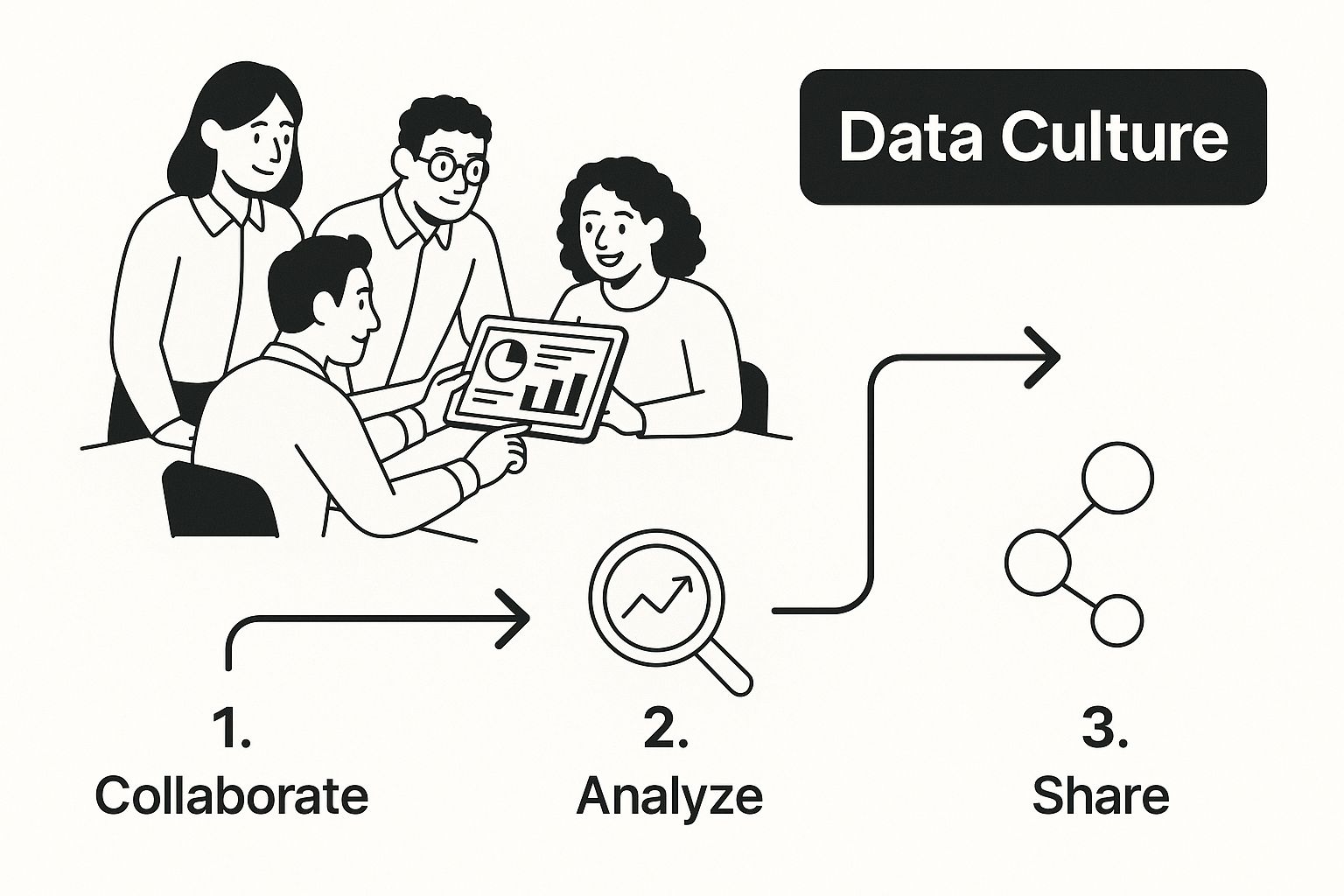
Step 2: Model Your Single Source of Truth
With your blueprint in hand, it’s time to turn that scattered, raw data into something clean, reliable, and centralised. The "Model" phase is all about building your single source of truth.
Imagine trying to bake a cake with ingredients spread across five different kitchens, with half of them mislabelled. That’s what it’s like working with siloed data. This phase brings everything into one central, automated data warehouse or model, checking the labels and measuring everything correctly.
Experts often cite the "80/20 rule," where a staggering 80% of the time is spent just cleaning and organising data, leaving only 20% for analysis. Getting this step right is non-negotiable if you want insights you can trust.
We use powerful but accessible business intelligence tools like Microsoft Power BI to automate this process:
- Data Integration: We pull data automatically from your different systems. Say goodbye to manually exporting CSVs and the pain of "Excel to Power BI" migrations.
- Data Cleaning: We standardise formats, remove duplicates, and fix the inconsistencies that make data untrustworthy.
- Creating a Data Model: We connect the dots. We link your sales data from Shopify to your ad spend data from Google Ads, letting you calculate your true return on ad spend (ROAS) without guesswork.
The result is a solid foundation for all your reporting. It puts an end to the "my spreadsheet is right" arguments and gives everyone one set of facts to work from.
Step 3: Mobilise Your Data for Action
Now that you have a reliable data model, it’s time to bring it to life. The Mobilise phase is where your data stops being a static spreadsheet and becomes a dynamic tool that empowers your whole team to see what's happening, understand why, and take decisive action.
We build the interactive dashboards and automated systems that drive the business forward. We work with you to design visuals that answer your most pressing questions at a glance.
A well-designed Power BI dashboard can show you:
- A real-time view of sales performance against targets.
- A drill-down analysis of profitability by product, service, or customer.
- An automated cash flow reporting model to help you create a reliable forecasting model.
- A KPI dashboard that tracks the vital signs of your business.
The key word here is automation. These dashboards are living tools connected directly to your data, set to refresh automatically. This frees your team from the soul-crushing cycle of manual report building. Instead of spending their week compiling data, they can spend it making strategic moves. This framework turns messy data from a source of frustration into a predictable, scalable engine for confident data-driven decision making.
Navigating Common Data Roadblocks
Embarking on a data journey is exciting, but it’s natural to worry about hitting a few bumps in the road. Many business owners we talk to share the same concern: "Will I end up more confused than when I started?" The good news is these challenges are predictable, and with the right game plan, completely avoidable.
Knowing these common roadblocks is the first step to sidestepping them. If you see them coming, you can build a data-driven decision-making process that’s resilient, effective, and free from the frustrations that derail so many projects.
The Challenge of Data Paralysis
One of the most frequent hurdles we see is data paralysis: that sinking feeling of being completely overwhelmed by the sheer volume of information. Data pours in from sales, marketing, and operations, but instead of giving you a clear picture, it just creates a fog of numbers.
This happens when businesses collect data without a clear "why." The impulse is to grab everything, but this "more is more" approach quickly leads to a noisy, unmanageable mess. You're left staring at dozens of metrics with no real insight, pushing you right back to guesswork.
The fix? Start with your business questions, not your data sources. A focused, consultative approach helps you zero in on the handful of critical metrics that actually impact your goals. This turns an overwhelming flood of information into a focused beam of insight.
The Hidden Danger of Dirty Data
Another huge roadblock is dirty data—information that’s inaccurate, incomplete, or inconsistent. Think of it like navigating with a faulty compass. Any decision you make based on bad information will likely lead you in the wrong direction.
Dirty data creeps in from all over the place:
- Manual Entry Errors: A simple typo in a CRM or spreadsheet can throw off an entire report.
- Inconsistent Formats: One system logs a customer as "ACME Inc." while another uses "Acme Corporation," creating duplicates and confusion.
- Outdated Information: Trying to make today's decisions with last quarter's numbers is a recipe for failure.
Inaccurate data isn't just a minor headache; it’s a direct hit to your finances. Cleaning and validating your data isn't just a technical chore—it's a critical business function that protects your bottom line. A solid data model, like the one we build in our Model phase, automates the entire cleaning and standardisation process. This ensures your single source of truth is reliable and trustworthy.
Tool Overload and Cultural Hurdles
Many businesses fall into the trap of buying expensive, complicated software without a clear strategy. This tool overload usually creates more problems than it solves, leaving teams with powerful but unused platforms. The key is to choose tools like Power BI that fit a well-defined strategy, not the other way around.
Finally, never underestimate cultural resistance. Your team might be used to the old way of doing things in Excel. Introducing a new system without getting buy-in and providing proper training will lead to pushback and low adoption. A successful data initiative involves more than technology; it’s about empowering your team, showing them how new tools make their jobs easier, and building a culture where data is a shared, valuable asset.
Navigating these challenges takes more than just software; it takes a strategic partner. Want to automate your reporting and finally trust your data? Book a free call with our BI consultants today.
How Data Drives Real-World Business Decisions
Theory and frameworks are one thing, but the true value of data-driven decision making hits home when you see it solve actual, everyday business problems. The Map-Model-Mobilise framework isn't just a concept; it’s a practical roadmap for turning messy data into clear, profitable action.
Let’s walk through three common scenarios that business owners, operators, and founders constantly wrestle with.
Scenario 1: The E-commerce Retailer
The Pain: An online retailer is pouring money into marketing but has no real clue what’s working. Worse, their warehouse is a mess—overstuffed with items nobody wants while bestsellers are constantly out of stock, killing sales and tying up cash.
The Solution (Map-Model-Mobilise):
- Map: We nail down the critical questions: "Which marketing channels bring in our most valuable customers?" and "Which products should we double down on?" The answers are buried in their Shopify store, Google Analytics, and Facebook Ads accounts.
- Model: Using Power BI, we pull these scattered data sources into one unified model. The model automatically links a customer’s purchase history back to the specific ad that brought them in, creating a clean single source of truth.
- Mobilise: We build an interactive dashboard. The owner can now see, at a glance, their true Return on Ad Spend (ROAS) for each channel. Another view highlights product sales velocity and profit margins, instantly separating winners from losers.
The Outcome: Armed with clarity, the retailer shifts 20% of their marketing budget from a poor-performing channel to their most profitable one, doubling their ROAS in a single quarter. They also use the inventory insights to run a targeted sale, freeing up £30,000 in working capital.
Scenario 2: The Service Business Owner
The Pain: The owner of a small digital agency is in a constant state of panic about profitability. Projects frequently creep over budget, and they have a nagging feeling they aren't pricing their services correctly. The team seems permanently overworked, but it’s impossible to tell if it's due to too much work or inefficient processes.
The Solution (Map-Model-Mobilise):
- Map: The key questions are blunt: "Which of our projects are actually making us money?" and "How is my team's time really being spent?" The data is fragmented across their project management tool, time-tracking software, and Xero.
- Model: We construct a financial model in Power BI that acts as a bridge between these three siloed systems. It automatically reconciles team hours and project costs against the final invoice amount for every job.
- Mobilise: The owner receives a "Project Profitability" dashboard showing a real-time view of the margin on every project. A "Team Utilisation" dashboard clearly shows the trends in billable vs. non-billable hours.
The Outcome: The data reveals that their "quick-turnaround" projects are consistently unprofitable. They adjust their pricing model for these services and boost overall agency profitability by 15%. They also drive growth through effective data analysis by optimising their project onboarding, which directly improves team capacity.
Scenario 3: The Startup Founder
The Pain: A SaaS startup founder is prepping for their next funding round. They have promising early traction but are struggling to weave a compelling, data-backed growth narrative for investors. Their financial forecasts are a tangled mess of spreadsheets that are a nightmare to update.
The Solution (Map-Model-Mobilise):
- Map: The founder needs answers, fast: "What are our Customer Acquisition Cost (CAC) and Lifetime Value (LTV)?" and "How will different growth assumptions affect our cash runway?" The data is spread across their payment processor, CRM, and marketing platforms.
- Model: We build a dynamic financial modelling solution in Power BI connected directly to their live operational data. Key metrics like new user sign-ups and churn rates automatically feed into the forecasting model.
- Mobilise: The founder now has a powerful forecasting tool, not a static document. They can sit in a meeting and adjust assumptions on the fly—like increasing marketing spend—and instantly see the impact on their cash flow and profitability for the next 18 months.
The Outcome: The founder walks into investor meetings with a live, dynamic, data-driven model. They answer tough questions with confidence and demonstrate an intimate understanding of their business levers, helping them successfully close their funding round.
Ready to Take Your First Step Toward Data Clarity?
You've seen the theory and the real-world wins. The line between businesses that just get by and those that scale with confidence is drawn by how they handle their data. Turning that chaotic mess of numbers into your sharpest strategic asset is the key to smart growth.
The journey from confusion to clarity, from guesswork to growth, is more straightforward than you think. It starts with a single, focused conversation.
This is your invitation to book a complimentary discovery call with our BI consultants. This isn't a high-pressure sales pitch. It’s a no-strings-attached strategy session where we will listen to your frustrations, understand your goals, and start sketching out what a smart data strategy could look like for you.
Your Path to Actionable Insights
During our chat, we'll walk through how Vizule’s proven Map-Model-Mobilise framework can be plugged directly into your business. We'll talk about how to:
- Pinpoint your most urgent business questions to get you quick wins and immediate focus.
- Identify where your most valuable data is hiding across the software you're already using.
- Outline a plan for a 'single source of truth' to finally kill off conflicting reports and team misalignment.
This is about building a solid foundation for the long haul while getting you results you can see right away. It's about swapping hours of manual work for automated reporting and building dynamic dashboards that give you answers, not just more data points. For a deeper look, check out our guide on how to supercharge your finances with smarter modelling.
The goal isn’t to drown you in technology. It's to give you the specific instrument panel you need to navigate your business, making data-driven decision making a daily reality, not a distant ambition.
Stop wrestling with spreadsheets and start leading with clarity.
Ready to see what your data is truly capable of? Book your free discovery call with a Vizule consultant today and take control of your business narrative.
Frequently Asked Questions
Diving into the world of data can feel like a big leap, especially for SMB owners and founders. Here are straightforward answers to the questions we hear most often.
My business is small. Is a full data strategy overkill?
Not at all. In fact, smaller, agile businesses often see the biggest and fastest impact from getting their data in order. Starting early—even by just properly analysing sales and financial data—builds a powerful foundation for growth that scales with you. It helps you make smarter moves on a tight budget and sidestep costly mistakes. Our approach is built for SMBs, focusing on the metrics that drive immediate value, not boiling the ocean with unnecessary complexity.
How long does it take to see results from Power BI?
While it varies, it's much faster than most people think. Our Map-Model-Mobilise framework is designed for speed. We often deliver a "first-win" dashboard that tackles a critical pain point—like cash flow visibility or sales performance—in just a few weeks. The goal is to get actionable insights into your hands quickly while we build out the comprehensive system. You do not have to wait months to start making better, more informed decisions.
We already use Excel. How is this different?
Excel is a familiar tool, but for a growing business, relying on it alone creates significant risk. It's prone to manual errors, buckles under the pressure of multiple datasets, and makes collaboration a nightmare, leading to conflicting "versions of the truth." A dedicated BI solution like Power BI, when implemented by experts, automates your data collection, guarantees data integrity, and provides interactive, real-time dashboards your whole team can trust. It’s the difference between using a manual calculator and commanding a fully automated financial control centre.
Ready to finally trust your numbers and make decisions with confidence? Vizule can help you design the reporting systems you need to scale smart. Book your free BI consultation and see how we can automate your reporting stack.
Article created using Outrank


