

As a founder or operator, you're constantly making high-stakes decisions. But are you relying on gut feelings and messy, disconnected Excel sheets? Imagine having crystal-clear visibility into what's really driving your business, from cash flow reporting to customer behaviour. The shift from intuition-led to insight-led choices is the single most powerful lever for scalable growth.
The core challenge for most SMBs isn't a lack of data; it's the chaos of siloed information and the hours wasted on manual reporting. This article unpacks the tangible, data driven decision making benefits you can unlock by connecting the dots in your data.
We will move beyond jargon to show you how a modern BI stack, like one built on Power BI, transforms raw numbers into your most valuable strategic asset. This approach empowers you to automate reporting, align finance with operations, and scale with confidence. Let's explore the eight key benefits that will change how you run your business.
1. Achieve Unprecedented Decision Accuracy
One of the most transformative data-driven decision-making benefits is the shift from intuition-based choices to evidence-backed strategies. For SMBs, this means moving away from decisions based on 'gut feelings' and towards a culture where hypotheses are validated against real-world numbers. By grounding your strategy in the statistical analysis of your own operational and financial data, you can systematically reduce the cognitive biases that often lead even experienced founders astray.
This process isn't about eliminating your experience; it’s about augmenting it with factual insights. Tools like Power BI enable you to navigate market shifts and allocate resources with a newfound confidence that is simply unattainable through guesswork alone.
From Guesswork to Grounded Strategy
Many businesses fall into the trap of making critical choices based on what has worked in the past or what they feel should work next. A data-driven approach forces a more rigorous methodology. For instance, instead of launching a new product line based on an assumption, you can analyze customer purchase history, market trend data, and even conduct A/B tests on a small scale to predict its viability.
This methodical validation is where accuracy is born. Companies like Netflix famously use viewing data to greenlight original content, virtually guaranteeing an audience before production begins. While your SMB may not operate on that scale, the principle is the same: use your data warehouse and BI tools to de-risk major decisions and improve your odds of success.
This infographic breaks down the core components that enhance decision accuracy.
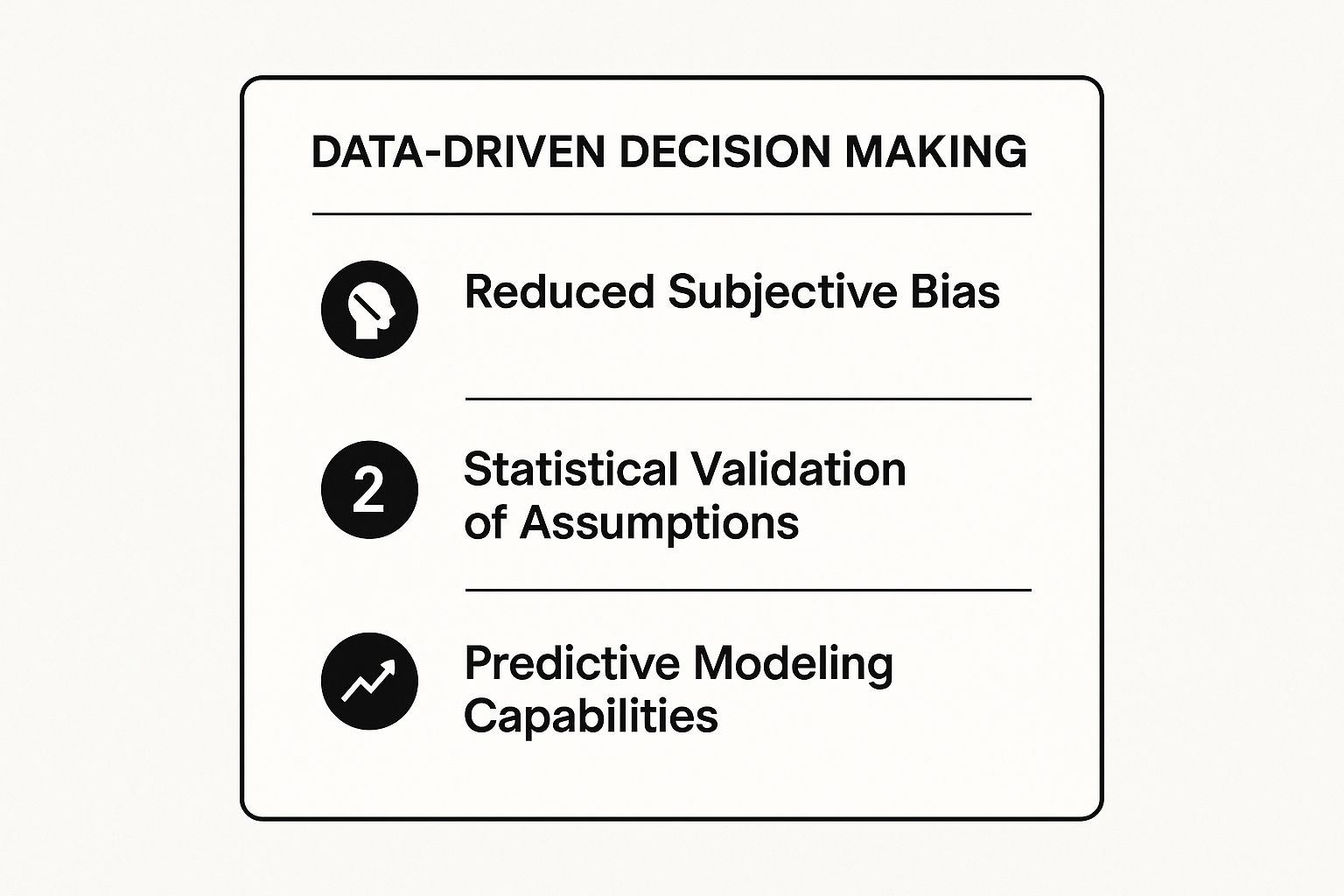
As the visualization highlights, this structured approach builds a reliable foundation for your strategy, moving your operations from reactive to predictive.
How to Implement for Better Accuracy
Making this shift requires a deliberate change in process. Here are actionable steps to start improving your decision accuracy:
- Establish Clear Criteria: Before you even look at the data, define what a successful outcome looks like. Set specific, measurable KPIs for the decision at hand.
- Combine Data Types: Don't rely solely on quantitative data. Augment your financial and operational metrics with qualitative insights from customer feedback, surveys, and team observations for a holistic view.
- Set Decision Deadlines: Avoid "analysis paralysis" by setting a firm deadline for making a choice. This ensures the process remains agile and doesn’t stall critical business momentum.
- Validate Your Sources: Ensure the data feeding into your analysis is clean, reliable, and up-to-date. Inaccurate source data from your CRM or ERP will inevitably lead to inaccurate conclusions.
2. Enhanced Operational Efficiency and Cost Reduction
One of the most immediate data-driven decision-making benefits is the ability to pinpoint and eliminate operational waste. By shifting from anecdotal process reviews to quantitative analysis, businesses can identify bottlenecks, streamline workflows, and optimize resource allocation with surgical precision. This allows leaders to move beyond generalized cost-cutting and towards strategic improvements that boost productivity and directly impact the bottom line.
By analyzing operational data, you can uncover hidden inefficiencies that erode profits day by day. This evidence-based approach provides the foundation for implementing proven strategies to improve operational efficiency and foster a culture of continuous improvement.

This graphic illustrates how data transforms raw operational metrics into actionable insights for process optimization.
From Inefficiency to Intelligent Automation
Many companies operate with legacy processes that are "good enough" but far from optimal. A data-driven approach challenges these norms by measuring every step. For example, instead of accepting high inventory holding costs as a given, you can analyze sales data, supplier lead times, and demand forecasts to optimize stock levels, as Walmart did to significantly reduce its inventory expenses.
This methodology is about making your operations smarter, not just leaner. Global logistics giants like UPS use their ORION system to analyze route data, saving millions of miles and gallons of fuel annually. While your SMB may not manage a global fleet, the principle remains powerful: use data from a forecasting model to find the most efficient path forward for every process, from supply chain management to customer service response times.
How to Implement for Greater Efficiency
Boosting efficiency requires a structured, data-first mindset. Here are actionable steps to identify and eliminate waste:
- Map High-Impact Processes: Start by flowcharting a critical operational process, such as order fulfillment or client onboarding. Identify every step and the data generated at each stage.
- Establish Performance Baselines: Before making any changes, use your data to measure the current performance. Define key metrics like cycle time, error rate, or cost-per-unit to create a benchmark.
- Involve Your Frontline Team: Your employees who execute these processes daily often have the best insights into what's working and what isn't. Use their qualitative feedback to add context to your quantitative data.
- Create Feedback Loops: Implement dashboards that track your key efficiency metrics in near real-time. This allows you to monitor the impact of changes and continuously refine your processes for optimal performance.
3. Better Customer Understanding and Personalization
A key benefit of data-driven decision making is the ability to move beyond generic customer profiles and connect with individuals on a personal level. By analyzing customer behavior, purchase history, and engagement metrics, businesses can uncover deep insights into their needs and preferences. This allows you to craft highly targeted products, services, and communications that resonate on a one-to-one basis.
This shift from mass marketing to personalized experiences is no longer a luxury; it's a core expectation. Analytics tools help you segment your audience with precision, allowing you to tailor offers and messages that significantly improve customer satisfaction, foster loyalty, and increase lifetime value.
As the data shows, a direct line can be drawn from personalization efforts to stronger customer relationships and revenue growth.
From Broad Strokes to Individual Portraits
Too many SMBs rely on broad assumptions about their customer base, leading to ineffective marketing and missed opportunities. A data-driven approach replaces these assumptions with concrete evidence, enabling you to understand not just what customers buy, but why they buy it. This deeper comprehension is the foundation of true personalization.
For example, e-commerce giant Amazon attributes up to 35% of its revenue to its recommendation engine, which analyzes browsing history and past purchases. Similarly, Spotify's "Discover Weekly" playlist, powered by listening data, has become a defining feature that drives massive user engagement. These principles are directly applicable to SMBs; by using your own data, you can create tailored experiences that make customers feel seen and valued.
How to Implement for Better Personalization
Building a personalization engine requires a structured approach to data collection and analysis. Here are actionable steps to get started:
- Start with Segmentation: Before diving into one-to-one personalization, group customers into meaningful segments based on behavior, demographics, or purchase value. This is a practical first step.
- Respect Customer Privacy: Be transparent about the data you collect and how you use it. Building trust is essential for long-term customer relationships, so ensure compliance with privacy regulations.
- Test and Iterate: Launch personalization strategies with small, controlled user groups first. Use A/B testing to measure the impact of your efforts and refine your approach based on the results.
- Balance Automation with Oversight: While automation is powerful, maintain a human element to review outputs and ensure your personalization efforts remain authentic and on-brand, avoiding a robotic feel.
4. Risk Mitigation and Predictive Insights
One of the most potent data-driven decision-making benefits is the ability to move from a reactive to a proactive stance on risk. Instead of responding to crises as they happen, businesses can use data to identify and neutralize potential threats before they materialize. This involves leveraging historical data and predictive modeling to anticipate market shifts, operational bottlenecks, and financial exposures.
For an SMB, this means transforming uncertainty into a manageable variable. By analyzing patterns in your cash flow reporting and sales funnel, you can build a more resilient organization that is prepared for economic fluctuations or supply chain disruptions. Tools like Power BI allow you to model different scenarios, providing the foresight needed to plan effectively and protect your bottom line.
From Reactive to Predictive Strategy
Many businesses operate in a constant state of reaction, addressing problems only after they have impacted operations or financials. A data-driven approach flips this dynamic by using predictive insights to forecast potential challenges. For instance, instead of being surprised by a sudden drop in sales, you can analyze leading indicators like declining website traffic or shifts in customer sentiment to take corrective action early.
This predictive capability is crucial for sustainable growth. Financial services firms like JPMorgan Chase use sophisticated AI models to prevent fraudulent transactions, saving millions annually. While the scale may differ, the principle applies to any business: use your data to look around the corner. Learn more about how you can start applying predictive and prescriptive analytics to build a more forward-looking strategy.
How to Implement for Better Risk Management
Shifting to a predictive risk management model requires a structured and data-centric process. Here are actionable steps to get started:
- Develop Multiple Scenarios: Use your financial and operational data to model various risk scenarios, from best-case to worst-case. Create clear contingency plans for each.
- Update Models Regularly: Risk is not static. Continuously feed new data into your risk models to ensure they remain relevant and accurate as market conditions change.
- Combine Models with Expertise: Quantitative models provide the 'what', but your team’s expert judgment provides the 'why'. Blend statistical outputs with qualitative insights from experienced leaders.
- Establish Clear Escalation Paths: Create a clear protocol for when a potential risk crosses a certain threshold. Define who is responsible for taking action and what steps they need to follow.
5. Competitive Advantage Through Market Intelligence
One of the most powerful data-driven decision-making benefits is the ability to outmaneuver competitors by transforming raw market data into strategic intelligence. This moves your business from reacting to market shifts to proactively shaping them. By analysing competitor behaviour, industry trends, and customer sentiment, you can identify untapped opportunities and mitigate emerging threats before they impact your bottom line.
This approach isn't just for large enterprises; it’s about strategically using accessible data to inform your unique market position. For example, to truly leverage data for market intelligence and gain an edge, it's beneficial to understand what data-driven marketing is and how it can transform your customer acquisition approach.
From Reactive Moves to Proactive Strategy
Many businesses operate in a bubble, focusing solely on internal performance metrics while the competitive landscape evolves around them. A data-driven approach to market intelligence forces an external perspective. Instead of reacting to a competitor's price drop, you can analyse market elasticity and customer value data to model the impact and formulate a strategic response that protects your margins and brand positioning.
This is where a true competitive edge is forged. Uber’s dynamic surge pricing algorithm, for instance, uses real-time supply and demand data to maximise revenue and driver availability, a model born from deep market understanding. Your SMB can apply the same principle by analysing sales data against local events or seasonal trends to optimise promotions and inventory.
How to Implement for Competitive Advantage
Building a market intelligence function requires a systematic process for gathering and interpreting external data. Here are actionable steps to get started:
- Combine Data Sources: Integrate your internal sales and customer data with external sources like industry reports, competitor press releases, and social media sentiment analysis tools for a complete picture.
- Focus on Actionable Insights: Don't get lost in the noise. The goal is not to collect the most data but to find specific, actionable insights that can inform a strategic decision, like a pricing change or a new feature launch.
- Establish a Rhythm: Create a regular process for competitive intelligence gathering and review. Schedule monthly or quarterly meetings to discuss findings and adjust your strategy accordingly.
- Leverage BI Tools: Use platforms like Power BI to build dashboards that track key competitor metrics and market trends, turning disparate data points into a clear strategic overview. Learn more about how you can boost your business edge with smarter data analysis.
6. Measurable Performance Tracking and ROI
A crucial benefit of data-driven decision making is the ability to connect actions directly to outcomes. This approach moves performance management from subjective assessments to objective, quantifiable results, enabling you to measure the return on investment (ROI) for every significant initiative. For SMBs, this means creating a culture of accountability where resources are strategically allocated to activities that demonstrably drive growth.
This is not about micromanagement; it's about clarity. By establishing clear metrics and tracking progress against specific objectives, you empower your team with a shared understanding of success. Tools like Power BI can centralise this data in a KPI dashboard, making it simple to monitor performance and ensure every department is aligned with core business goals.
From Ambiguous Efforts to Accountable Outcomes
Without clear metrics, it's impossible to know if a new marketing campaign, operational change, or product feature is truly paying off. A data-driven framework institutionalises measurement, turning every initiative into a testable hypothesis with a defined outcome. For example, instead of just launching a new digital ad campaign, you can track customer acquisition cost (CAC), conversion rates, and lifetime value (LTV) to calculate its precise ROI.
This focus on measurable results is exemplified by Google's widespread adoption of Objectives and Key Results (OKRs). This system forces teams to define ambitious goals and link them to specific, quantifiable metrics. While your business may not operate at Google's scale, the principle remains powerful: connect your strategic objectives to tangible KPIs to ensure every action is purposeful and impactful.
How to Implement for Better ROI Tracking
Embedding measurable performance into your operations requires a disciplined approach. Here are actionable steps to start tracking ROI more effectively:
- Align Metrics with Strategy: Ensure every KPI you track is directly tied to a high-level business objective. If your goal is to increase profitability, your metrics should focus on margin, cost efficiency, and LTV, not just top-line revenue.
- Balance Leading and Lagging Indicators: Track lagging indicators (like quarterly revenue) to measure past success, but also monitor leading indicators (like sales pipeline growth or website engagement) to predict future performance.
- Establish a Review Cadence: Performance tracking isn't a one-time setup. Schedule regular reviews (weekly, monthly, or quarterly) to discuss progress, analyze variances, and adjust your strategy as needed.
- Combine Quantitative and Qualitative Data: Supplement hard numbers with qualitative insights. Use customer feedback and team observations to understand the "why" behind the data and get a complete picture of performance.
7. Innovation and Product Development Optimization
One of the most impactful data-driven decision-making benefits is the ability to de-risk and accelerate innovation. Instead of relying on instinct to guide product development, businesses can use data analytics to uncover unmet customer needs, identify lucrative market gaps, and validate new features before committing significant resources. This shifts innovation from a high-stakes gamble to a calculated, strategic process.
For SMBs, this means using customer behavior data and market trends to build products people actually want. By analyzing how users interact with existing offerings, you can pinpoint friction points and opportunities for improvement. This data-backed approach, championed by methodologies like Eric Ries's Lean Startup, ensures your R&D investments are directly tied to tangible market demand, dramatically increasing the success rate of new launches.
From Speculation to Strategic Innovation
Many companies invest heavily in developing products based on internal assumptions or a competitor's moves, only to find a lukewarm market reception. A data-driven approach flips this model by starting with the customer. For instance, instead of building a dozen new features for your software, you can analyze usage data to see which existing features are most popular and where users drop off, prioritizing updates that will have the biggest impact.
This is where true optimization happens. Spotify, for example, uses listening data not just to recommend songs but to inform its investments in original podcast content, targeting genres and topics with proven audience engagement. The principle is scalable for any business: use your data to listen to what the market is telling you and build your roadmap accordingly. This transforms your innovation pipeline from a cost center into a reliable growth engine.
How to Implement for Better Innovation
Fostering data-driven innovation requires a structured yet agile approach. Here are actionable steps to optimize your product development cycle:
- Establish Feedback Loops: Create direct channels for customer feedback, such as surveys, user interviews, and in-app prompts. Systematically collect and analyze this qualitative data alongside your quantitative usage metrics.
- Use Rapid Prototyping: Develop minimum viable products (MVPs) or prototypes to test key assumptions with a small segment of your audience. Use the data from these tests to iterate quickly and cheaply.
- Combine Data Sources: Blend internal data (customer behavior, sales history) with external market trend data. This provides a holistic view, helping you anticipate market shifts rather than just reacting to them.
- Define Innovation Metrics: Track KPIs that go beyond revenue. Measure metrics like feature adoption rates, user engagement scores, and customer satisfaction to get a full picture of a new product's success.
8. Scalability and Strategic Growth Planning
One of the most powerful data-driven decision-making benefits is the ability to scale operations systematically rather than reactively. For SMBs, this means moving beyond opportunistic expansion and embracing a deliberate approach to growth. By grounding your strategy in a deep analysis of growth patterns, market capacity, and internal resource requirements, you can plan for the future with confidence.
This data-centric process transforms growth from a high-stakes gamble into a calculated, manageable strategy. It enables you to forecast infrastructure needs, talent acquisition, and capital allocation with precision, ensuring your organization is built to handle success without breaking.
From Reactive Expansion to Proactive Scaling
Many companies hit a growth ceiling because their foundational processes and systems weren't designed to scale. A data-driven approach allows you to model future demand and stress-test your operations before you reach a critical point. For instance, instead of hiring new staff only when current teams are overwhelmed, you can analyze leading indicators like sales pipeline velocity or customer support ticket volume to predict when new hires will be needed.
This proactive stance is how modern businesses manage hyper-growth. Shopify, for example, uses vast amounts of merchant data to forecast platform demand and plan its infrastructure investments, ensuring it can support millions of entrepreneurs seamlessly. While your business may be on a different scale, the principle remains crucial: use data to build a business that is ready for tomorrow's success today.
How to Implement for Strategic Growth
Building a scalable organization requires embedding data into your long-term planning. Here are actionable steps to get started:
- Develop Multiple Scenarios: Use your historical data to model several growth scenarios, from conservative to aggressive. Create contingency plans for each, detailing resource triggers and investment priorities.
- Monitor Leading Indicators: Identify and track the key metrics that signal impending scaling challenges. This could be anything from server load and API call rates to customer onboarding times.
- Create Scalable Systems: From the early stages, choose software and design processes that can grow with you. Avoid manual, ad-hoc workflows that will become bottlenecks later on.
- Balance Planning with Agility: While data provides a roadmap, market conditions can change rapidly. Continuously feed new market data into your models to ensure your strategic planning remains responsive and relevant.
Key Benefits Comparison of 8 Data-Driven Decision Making Aspects
| Aspect | Improved Decision Accuracy and Quality | Enhanced Operational Efficiency and Cost Reduction | Better Customer Understanding and Personalization | Risk Mitigation and Predictive Insights | Competitive Advantage Through Market Intelligence | Measurable Performance Tracking and ROI | Innovation and Product Development Optimization | Scalability and Strategic Growth Planning |
|---|---|---|---|---|---|---|---|---|
| Implementation Complexity 🔄 | Moderate – requires statistical & predictive modeling | High – involves process changes and automation | High – complex segmentation and real-time updates | High – sophisticated predictive analytics needed | Moderate – combines internal & external data | Moderate – KPI development and dashboards | High – integrates feedback, A/B testing, and analytics | High – requires forecasting and capacity planning |
| Resource Requirements ⚡ | Significant data analysis time and expertise | Substantial infrastructure and change management | Extensive data management and privacy compliance | Advanced analytical tools and skilled analysts | Investment in market data and intelligence systems | Tools for tracking, reporting, and metric analysis | Data integration, prototyping, and testing resources | Forecasting tools and scalable system development |
| Expected Outcomes 📊 | ⭐⭐⭐⭐⭐ Highly accurate, objective decisions | ⭐⭐⭐⭐ Cost reduction and process optimization | ⭐⭐⭐⭐ Enhanced personalization & customer loyalty | ⭐⭐⭐⭐ Risk anticipation and loss reduction | ⭐⭐⭐⭐ Strategic market positioning and opportunity | ⭐⭐⭐⭐ Clear performance visibility and ROI tracking | ⭐⭐⭐⭐ Improved product success and faster innovation | ⭐⭐⭐⭐ Systematic growth and strategic resource use |
| Ideal Use Cases 💡 | Strategic planning, resource allocation | Operations management and process improvement | Marketing, customer experience, and retention | Risk management, fraud detection, compliance | Competitive strategy and market entry | Performance management and investment justification | R&D prioritization and product feature optimization | Business scaling, growth forecasting, investment |
| Key Advantages ⭐ | Reduces bias, supports predictive insights | Significant cost savings, improved productivity | Increased satisfaction, higher sales conversion | Early risk detection, enhanced preparedness | First-mover advantage, better resource allocation | Accountability, faster issue identification | Higher success rates, reduced time-to-market | Sustainable scaling, better strategic planning |
| Main Limitations 🔄 | Time-consuming; may miss qualitative factors | Employee resistance; initial high cost | Privacy risks; complexity managing segments | Prediction errors; risk of over-conservatism | Expensive data; rapid info obsolescence | Over-focus on metrics; pressure for short-term gains | May stifle breakthrough innovation; complex analysis | Over-planning risk; slow to adapt unexpected changes |
Ready to Transform Your Data from a Liability into an Asset?
Throughout this article, we've explored the profound and practical benefits of data-driven decision-making. From achieving pinpoint forecast accuracy to optimising operational efficiency and uncovering powerful market intelligence, the advantages are clear and compelling. The journey from disconnected spreadsheets to dynamic, unified dashboards is no longer a luxury reserved for enterprise giants; it is a critical strategic imperative for ambitious small and medium-sized businesses aiming to scale intelligently.
The common thread connecting all these benefits, from risk mitigation to enhanced customer personalisation, is the move from reactive problem-solving to proactive strategy. Instead of relying on gut feelings or outdated reports to navigate complex business challenges, you can leverage a single source of truth to guide every choice. This transformation empowers your teams to stop wasting time on manual data wrangling and start focusing on high-value activities that drive growth and profitability. The ultimate goal is to turn your accumulated business data from a confusing, siloed liability into your most valuable strategic asset.
Turning Insights into Action
Recapping the core advantages, a data-driven approach allows you to:
- Boost Confidence: Make crucial decisions backed by verified data, not intuition, improving accuracy and reducing costly errors.
- Drive Efficiency: Automate reporting, identify operational bottlenecks, and reallocate resources to slash waste and improve margins.
- Enhance Strategy: Use predictive insights and scenario planning to anticipate market shifts, mitigate risks, and seize competitive opportunities faster.
- Fuel Growth: Align your entire organisation around measurable KPIs, ensuring that every initiative is tracked, optimised, and directly contributes to your strategic objectives.
Mastering these concepts is what separates market leaders from the competition. It creates a culture of accountability and continuous improvement where insights are not just discovered but are actively mobilised to create tangible business value. The initial step is often the most difficult, acknowledging that your current systems are hindering your potential. But you do not have to architect this change alone.
Embracing the benefits of data-driven decision-making is about creating a resilient, agile, and intelligent organisation prepared for the future. The tools and expertise to make this happen are more accessible than ever. By committing to this transformation, you equip your business with the clarity and foresight needed to navigate uncertainty and build a sustainable foundation for long-term success.
Ready to stop guessing and start knowing? The team at Vizule specialises in helping SMBs and founders transition from Excel chaos to automated, insightful Power BI dashboards. We build the financial and operational reporting systems that empower you to unlock the full potential of your data. Book your free BI consultation today and let's design the tools you need to lead with confidence.
