


A solid cloud migration plan is your roadmap for getting business data out of siloed spreadsheets and into a modern, central cloud environment. For SMB operators and founders, this isn't a technical IT project; it's a strategic business move to end the chaos of manual reporting. A good plan makes the transition smooth, minimises disruption, and unlocks the automated, real-time insights you need to scale smarter.
Escaping Spreadsheets with a Cloud Migration Plan
If you're a founder or operator, you know the pain of "Excel chaos." You're drowning in disconnected spreadsheets, burning hours manually pulling data for weekly reports, and making critical decisions with information that's already stale. It’s a frustrating cycle that holds back growth and creates a constant feeling of flying blind.
A cloud migration plan is your escape route. Let's be clear: this isn't about you becoming an IT guru. It’s a strategic process to pull all your financial and operational data into one reliable source of truth.
Think of it as building a solid data foundation where powerful tools like Power BI can finally work their magic. The goal is to get your data out of scattered sources—like QuickBooks, your CRM, and endless spreadsheets—and into a modern cloud platform like Microsoft Azure. This step alone is a game-changer, setting you up to automate your entire reporting stack and finally trust your numbers.
This simple graphic shows the high-level flow of a data migration.
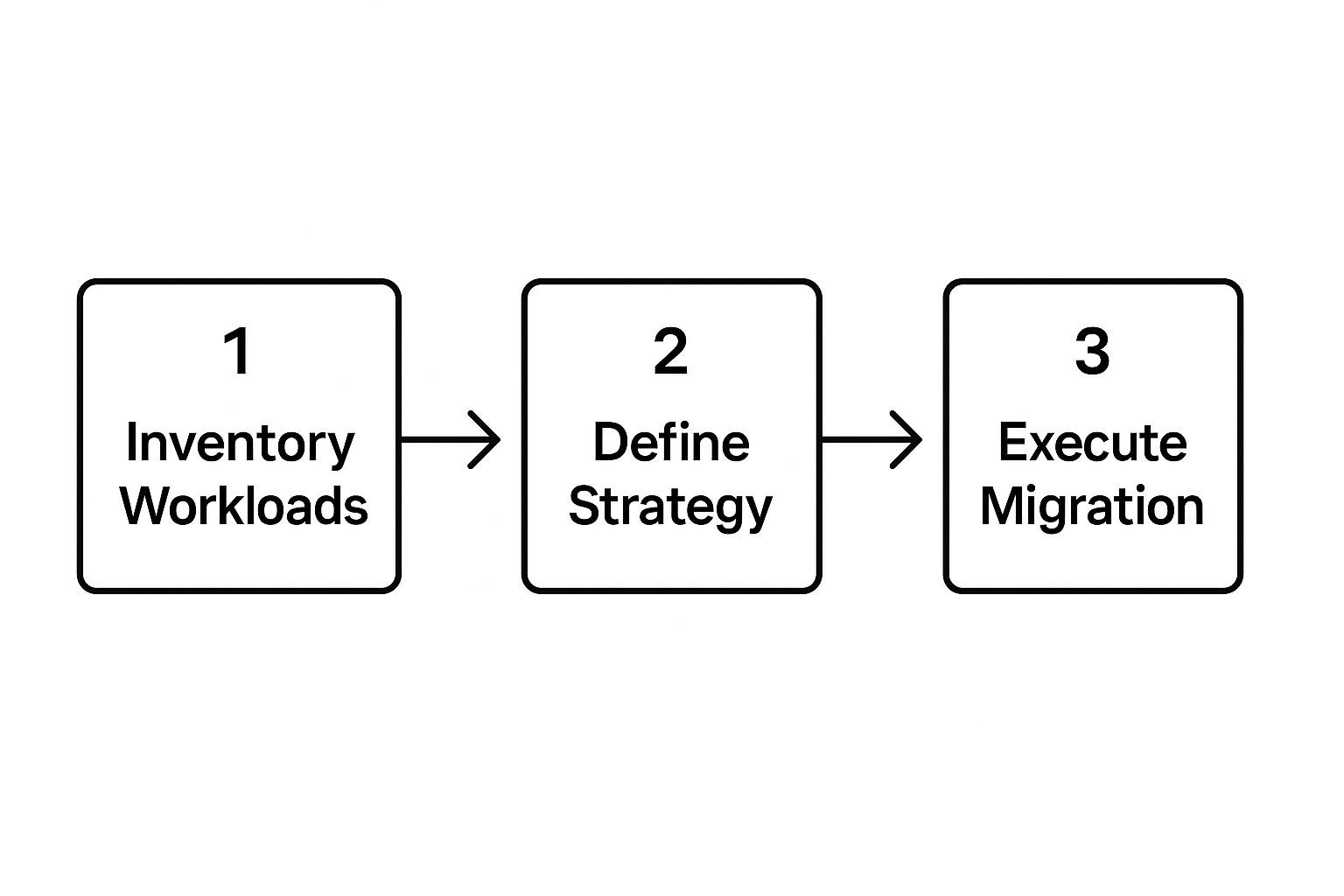
As you can see, the journey is broken down into three manageable phases. It shows that a successful migration is a structured, step-by-step process, not an overwhelming technical beast.
Why This Matters for SMBs
This structured approach is becoming the standard for a reason. By 2025, an estimated 94% of organizations will be using cloud services, and a whopping 89% of migration projects report a positive ROI. On top of that, this move can cut IT service management costs by 20-30% compared to sticking with traditional on-premise setups. You can explore more cloud migration statistics to see just how big this shift is.
For your business, the benefits are more direct than just saving a few dollars. Here’s what’s really in it for you:
- A Single Source of Truth: No more arguing over which spreadsheet has the "right" numbers. Everyone from finance to sales to ops works from the same, verified data.
- Automated Reporting: Imagine getting back dozens of hours every month. By ditching manual data pulls and report building, your KPI dashboards can update themselves automatically.
- Deeper Insights: Finally, you can connect the dots. See how sales activities impact cash flow or how marketing campaigns affect operational load, all in one place.
To make this crystal clear, here’s a breakdown of what each technical phase of a migration actually means for your business outcomes.
| Cloud Migration Phases and Their Business Impact |
| :— | :— | :— |
| Migration Phase | What It Means (In Plain English) | Why It Matters for Your Business |
| 1. Assessment & Planning | Figuring out what data you have, where it lives, and what business questions you need to answer. | You get a clear, realistic plan that aligns with your specific business goals, not just a tech project. |
| 2. Data Migration & Consolidation | Moving your data from scattered sources (Excel, QuickBooks, CRM, etc.) into a central cloud data warehouse. | This creates your "single source of truth." All your important data is finally in one secure, accessible place. |
| 3. Validation & Optimization | Testing everything to ensure the data is 100% accurate and the new system is running smoothly. | This step ensures your reports are reliable and your team can trust the numbers to make smart decisions. |
This table shows that a migration isn't just about moving files. Each step is directly tied to improving how you run your company, make decisions, and drive growth.
A well-executed cloud migration isn't about moving data for technology's sake. It's about empowering your team with the clarity and confidence to make smarter, faster decisions that fuel growth.
Ready to build a plan that connects your data and automates your reporting? Book your free BI consultation with a Vizule expert to map out your journey from spreadsheets to strategic insights.
Defining Your Data and Business Goals

Before you touch a single spreadsheet, let's get one thing straight: a successful cloud migration plan is built on business strategy, not just technology. This is where most DIY projects go wrong. We need to connect the dots between your biggest operational headaches and the real-world results you're chasing. The goal isn't to boil the ocean; it's to find the quickest path to a tangible win.
Forget the technical jargon for a moment. Instead, start by asking simple, powerful questions. What are the 3-5 metrics that actually move the needle for your business? Which manual reports are stealing hours from your team every single week?
This initial focus is everything. A tight, well-defined scope prevents the project from ballooning into a sprawling, expensive mess. It turns your migration into a targeted strike that delivers immediate value.
Start With High-Impact Questions
Let's make this real. Imagine you’re a SaaS founder. Your world probably revolves around Monthly Recurring Revenue (MRR), customer churn, and Customer Acquisition Cost (CAC). Your very first migration project should be laser-focused on getting the data for only those metrics into one place. That's it.
Or, maybe you run an e-commerce business. Your constant headache is trying to match real-time sales from your website with what's actually in the warehouse. A focused migration could pull data from Shopify and your inventory system into a single dashboard, finally giving you a clear, trustworthy picture of stock and demand.
The secret to a successful migration is starting small. I've seen it time and time again with our clients. Focus on one high-impact business problem, solve it completely, and use that success to build momentum. This approach proves the value of a modern data stack without a massive upfront risk.
A clear direction is non-negotiable. For a deeper look at this, our guide on building a successful data analytics strategy provides a solid framework for tying your data work directly to your core business objectives.
Build Your Foundational Checklist
To nail down this focused scope, get your key people in a room—from finance, sales, and operations—and hash out these questions. This exercise will become the rock-solid foundation for your entire cloud migration plan.
- What are our most soul-crushing manual reports? Identify the reports that are both critical and a massive time-sink. Automating these first gives your team back their time, an instant win.
- Which decisions feel like we're just guessing? Pinpoint the areas where a lack of timely data is creating risk or causing you to miss opportunities, like cash flow reporting.
- What data do we need to actually trust our financial forecasts? This helps define the exact financial data you need to migrate to build reliable forecasting models in Power BI.
- If we could only have one dashboard, what would it show? This classic question forces ruthless prioritisation and helps everyone visualise the finish line.
Answering these questions brings immediate clarity. You’ll walk away with a focused list of data sources and a clear vision for the first Power BI dashboard you want to build—the perfect, tangible starting point for your migration journey.
Choosing the Right Tools for Your SMB

The world of cloud technology can feel ridiculously crowded. For most small and medium-sized business owners, looking at all the options often leads to analysis paralysis. It's overwhelming.
But here’s the good news: for the specific goal of ditching Excel chaos and automating your analytics, the choice is far simpler than it looks. A solid cloud migration plan isn't about chasing the trendiest new tool; it's about picking the right tools for the job.
Let's cut through the noise. You only need to understand three core components that will work together to create your new analytics engine. Think of it as building a well-oiled machine for generating insights.
Your Modern Data Stack Explained
Your new setup is built on three key layers, each with a specific role. When these pieces click together, they create a powerful system for turning raw numbers into real business intelligence.
-
Cloud Platform (The Foundation): This is the basic infrastructure where everything else is built and runs. For most SMBs, Microsoft Azure is a fantastic choice. It’s built to scale, it's secure, and it plays nicely with the software your team is probably already using.
-
Data Warehouse (The Organised Stockroom): This is where all your data gets cleaned up, structured, and stored, ready for analysis. It's the central hub that replaces your messy spreadsheets. An Azure SQL Database is a cost-effective and powerful option that sits right inside the Azure ecosystem.
-
Business Intelligence Tool (The Interactive Storefront): This is where the magic happens. This tool connects to your data warehouse and turns all those boring numbers into beautiful, interactive dashboards. Power BI is the clear winner here, letting you visually explore your data, drill down into details, and share insights with your team.
This trio—Azure, Azure SQL, and Power BI—is often called the “Microsoft Modern Data Stack.” It’s a proven, end-to-end solution that gives you everything you need without bogging you down with unnecessary complexity or cost.
I often tell clients to picture it this way: Azure is the land you build on, Azure SQL is the clean, secure warehouse you construct, and Power BI is the dynamic, interactive showroom where you display your most valuable products—your business insights.
There's a reason the market for these services is exploding. Projections show the global cloud migration market rocketing from $232.5 billion in 2024 to over $806.4 billion by 2029. A big driver is that SMBs are expected to dedicate over 50% of their tech budgets to cloud services by 2025. They're moving away from old-school systems that can't handle modern demands like AI and advanced analytics. You can discover more about the coming inflection point for cloud migration and understand why so many businesses are finally making the move.
Ultimately, choosing an integrated stack like this simplifies your cloud migration plan immensely. It guarantees that all the parts are designed to work together from the start, cutting down on integration headaches and letting you focus on what really matters—using your data to make smarter moves.
Want to see how this powerful stack can be tailored to your specific business needs? Book your free BI consultation and we’ll show you how to design your ideal reporting system.
Executing The Migration and Validating Your Data
This is where the rubber meets the road. All that meticulous planning now comes to life. The execution phase isn't a massive, dramatic overhaul. It’s a methodical, step-by-step process of moving your data from its old, siloed homes—think spreadsheets, accounting software, and CRMs—into your new cloud data warehouse.
The secret to a low-stress execution is a phased approach. Fight the temptation to move everything at once. A "big bang" migration is a recipe for risk, disruption, and headaches for an SMB. Instead, we always start small with a single, high-impact dataset identified back in the planning stage.
The Pilot and Phased Rollout
Let's imagine your biggest bottleneck is weekly sales reporting. That becomes our pilot. We'll focus exclusively on connecting to your CRM and payment processor, pulling that specific sales data into your new Azure SQL warehouse, and building the first Power BI report.
This initial pilot is invaluable for a few reasons:
- It’s a real-world test of the entire data pipeline, from extraction to the final dashboard.
- It uncovers unexpected quirks in a controlled way. You might find a data field in your CRM doesn't match your accounting software's format—it's far better to find that now.
- It delivers a quick win. Getting that first report automated provides immediate value, building confidence and momentum for the rest of the project.
Once the sales data is flowing perfectly, we tackle the next piece of the puzzle, like pulling financial data from QuickBooks. You simply repeat the process, adding one data source at a time until your single source of truth is complete.
Building Trust Through Data Validation
This is the most critical part of the entire project. How can you be 100% certain that the numbers in your new Power BI dashboard are correct? If your team doesn't trust the data, the whole initiative is dead in the water.
Confidence is built, not assumed. The only way to trust your new reports is to prove they are right, side-by-side with the old ones. This parallel validation step is non-negotiable for a successful migration.
The most effective way to build that trust is to run your old and new reporting systems in parallel. We typically do this for a few weeks or even a full month. This means you keep pulling your old manual Excel report while, at the same time, you're reviewing the new, automated Power BI dashboard.
Then, you compare them. Line by line. Do the total revenue figures match to the penny? Are the customer counts identical? When you find a discrepancy—and you probably will—it’s not a failure; it’s a success. It means you’ve caught a logic error or a data mapping issue that can be quickly fixed.
This careful, iterative process ensures that by the time you're ready to switch off the old system, everyone from the founder to the finance team has complete faith in the new numbers.
Ready to see how a phased, validated migration can transform your reporting without disrupting your business? See how Vizule can help automate your reporting stack and build the trust you need to make confident, data-led decisions.
Turning Data Into Decisions with Power BI
You’ve done the heavy lifting. Your data is now clean, centralized, and validated in the cloud. But let's be honest, the meticulous cloud migration plan was never just about moving files around. It was about laying the foundation for something much bigger: making smarter, faster decisions. This is where your business truly starts to feel the payoff.

With this new, unified data layer, you can plug in a tool like Power BI and build powerful, interactive dashboards that answer your most pressing business questions automatically. This marks the end of tedious, manual report building. It’s the beginning of having a live, trustworthy view of your company's health, accessible to anyone, anytime.
From Static Reports to Interactive Insights
The change is like night and day. Forget those static PDF reports that are already outdated the moment you hit "send." Now, you have a dynamic dashboard. You can click on a high-level KPI like "Total Revenue" and instantly drill down to see performance by product line, region, or even a single transaction.
This capability fundamentally changes how your teams operate. It aligns everyone—from finance to sales to operations—around a single source of truth. The weekly meeting arguments over whose spreadsheet is correct? They simply vanish.
For the first time, you're not just looking at what happened last month. You're exploring your data in real-time, asking 'what if' questions, and spotting trends as they emerge, not weeks later. This is how you shift from reactive problem-solving to proactive strategy.
The Business Outcomes of a Modern Data Stack
The benefits here go far beyond just having prettier charts. When you build a Power BI setup on a solid cloud foundation, it delivers tangible business results that founders and operators care about. There's a reason 83% of mid-sized businesses have moved over half their workloads to the cloud, and 54% of SMBs now spend over $1.2 million annually on cloud services. The investment is significant because the returns are real.
Here are the kinds of outcomes we consistently help our clients achieve:
- Reclaim Dozens of Hours: We regularly see teams save 20-40 hours per month by completely automating their financial and operational reporting.
- Make Decisions with Confidence: Spot a dip in sales? You can immediately identify the root cause without waiting days for an analyst to dig through endless spreadsheets.
- Improve Forecast Accuracy: Connect your sales pipeline data directly to your financial model for a more reliable, driver-based forecasting model you can actually trust.
This isn't just an upgrade; it's about empowering your team to lead with data. To learn more, check out our guide on how to drive growth with effective data analysis for your business.
Common Cloud Migration Questions Answered
Even with a solid plan, it's normal for founders and operators to have questions. A cloud migration plan is a major business decision, and it's smart to look at it from every angle. I'll walk you through some of the most common questions we hear from SMBs to help you move forward with confidence.
Is Cloud Migration Secure for My Sensitive Financial Data?
This is usually the first question, and for good reason. The short answer is a resounding yes—when handled correctly.
Cloud giants like Microsoft Azure pour billions into security, building an infrastructure that’s far more robust than what most individual businesses could ever manage. Their physical and network security measures are top-tier.
But security is a shared responsibility. The provider secures the cloud, but a partner like Vizule ensures your application within that cloud is buttoned up tight. This means we implement:
- Strict access controls so team members only see the data relevant to their roles. No more, no less.
- End-to-end encryption for your data, both when it's moving over the network (in transit) and when it's sitting in the data warehouse (at rest).
- A 'least privilege' model. This is a critical concept that minimises risk by giving users the absolute minimum level of access they need to do their jobs. It's the best way to protect your most sensitive financial data.
When security issues arise, it’s almost always due to human error and misconfigurations, not a fundamental flaw in the cloud platform itself. A well-designed migration plan is your best defense.
How Much Does a Cloud Migration for Analytics Actually Cost?
The price tag is often more manageable than SMB owners expect, and it's definitely not one-size-fits-all. The cost breaks down into two parts: the one-time migration project and the ongoing monthly cloud service fees.
The initial project cost depends on the complexity. A focused project to automate your core financial reporting from QuickBooks will be much more affordable than a massive migration involving multiple legacy systems.
The real game-changer for SMBs is the pay-as-you-go model for ongoing fees. You only pay for the data storage and processing power you use. This flexibility lets you start small and scale your investment as your business grows, completely sidestepping the huge upfront capital expense of buying traditional hardware.
How Long Will This Disrupt My Business Operations?
A properly designed cloud migration shouldn't cause any disruption. Zero. The goal is never to "rip and replace" everything overnight—that's a recipe for chaos.
Instead, we use a phased approach. The new cloud-based reporting system is built and tested in parallel with your existing, familiar processes.
We never turn off the old system until the new one is proven to be 100% accurate and your team is fully confident using it. This parallel run ensures total business continuity and de-risks the entire project.
For a while, your team just keeps doing their day-to-day work with the reports they know. Behind the scenes, we're perfecting the new Power BI dashboards. The final 'cutover' is a smooth, planned event, not a panicked scramble. This entire methodology is rooted in core business intelligence best practices that always put accuracy and user trust first.
Feeling more confident about making the move to the cloud? The team at Vizule can help you map out a secure, cost-effective, and non-disruptive migration plan tailored to your business.


