


Ever wonder why your insurance reports are stale the moment they land on your desk? Manual spreadsheets, siloed systems, and endless copy-pasting leave you making decisions on yesterday’s data. Data analytics for insurance uses modern business intelligence (BI) tools like Power BI to unify data sources into a single dashboard, automate reporting, and deliver real-time insights into claims, underwriting, and customer trends. For small-to-medium insurance businesses, this shift replaces spreadsheet chaos with clear, consistent metrics—so you can act fast, reduce risk, and drive growth through insight-led decision-making.
Moving Beyond Spreadsheets With Insurance Data Analytics

If you're an insurance operator, founder, or manager in a small-to-medium business, you know the daily grind of spreadsheet chaos all too well. Your critical data is scattered—claims systems, underwriting logs, CRM platforms, accounting tools—all stuck in silos. Every report becomes a manual task: export, copy-paste, reconcile—and by the time it’s done, it’s already outdated.
This old-school approach isn't just a time sink; it's a roadblock to growth. When decisions rely on stale numbers, you miss trends, misprice policies, and lose competitive edge. Modern BI automation and data transformation bridge those gaps, so you stop firefighting and start planning with confidence.
From Manual Reporting to Automated Insight
Think of data analytics as the bridge from spreadsheet chaos to a reliable single source of truth. Instead of wrestling with Excel, you leverage a BI platform to automate everything—from data extraction in your cloud data warehouse to KPI dashboards that update in real time.
This shift empowers you to:
- Get a Unified View: Connect all your data—CRM, claims, policy administration, accounting—into one interactive dashboard.
- Automate Tedious Tasks: Eliminate manual exports and copy-pasting, freeing your team for high-value analysis.
- Access Real-Time Data: Swap static month-end reports for dynamic views that reflect the current state of your business.
- Make Confident Decisions: Align finance, operations, and sales around consistent metrics for pricing, claims, and customer retention.
Data analytics for insurance is no longer a luxury for big carriers. It’s an accessible lever for SMBs that turns data into proactive growth strategies.
To really grasp the difference, let’s compare the old way to the new one.
The Shift from Manual Reporting to Automated Analytics
| Challenge Area | Traditional Method (Excel & Manual) | Modern Approach (Data Analytics & Power BI) |
|---|---|---|
| Data Silos | Data scattered across CRM, claims, finance—manual consolidation required. | All sources connected via automated pipelines, creating a unified view in a data warehouse. |
| Reporting Speed | Reports take days or weeks and are outdated on delivery. | Real-time dashboards provide instant access to current metrics. |
| Accuracy | Prone to copy-paste errors and version control issues. | Automation and data quality checks ensure reliable, consistent numbers. |
| Decision-Making | Based on gut feel and old data, leading to missed opportunities. | Data-driven decisions backed by live performance indicators. |
| Team Focus | Staff tied up in low-value data entry tasks. | Team freed to focus on strategy, client service, and growth initiatives. |
The Growing Importance of Analytics
The shift to data-driven operations isn’t just a trend; it’s reshaping the industry. The global insurance analytics market, recently valued at USD 13.84 billion, is projected to soar to USD 31.33 billion by 2030 (Straits Research). That surge highlights the critical value of analytics for efficiency, risk management, and growth. For SMBs, getting onboard now means building a competitive edge for tomorrow.
Curious how these universal principles play out across small businesses? Check out our guide on data analytics for small business.
Book your free BI consultation and see how Vizule can help automate your reporting and build your single source of truth.
Unlocking Insights Across Your Core Insurance Operations

Data analytics isn't just crunching numbers—it’s telling the story of your business so you can act on it. For small and mid-sized insurers, that story unfolds across three critical acts: risk assessment, claims processing, and customer engagement.
Imagine your raw data as puzzle pieces—claims logs, policy details, customer interactions. Alone they’re snapshots; together they reveal the full picture. A robust BI system connects those pieces, moving you from reactive troubleshooting to proactive management.
Sharpening Your Risk Assessment
Traditional risk models rely on static tables and broad averages. Modern data analytics for insurance replaces guesswork with dynamic forecasting models that evolve as new data flows in.
With living risk models, you can:
- Pinpoint Profitable Niches: Identify customer segments or regions with lower loss ratios and tailor your marketing there.
- Spot Emerging Risks: Real-time trend monitoring flags spikes—like post-storm claims—before quarterly reviews catch them.
- Price with Precision: Match premiums to individual risk profiles, staying competitive while protecting your margins.
Streamlining Claims Processing
Claims are the engine and expense center of any insurance business. Analytics acts like a detective—uncovering patterns invisible to the naked eye.
By analyzing historical and live claims data:
- You automate fraud detection, fast-track simple claims, and reserve deep-dive reviews for outliers.
- You shorten processing times, cut administrative costs, and boost customer satisfaction.
- You apply BI automation to standardize decision rules and accelerate throughput without sacrificing control.
Deepening Customer Understanding
Your customer data is a goldmine. Analytics turns it into a 360-degree view, combining policy, claims, and CRM logs to predict behavior and personalize outreach.
A unified customer profile is the cornerstone of effective retention and upsell strategies. With it, you can forecast churn, deliver timely renewals, and offer tailored coverage.
This is the essence of data-driven decision making—using insight, not intuition, to guide every interaction.
See how Vizule can help automate your reporting stack and turn your risk, claims, and customer data into your most powerful asset.
Visualizing Success with Insurance Dashboards
Data analytics can feel abstract—so let’s make it tangible. Picture logging in each morning to a live dashboard that shows your entire insurance business at a glance. No more juggling spreadsheets or waiting for month-end reports.
This command centre, often built in platforms like Power BI, is more than pretty charts. It’s an interactive tool that lets you drill into KPI dashboards—claims cycle time, underwriting profitability, customer lifetime value—to answer urgent questions on the fly.
From Raw Data to Actionable Intelligence
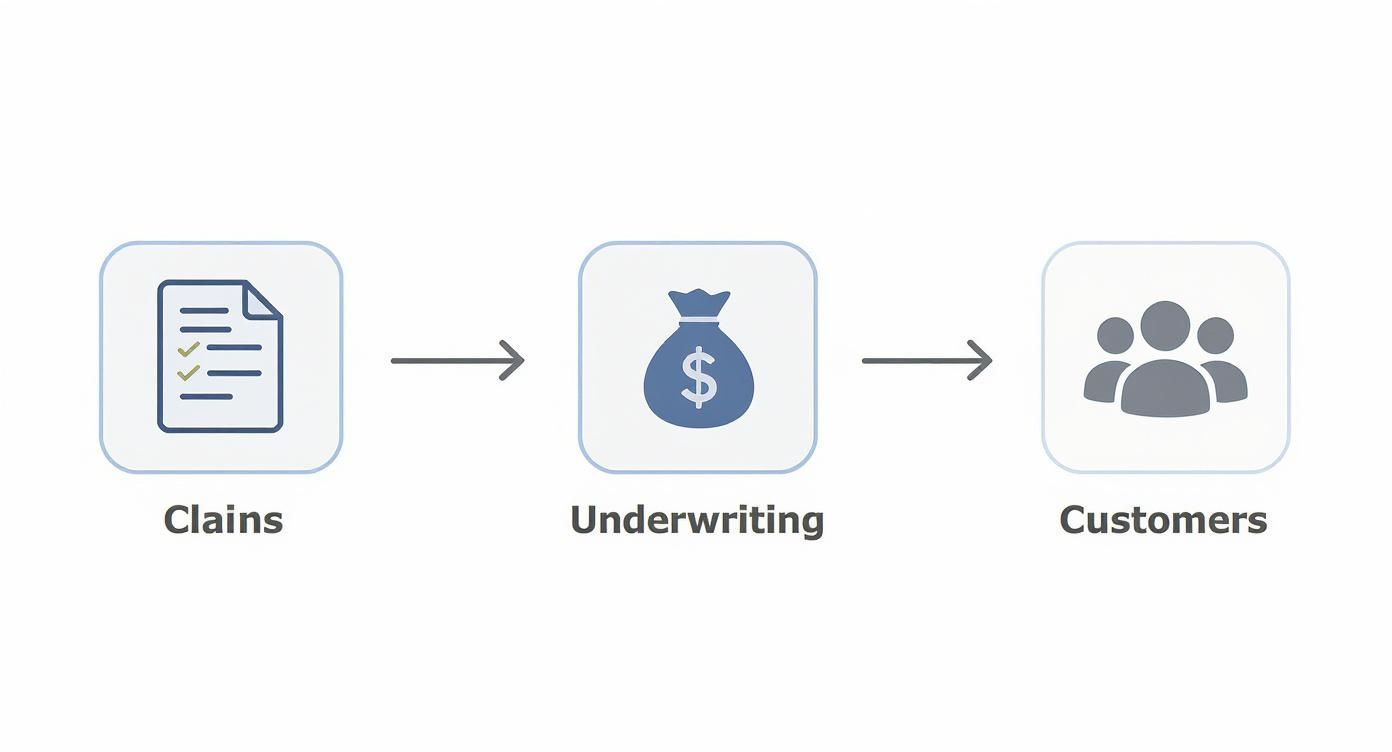
A great dashboard weaves your core operations—claims, underwriting, customer—into a single narrative. It takes messy information and refines it into clear, actionable intelligence.
At a glance, you see performance against targets, emerging trends, and potential risks—then click to drill down into the underlying data. That’s true business intelligence, not just reporting.
Key Dashboards for Insurance SMBs
Effective dashboards mirror your strategy, focusing on the metrics that drive growth and profitability:
- Claims Performance Dashboard: Tracks average claim processing time, cost per claim, settlement accuracy—and highlights workflow bottlenecks.
- Underwriting Profitability Dashboard: Visualizes loss ratios by policy type, premium growth, combined ratios—to reveal your most and least profitable lines.
- Customer Lifetime Value (CLV) Dashboard: Monitors retention rates, acquisition costs, upsell opportunities—to pinpoint your most loyal and lucrative segments.
Interactivity is the magic: filter by date, policy type, or region; click a spike in claims to uncover root causes; isolate a drop in retention to take immediate action.
Data visualization and dashboards don’t just show you numbers; they push you to act.
Book your free BI consultation to see what a custom Power BI dashboard could look like for your business.
Your Roadmap to Implementing Data Analytics
Seeing the potential is one thing—knowing where to start is another. A successful analytics rollout is a series of logical, manageable steps, not a single giant leap. Here’s the roadmap we follow with our clients:
Phase 1: Discovery and Goal Setting
First, define the business problems you need to solve. Is underwriting profitability off target? Are claims backlogs growing? Are retention rates slipping? Clear goals give your analytics strategy purpose from day one.
Phase 2: Data Consolidation
Map and connect your existing systems:
- Claims Management System for history and cycle times
- CRM for policyholder interactions
- Accounting Software (Xero, QuickBooks) for financials and loss ratios
- Policy Administration for coverage details and premiums
We integrate these sources into a central data warehouse, eliminating manual exports and ensuring automatic, secure data flows.
Phase 3: Business Intelligence Tool Setup
For SMBs, Power BI is often the perfect fit—cost-effective, scalable, and seamlessly integrates Excel to Power BI pipelines, cloud data warehouses, forecasting models, and cash flow reporting. We build a robust data model that links all your data points, powering your BI automation and KPI dashboards.
A solid data model is the engine behind dashboards that move you from raw numbers to actionable insights.
Phase 4: Custom Dashboard Development
With strategy and data in place, we craft interactive dashboards tailored to your KPIs—loss ratios, claim cycle times, customer lifetime value, and more. Every element answers the specific business questions you identified in Phase 1.
Phase 5: Team Training and Adoption
Dashboards only deliver value when your team uses them. We provide hands-on training so everyone—from underwriters to finance—can explore data, drill down into details, and apply insights to daily decisions. This cultural shift to data-driven decision-making drives continuous improvement.
Read more about global trends in the insurance analytics market to see where the industry is heading.
Book your free BI consultation to start your journey from data chaos to clarity.
Tackling the Common Data Roadblocks for SMBs
Jumping into analytics can feel daunting, but common hurdles—messy data, budget concerns, and skill gaps—are entirely manageable with the right approach.
The Messy Data Problem
Many SMBs begin with fragmented, inconsistent data. The cure is a structured process of data cleaning and transformation:
- Connect Your Sources: Pull data from silos into one central repository.
- Standardize Formats: Ensure dates, names, and policy IDs match across systems.
- Clean Up Errors: Fix duplicates, fill gaps, and validate records.
This groundwork creates the trusted foundation you need. Learn more about improving your data quality in our guide on how to improve data quality.
The Budget and ROI Question
Analytics isn’t just an expense—it’s an ROI-driven investment. Consider the wasted hours on manual reporting, the cost of unprofitable policies, and the risk of undetected fraud. A 10% reduction in claims processing time or an early fraud alert can pay for your entire analytics system many times over.
The In-House Skills Gap
You don’t need a full-time data scientist to succeed. Partnering with a specialist consultancy like Vizule lets you offload the heavy technical work—data architecture, pipeline setup, dashboard design—while you focus on running your business with newfound clarity.
Book your free BI consultation and let’s tackle these hurdles together.
Frequently Asked Questions About Insurance Analytics
How Long Does It Take to Set Up an Insurance Analytics System?
Surprisingly fast. A foundational Power BI reporting system, designed to answer your top business questions, can be live in just a few weeks. We focus on rapid, iterative value—solving urgent challenges first, then layering in advanced insights over time.
Is Power BI Affordable for a Small Insurance Business?
Absolutely. Power BI is one of the most cost-effective BI tools, especially for teams already in the Microsoft 365 ecosystem. Beyond license fees, the real ROI comes from:
- Saving Hours: Automate manual reporting tasks.
- Smarter Decisions: Discover insights—like unprofitable policy cells or process bottlenecks—that drive immediate savings.
Can We Do This Ourselves or Do We Need a Consultant?
A DIY build is possible but often stalls on technical roadblocks or delivers dashboards that don’t answer key questions. Partnering with Vizule speeds implementation, avoids pitfalls, and ensures your analytics engine scales with your business.
What Kind of Data Do We Need to Get Started?
You can begin with your existing systems:
- Claims Management
- Policy Administration
- CRM
- Accounting Software (QuickBooks, Xero)
You don’t need “perfect” data to start. Connecting these sources highlights quality issues, giving you a clear path to clean, reliable reporting.
Ready to stop guessing and start knowing? If you want to automate your reporting, trust your numbers, and finally unlock the insights hidden in your data, let’s talk. At Vizule, we connect the dots in your data to empower insight-led decision-making.
Book your free BI consultation and let’s build your single source of truth together.
