


So, what exactly are data governance responsibilities? Think of it as assigning clear ownership over your company's data. It’s about deciding who is accountable for data quality, who can access what, and who keeps it secure. This simple act of assigning ownership is what turns data from a confusing, often messy liability into a reliable asset that fuels smart decisions.
Why Data Governance Matters for Your Bottom Line

Are you staring at conflicting sales reports again? If you're running a small-to-medium business, you know this headache all too well. One report says one thing, another spreadsheet shows something completely different, and you're left making calls based on gut feelings instead of hard facts. This is the exact chaos that a lack of clear data governance creates.
For many SMB founders, "data governance" can sound like a stuffy corporate buzzword meant for giant enterprises. But it's really just a practical fix for a very common problem. Picture it like building a dependable supply chain, but for your information. When everyone on the team understands their specific data governance responsibilities, the whole operation just runs smoother.
From Chaos to Competitive Advantage
The first step toward trusting your numbers is simply defining who is responsible for what. When your team knows precisely who owns sales data, who validates financial metrics from your accounting software, and who manages the systems, all the guesswork that leads to frustrating errors disappears.
This clarity lays the groundwork for creating a single source of truth—a central, trusted data hub that powers your entire business. And this isn't just about tidying up spreadsheets. It's about unlocking powerful tools like automated Power BI dashboards and building an accurate financial forecasting model you can actually rely on.
With a solid governance framework in place, you can:
- Kill conflicting reports by making sure everyone uses the same approved data sources and definitions.
- Automate manual reporting, freeing up your team from hours of tedious Excel copy-pasting so they can focus on real analysis.
- Make faster, smarter decisions backed by data you know is accurate.
- Scale your operations with confidence, knowing your data infrastructure can handle the growth.
The real goal here is to shift from being reactive—always fixing data errors and second-guessing reports—to being proactive, where data becomes one of your most valuable strategic assets.
The Growing Need for Clear Responsibilities
Making this shift isn't just a "nice-to-have" anymore; it's quickly becoming a business necessity. The global data governance market was valued at around USD 3.97 billion in 2024 and is expected to explode to USD 15.86 billion by 2032. This massive growth is all driven by the increasing demand for reliable data and the need to meet regulatory requirements. You can learn more about these drivers from in-depth analyses of data governance market growth.
For ambitious SMBs, setting up data governance responsibilities isn't about adding red tape. It’s a strategic play to build a rock-solid foundation for scalable growth. It ensures that as your business gets bigger, your data remains a powerful competitive edge, not a bottleneck holding you back.
Defining the Core Data Governance Roles in Your Business

Putting data governance into practice can feel like a huge undertaking, but it doesn't mean you need to go on a hiring spree. The secret for most SMBs is assigning clear data governance responsibilities to people already on your team.
This isn't about creating new departments; it's about formalizing the roles your team members are likely already playing informally. By assigning ownership, you create accountability—the first step to eliminating the confusion that leads to inconsistent reporting and bad data.
Let's break down the three core roles you can establish in your business today.
The Data Owner: The Team Captain
Think of a Data Owner as the team captain for a specific type of data. This person is typically a senior leader—like your Head of Sales, Finance Director, or Operations Manager—who is ultimately accountable for the quality and security of the data within their department.
They don't get tangled up in the day-to-day data entry or cleanup. Instead, their high-level responsibilities include:
- Setting the rules: They define who can access their department's data (e.g., sales pipeline data) and what it can be used for.
- Approving definitions: They sign off on the official definitions for key metrics, like what constitutes a "Qualified Lead" or "Customer Churn."
- Final accountability: When a major data quality issue pops up in their domain, the buck stops with them. They are responsible for making sure it gets resolved.
Essentially, the Data Owner is accountable for the big-picture strategy and value of a specific data set, ensuring it serves the business's goals.
The Data Steward: The On-the-Ground Expert
If the Data Owner is the captain, the Data Steward is the expert player on the field. This is someone who works with the data every single day and understands its nuances inside and out. It could be a senior sales analyst, a finance manager, or anyone who is a subject-matter expert for a particular data set.
Data Stewards are the hands-on champions of data quality. Their key responsibilities involve:
- Daily management: They are responsible for the day-to-day data quality, accuracy, and completeness.
- Defining the data: They draft the business definitions and rules for data in their area for the Data Owner to approve.
- Issue resolution: When someone spots an error in the CRM or a financial report, the Data Steward is the first person to call to investigate and fix the root cause.
Your Data Stewards are critical. They bridge the gap between high-level business rules and the practical, daily realities of managing data.
The Data Custodian: The Tech Guardian
Finally, every team needs a guardian for the systems where the data lives. The Data Custodian is the person responsible for the technical environment that stores and moves the data. This is often someone in your IT department, an operations manager, or whoever manages your tech stack.
Their role is not to understand what the data means, but to ensure it is secure, accessible, and properly stored.
A simple way to think about it: The Data Owner is accountable for the content, while the Data Custodian is accountable for the container.
This role handles the technical side of things, like managing user permissions in your CRM, ensuring your accounting software is backed up, and implementing security measures to protect sensitive information.
This structured approach is gaining traction for a reason. As of 2024, 71% of organizations now have formal data governance programs, a significant jump from 60% in 2023. Companies are seeing real benefits: 58% report improved data analytics quality, and 57% see better collaboration between teams.
To really nail down these roles, it helps to understand the broader concepts of organizational roles and responsibilities. By assigning these three simple roles, you can bring immediate order to your data chaos without needing a massive budget or a dedicated data team.
Key Data Governance Roles and Responsibilities for SMBs
To make this even clearer, here’s a simple breakdown of how these roles often look inside a small or medium-sized business. Remember, one person might wear multiple hats, especially in a smaller company.
| Role | Core Responsibility | Example in an SMB |
|---|---|---|
| Data Owner | High-level accountability for a specific data domain (e.g., sales, finance). | The Head of Sales is the Data Owner for all CRM and pipeline data. |
| Data Steward | Day-to-day management of data quality, definitions, and issue resolution. | A senior Sales Operations Analyst who manages the CRM data daily. |
| Data Custodian | Technical management of the systems where data is stored and secured. | The IT Manager or an Operations lead who manages the company's software stack. |
Assigning these roles clarifies who does what, which is the first—and most important—step toward building a data-driven culture that you can actually trust.
Building Your First Data Governance Framework

Alright, you've got your data roles sorted. Now, let's put them into action. Building a data governance framework sounds intimidating, but it doesn't have to involve expensive software or endless meetings. For a small or mid-sized business, the name of the game is progress, not perfection.
A simple, practical framework can genuinely solve 80% of your data headaches. Think of it as creating a basic rulebook for your company's data—a lean approach that gets you quick wins and builds a foundation you can scale later. We're going to start small, target the biggest pain points first, and bring clarity to the chaos.
Identify Your Critical Data Assets
First things first: you can't govern what you don't know matters. Your entire business doesn't hinge on hundreds of metrics. It runs on a handful of critical numbers that tell you if you're winning or losing. This is where we start.
For most businesses, this list will probably include 5-10 key performance indicators (KPIs). Don't overthink it. Just focus on the numbers your leadership team actually uses to make big decisions.
Here are a few common examples for SMBs:
- Monthly Recurring Revenue (MRR) for any subscription business.
- Customer Acquisition Cost (CAC) to see how efficient your marketing spend is.
- Customer Lifetime Value (LTV) to figure out what a customer is really worth over time.
- Sales Conversion Rate to track how well your sales team is closing deals.
- Cash Flow to keep a finger on the financial pulse of the business.
Just listing these out is a surprisingly powerful step. It forces you to get crystal clear on what drives growth and gets everyone rowing in the same direction. This kind of focus is the bedrock of any successful data analytics strategy that actually ties data to business results.
Create a Simple Data Dictionary
Ever been in a meeting where two people pull up reports with different numbers for the exact same metric? It's one of the most common—and infuriating—data problems out there. A simple data dictionary puts an end to it, instantly.
Forget the idea of some complex technical document. At its core, a data dictionary is just a shared spreadsheet that defines your critical metrics. It becomes the single source of truth that stops all the debates about whose numbers are "right."
For each of your critical data assets, your dictionary just needs to answer three simple questions:
- What does this metric mean? (Define it in plain English, no jargon.)
- How is it calculated? (Lay out the exact formula.)
- Where does the data come from? (Name the official system, like your CRM or accounting software.)
This simple tool ensures everyone is speaking the same language. When a new hire needs to build a report, they don't have to guess or track someone down for answers; they have a definitive guide. It's a foundational move in establishing clear data governance responsibilities.
Establish Basic Data Quality Rules
With your key metrics defined and a dictionary in place, the final step is to set a few simple rules to keep your data clean from the start. Data quality issues usually begin as small things: a missing email in the CRM, an incorrectly formatted date, or a sales deal marked "won" without a dollar value attached.
Your goal is to stop these small errors from piling up into a giant mess. Start with easy, high-impact rules that your Data Stewards can oversee.
For instance, you could establish rules like:
- Every new customer record in the CRM must include a valid email address and phone number.
- All sales deals must have an estimated close date and deal value entered.
- Financial transactions must be categorized within 48 hours of being posted.
See? These aren't complicated technical problems; they're process standards. By documenting and enforcing a few simple rules, you radically improve the quality of your raw data. That means your automated reporting in tools like Power BI becomes far more reliable and insightful. This is how you turn your data from a chaotic liability into a trustworthy asset.
Using a RACI Chart to Assign Responsibilities
So, you've defined the core data governance roles. Great. But how do you make them work day-to-day? It’s one thing to give someone the title of Data Owner; it’s another to know exactly who does what when a specific task lands on your desk.
Without clarity, you get chaos. Finger-pointing, missed deadlines, and that dreaded phrase: “I thought you were doing that.” This is where a simple but incredibly powerful tool called a RACI chart saves the day. It’s a straightforward matrix that maps out responsibilities for any given process, killing confusion before it starts.
Understanding the RACI Framework
The acronym RACI stands for the four key roles a person or team can have in any task. It’s a way to make sure that for every single data-related activity, there’s no question about who owns it, who does the work, and who just needs to be kept in the loop.
Let's break it down in plain English:
- Responsible (R): This is the "doer." The person or team physically carrying out the task. You'll always have at least one Responsible party.
- Accountable (A): This is the "owner." The single person who is ultimately answerable for the task being completed correctly. The buck stops here. Critically, there should only ever be one Accountable person.
- Consulted (C): These are the folks you need to talk to. They provide input, expertise, or feedback. It’s a two-way street—you ask for their opinion before making a move.
- Informed (I): These are the people who just need a heads-up. It's a one-way communication stream. They are kept up-to-date on progress or outcomes but don't have a say in the task itself.
Assigning these roles creates a clear roadmap for communication and action, which is the absolute foundation of successful data governance.
This is more than just theory. When roles are clear, the results are dramatic.
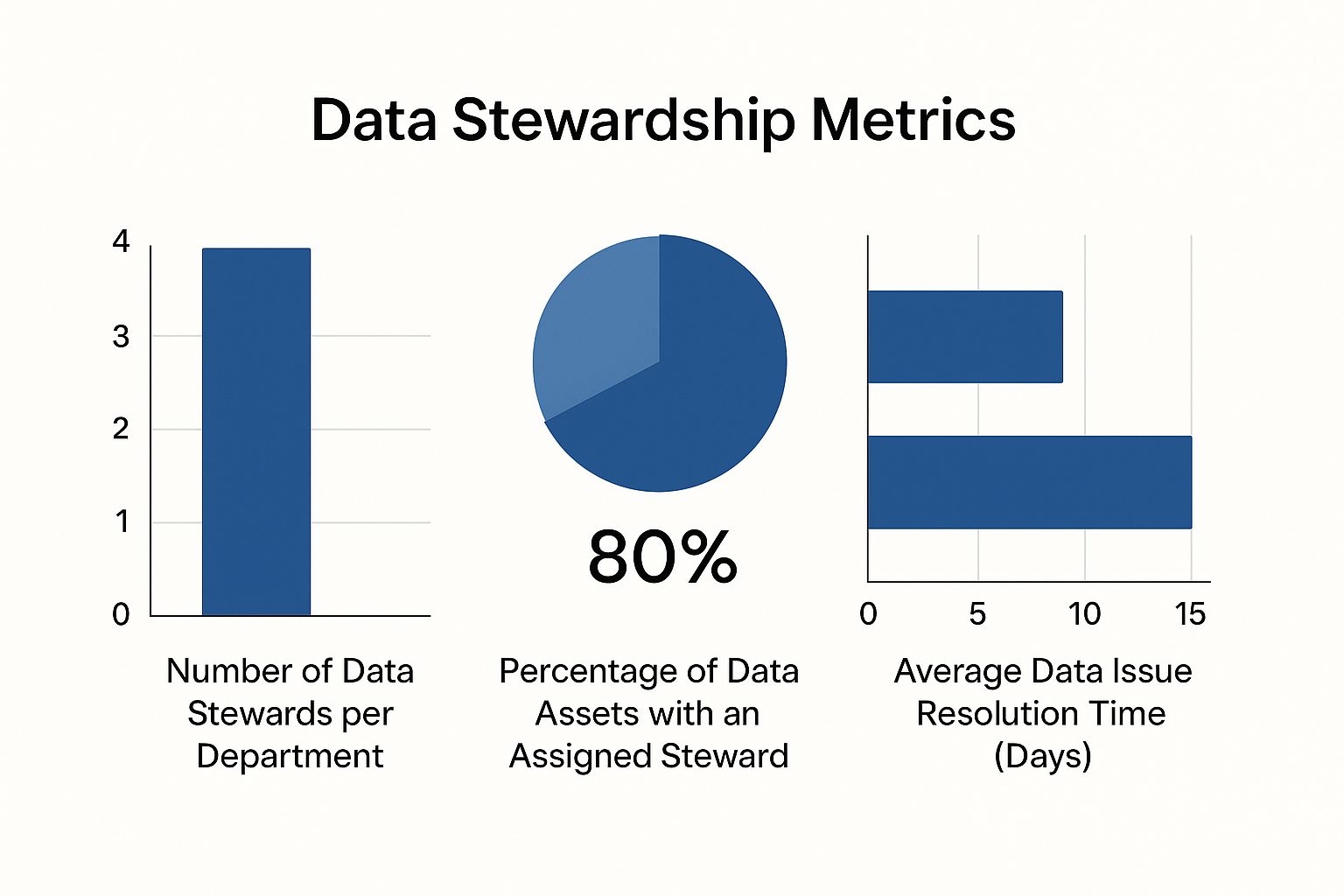
As you can see, organizations with clear ownership manage a far greater percentage of their data assets and slash the time it takes to fix problems. That’s the power of clarity in action.
A Practical Example for an SMB
Let's bring this to life with a real-world scenario. Imagine you're trying to improve the data quality in your sales pipeline—a process critical to forecasting and revenue. How would a RACI matrix work here?
Here’s a sample RACI chart that breaks down how different roles would handle the task of managing sales pipeline data. It provides a clear, at-a-glance view of who is responsible for what, ensuring nothing falls through the cracks.
| Task / Process | Data Owner (e.g., Head of Sales) | Data Steward (e.g., Sales Analyst) | Data Custodian (e.g., IT/Ops) | Data Consumer (e.g., Finance) |
|---|---|---|---|---|
| Defining Data Quality Standards | A – Accountable | C – Consulted | I – Informed | C – Consulted |
| Updating & Cleansing CRM Records | A – Accountable | R – Responsible | I – Informed | I – Informed |
| Implementing CRM Data Validation Rules | C – Consulted | R – Responsible | A – Accountable | I – Informed |
| Generating Weekly Sales Forecast Report | I – Informed | R – Responsible | I – Informed | A – Accountable |
See how clear that is? The Sales Analyst knows they're on the hook for cleaning data and running reports. The Head of Sales is ultimately accountable for quality but consults with others. IT owns the technical implementation, and Finance gets the final report without being bogged down in the daily details.
This simple chart brings immediate order to what could otherwise be a messy, confusing process. By using a RACI matrix, everyone knows their role, decisions get made faster, and accountability is baked directly into your workflow.
Ready to bring this level of clarity to your own business and finally trust your data? Book your free BI consultation with a Vizule expert today, and we'll help you design a practical data governance plan that gets results.
Navigating Common Data Governance Challenges

Rolling out a data governance framework is a massive win, but let's be real—it's rarely a straight shot to the finish line. Handing out data governance responsibilities is one thing; getting your team to buy in and navigate the hurdles that pop up is where the real work begins. As a founder or operator, you're going to hit these practical, human roadblocks long before you ever see a technical glitch.
The trick is knowing what's coming. At Vizule, we’ve seen these exact issues play out with countless clients. We help them see these challenges not as dead ends, but as chances to build a stronger, more resilient data culture.
Overcoming Team Resistance
One of the first walls you'll likely run into is pushback. When you introduce new roles and processes, the team's knee-jerk reaction is often, "Great, more work." A sales manager might see data quality checks as a distraction from closing deals, or a marketing analyst might fight new reporting standards.
The secret is to flip the script from responsibility to benefit. Don't just tell them what to do—show them why it makes their jobs less frustrating.
- Talk to the sales team about saving time. "Following this one simple rule for CRM entry will save you two hours of fixing reports at the end of every month."
- Connect with the finance team on accuracy. "By defining this metric now, we kill the risk of our numbers clashing during the quarterly board meeting."
- Show the operations team the path to efficiency. "This process guarantees we're all pulling from the same data source, so you'll never have to second-guess a report again."
When your team starts seeing data governance as a tool that solves their biggest headaches, that resistance melts away and turns into genuine adoption.
Breaking Down Stubborn Data Silos
Another classic growing pain is the data silo. This is what happens when departments act like their own little islands—Sales has its data in a CRM, Finance has its own in an accounting platform, and Operations is juggling a dozen different spreadsheets. None of it talks to each other, and nobody has the full picture.
Tearing down these walls doesn't have to mean a huge tech overhaul. It starts with a conversation.
A simple but powerful first step? Schedule a recurring, cross-functional data meeting. Get the Data Stewards from Sales, Finance, and Marketing in the same room once a month to look at key metrics together. This one move forces collaboration and a unified view of performance.
This approach builds bridges, transforming isolated datasets into a shared, strategic asset. For more ideas on creating a unified approach, check out our guide on data governance best practices.
Managing Messy Unstructured Data
Finally, there’s the beast of unstructured data. This is all the messy, hard-to-organize stuff that holds incredible value—think customer feedback from emails, notes from sales calls, or specific clauses buried in legal contracts. It’s not as clean as a number in a spreadsheet, which makes it a nightmare to govern.
And this problem is only getting bigger. By 2025, unstructured data is expected to make up over 90% of all business data, a huge hurdle for companies that aren't ready for it. As you can read in this analysis of data trends, ignoring it means leaving money and insights on the table.
You don't have to boil the ocean. Start small by creating simple tagging systems for call notes or a standard process for logging customer feedback. Even a little bit of organization can start to unlock its hidden value.
This is where it all comes together. We've walked through the nitty-gritty of assigning clear data governance responsibilities, laying the groundwork for reporting you can actually rely on and growth that doesn't break your processes. Now, let’s talk about the payoff.
Picture your next leadership meeting. No more dueling spreadsheets, no more arguments over whose numbers are right. Instead, everyone's looking at the same automated Power BI dashboards, all powered by a single source of truth that the entire team trusts without question. For a deeper dive into building that trust, this expert guide to knowledge management and artificial intelligence is a great resource.
This isn't some far-off corporate fantasy. It's the very real, very achievable next step for founders ready to move from putting out fires to strategically building the future. When you set up even a basic governance framework, you're doing more than just tidying up data—you're forging a powerful asset that fuels smarter decisions everywhere, especially when it comes to business intelligence for finance.
The end goal is simple: spend less time questioning your data and more time acting on the insights it provides. This is how you reclaim hours lost to manual report-building and finally align your finance and operations teams around a unified view of performance.
If you’re ready to stop wrestling with your data and start putting it to work, the time is now. Let's finally connect the dots in your data ecosystem and build a reporting engine that fuels your growth instead of holding it back.
Want to automate your reporting and finally trust your data? Book your free BI consultation with our BI consultants today.
Frequently Asked Questions About Data Governance
When you're just starting out with data governance, a few questions always seem to pop up. As a founder or operator of an SMB, you don't have time for jargon—you need practical answers that help you get moving.
Here are the straightforward answers to the questions we hear the most from businesses just like yours.
Do I Need to Hire a Dedicated Data Governance Manager?
Probably not. For the vast majority of small and medium-sized businesses, handing out data governance responsibilities is about empowering the team you already have, not adding to the payroll.
It's far more effective to build these duties right into your existing roles. The real work is in clearly defining who on your current team will be the Data Owner, the Data Steward, and the Data Custodian. This approach weaves accountability directly into your day-to-day operations without the expense of a new hire. It’s a process shift, not a new job title.
How Long Does It Take to See Results?
You can start seeing a real impact much faster than you’d expect. This isn't some multi-year corporate initiative.
Once you establish basic rules for your most critical data and assign clear roles, you'll notice a jump in data quality and consistency in just a few weeks. These early wins are huge because they translate directly into more reliable reports and dashboards in tools like Power BI that you can actually trust. From there, bigger wins—like fully automated and trusted cash flow reporting—are often just a few months away.
Is Implementing Data Governance Expensive for an SMB?
It really doesn't have to be. A smart data governance framework should be seen as an investment in getting your time back, not a major new expense. The heavy lifting at the start is all about process, communication, and accountability—things that don't come with a hefty software subscription.
The real return comes from stamping out expensive manual errors, reclaiming dozens of hours your team used to spend wrestling with spreadsheets, and empowering everyone to make smarter, data-backed decisions that actually move the needle. The cost of not governing your data—paid in wasted time and bad calls—is almost always higher.
Beyond just assigning roles, you can explore tools and strategies to get more from your existing data. For example, looking into Conversation Intelligence for Data Insights can uncover a goldmine of information you're already sitting on.
Ready to stop wrestling with spreadsheets and finally trust your numbers? The team at Vizule helps SMBs like yours build practical data frameworks that drive real results.
Book your free BI consultation to see how we can help you automate reporting and unlock insight-led decision-making.
