


Growth and new technology are exciting, but let's be honest—they also bring chaos. For owners of small-to-medium businesses (SMBs), rolling out a new system like Power BI often means hitting a wall of employee pushback, watching projects stall, and dealing with that gnawing fear of a wasted investment. This isn't just a growing pain; it's what unmanaged change looks like.
Is Unmanaged Change Holding Your Business Back?
Think about a major project you launched recently. Maybe it was finally automating financial reporting to escape Excel hell, or deploying a new KPI dashboard for a clearer view of performance. You probably invested in the best tech you could find and had a crystal-clear vision for the outcome.
But weeks or even months later, adoption is painfully slow. The team keeps defaulting to their old, comfortable habits, and that promised efficiency feels miles away.
This gap between a brilliant idea and a disappointing result is rarely about the technology. It’s always about the people.
This guide is here to reframe organizational change management from a stuffy corporate buzzword into a practical survival kit for scaling your business. It’s the structured, human-centric approach to managing any transformation—making sure your team not only adapts but actually thrives.
The Real Cost of Ignoring the Human Element
When you announce a change without a clear plan for the people involved, you create a vacuum filled with uncertainty and resistance. Your team isn't just being difficult; they're reacting to a real disruption of their daily work, their skills, and their comfort zones. Without a strategy to guide them through it, you risk a lot more than just a delayed project. The fallout can ripple through your entire operation.
Here’s a stat that should stop you in your tracks: a staggering 70% of change initiatives fail. The real kicker? Over 70% of those failures are chalked up to initial employee resistance. It all comes down to people. Despite all the money poured into new initiatives, only about 25% of employees see change management as a strength in their senior leaders. You can dig into more of these eye-opening change management statistics.
Why This Matters for SMBs
For small businesses and startups, the stakes are even higher. Unlike massive corporations with dedicated change departments, the responsibility usually lands on founders and operators who are already wearing a dozen other hats. A failed implementation isn't just a number on a spreadsheet; it's a massive drain on limited resources, morale, and precious momentum.
The core challenge isn’t getting the technology to work; it's getting your people to want it to work. It’s about turning resistance into engagement and skepticism into advocacy.
Mastering the human side of a technical upgrade is the only way to unlock the true potential of your investment. This guide is your roadmap to do just that, turning that potential friction into sustainable, data-fueled growth. We’ll show you how to lead your team through the change, ensuring your investment in tools like Power BI actually delivers the insight-led decision-making your business needs to scale smart.
What Organizational Change Management Really Means for SMBs
Let's cut through the jargon. For a small or medium-sized business, organizational change management (OCM) isn't some rigid policy you bury in an HR manual. It's much more practical than that.
Think of it like upgrading your company’s entire operating system. You aren't just installing a new piece of software; you're making sure everyone on your team knows how to use it, understands why it's better, and sees how it genuinely makes their work more valuable.

When you're drowning in siloed data and manual reports, the first instinct is often to chase a quick tech fix. But real, lasting change—the kind that actually sticks—comes from a structured approach that puts the human side of that technology front and center. For a solid primer, it's worth exploring what is Change Management as a core discipline. It’s the essential bridge between a brilliant idea and your team actually getting on board.
The Three Pillars of Successful Change
To make this tangible, you can break down any business transformation into three simple, connected parts. This view helps clarify that rolling out a powerful tool like Power BI isn't just a tech project—it’s a fundamental shift in how your entire business thinks and acts.
-
People: This is the big one. It's all about getting inside your team's head—understanding their anxieties, clearly communicating the vision for the change, and giving them the training and support they need to feel confident. You have to answer the "What's in it for me?" question for every single person.
-
Process: This covers the nuts and bolts of daily work. How will your standard operating procedures change? Moving from manual Excel reports to an automated Power BI dashboard completely rewires how your team gathers, analyzes, and talks about data. It changes their day-to-day.
-
Technology: This is the tool, the enabler. Whether it's Power BI for financial reporting or a new CRM system, the tech is only as good as the people and processes you build around it.
Successful organizational change management isn’t about forcing a new tool on your team. It’s about creating an environment where the new way of working is so obviously better that nobody wants to go back to the old one.
From Excel Hell to Automated Insight
Let's make this real. A classic SMB pain point is escaping the "Excel chaos" of manual financial reporting. Just buying a Power BI license (Technology) won’t magically fix the problem.
A proper change management approach means you also map out the new workflow (Process) for your finance and operations teams. Who owns which data? How will these new dashboards be used in weekly meetings? And most critically, you get your team’s buy-in (People) by showing them how automation frees them from soul-crushing copy-pasting and lets them focus on high-value strategic analysis.
When you tackle all three pillars together, you build a system that actually works and endures. This complete view is non-negotiable for SMBs that want to automate reporting, gain financial clarity, and make smarter decisions without the project getting derailed. It’s the very core of building a data-driven culture that can scale with you.
Why Most Change Initiatives Falter
Even the most brilliant strategies can fall flat. You invest in a state-of-the-art Power BI dashboard, designed to solve your team's deepest reporting frustrations. Yet, it ends up gathering digital dust while everyone defaults to their old, familiar spreadsheets.
Why does this happen so often? We see it all the time with new clients. A founder invests heavily in a new system, expecting it to be a silver bullet, only to be met with resistance, confusion, and a disappointing lack of adoption.
The hard truth is that transformations fail not because the technology is flawed, but because the human element is overlooked.

This isn’t just a gut feeling; the data backs it up. On average, companies navigate about five major changes every three years. But here’s the kicker: only 34% of these initiatives ever fully achieve their goals. To make matters worse, one in three CEOs admit their big transformation efforts simply failed to deliver the expected value.
This disconnect between great ideas and poor results is where most change initiatives begin to crumble.
The Disconnect Between Vision and Reality
One of the most common failure points is a poorly communicated vision. A founder might see the big picture—automated cash flow reporting, real-time performance metrics, insight-led decisions—but the team only sees a disruptive new tool that complicates their already busy workday.
Without a clear "why" that connects to their daily pains and goals, the change feels imposed rather than empowering. It becomes just another task on their to-do list, not a solution to their problems.
A vision isn't what you see in your head; it's what you can make your team see in theirs. If they can't picture the destination, they won't want to join the journey.
Overlooking The Power of Anxiety
Let's be honest: change is stressful, even when it’s for the better. Your team might be worried about their job security, their ability to learn new skills, or simply looking incompetent in front of their peers. Ignoring this undercurrent of anxiety is a critical mistake.
When leadership pushes forward without acknowledging these fears, they create an environment of distrust. Employees who feel unheard are far more likely to resist, whether it’s openly or through passive non-compliance. In effect, they sabotage the project from the inside.
Common fears include:
- Fear of the Unknown: "Will this new dashboard make my role obsolete?"
- Fear of Incompetence: "What if I can't figure out Power BI and everyone else can?"
- Loss of Familiarity: "I've used this Excel model for years; I'm fast and I trust it."
Addressing these concerns head-on with empathy and clear support is non-negotiable for success.
Training That Misses The Mark
Too often, training for a new system is just a box-ticking exercise. It focuses on the technical "how"—how to click this button, how to apply that filter—but completely misses the strategic "why."
Effective training isn't about creating expert software users; it's about creating confident problem-solvers. The training needs to be contextual, showing exactly how the new tool solves specific, real-world problems your team faces every single day. Without that link, the skills are quickly forgotten and adoption stalls.
This lack of context also feeds into poor data hygiene. If your team doesn't understand the "why," they're less likely to follow the processes needed to keep the new system running smoothly. You can learn more about the crucial link between process and data integrity by exploring our guide on data governance best practices.
Common Change Management Pitfalls and Their Solutions
When we dig into why change initiatives fail, a few common themes emerge. The good news is that for every common pitfall, there's a practical, data-driven solution that can steer you back on course.
| Common Pitfall | Why It Happens | Data-Driven Solution |
|---|---|---|
| Lack of a Clear "Why" | Leadership focuses on features, not benefits. The team doesn’t see how the change helps them personally. | Use surveys and focus groups to identify specific team pain points. Create a "Benefits Dashboard" that tracks metrics directly related to solving those pains (e.g., "Hours Saved on Manual Reporting"). |
| Ignoring Employee Anxiety | The change feels like a top-down mandate. There's no space for employees to voice concerns or feel heard. | Implement anonymous feedback channels. Track sentiment on feedback to identify key areas of concern. Use this data to adjust communication and training strategies in real-time. |
| Generic, One-Size-Fits-All Training | Training sessions are technical and lack real-world context, leading to low engagement and poor knowledge retention. | Develop role-specific training modules. Use analytics from the new system to create use cases based on actual team workflows and common data queries. Track post-training usage to identify who needs more support. |
| No Accountability or Follow-Up | The initial excitement fades because there are no clear metrics for success or ongoing support. | Establish clear Key Performance Indicators (KPIs) for adoption and usage. Set up regular "Data Huddles" to review dashboards, share wins, and troubleshoot challenges as a team. |
Ultimately, when a change initiative falters, it’s rarely a single catastrophic event. It’s a series of small but significant missteps—in communication, empathy, and strategic support—that accumulate over time, turning a promising investment into a frustrating dead end.
Proven Frameworks for Managing Change
Knowing why change initiatives often sputter out is one thing, but having a playbook to make sure yours doesn't is something else entirely. To successfully guide your team through a big shift, you need a structured approach—a map that takes you from the initial lightbulb moment all the way to full adoption.
The good news? You don’t have to invent the map from scratch. Let's walk through three powerful, time-tested organizational change management models. Think of these less as dry academic theories and more as practical toolkits you can start using today, especially when you're rolling out data-driven tools like Power BI.
Kotter’s 8-Step Process for Leading Change
Developed by Harvard Business School professor John Kotter, this model is a classic for a reason. It’s a sequential, step-by-step process designed to build momentum and weave change so deeply into your company culture that it sticks. It's especially powerful for those big, company-wide transformations.
Let's apply it to a goal we see all the time: moving a team from a tangled mess of Excel files to a clean, unified financial reporting system in Power BI.
- Create a Sense of Urgency: Don't just announce the new system. Show, don't tell. Build a simple dashboard that calculates exactly how many hours the team collectively wastes on manual reporting each week. Data makes the pain point impossible to ignore.
- Form a Powerful Coalition: You can't do this alone. Pull together key influencers from different departments—maybe a sharp analyst from finance and a respected manager from operations. This group becomes your internal champions, spreading the word and building support from the ground up.
- Create a Vision for Change: Get specific and paint a picture of the future. Something like: "We will spend less than one hour a week generating reports, freeing us up for the strategic analysis that actually grows the business."
- Communicate the Vision: Talk about it. Then talk about it again. Share this vision in team meetings, emails, and one-on-ones. Use mockups of the new Power BI dashboards to make the future feel tangible and exciting.
- Remove Obstacles: Be a roadblock remover. Actively hunt for friction points. Is an old software integration messing things up? Does a key team member need a bit more coaching? Clear these hurdles quickly before they kill your momentum.
- Create Short-Term Wins: Don't wait for the grand finale. Roll out a single, high-impact dashboard first—like a daily sales tracker—and celebrate the immediate value it delivers. These small victories prove the change is working.
- Build on the Change: Use the energy from those early wins to tackle bigger pieces of the project. Now that the team trusts the process, you can automate the full month-end close.
- Anchor the Changes in Corporate Culture: Make the new Power BI dashboards a non-negotiable part of your regular meetings. Loop them into your decision-making process until looking at the dashboard becomes the default, not the exception.
The ADKAR Model for Individual Change
While Kotter's model is about the big picture, Prosci's ADKAR model zooms in on what it takes for a single person to get on board. It’s a simple acronym for the five milestones every individual has to hit for a change to be successful.
The ADKAR model is a powerful reminder that organizational change is just the sum of many individuals changing their day-to-day behaviors. If you can’t get the person to change, the organization never will.
Let's use ADKAR to get a sales team to ditch their private spreadsheets and start using a new KPI dashboard.
- Awareness: First, explain why this is happening. Show them concrete examples of how their siloed spreadsheets lead to conflicting numbers and missed opportunities.
- Desire: This is all about answering, "What's in it for me?" Demonstrate how the new dashboard gives them real-time commission tracking or helps them spot their best leads in seconds.
- Knowledge: Provide hands-on training that’s actually relevant to their job. Don’t just show them the tool; show them how to build a custom report for their specific sales territory.
- Ability: Give them the space and support to practice without pressure. Maybe you pair them with a super-user or a consultant to help them build confidence.
- Reinforcement: Publicly praise team members who are using the new dashboard well. More importantly, start tying performance conversations to the insights they're gathering from the new system.
Lewin's Change Management Model
Kurt Lewin’s model is one of the originals and perhaps the simplest. He broke change down into just three stages, using a brilliant analogy: melting a block of ice, changing its shape, and freezing it again.
- Unfreeze: This is all about prepping the organization for what's coming. You have to challenge the old ways of thinking—demonstrating that manually building reports in Excel is not only slow but also riddled with errors. You're melting the status quo.
- Change: This is where you actually implement the new thing. It’s the phase where you roll out the Power BI dashboards, conduct the training sessions, and put new data governance rules in place. You're pouring the water into a new mold.
- Refreeze: In the final stage, the new way of doing things becomes the new standard. The change gets locked in by updating company policies, celebrating successes, and making the Power BI-driven reporting process the new normal.
When you're rolling out any change, especially one that touches on data security and privacy, you also have to think about how you're shaping team habits. This means creating a culture of security where doing the right thing becomes second nature.
This diagram shows exactly how support for these changes should cascade through the company, from the top down.
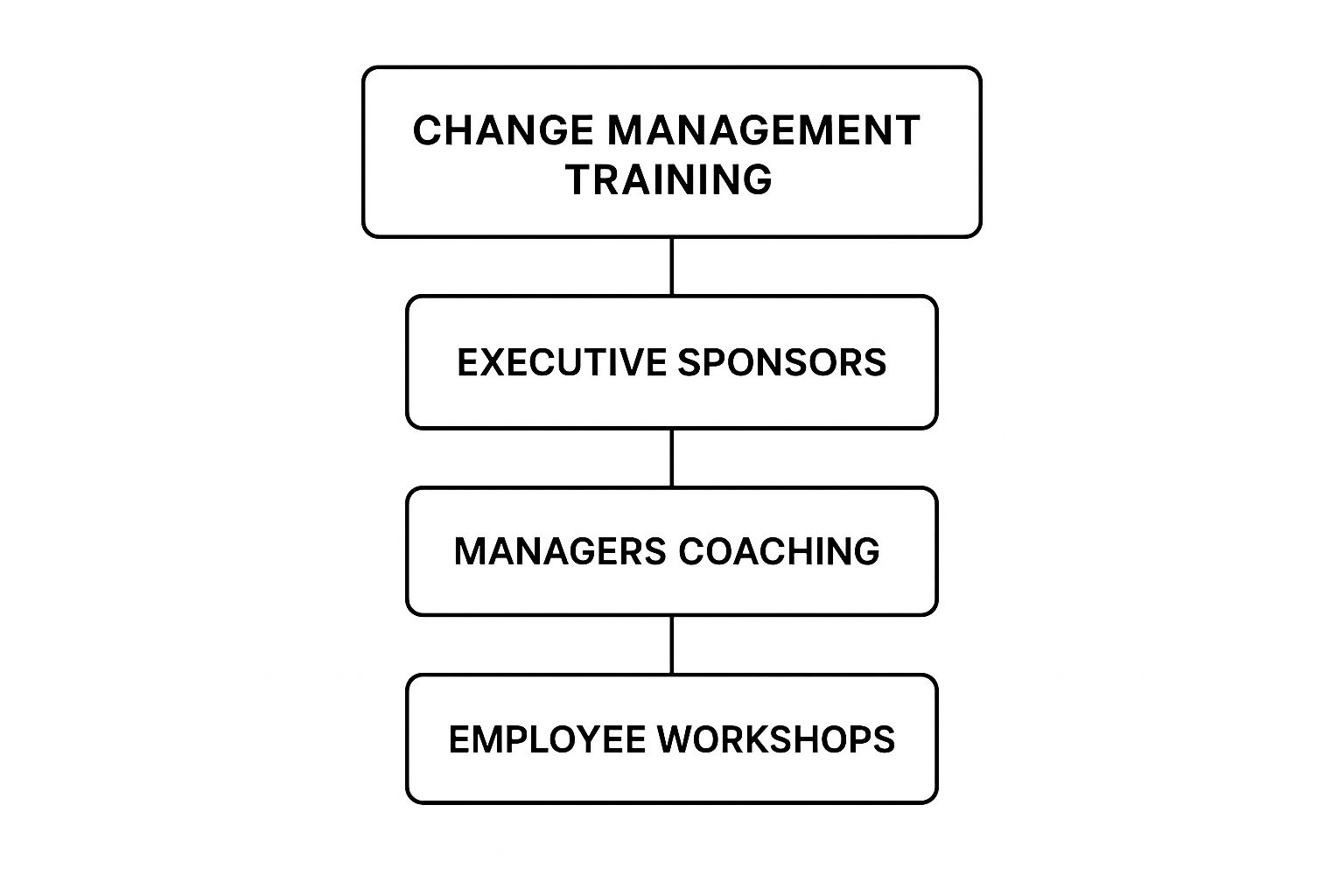
As you can see, real change isn't just announced in an email. It has to be sponsored by executives, coached by managers, and brought to life through practical, hands-on help for every employee.
Leading Your Team Through a Data-Driven Transformation
Proven frameworks give you the blueprint, but real leadership is what brings any data strategy to life. Guiding your team through a data-focused transformation isn't just a project management exercise; it's about leading people through the very human side of change. This is where your ability to communicate a compelling vision, build a coalition of champions, and tackle resistance head-on with empathy truly shines.

This process elevates a new BI dashboard from a simple reporting tool into a powerful asset for communication. It helps you tell a story with data—a story that aligns your team, drives adoption, and ultimately proves the value of your investment.
Communicate a Compelling Vision
Your first and most important job is to answer the "why." A clear vision isn't about listing the technical specs of a new Power BI report; it's about painting a vivid picture of a better future for your team. You have to connect the change directly to the frustrations they feel every single day.
Instead of saying, "We're implementing automated dashboards," try this: "We're getting rid of the five hours you each lose every week to manual copy-pasting, so you can finally focus on the strategic analysis you were hired to do." See the difference? This reframes the change from a top-down mandate into a genuine solution.
For leaders navigating big transformations, improving internal communication is absolutely essential. A well-crafted message is the first step in turning skepticism into support and making sure your vision lands with impact.
Build a Coalition of Internal Champions
You can't lead a change initiative by yourself. It's just not possible. Look for influential team members—not necessarily managers, but the respected peers everyone listens to—who get the vision and are genuinely excited about it. These people are your internal champions.
Empower them. Give them early access, extra training, and a direct line to you. They'll become your advocates on the ground, answering questions, calming fears, and showing everyone the benefits of the new system in real-time. Their authentic enthusiasm is far more persuasive than any corporate directive.
This approach is key to building the right environment for data-driven decision-making, where insights are shared and championed from the ground up.
Your goal is to create a pull, not a push. When your team sees their trusted colleagues succeeding with the new tools, they'll want to join in rather than feeling forced to comply.
Address Resistance with Empathy and Data
Resistance is a natural, expected part of any change management effort. Don't treat it as a problem to be crushed; treat it as valuable feedback. Listen carefully to understand the real root of the anxiety.
Often, resistance isn't about the change itself, but the uncertainty that comes with it. Research shows that about 37% of employees push back on change initiatives. The primary drivers? A lack of trust in leadership (41%) and a simple fear of the unknown (38%). To make matters worse, 23% of employees feel completely left out of decisions related to the change, which is a perfect recipe for opposition.
Use data to address these fears directly:
- Fear of Being Replaced: Show them a dashboard that visualizes the growth in high-value analytical tasks. Reinforce that automation is here to elevate their role, not eliminate it.
- Fear of Not Being Good Enough: Use training data to see where people are struggling. This allows you to provide targeted, one-on-one support where it's actually needed.
- Fear of Losing Control: Involve them in the design process. Ask for their input on which metrics are most valuable to their day-to-day roles.
By using empathy to understand the "why" behind the resistance and data to provide clear, reassuring answers, you transform fear into trust. This proactive leadership is the secret to embedding new data-driven processes that actually stick.
Answering Your On-the-Ground Change Management Questions
When you’re about to steer your business in a new direction, a lot of practical, “how does this actually work?” questions pop up. Let’s tackle the most common ones we hear from SMB owners and founders, so you can move forward with a clear head.
Is Organizational Change Management Just for Big Corporations?
Not a chance. In fact, you could argue it’s even more critical for small and mid-sized businesses. Why? Because in a smaller team, every single person's buy-in matters immensely. One person resisting a new process can jam up the works for everyone else.
For an SMB, a structured approach to organizational change management isn't about red tape; it's about survival. It helps you dodge costly disruptions, get tools like Power BI adopted quickly, and make sure the whole team is pulling in the same direction. That alignment is what allows you to pivot and grow without leaving good people behind.
How Can Data and BI Tools Actually Help with This?
Think of data as your most honest and persuasive team member. Instead of just telling everyone a change is necessary, a well-built BI dashboard can show them. It makes the problem real and the need for change impossible to ignore.
- Create a Clear "Why": A simple dashboard tracking metrics like "hours wasted on manual reporting" or "revenue lost to data entry errors" doesn't just suggest a problem—it proves it. This gives you a data-backed reason for change that resonates far more than a gut feeling.
- Showcase the Wins: As you roll out the new process, your dashboards can become a scoreboard for success. Showing real-time improvements in performance turns skeptical team members into believers and builds the momentum you need to see it through.
The single biggest mistake we see is companies focusing all their energy on the technology while completely ignoring the people. A technically brilliant Power BI dashboard is worthless if your team doesn't get why it exists or how to use it. Real change management always puts communication, training, and empathy first.
So, How Do I Even Get Started?
You don't need a hundred-page, bureaucratic plan to kick things off. Just start by creating a simple but powerful vision that answers two core questions:
- What specific, painful problem are we finally solving? (e.g., "We're killing the three-day, manual month-end reporting nightmare for good.")
- What does a win look like for the team? (e.g., "Success means we have live financial data anytime we want, letting us make smarter decisions, faster.")
With clear, compelling answers to those two questions, you're ready to start the conversation with your team. This vision becomes your north star for every decision that follows, making sure everyone is on the same page and rowing in the same direction.
Ready to lead your team through a data-driven transformation without all the friction and headaches? The experts at Vizule can help you map out a clear strategy, build the right tools, and guide your team toward confident adoption.
Book your free BI consultation today and see how we can turn your data into your most powerful asset for growth.
