


When founders hear ‘financial forecasting,’ their minds often jump straight to fragile, error-prone spreadsheets. It’s a familiar pain point for many startups: wrestling with complex Excel files, hunting down broken formulas, and plugging in outdated numbers. This becomes a painful chore you only suffer through for a board meeting or an investor pitch.
But that static, manual approach is actively failing today's fast-moving startups. A forecast shouldn't be a historical document; it should be a strategic co-pilot for growth.
Moving Beyond Spreadsheets for Startup Forecasting
The truth is, modern forecasting is less about filling out a template and more about building a dynamic, strategic tool that actually helps you make decisions. It's about creating a live model of your business—one that connects your day-to-day operational activities directly to clear financial outcomes.
This is the very core of driver-based forecasting.

Why Static Spreadsheets Hold You Back
Manually updated spreadsheets just can't keep up with the speed of a startup. As business intelligence consultants, we’ve seen them create more problems than they solve, time and time again.
- Endless Manual Entry: Hours get torched copying and pasting data from different systems. It’s not just tedious; it’s a recipe for human error that erodes trust in your numbers.
- No Real-Time Insight: By the time you finish the report, the data is already old. That makes it pretty useless for making sharp, timely decisions.
- Siloed Information: The forecast is completely disconnected from your sales, marketing, and ops data. This hides the crucial relationships between what you spend and the results you get.
This disconnected approach is like trying to navigate a new city with a map that’s a month out of date. You’re making decisions based on old information, which is a recipe for disaster.
A great forecast is a strategic co-pilot, not a historical document. It should tell you where you're going, not just where you've been. By linking operational drivers to financial outcomes, you transform forecasting from a reactive chore into a proactive, decision-making engine.
This shift isn't just about convenience; it's what sophisticated investors now demand. Financial forecasting accuracy has become a critical factor in securing venture capital. Today's VCs want to see detailed 13-week cash flow forecasts with variance analysis and multiple scenarios built-in, reflecting a much higher standard of due diligence.
Traditional Spreadsheets vs. Modern BI Forecasting
See the strategic advantages of moving from static Excel files to a dynamic, BI-driven approach for your startup's financial planning.
| Aspect | Traditional Forecasting (Excel) | Modern Forecasting (Power BI) |
|---|---|---|
| Data Updates | Manual, time-consuming data entry from various sources. | Automated data integration from live sources (CRM, ERP, etc.). |
| Accuracy | Prone to human error, broken formulas, and version control issues. | High accuracy with a single source of truth and validated data models. |
| Timeliness | Data is often outdated by the time the report is complete. | Real-time dashboards provide instant, up-to-the-minute insights. |
| Collaboration | Difficult to share and collaborate; often leads to multiple file versions. | Seamless, cloud-based collaboration with controlled user access. |
| Scenario Planning | Clunky and slow; creating multiple scenarios is a manual overhaul. | Dynamic and interactive; easily model best-case, worst-case scenarios. |
| Insight Generation | Relies entirely on the user to manually identify trends. | AI-powered features can automatically detect anomalies and trends. |
The takeaway is clear: while Excel was a great starting point, the complexity and speed of modern startups demand a more powerful, integrated solution. As you transition to more sophisticated methods, you'll need to master your cash flow projection, which is the absolute cornerstone of any robust financial forecast.
Building Your First Driver-Based Financial Model
Alright, let's get practical. The term "driver-based financial model" might sound intimidating, but the core idea is actually pretty straightforward. It's all about building a financial forecast that's directly wired into the real-world activities that make your business tick.
Instead of just guessing at arbitrary growth percentages, you’re linking your revenue and expenses to the operational metrics you can actually influence. This is a game-changer. It shifts your entire mindset from, "How much will we grow?" to the far more powerful question, "What specific actions do we need to take to grow?"
For a startup, this means zeroing in on the handful of drivers that truly move the needle. Let’s put the accounting jargon on the shelf for a moment and think about the engine of your business. What are the levers you can pull to bring in more cash or keep costs in check?
Identifying Your Core Business Drivers
The trick here is to focus. Don't get lost in a sea of metrics. You need the handful of drivers that have the biggest, most direct impact on your bottom line. For a classic SaaS startup, this usually boils down to a few key players:
- New Leads per Month: The very top of your funnel, driven by things like marketing spend or your content strategy.
- Lead-to-Customer Conversion Rate: How good is your sales process at turning a "maybe" into a "yes"?
- Customer Acquisition Cost (CAC): The all-in cost of sales and marketing to land one new paying customer.
- Average Revenue Per Account (ARPA): What's the average monthly check you get from each customer?
- Customer Lifetime Value (LTV): The total revenue you can realistically expect from a single customer over their entire relationship with you.
- Monthly Churn Rate: The percentage of customers who say goodbye each month.
These aren't just numbers on a pretty dashboard; they are the gears in your growth machine, all interconnected. An increase in your ad budget should directly translate to more new leads. That number, multiplied by your conversion rate, equals new customers and, ultimately, predictable revenue.
This visual perfectly illustrates how revenue projections are built from the ground up using these operational drivers, not just pulled from thin air.
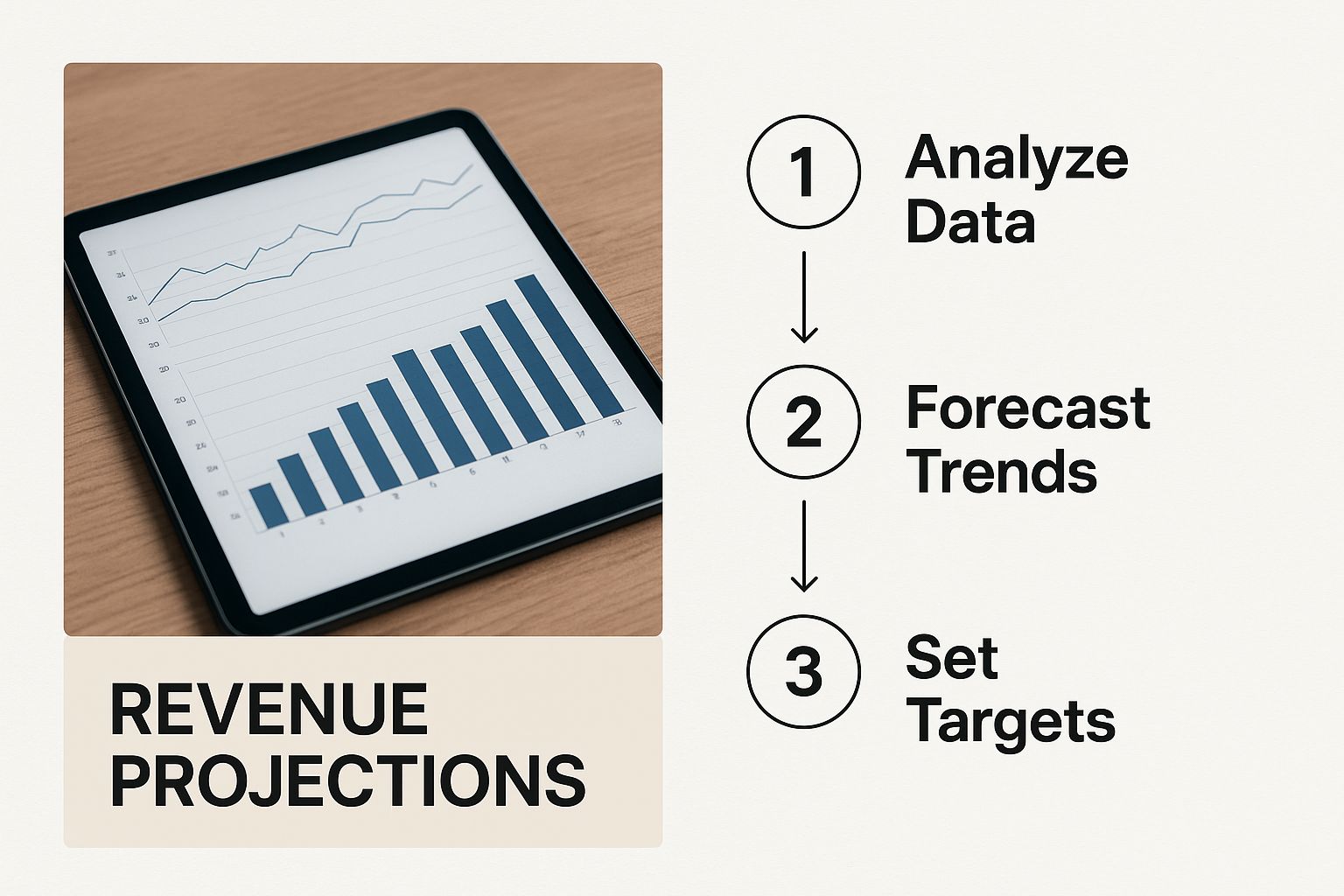
The big takeaway? Your financial statements become the result of your operational plan, not some separate document that feels disconnected from reality.
Connecting Drivers to Financial Statements
Once you've nailed down your key drivers, the next move is to link them to your three core financial statements: the Profit & Loss (P&L), Balance Sheet, and Cash Flow Statement. This is where the model really comes to life.
Let’s say a SaaS startup has a goal to grow from 100 to 150 customers next quarter.
A traditional forecast might just pencil in a 50% revenue increase. A driver-based model, on the other hand, tells the story behind that number. It shows you'll need to crank up marketing spend (which hits your P&L expenses), generating a specific number of new leads. Based on your conversion rate, that turns into new customers and revenue (hitting your P&L revenue). This whole chain reaction also impacts your cash flow, since you're spending money on ads before you start collecting those new subscription payments.
When you build a model this way, you create a dynamic system. Tweaking one operational assumption—like bumping your conversion rate by just 2%—automatically sends ripples through the entire financial forecast. It transforms your model from a static report into a powerful sandbox for strategic thinking.
If you want to get into the nitty-gritty mechanics of this, our complete guide on how to build financial models breaks down the framework in much more detail.
The end goal is to build a forecast you actually understand and believe in—one that mirrors the interconnected, cause-and-effect nature of your business. That’s the real foundation for making smarter, insight-led decisions.
Setting Realistic Growth Assumptions That Still Impress
We’ve all done it. Sketched that beautiful, soaring hockey-stick growth chart on a whiteboard. It’s the dream, the visual proof of every late night and ambitious goal.
But when you move from the whiteboard to your formal financial forecast, that same curve can look less like a vision and more like a fantasy if it’s not anchored in solid logic. The real art is balancing that ambition with a story that investors can actually get behind.
Think about it from their perspective. They aren't just investing in an idea; they're investing in a well-reasoned plan. An overly optimistic forecast without solid assumptions backing it up is a massive red flag. It tells them you either don't truly understand your market or haven't grasped what it actually takes, operationally, to make that growth happen.
Get this wrong, and you risk burning through cash on unrealistic hiring sprees or losing all credibility when your actuals inevitably fall miles short of your projections.
Grounding Your Goals in Reality
So, how do you build assumptions that are both impressive and believable? You triangulate. This isn’t about pumping the brakes on your ambition; it's about proving you have a mature, operational plan to bring it to life.
Here are the three pillars of a defensible forecast:
- Market Research (Top-Down): Start with the big picture: your Total Addressable Market (TAM). How big is the entire pie? From there, slice it down to what you can realistically capture over the next 3-5 years. This shows investors you understand the competitive landscape and your specific place within it.
- Early Traction Data (Bottom-Up): Your own history is your most powerful evidence. Use your early data on conversion rates, sales cycle length, and customer acquisition cost (CAC) to build your forecast from the ground up. This proves your future growth is an extension of proven success, not just a shot in the dark.
- Industry Benchmarks: How are similar companies in your space growing? Dig into public company reports or industry surveys to find comparable benchmarks for crucial metrics like churn, LTV to CAC ratios, and growth rates. This provides a vital third-party sanity check.
When you weave these elements together, you create a powerful narrative. Sure, startups aim for the moon—analysis of over 140,000 startups shows a forecasted average growth of 522% in year one, tapering to 136% by year three.
The massive gap between those forecasts and reality is precisely why well-reasoned financial forecasting for startups is so critical for managing cash and maintaining investor trust. You can dig deeper into these startup growth rate findings to benchmark your own goals against a wider dataset.
Your defensible forecast tells a story that goes like this: "The market opportunity is this big (TAM). We've already proven we can capture a piece of it with these specific unit economics (Traction). And our plan for scaling is right in line with what's considered strong for our industry (Benchmarks)."
By layering these perspectives, you move beyond a simple "what if" scenario. You’re presenting a strategic roadmap that shows you not only have a vision for the future but also a clear-eyed understanding of how to get there.
Ready to build a forecast that impresses investors and actually guides your strategy? Book your free BI consultation, and let's connect your operational drivers to a financial model you can truly stand behind.
Automating Your Forecasts with Power BI
So, you've built a solid driver-based model and your assumptions are actually grounded in reality. What's next? It's time to free yourself from the tyranny of manual updates. This is where you connect your strategic model to some serious automation, turning your forecast from a static document into a dynamic, living dashboard.
The goal here is simple: ditch manual data entry for good. By pulling your disparate data sources—your CRM, accounting software, operational platforms—into a single, unified Power BI model, you create one source of truth.
Just imagine your financial forecast updating in near-real-time as new deals are closed in HubSpot, invoices get paid in Xero, or you log new marketing spend. This isn't some far-off dream; it's the immediate, tangible payoff of a well-architected BI system.
The Power of a Unified Data Model
Connecting these systems isn't just a time-saver—it's a massive strategic advantage. When your financial model is fed directly by live operational data, you unlock a whole new level of clarity and speed. You’re no longer looking at a snapshot from last month; you’re looking at what’s happening right now.
This integration allows you to:
- Reclaim Dozens of Hours: Stop the soul-crushing task of exporting CSVs and copy-pasting data. Your team can finally focus on analysing what the numbers mean, not just chasing them down.
- Eliminate Human Error: Automated data pipelines get rid of the risk of typos, broken formulas, and the version control nightmares that plague even the most disciplined spreadsheet jockeys.
- Gain Agility: Instantly see how operational changes hit your bottom line. Did a marketing campaign just drive a spike in leads? You’ll see it ripple through to your revenue forecast immediately.
This dashboard shows exactly how you can visualize operational KPIs and financial projections together. It gives you instant clarity and a full picture of business health on a single screen.
This isn't just about pretty charts. It’s about merging high-level financial outcomes with the granular operational data that actually drives them, all updated automatically.
Running Scenarios On the Fly
One of the most powerful things you get with an automated Power BI model is the ability to run ‘what-if’ scenarios without breaking a sweat. Because your drivers are all interconnected within the model, you can tweak a single variable and watch the entire forecast update in seconds.
For example, you could ask:
- "What happens to our cash runway if we increase marketing spend by 15% but our conversion rate only improves by 1%?"
- "How does hiring two new salespeople in Q3 impact our Customer Acquisition Cost and our path to profitability?"
With a manual spreadsheet, answering these questions is a painful, multi-hour exercise. With an automated Power BI model, it becomes an interactive, strategic conversation you can have with your team in real time.
This turns your forecast into a true strategic co-pilot, helping you navigate uncertainty and make decisions with confidence. For a deeper look into the mechanics, check out our guide on revamping your reporting with Power BI for more on building these kinds of automated systems. Ready to connect your data and finally trust your numbers? See how Vizule can help automate your reporting stack.
Putting Your Forecast to Work for Strategic Decisions
An automated financial model is a fantastic start, but it's only half the story. The real magic happens when you start using it as a strategic co-pilot, guiding your big moves with data instead of just gut feelings. A great forecast isn't about predicting the future with perfect clarity; it's about understanding the range of possible futures so you can make smarter, faster decisions right now.
This is where your Power BI model transforms from a static report into a dynamic sandbox for strategy. You can instantly see the financial ripple effects of any key decision, turning all that uncertainty into something you can actually measure and plan around.
Turning Your Forecast into a Co-Pilot
A live, driver-based forecast helps you tackle the tough questions that keep founders up at night. By plugging in real-time data, you shift from simply reacting to last month's numbers to proactively shaping next quarter's strategy.
Here are three ways this plays out in the real world:
- Scenario Planning: This is your classic ‘what-if’ machine. What happens if you hire two more salespeople next quarter? What if a hot new marketing channel doubles your lead flow but also jacks up your Customer Acquisition Cost by 20%? An automated model shows you the immediate impact on your cash runway and path to profitability. No guesswork needed.
- Variance Analysis: At the end of each month, you're not just looking at whether you hit your numbers. You're digging into why. Did you miss the revenue target? A connected model lets you drill down from that top-line financial miss to the specific operational driver, like a sudden dip in website conversion rates or a sales cycle that's dragging on longer than expected.
- Cash Flow Management: For any startup, cash is oxygen. Your forecast acts as an early warning system, flagging potential cash crunches months before they happen. This gives you precious time to adjust spending, chase down receivables, or line up funding. Finding capital without giving up more equity is a huge win—exploring options like startup grants can be a game-changer.
Sharpening Your Accuracy with Modern Tools
The quality of your strategic decisions is directly linked to the accuracy of your forecast. And this is where modern tools are completely changing the game.
A forecast is a tool for managing uncertainty, not eliminating it. The goal is to make decisions with a clear-eyed view of potential risks and rewards, backed by data that reflects the real-time pulse of your business.
Recent studies have shown that startups using AI tools in their financial forecasting can see up to a 20% bump in prediction accuracy over old-school methods. In fast-moving markets, that's a massive advantage. AI-driven platforms can automate the heavy lifting of modeling and run real-time analytics, directly improving your cash flow management and decision-making. You can get more insights on AI's impact on startup forecasting.
Ultimately, when you use your forecast for strategic decisions, it stops being a simple financial exercise. It becomes the central nervous system of your startup, ensuring every major choice is tested, debated, and made with a crystal-clear understanding of its financial consequences.
Ready to turn your forecast into a dynamic strategic tool? Connect with us to design your financial dashboard in Power BI.
Answering Your Top Financial Forecasting Questions
Even with a great, automated model, you're bound to have questions. It’s only natural. Let's tackle some of the most common ones we hear from founders, cutting through the noise to get you the practical answers you need.
How Often Should a Startup Update Its Financial Forecast?
For any early-stage company, a formal, in-depth review should happen monthly. That’s non-negotiable. You need to plug in your actuals every month to run a variance analysis—this is where you dig into not just what happened, but why it happened.
But your cash flow forecast? That’s a different beast. You should have eyes on that weekly, especially in the first year or two when every dollar counts. This doesn't have to be a manual nightmare; modern BI tools can put this on autopilot for you.
Think of your forecast as a living, breathing co-pilot for your business journey. It’s not a dusty report you only pull out when you’re fundraising.
What’s the Single Biggest Forecasting Mistake Startups Make?
Hands down, the most common pitfall is creating a forecast based purely on expenses without a realistic, bottoms-up revenue model. Too many founders just slap a growth percentage on their revenue—"we'll grow by 15% month-over-month"—and call it a day.
This approach is completely detached from reality. It ignores the actual work and investment required to generate that revenue, like your marketing spend, sales team capacity, conversion rates, and the actual size of your market. This is how you end up with that unbelievable 'hockey stick' projection that seasoned investors can spot from a mile away.
A credible forecast always builds revenue from the ground up, linking it directly to identifiable, measurable business activities.
Can I Build a Solid Forecast if I’m Not a Finance Whiz?
Absolutely. You don't need to be a CPA to build a powerful forecast. While the jargon can feel intimidating, the core logic behind a great model is all about your business operations—and nobody knows those better than you. Your true expertise isn't in accounting principles; it's in knowing which levers actually move the needle in your company.
Focus on the drivers you can directly control and influence. This is where partnering with a consultancy can be a game-changer. We can help you structure the model correctly and automate the data flows in a powerful tool like Power BI. That frees you up to focus on the high-level strategic assumptions, not getting lost in spreadsheet formulas or mind-numbing data entry.
You bring the operational smarts; we bring the framework to translate it into a compelling financial story.
Feeling buried in spreadsheet chaos? Ready to build a forecast you can actually trust and use to make decisions?
The team at Vizule specialises in transforming messy, siloed data into clear, automated financial models that drive real strategic conversations. We connect the dots between your operations and your financials, giving you the clarity and confidence to scale smart.
Book your free BI consultation with our experts today and see how we can help you build a forecast that's ready for investors and, more importantly, ready for your next big move.
