


Making critical business decisions based on intuition is like navigating a maze blindfolded. You might eventually find your way, but the process is inefficient and prone to costly mistakes. The alternative, data-driven decision-making (DDDM), is no longer a luxury reserved for tech giants. For small and medium-sized business owners, it’s a crucial strategy to gain a competitive edge, streamline operations, and drive sustainable growth. By systematically collecting and analysing data, you replace guesswork with informed strategy, turning raw information into your most valuable asset.
This article moves beyond theory to provide powerful, real-world data driven decision making examples. We'll break down specific scenarios relatable to SMBs, from a founder optimising cash flow with predictive models to an operations manager using a Power BI dashboard to slash inventory waste. You won't find generic success stories here. Instead, you'll discover how to solve the real pain points caused by Excel chaos and siloed data.
For each example, we'll detail the strategic thinking, the practical steps, and the measurable results. We will also highlight how a unified data layer and powerful BI tools like Power BI can automate this process, transforming disconnected spreadsheets into a source of clear, actionable insight. Consider this your playbook for building a data-first culture that delivers real financial and operational returns.
1. Retail Sales Forecasting and Inventory Optimization
One of the most powerful data driven decision making examples comes from the retail sector: using analytics for sales forecasting and inventory management. Instead of relying on guesswork, business owners can analyze historical sales data, seasonal trends, and promotions to predict future customer demand with remarkable accuracy. This is a common pain point for SMBs frustrated with capital being tied up in the wrong stock.
This foresight allows them to optimize stock levels. The goal is to strike a balance, preventing costly stockouts that lead to lost sales, while also avoiding overstock situations that tie up cash flow and lead to markdowns.
Strategic Breakdown
Global giants like Amazon have perfected this model, but the principles are universal. Amazon’s algorithms predict demand by geographical region, ensuring items are stored in fulfillment centers closest to likely buyers. Similarly, fast-fashion retailer Zara uses near-real-time sales data to inform rapid production and distribution decisions, minimizing waste.
Key Insight: Effective inventory optimization isn't just about avoiding extremes. It's a dynamic process that directly impacts cash flow, warehouse costs, and gross margin. Getting it right is a significant competitive advantage.
Actionable Takeaways for Your Business
Even without Amazon's resources, SMBs can implement this strategy:
- Unify Your Data: Start by consolidating sales data from your POS system, e-commerce platform (like Shopify), and any other channels into a single source of truth. Moving from siloed Excel sheets to a unified data layer is the foundation for accurate forecasting.
- Identify Key Drivers: Analyze sales patterns to identify seasonality and the impact of past promotions. What truly drives your demand?
- Implement Forecasting Models: Utilize statistical methods to project future sales. For a deeper dive, explore various time-series forecasting techniques that can be applied in tools like Power BI.
- Automate and Refine: Use BI tools to create dashboards that monitor forecast accuracy against actual sales. Set up automated alerts for when inventory levels for key products drop below a certain threshold, triggering a reorder process.
By connecting your sales, inventory, and purchasing data, you can move from reactive ordering to a proactive, data-informed strategy that boosts profitability.
2. Healthcare Patient Outcomes and Treatment Optimization
Another profound data driven decision making example is found within healthcare, where providers leverage patient data to enhance treatment protocols and improve health outcomes. Instead of relying solely on general practice guidelines, hospitals and clinics analyze vast datasets-including medical histories, genomic data, lab results, and treatment responses-to personalize care, predict patient risk, and optimize operational efficiency.
This data-centric approach enables clinicians to identify which treatments are most effective for specific patient subgroups, predict potential complications before they arise, and reduce costly hospital readmissions. The ultimate goal is to shift from a reactive treatment model to a proactive, preventative, and highly personalized standard of care.

Strategic Breakdown
Leading institutions like the Mayo Clinic and Kaiser Permanente are at the forefront of this movement. Kaiser Permanente’s integrated data system allows for comprehensive analysis across a patient's entire care journey, helping to identify at-risk populations and manage chronic diseases more effectively. Similarly, the Cleveland Clinic tracks patient-reported outcomes to continuously refine its treatment protocols and ensure care is aligned with patient well-being, not just clinical metrics. These efforts are similar in spirit to how leveraging predictive analytics in retail helps businesses anticipate customer needs, but here the focus is on anticipating patient health trajectories.
Key Insight: Optimizing patient outcomes isn't just a clinical imperative; it's a financial one. Data-driven interventions that reduce readmission rates, shorten hospital stays, and prevent chronic disease progression lead to significant cost savings and improved operational capacity.
Actionable Takeaways for Your Business
Healthcare organizations of all sizes can adopt these data-driven principles:
- Establish a Secure Data Hub: Begin by integrating disparate data sources like Electronic Health Records (EHR), lab systems, and billing information into a secure, HIPAA-compliant unified data layer. This foundational step is critical for holistic analysis.
- Identify High-Impact Areas: Start with a specific, high-priority use case, such as reducing readmission rates for patients with congestive heart failure or optimizing operating room scheduling. Focused projects deliver tangible wins quickly.
- Develop Predictive Models: Use historical patient data to build models that identify individuals at high risk for adverse events. These insights allow for targeted, preventative interventions.
- Empower Clinicians with Dashboards: Create intuitive BI dashboards that provide clinicians with real-time insights at the point of care. Visualizing patient risk scores, treatment adherence, and outcome trends empowers better, faster decision-making.
By connecting clinical and operational data, healthcare providers can unlock powerful insights that directly translate to better patient care and a healthier bottom line. Explore how Vizule delivers specialized healthcare analytics solutions to transform patient data into actionable intelligence.
3. E-commerce Personalization and Customer Recommendation Engines
Another of the most impactful data driven decision making examples is found in e-commerce: using customer data to power personalization. Instead of presenting a generic storefront to every visitor, online businesses analyze browsing history, past purchases, and cart additions to create a uniquely tailored shopping experience for each user.

This data-first approach allows founders and operators to surface the most relevant products, increasing the probability of a sale. The objective is to guide the customer journey, making discovery feel intuitive and personal, which directly boosts key metrics like average order value (AOV), conversion rates, and long-term customer loyalty.
Strategic Breakdown
Streaming giant Netflix is a master of this, with its recommendation algorithm reportedly influencing over 80% of content watched. Amazon’s "Frequently Bought Together" sections are legendary, driving billions in incremental revenue. Similarly, Spotify's "Discover Weekly" playlists leverage listening habits to create a deeply personal and engaging experience that encourages retention.
Key Insight: Personalization is no longer a luxury; it's a customer expectation. An effective recommendation engine transforms a transactional website into a consultative shopping assistant, building trust and increasing customer lifetime value.
Actionable Takeaways for Your Business
You don't need a huge data science team to get started with personalization:
- Integrate Customer Data: Consolidate data from your e-commerce platform (e.g., Shopify), CRM, and analytics tools. A unified view of each customer's interaction history is the bedrock of effective personalization.
- Segment Your Audience: Go beyond basic demographics. Create segments based on browsing behavior (e.g., "frequent category viewers") or purchase history ("high-value customers") in your business intelligence tools.
- Leverage Platform Tools: Many e-commerce platforms have built-in apps for product recommendations. Start with these to implement basic "related products" or "trending items" features.
- Test and Measure: Use A/B testing to refine your recommendation strategies. Track key metrics like click-through rate, conversion rate, and AOV in a performance dashboard to understand what resonates with your audience.
By connecting customer behavior data to your on-site experience, you can create a more relevant journey that turns browsers into loyal buyers.
4. Financial Services Risk Management and Fraud Detection
A critical area where data driven decision making examples shine is in financial services, specifically for managing risk and detecting fraud. Instead of relying on manual reviews, institutions now deploy sophisticated models to analyze vast streams of transaction data in real time. These systems are trained to identify normal user behavior and instantly flag anomalies that suggest fraudulent activity or credit risk.
This data-centric approach allows banks and fintech companies to protect customer assets and maintain regulatory compliance on a massive scale. The core objective is to identify and block illegitimate transactions with surgical precision while ensuring legitimate customer activity proceeds without unnecessary friction.
Strategic Breakdown
Financial giants like JPMorgan Chase and Visa have pioneered this space. Visa's AI-powered system analyzes over 500 risk attributes for every transaction in milliseconds, preventing billions in fraud annually. Similarly, PayPal’s transaction monitoring algorithms assess user history, device information, and transaction context to calculate a real-time risk score, blocking high-risk payments before they are processed.
Key Insight: Advanced fraud detection isn't about building a single, impenetrable wall. It's about creating a multi-layered, intelligent system that adapts to new threats, balancing robust security with a frictionless customer journey.
Actionable Takeaways for Your Business
While you may not operate at the scale of Visa, the principles are applicable to any SMB handling transactions:
- Establish Baselines: Consolidate transaction and user behavior data to understand what "normal" looks like. Identify key metrics like average transaction value, frequency, and common geographical locations for your customer segments.
- Implement Anomaly Detection: Use rules-based systems or simple statistical models to flag deviations from established baselines. For example, an order significantly larger than a customer's average could trigger a review.
- Model Complex Risks: For a more advanced approach to financial modelling, consider using probabilistic methods. You can learn more about how Monte Carlo simulations can be applied to finance to assess a range of potential outcomes and quantify risk.
- Create Feedback Loops: Develop a process to review flagged transactions. This feedback is crucial for refining your detection models, reducing false positives, and identifying emerging fraud patterns before they cause significant damage.
5. Human Resources Talent Management and Predictive Attrition
Another transformative data driven decision making example is found in Human Resources, where organizations use data to proactively manage their most valuable asset: their people. Instead of reacting to employee turnover, modern HR departments analyze data to predict which employees are at risk of leaving and identify high-potential individuals for development.
This proactive approach allows businesses to intervene before a valuable employee resigns, reducing costly recruitment cycles and retaining institutional knowledge. By understanding the key drivers of employee satisfaction and attrition, founders can create a more engaged and stable workforce.
Strategic Breakdown
Tech giants like Google and Microsoft pioneered this field. Google's "Project Oxygen" used performance data and employee feedback to identify the key behaviors of its best managers. Microsoft leverages a sophisticated model that analyzes factors like tenure and performance to generate an "attrition risk" score for employees, allowing managers to offer targeted support.
Key Insight: Predictive attrition isn't about identifying "disloyal" employees. It's about uncovering systemic issues—like poor management or lack of growth opportunities—that cause talented people to leave. Addressing these root causes boosts retention across the entire organization.
Actionable Takeaways for Your Business
Even without a dedicated data science team, any business can apply these principles:
- Unify Your HR Data: Consolidate data from your HRIS (Human Resources Information System), performance management software, and employee engagement surveys into a central data warehouse or BI tool.
- Identify Attrition Drivers: Analyze historical data to find patterns. Do employees in a specific department have a higher turnover rate? Do low engagement scores consistently precede resignations?
- Develop a Risk Model: Start simple. Create a basic scoring system in a tool like Power BI that flags employees with a combination of risk factors, such as low engagement or long tenure in the same role without promotion.
- Automate and Intervene: Build dashboards to monitor key HR metrics like turnover rate by department and manager. Set up alerts for managers when a team member is flagged as a high attrition risk, prompting a supportive conversation.
By connecting your people data, you can shift from a reactive HR function to a strategic talent management powerhouse.
6. Manufacturing Quality Control and Predictive Maintenance
One of the most transformative data driven decision making examples is found on the factory floor: leveraging sensor data for predictive maintenance and quality control. Instead of reacting to equipment failures or discovering product defects late in the cycle, manufacturers analyze real-time data from machinery and production lines to anticipate problems before they happen. This proactive approach minimizes costly downtime and ensures higher product quality.
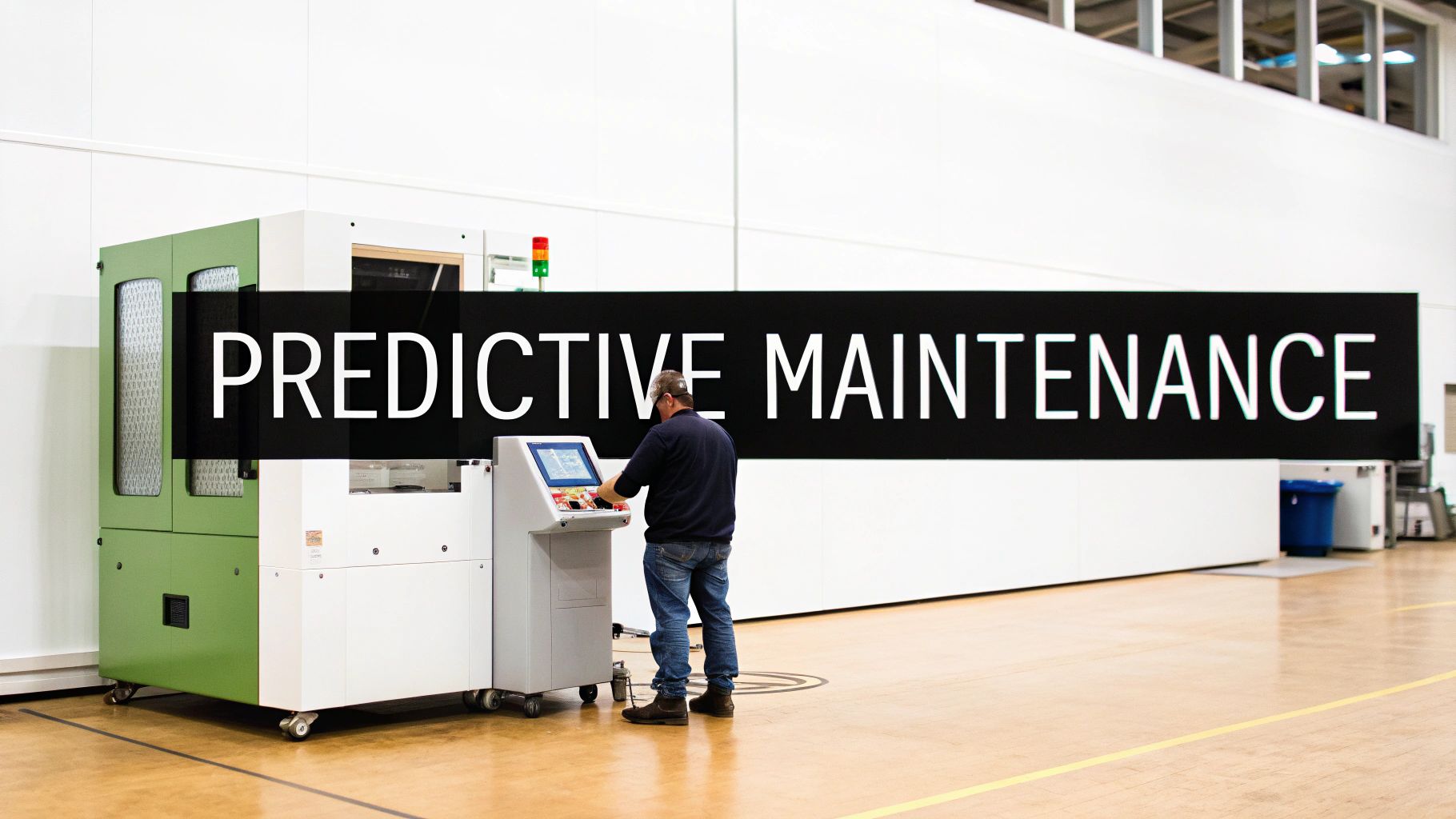
By tracking variables like temperature and vibration, algorithms can detect subtle anomalies that signal an impending breakdown. This allows for scheduled, efficient maintenance and immediate process adjustments, turning operational data into a powerful tool for efficiency and reliability.
Strategic Breakdown
Industrial leaders like Siemens and Intel have long pioneered this approach. Siemens uses data from its automated systems to predict component failure, scheduling maintenance during planned downtimes to maximize uptime. Similarly, Intel analyzes billions of data points from its semiconductor fabrication process to identify and correct minuscule defects early. This is a shift from a "fail and fix" model to a "predict and prevent" strategy.
Key Insight: Predictive maintenance isn't just about preventing failures. It's about optimizing the entire production lifecycle, reducing waste, lowering operational costs, and increasing overall equipment effectiveness (OEE).
Actionable Takeaways for Your Business
Manufacturing SMBs can adopt these principles to gain a competitive edge:
- Start with Critical Assets: Begin by instrumenting your most mission-critical equipment with sensors. Focus on machinery where downtime would cause the most significant financial impact.
- Centralize Operational Data: Consolidate data from sensors, production logs, and quality checks into a unified platform. This creates the comprehensive dataset needed for meaningful analysis.
- Develop Alerting Systems: Use BI tools like Power BI to build dashboards that monitor key equipment metrics in real time. Set up automated alerts that notify maintenance teams of anomalies that precede failures.
- Analyze Root Causes: When quality issues are detected, use the data to perform a root cause analysis. To see how this can be applied, you can explore specialized analytics for manufacturers that turn raw data into actionable insights.
By embedding data analysis into your production process, you can significantly reduce unexpected downtime and drive down operational costs.
7. Marketing Campaign Optimization and Customer Segmentation
One of the most transformative data driven decision making examples is found in modern marketing: using customer data to segment audiences and personalize campaigns. Instead of broadcasting one message to everyone, marketers analyze behavioral data, demographics, and purchase history to group customers into distinct segments. This allows for highly targeted messaging that resonates with each group’s needs.
This data-led approach allows marketing teams to optimize every aspect of a campaign. The goal is to maximize return on investment (ROI) by allocating budget to the most effective channels and targeting the most profitable customer segments, dramatically improving engagement and conversion rates.
Strategic Breakdown
Digital platforms like Google and Facebook built their advertising empires on this principle. Their algorithms allow advertisers to target users based on incredibly granular data. Similarly, marketing automation platforms like HubSpot empower businesses to segment their contact lists and deliver personalized email sequences based on how a user interacts with their website.
Key Insight: Effective marketing is no longer about reaching the most people; it’s about reaching the right people with the right message. Granular segmentation moves marketing from a cost center to a predictable, data-backed revenue driver.
Actionable Takeaways for Your Business
You don’t need a massive budget to start making data-driven marketing decisions:
- Unify Your Data: Connect customer data from your CRM, e-commerce platform, and website analytics. This unified view is essential for creating meaningful customer segments that reflect the full journey.
- Segment Beyond Demographics: Create segments based on user behavior, such as "frequent buyers," "abandoned carts," or "users who viewed a specific product category," to enable highly relevant campaigns.
- Implement A/B Testing: Continuously test different ad creatives, headlines, and calls-to-action. Use data, not intuition, to determine which variations perform best and iterate accordingly.
- Track Performance with Dashboards: Use a BI tool to build KPI dashboards that monitor metrics like Customer Acquisition Cost (CAC), Lifetime Value (LTV), and conversion rates by campaign. This provides a clear, real-time view of what's working.
By leveraging your customer data, you can stop guessing and start building a marketing engine that consistently delivers measurable results.
8. Transportation and Logistics Route Optimization
Another classic and high-impact example of data driven decision making is found in the logistics and transportation sector: optimizing delivery routes. Instead of assigning routes based on simple geography, companies now leverage algorithms that process real-time traffic, weather conditions, vehicle capacity, and delivery time windows to map out the most efficient path.
This dynamic approach goes far beyond finding the shortest distance. It solves a multi-variable problem to minimize fuel consumption, reduce labor hours, and increase the number of deliveries a single vehicle can make in a day, directly boosting operational efficiency.
Strategic Breakdown
Global logistics leaders like UPS and FedEx are pioneers in this space. UPS's famous On-Road Integrated Optimization and Navigation (ORION) system uses advanced algorithms to process massive datasets and create optimal routes for its drivers, saving millions of gallons of fuel annually. Similarly, Amazon's last-mile delivery network continuously optimizes routes in real-time to meet its delivery promises.
Key Insight: Route optimization is not a "set it and forget it" task. The most effective systems are dynamic, constantly re-calculating based on new information to adapt to unpredictable real-world conditions.
Actionable Takeaways for Your Business
Even smaller businesses with local delivery fleets can apply these principles:
- Integrate Key Data Streams: Centralize data from vehicle telematics (GPS), order management systems, and external APIs for real-time traffic and weather. A unified view is the foundation for intelligent routing.
- Account for All Variables: Your model shouldn't just solve for distance. Factor in service time at each stop, vehicle load capacity, and driver shift schedules.
- Start with Off-the-Shelf Tools: You don't need to build an enterprise system from scratch. Many SaaS platforms offer powerful route optimization capabilities suitable for smaller fleets.
- Create a Feedback Loop: Monitor performance by comparing planned routes against actual routes taken. Use this data on time, mileage, and fuel consumption to continuously refine your routing algorithms.
By transforming your logistics data into an actionable routing strategy, you can significantly lower operational costs and improve delivery reliability.
9. Sports and Gaming Performance Analytics
The world of competitive sports and esports provides compelling data driven decision making examples, where analytics are used to gain a razor-thin competitive edge. Teams now systematically analyze vast datasets, from in-game player statistics and biometric data to opponent tendencies, to inform everything from game-day strategy to player recruitment.
This approach moves beyond traditional scouting and intuition. It quantifies performance, identifies hidden patterns, and predicts future outcomes, allowing coaches and managers to make more objective and effective decisions. The goal is to optimize every aspect of performance.
Strategic Breakdown
The "Moneyball" philosophy demonstrated how undervalued statistics could be used to build a championship-winning team on a limited budget. Modern teams like Liverpool FC have taken this further, using sophisticated data models to identify recruitment targets who fit their specific tactical system. In the NBA, the Golden State Warriors leverage player tracking data to optimize offensive spacing and shot selection.
Key Insight: In sports and business, data analytics doesn't replace expert intuition; it enhances it. The most successful organizations combine quantitative analysis with the qualitative insights of experienced leaders.
Actionable Takeaways for Your Business
While you may not be managing a sports franchise, the principles of performance analytics are highly transferable to managing your team:
- Define Key Performance Metrics: Identify the specific, quantifiable metrics that define success for each role in your organization (e.g., sales conversion rates, customer support ticket resolution time).
- Collect Granular Data: Use your CRM, project management tools, and other systems to gather performance data at an individual and team level.
- Visualize Performance: Develop dashboards in a BI tool like Power BI to track these key metrics. Visualizing trends helps managers quickly identify top performers and individuals who may need additional support.
- Correlate Actions to Outcomes: Analyze how specific activities (e.g., number of client outreach calls) correlate with desired outcomes. Use this analysis to refine your team's processes and best practices.
10. Real Estate Market Analysis and Property Valuation
The real estate industry has been transformed by data-driven decision making, moving from intuition-based appraisals to sophisticated, algorithm-driven valuations. Investors and agencies now analyze vast datasets encompassing historical sales, property characteristics, and local economic indicators to predict property values and identify lucrative investment opportunities.
This analytical approach allows for a more objective and precise understanding of market dynamics. By systematically processing these variables, companies can forecast appreciation, set optimal listing prices, and guide clients toward sound financial decisions, mitigating risk and maximizing returns.
Strategic Breakdown
Companies like Zillow and Redfin have popularized this model with their consumer-facing tools. Zillow’s “Zestimate” is an automated valuation model (AVM) that uses a proprietary formula to provide an estimated market value for millions of homes. Similarly, Redfin provides detailed market analysis tools that show trends in pricing and inventory.
Key Insight: Data-driven valuation isn't just about arriving at a single price. It's about understanding the underlying drivers of value and market momentum, enabling strategic decisions on when to buy, sell, or hold an asset.
Actionable Takeaways for Your Business
Investors and smaller agencies can adopt a similar data-centric approach:
- Aggregate Diverse Data Sources: Combine MLS data with public records (tax assessments, permits) and local economic data. Creating a unified view is the first step toward powerful analysis.
- Identify Value Drivers: Analyze which property features and neighborhood characteristics have the strongest correlation with final sale prices in your target market.
- Develop a Valuation Model: Start with a comparative market analysis (CMA) and enhance it with regression models in tools like Excel or Power BI to predict sale prices. Learning how to leverage data analytics in real estate is crucial.
- Visualize Market Trends: Use BI tools to create heat maps of appreciation rates and dashboards tracking inventory levels. Exploring modern real estate business intelligence solutions can provide a significant competitive advantage.
By integrating these data points, you can shift from speculative investing to a calculated strategy grounded in empirical evidence.
Data-Driven Decision Making: 10 Use Case Comparison
| Solution | Implementation Complexity 🔄 | Resource Requirements & Cost ⚡ | Expected Outcomes 📊 | Ideal Use Cases ⭐ | Key Advantages / Tips 💡 |
|---|---|---|---|---|---|
| Retail Sales Forecasting and Inventory Optimization | 🔄 Medium–High: time-series models + supply-chain integration | ⚡ Medium–High: historical data, ERP integration, compute | 📊 Fewer stockouts/overstock; improved cash flow | ⭐ Brick‑and‑mortar & omni‑channel retailers with seasonal SKUs | 💡 Clean historical data, integrate external signals, monitor model drift |
| Healthcare Patient Outcomes and Treatment Optimization | 🔄 High: EHR integration + regulatory controls | ⚡ High: secure infrastructure, clinical validation, compliance costs | 📊 Better outcomes, fewer readmissions, cost savings | ⭐ Hospitals and care networks managing chronic patients | 💡 Ensure HIPAA/GDPR compliance; involve clinicians; validate models |
| E‑commerce Personalization and Recommendation Engines | 🔄 Medium: recommender systems + real‑time pipelines | ⚡ Medium: user behavior data, online serving, A/B testing | 📊 Higher conversion and AOV; improved retention | ⭐ Online retailers seeking personalized UX and cross‑sell | 💡 Use hybrid models, mitigate cold‑start, test continuously |
| Financial Services Risk Management and Fraud Detection | 🔄 High: real‑time monitoring and compliance workflows | ⚡ High: streaming data, low‑latency compute, regulatory controls | 📊 Detect fraud quickly; lower losses; improve compliance | ⭐ Banks, payment processors, card networks | 💡 Balance detection sensitivity with UX; update models often |
| Human Resources Talent Management & Predictive Attrition | 🔄 Medium: HRIS integration and sensitive modeling | ⚡ Medium: employee data, analytics platform, governance | 📊 Reduced turnover; targeted retention interventions | ⭐ Large organizations with measurable performance/engagement data | 💡 Maintain transparency, audit for bias, protect privacy |
| Manufacturing Quality Control & Predictive Maintenance | 🔄 High: IoT, edge integration, legacy systems | ⚡ High: sensors, edge/cloud compute, domain experts | 📊 Reduced downtime; higher quality; lower maintenance cost | ⭐ Facilities with high‑value assets and continuous production | 💡 Start on critical equipment, invest in sensor quality, monitor models |
| Marketing Campaign Optimization & Customer Segmentation | 🔄 Medium: data integration + experimentation | ⚡ Medium: tracking infra, analytics, attribution tools | 📊 Higher ROI and better ad spend allocation | ⭐ Digital marketers running multi‑channel campaigns | 💡 Implement robust tracking, use multiple attribution models, test |
| Transportation & Logistics Route Optimization | 🔄 High: real‑time routing + fleet systems | ⚡ Medium–High: telematics, traffic feeds, routing compute | 📊 Lower fuel/costs; faster deliveries; reduced emissions | ⭐ Fleet operators and last‑mile delivery services | 💡 Use real‑time traffic, respect driver constraints, update routes |
| Sports & Gaming Performance Analytics | 🔄 Medium–High: sensors + domain modeling | ⚡ High: specialized sensors, analytics, domain experts | 📊 Better performance, injury prevention, fan engagement | ⭐ Professional sports teams and esports organizations | 💡 Combine analytics with coaches’ insight; respect privacy |
| Real Estate Market Analysis & Property Valuation | 🔄 Medium: data aggregation + valuation models | ⚡ Medium: transaction data, MLS/tax feeds, geospatial data | 📊 More accurate pricing; faster transactions; portfolio insights | ⭐ Investors, brokerages, valuation platforms | 💡 Include local factors, use multiple data sources, update frequently |
From Insight to Action: Making Data-Driven Decisions Your Default
The diverse collection of data-driven decision-making examples we've explored—from retail inventory to predictive maintenance—reveals a universal truth: data is the most valuable asset a modern business possesses. Each example demonstrates that moving beyond gut feelings is not just a competitive advantage; it's a fundamental shift in operational excellence that is achievable for SMBs.
We saw how e-commerce founders can use personalization to create better customer journeys and how fintechs can mitigate risk. We explored how HR departments can proactively reduce attrition and how logistics companies can shave millions off fuel costs. The common thread is a systematic process: identify a critical business question, gather the right data, analyze it for patterns, derive actionable insights, and act on them.
Your Roadmap to Data-Driven Maturity
For an SMB owner, the journey from being data-rich to insight-driven can seem daunting, but the path is clear. These examples aren't just success stories; they are blueprints for solving the pain points of manual reporting and disconnected data.
Here are the core takeaways to guide your next steps:
- Start with a Specific Pain Point: Don't try to "boil the ocean." Identify a single, high-impact business challenge, whether it's understanding customer churn, improving your cash flow reporting, or optimizing a marketing budget. A focused objective provides clarity and delivers a tangible early win.
- Democratize Your Data: Insights locked away in siloed Excel files are wasted. The goal is to build a culture where every decision-maker has access to the information they need in a format they can understand. This requires a unified data layer and intuitive Power BI dashboards.
- Connect Finance and Operations: The most powerful decisions are made when financial outcomes are directly linked to operational drivers. A good financial model doesn't just show you what your revenue is; it shows you why, connecting it to variables like website traffic, conversion rates, and average order value.
- Embrace Automation: Your team's time is too valuable for manual report generation. Automating the data flow from its source to your dashboard frees up your brightest minds to focus on strategy and execution, not tedious data wrangling.
The Future is Decisive
Ultimately, embedding data into your decision-making DNA is about building organizational resilience and agility. It empowers you to anticipate market shifts, respond to customer needs, and allocate resources with confidence. The examples prove that with the right strategy and tools, any SMB can turn its data from a passive record of the past into an active guide for the future. You don't need a massive data science team to begin; you just need the commitment to ask better questions and the right partner to help you find the answers.
Tired of wrestling with siloed data and manual Excel reports? The team at Vizule specializes in building the automated BI systems and Power BI dashboards that turn the data-driven decision-making examples in this article into your business reality. Book your free BI consultation today to see how Vizule can help automate your reporting stack.


