


A Monte Carlo simulation is one of the most powerful tools in a financial leader's arsenal, fundamentally changing how you look at uncertainty. For founders and SMB operators, it’s the difference between guessing and genuine, data-backed strategic planning.
So, what is a Monte Carlo simulation in finance? Instead of banking everything on a single, static forecast buried in an Excel sheet, you run thousands of possible scenarios based on real-world variables. This gives you a full spectrum of potential financial outcomes and, critically, the probability of each one happening. It helps you answer the crucial question: "What is the likelihood we will achieve a range of outcomes?"
Moving Beyond Risky Spreadsheet Forecasts
As a founder or operator, you practically live in your spreadsheets. They are the bedrock of your revenue projections, cash flow models, and the financial frameworks guiding your most critical decisions. But there’s a massive blind spot hidden in that familiar grid of cells: every forecast is built on a single set of assumptions—your "best guess."
In a volatile market, this approach is like navigating a storm with a map that only shows one possible route. What happens if interest rates spike? Or a key supplier jacks up their prices overnight? What if a new product launch just doesn't hit the numbers you projected?
Your static financial models simply can't handle this kind of real-world chaos, leaving you dangerously exposed. This is exactly where a Monte Carlo simulation completely changes the game. It helps you stop asking, "Will we hit this specific target?" and start asking the far more powerful question: "What is the probability we will achieve a range of outcomes?"

From Guesswork to Probabilistic Insight
Instead of just plugging in one number for sales growth, you can define a realistic range—let's say, somewhere between 3% and 10%. The simulation then gets to work, running thousands of iterations and randomly picking values from within your defined ranges for every single variable in your model.
The result isn't one number. It’s a probability distribution—a clear, visual map of your company’s potential financial future.
This probabilistic view is a game-changer for common business challenges:
- Launching a New Product: Forget a single break-even point. Now you can see the actual likelihood of hitting profitability within the first year.
- Budgeting and Planning: You can set budget targets with real confidence because you understand the probability of staying within them.
- Securing a Loan: Imagine walking into a lender's office with a financial case that not only acknowledges risk but quantifies it. That builds immense credibility.
The difference between a single-point forecast and a probabilistic one can be dramatic. Think about how this method is used in complex financial planning, like for retirement. One analysis showed a Monte Carlo model indicating a 100% success rate for a withdrawal strategy, while a simpler historical model pegged the success rate below 50%. That’s the power of seeing the whole picture.
This table gives a quick breakdown of how these two approaches stack up.
Static Forecasting vs Monte Carlo Simulation
| Feature | Static Spreadsheet Forecast | Monte Carlo Simulation |
|---|---|---|
| Core Concept | A single set of "best guess" assumptions. | Thousands of scenarios based on probability ranges. |
| Output | One specific outcome (e.g., "$2M profit"). | A distribution of potential outcomes and their likelihoods. |
| Risk Handling | Risk is ignored or handled with a few manual scenarios. | Risk is quantified and visually represented. |
| Decision-Making | Based on a single, often optimistic, projection. | Informed by understanding the probability of success/failure. |
| Best For | Simple, stable, and highly predictable environments. | Complex, volatile situations with multiple uncertainties. |
Ultimately, the choice is between a brittle, singular view and a robust, comprehensive one.
Moving to a probabilistic model isn't just a technical upgrade; it's a fundamental shift in how you lead your business through the inevitable fog of uncertainty. For a broader perspective on this, it's worth exploring a detailed Monte Carlo Simulation Financial Guide.
How a Monte Carlo Simulation Actually Works

At its core, a Monte Carlo simulation is all about turning uncertainty into a strategic advantage. Instead of getting stuck trying to predict a single, perfect future, you map out thousands of possibilities to see which outcomes are most likely. It takes the guesswork out of your forecasting model by running the numbers on countless "what-if" scenarios, all based on the variables you're already tracking.
This isn't abstract, high-level math. It's a structured way of thinking that starts with pinpointing the key drivers in your financial model—the handful of numbers that really move the needle.
Identifying Your Key Business Variables
Every business has a few critical inputs that make or break its financial health. These are the real-world numbers you probably lose sleep over. For a founder launching a new service, these variables might look pretty familiar:
- Monthly New Customers: How many new clients can you realistically sign up each month?
- Average Revenue Per Customer: What's the typical contract value?
- Customer Churn Rate: What percentage of clients are likely to leave over a year?
- Marketing Cost Per Acquisition (CPA): How much do you have to spend to land one new customer?
Instead of being forced to choose a single, static number for each, a Monte Carlo simulation finance model encourages you to define a range of possibilities. This is where your hard-earned business intuition really shines. You might know from experience that new customers could be as low as 10 in a slow month but could ramp up to 30 when things are firing on all cylinders.
The Power of the Range: Defining a realistic range for each variable—think best-case, worst-case, and most-likely—is the entire foundation. This one simple shift moves you from a world of false certainty to one of practical probability. That’s where the real strategic insights live.
Running Thousands of Scenarios Automatically
Once you’ve set the potential range for each of your key variables, the simulation engine does the heavy lifting. Imagine an incredibly fast and meticulous analyst running your financial model over and over again—literally thousands of times in a matter of seconds.
In each "run," the model randomly selects a value for each variable from within the range you provided.
- In Simulation #1, it might pull low customer growth, average revenue, and high marketing costs—a tough quarter.
- In Simulation #2, it could grab high growth, high revenue, and low costs—the dream scenario.
- By Simulation #1,847, it’s probably testing some combination of average and below-average results.
By repeating this process 10,000 times (or more), the simulation builds an incredibly detailed picture of every possible financial outcome. It’s not just showing you one potential future; it's mapping the entire landscape of possibilities and, crucially, telling you how often each one is likely to happen.
This is how you graduate from a single, fragile profit forecast to a rich, data-backed probability distribution. From there, you can visualize the results in a tool like Power BI to make confident, insight-led decisions.
Building Your First Financial Simulation Model
Theory is one thing, but actually putting it to work in your business is what really matters. Let’s get out of spreadsheet chaos and build a straightforward but powerful Monte Carlo simulation finance model. We'll tackle a classic challenge for small and medium-sized businesses: forecasting next year's revenue.
The whole idea is to stop relying on single, static numbers and instead identify the core drivers of your revenue and assign them a realistic range of possibilities. This is where the magic happens.
Defining Your Model Inputs
For a typical SMB, especially one with a subscription or recurring revenue model, your key inputs are probably the same metrics you're already tracking obsessively every week. These variables become the foundation of your financial simulation.
Let's break it down:
- Monthly Customer Growth: Instead of locking in a fixed 5%, you know some months are slow and others are great. A realistic range might be between 2% (a quiet month) and 8% (a strong sales push).
- Average Revenue Per User (ARPU): Your ARPU might hover around $250, but it can easily dip to $220 when smaller clients sign up or jump to $300 with a few enterprise deals.
- Customer Churn Rate: A single 1.5% churn rate is wishful thinking. A more honest range could be anywhere from 1% to 2.5%, depending on things like customer satisfaction and contract renewals.
These ranges are where your hands-on business experience and historical data are invaluable. They transform a brittle, static forecast into a dynamic model that actually reflects the messy reality of running a business. For some more practical tips on this, check out our guide to smarter financial modelling.
Choosing the Right Probability Distribution
Once you’ve got your ranges, the next step is deciding how the simulation will pick random numbers from within those ranges. This is called assigning a probability distribution, and it’s a lot simpler than it sounds.
A Normal Distribution—the classic "bell curve"—is a great fit for variables like ARPU, where values tend to bunch up around an average. Most of your customers will be close to that $250 mark, with fewer outliers at the extreme high or low ends.
On the other hand, a Triangular Distribution is perfect when you have a clear minimum, maximum, and a "most likely" value that isn't necessarily dead center. For example, your monthly customer growth might most likely be 4%, even though it has the potential to hit 8%.
Choosing the right distribution adds a critical layer of realism. It ensures the thousands of scenarios your simulation runs are a true reflection of the patterns you actually see in your business, making the final output far more reliable for making big decisions.
The entire process of a Monte Carlo simulation boils down to three core stages: defining your inputs (like we just did), running the simulation, and then analyzing what comes out the other side.
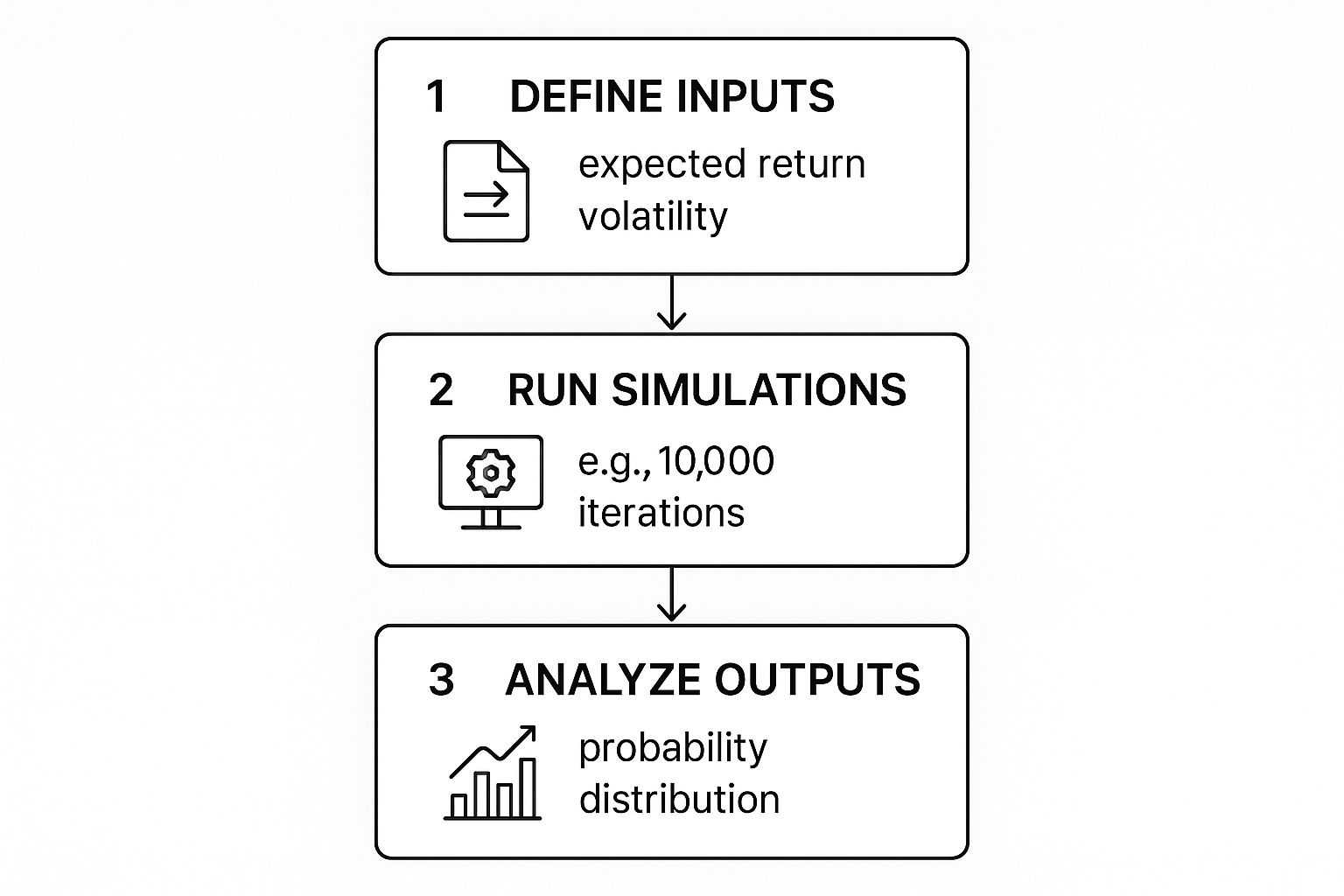
This structured approach is how you turn ambiguous risks into quantifiable probabilities—an absolute game-changer for strategic planning.
The power of this technique is widely recognized, especially when it comes to assessing investment portfolios. In one project, a team simulated future prices for 50 different ETFs by using 20 years of historical data, running thousands of random walks to accurately map out risk and potential returns.
With your variables and distributions locked in, you're ready to run the simulation and start turning all that raw data into clear, actionable business insights.
Turning Simulation Data Into Business Decisions
Running the simulation is just the beginning. The real magic of a Monte Carlo simulation finance model happens when you start digging into the output. Unlike a static forecast that spits out a single, often misleading number, a Monte Carlo analysis gives you something far more powerful: a full probability distribution.
Think of this distribution as your map of potential futures. It allows you to shift from guessing to making confident, data-backed decisions. The key is knowing how to read the visuals the simulation generates, like histograms, to finally get answers to the tough questions that keep founders up at night.
From Histograms to Business Probabilities
The most common output you'll see is a histogram. It's basically a bar chart showing how many times each potential outcome popped up across thousands of simulations. If you're forecasting annual profit, for example, the tallest bars will be clustered around the most likely profit figures. The bars tapering off to the left? That’s your downside risk. The ones on the right show your upside potential.
This single visual immediately gives you clear answers:
- "What's the probability we'll actually hit our revenue target?" You can instantly see what percentage of the thousands of simulated outcomes met or beat your goal.
- "What are the chances this project loses money?" Just look at the portion of results that fall below zero, and you can quantify your risk with a precise percentage.
This is exactly how we help clients at Vizule. We don't just build models; we translate the complex statistical output into clear, actionable strategies that make sense for your real-world decisions.
It's fascinating when you compare Monte Carlo simulations to ones based purely on historical data. Research has shown that for scenarios with moderate to high risk, Monte Carlo models can sometimes suggest lower risk because they don't over-weight extreme past events like the 2008 financial crisis. This offers a more balanced, probabilistic view. You can explore the research on simulation methodologies to get into the weeds on these nuances.
Using Confidence Intervals to Guide Strategy
Armed with that full probability distribution, you can now define confidence intervals. This isn't as technical as it sounds. It’s simply about establishing a range of outcomes you can be reasonably sure of.
For instance, you might discover there’s a 90% probability that your annual profit will land somewhere between $150,000 and $450,000.
This one insight is a complete game-changer for planning. Instead of building your entire budget around a single, fragile $300,000 profit target, you can now plan with a clear-eyed view of the most likely range. This lets you set realistic goals, manage stakeholder expectations, and make much smarter decisions about where to put your capital.
Ready to stop guessing and start making decisions with quantified confidence? Book your free BI consultation and see how Vizule can help you build and interpret financial models that drive real business growth.
Putting Your Financial Reporting on Autopilot with Power BI
A Monte Carlo simulation is a fantastic tool, but the real magic happens when you pull those insights out of a spreadsheet and embed them into your daily operations with business intelligence automation. This is how you close the loop between complex analysis and actual, decisive action.
It's all about moving beyond static, one-off reports and stepping into a world of dynamic, automated financial reporting where your entire team can see what's going on.
From Static Report to Interactive Risk Dashboard
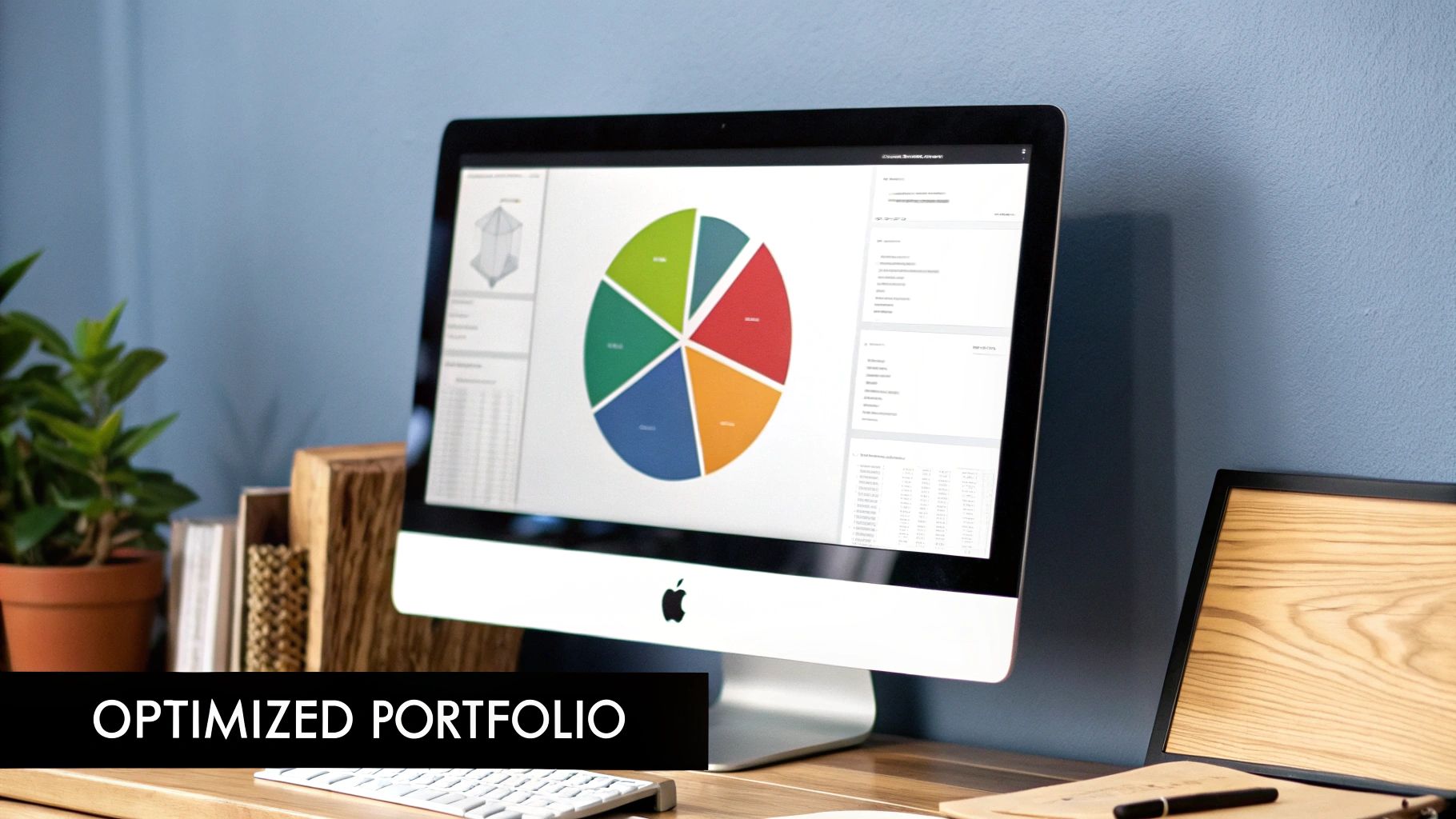
Picture this: a Power BI dashboard connected directly to your financial model. Instead of a flat PDF, you've got a living, breathing tool. Your stakeholders can play with the numbers themselves—tweaking assumptions like customer growth or operating costs—and instantly see the domino effect on the company's risk profile.
This completely changes the game. Your financial reporting transforms from a rearview mirror into a forward-looking strategic asset.
With an interactive KPI dashboard, you can:
- Stress-Test Strategies in Real Time: Model different scenarios on the fly during a leadership meeting. What happens if our top client leaves? Let's see.
- Get Everyone on the Same Page: Give every department, from sales to operations, a crystal-clear view of how their performance impacts the company's financial probabilities.
- Present with Unshakeable Confidence: Back up your pitch to investors or lenders with a dynamic model that doesn't just state risk but quantifies it, showing exactly how resilient your business is.
This approach—embedding probabilistic forecasts directly into your routine reporting—is what true insight-led decision-making is all about. You're making uncertainty a visible, manageable part of your strategy, not something you ignore until it blows up.
Ultimately, this level of automation builds incredible trust in your data. When your cash flow reporting is both dynamic and accurate, the quality of every strategic conversation goes through the roof. If you want to shore up your foundations, our guide on how to calculate forecast accuracy is a great place to start.
By wiring up your Monte Carlo simulation finance models to a powerhouse BI tool like Power BI, you're creating a single source of truth that fuels smarter, faster decisions across the entire organization.
Want to automate your reporting and finally trust your data? Book a free call with our BI consultants today.
Got Questions About Monte Carlo Simulations?
Even when you see the potential, jumping into a new financial modeling technique can feel like a big leap. As a business owner, your time is everything, so it's only natural to wonder if a Monte Carlo simulation finance model is really the right move for you.
Let's tackle some of the most common questions and concerns we hear from founders and operators.
Is Monte Carlo Simulation Too Complex for a Small Business?
Not at all. While the math behind it can get complex, modern business intelligence tools do all the heavy lifting. You absolutely do not need to be a statistician to get huge value out of this.
For a small or medium-sized business, the focus isn't on the formulas. It’s on your expertise. Your job is to identify the variables that really drive your business—things like sales conversion rates or operating costs—and then define a realistic range of possibilities for them. The software handles the rest.
At Vizule, we believe that powerful financial tools should be accessible, not intimidating. The clarity you'll get on risk and probability will far outweigh the time it takes to get comfortable with the process.
What Tools Do I Need to Get Started?
You can actually get your feet wet with what you probably already have: Microsoft Excel. By using built-in functions, you can run basic simulations to see how it works. It's a great way to start with simpler models.
But if you want to really integrate this into your regular reporting and unlock its true power, a tool like Power BI is where you want to be. Migrating from Excel to Power BI doesn't just run more complex simulations; it turns the results into dynamic, interactive dashboards.
This is key. It allows you to visually explore the outcomes and share them in a way your whole team can understand and act on. That’s how you build a culture around making smarter, data-backed decisions.
The real shift happens when simulation results move from a static spreadsheet into a dynamic dashboard. It stops being a one-off analysis and becomes a living part of your strategic toolkit, informing decisions every single day.
How Is This Different From a Best-Case / Worst-Case Analysis?
This is a really important distinction. A "best-case, worst-case, most-likely" analysis is a decent first step, but it only gives you three data points out of an infinite number of possibilities. It’s like trying to understand a landscape by looking at just three photographs. You miss everything in between.
A Monte Carlo simulation is fundamentally more powerful because it runs thousands of scenarios, not just three. It looks at the entire probability distribution for each of your variables.
Instead of seeing just three isolated outcomes, you get a complete map of every potential future. And, crucially, you see the likelihood of each one happening. This gives you a much richer, more realistic, and ultimately more defensible picture of your actual business risk.
Ready to move beyond guesswork and build financial models that give you true clarity and confidence? The team at Vizule specializes in helping SMBs and founders turn complex data into clear, actionable insights. We connect the dots in your data to unlock insight-led decision-making.
Book your free BI consultation to see how we can design your financial dashboard in Power BI and automate your reporting stack for good.
