


You need a simple sales number for your weekly leadership meeting. Marketing pulls a figure from their Power BI dashboard, finance chimes in with a different total from an Excel sheet, and both numbers clash with what’s sitting in your CRM.
Sound familiar? This daily grind of wrestling with messy, inconsistent data isn't just frustrating—it's a sign of deeper operational chaos that's holding back your growth. This is a clear pain point that data governance consulting solves by creating a single, trusted source of truth for your business.
Why Your Business Is Drowning in Data Chaos
For many SMB owners and startup founders, that scenario hits a little too close to home. You're swimming in data from sales, operations, marketing, and finance, yet you can't get a straight answer to the simplest questions.
This isn't a personal failure or a sign your team isn't working hard. It's a structural problem. Without a solid foundation for how your data is collected, managed, and used, you’re essentially building your business on quicksand. This lack of structure isn't just an annoyance; it creates tangible problems that actively stifle your growth.
The Real Cost of Messy Data
When data is unreliable, every corner of the business feels the pain. Your team wastes countless hours manually piecing together reports in Excel instead of focusing on strategic work. Decisions get made on gut feelings and outdated spreadsheets because nobody trusts the official numbers.
This kind of environment makes it nearly impossible to scale. As your company grows, the data chaos only multiplies, creating operational bottlenecks and burying critical insights you need to move forward.
The root of the problem is almost always a lack of data governance—a clear, practical set of rules for how your data is defined, stored, and used.
Think of it like this: you wouldn't build a house without a blueprint. A blueprint ensures every contractor knows where the walls go, how the plumbing connects, and what materials to use, creating a stable, functional structure.
Data governance is the blueprint for your company's data. It provides the structure, rules, and accountability needed to turn scattered information into a reliable, strategic asset that everyone can trust and use to make better decisions.
To better illustrate the shift, let's look at the common struggles and how governance directly addresses them.
From Data Chaos to Strategic Clarity
| Common Pain Point | The Data Governance Solution |
|---|---|
| Conflicting reports from different departments. | A single source of truth with agreed-upon definitions for key metrics like "sales" or "lead." |
| Hours wasted manually cleaning and reconciling data. | Data quality standards and automated validation rules ensure data is clean and consistent from the start. |
| Decisions are slow and based on guesswork. | Reliable dashboards and reports provide trustworthy, real-time insights for confident decision-making. |
| No one is sure who owns specific data. | Data stewardship roles are assigned, creating clear accountability for data accuracy and security. |
| It's impossible to track a customer's journey. | Data lineage maps how data flows, connecting marketing efforts to sales outcomes and financial results. |
A well-defined governance framework transforms your data from a liability that causes confusion into a strategic asset that drives clarity.
From Silos to a Single Source of Truth
One of the most classic symptoms of poor data governance is the dreaded data silo. Each department—sales, marketing, finance—operates its own systems and speaks its own "data language." Marketing tracks "leads," sales tracks "opportunities," and finance tracks "revenue," with no clear connection tying them all together.
We've all seen this movie before, and it makes getting a complete picture of the business an absolute nightmare. To learn more about this common issue, explore our detailed guide on breaking down data silos.
This is precisely the problem that data governance consulting is designed to solve. It’s not about buying flashy, expensive software; it's about creating a unified system where everyone agrees on key definitions and pulls from the same trusted well of information.
When your internal teams are already stretched thin just trying to keep up, bringing in outside help is a smart move. Understanding the broader market trends in engaging IT contractors can offer valuable context here. For an SMB, this often means partnering with a consultant who can build a practical framework that turns that data chaos into your most powerful asset for growth.
What a Data Governance Consultant Actually Does
So, what really happens when you bring a data governance consultant into the mix? It’s a fair question. The term itself can sound a bit corporate and vague, but the work is incredibly hands-on and practical, especially for a business that's growing.
Think of a consultant as a data architect. You wouldn't build an extension on your office without a solid blueprint, right? In the same way, you shouldn’t try to scale your operations without a clear plan for your data. A consultant's job is to draw up that blueprint and help you build a reliable structure you can count on.
This isn’t about patching up a few messy reports for the short term. It's about building a sustainable system that transforms your data from a source of constant frustration into a powerful asset for making confident, clear-headed decisions.
Starting with a Data Audit
The journey always begins with discovery. A consultant will kick things off with a comprehensive data audit to map out your entire information landscape. This isn't just a technical check-up; it's a commercial deep-dive to get under the hood and see how your business actually runs.
They trace the flow of information from every corner of your company, including:
- Financial Systems: Tools like QuickBooks or Xero, to get a handle on revenue, expenses, and cash flow reporting.
- Sales CRMs: Platforms such as HubSpot or Salesforce, to see how you track customer conversations and pipeline health.
- Operational Platforms: Your inventory management, project management, or e-commerce software.
- Marketing Tools: Analytics platforms that show how your campaigns are performing and where leads are coming from.
This process shines a light on where your data lives, how it moves between departments, and—most importantly—where all the inconsistencies and bottlenecks are hiding. It’s the first, essential step to untangling the chaos.
A data audit isn't about judging past mistakes. It's about creating an honest, clear map of where you are right now so you can chart a practical course toward a more organised future. Everything else is built on this foundation.
Establishing Ownership and Accountability
Once the map is drawn, the next critical move is to assign ownership. Data chaos often happens for a simple reason: nobody is officially responsible for keeping key information accurate. When everyone owns the data, it turns out that no one actually does.
A data governance consultant helps you fix this by establishing clear lines of accountability. This means identifying your most critical data assets—like customer records, product details, or key financial metrics—and appointing Data Stewards. These are people already on your team who become the go-to experts responsible for the quality and integrity of specific data sets.
By defining clear ownership, you make sure someone is on the hook for maintaining standards. This simple act of assigning responsibility is one of the most powerful moves you can make to build a culture of data quality. If you want to dig deeper into this, you can learn more about the different data governance roles and their responsibilities and see how they fit within a growing business.
Defining Simple Rules and a Shared Language
With owners in place, the consultant works alongside your team to create a simple, practical rulebook. Forget a 100-page manual filled with jargon nobody will read. This is about a straightforward guide that keeps everyone on the same page.
These rules tackle common, everyday headaches, like:
- Consistent Formatting: Agreeing on a standard way to enter customer addresses or format dates so they’re the same everywhere.
- Data Entry Protocols: Outlining exactly how a new sales lead should be logged in the CRM to ensure all the important fields are filled out.
- Metric Definitions: Creating a shared data dictionary that puts in black and white what terms like "Active Customer" or "Gross Margin" actually mean across all departments.
This shared language finally puts an end to the "he said, she said" arguments over conflicting reports. When marketing, sales, and finance are all speaking the same data language, you get one version of the truth. The consultant's role here is to facilitate these conversations and document the agreements, creating a system your team can actually manage long after the engagement is over.
The Pillars of a Practical Data Governance Framework
A solid data governance framework isn't some abstract theory reserved for massive corporations with bottomless IT budgets. For a growing business, it's a simple, powerful system that brings much-needed order to your data chaos.
Think of it as the support beams in a well-built house. You don't see them every day, but they provide the essential structure that keeps everything else stable and reliable.
This practical structure is built on four core pillars. When set up correctly through data governance consulting, these pillars work together to turn your data from a source of confusion into a dependable asset that actually fuels growth. Let's break down what each one really means.
Pillar 1: Data Quality
Data quality is all about stopping bad data before it even gets in the door. It’s the simple practice of making sure the information entering your systems is accurate, complete, and consistent from the very beginning. Without this, you’re stuck constantly cleaning up the mess downstream—think flawed reports and unreliable forecasts.
Picture this: Your sales team’s CRM is a disaster. It's filled with duplicate customer entries, some with missing phone numbers and others with misspelled company names. This makes it impossible to get a clear view of your customer base, and your marketing campaigns end up hitting the same person multiple times or just failing completely.
- The Fix: A simple data quality rule is put in place. Before a new contact can be saved, the system requires a correctly formatted email address and phone number. It also automatically flags potential duplicates for a quick review. This small change ensures your customer list is finally clean and trustworthy.
Pillar 2: Data Stewardship
This pillar is about one thing: accountability. Data stewardship is simply the process of assigning specific people on your team to "own" and be responsible for key data sets. When someone is officially in charge of the quality and security of a particular type of data, it no longer falls through the cracks.
Data stewardship answers the simple but critical question: "Who is responsible for this data?" Without a clear answer, the default becomes "no one"—and that's the root cause of most data chaos.
This isn't about creating a new full-time job. It’s about empowering an expert already on your team. For example, the finance manager becomes the steward for financial data, or the sales ops lead owns customer data. To make this work, it's vital to build a clear data governance strategy that outlines exactly who is responsible for what.
Pillar 3: Data Policies
Think of data policies as a straightforward rulebook for how your company handles its data—from creation and storage to how it's used. These aren't complex legal documents; they are practical, one-page guidelines your team can actually follow to keep things consistent and orderly. Good policies eliminate guesswork and get everyone on the same page.
Here’s a common scenario: Your team has no standard process for logging new sales leads. Some reps add detailed notes, others leave fields blank, and everyone uses different abbreviations. As a result, pipeline reports are a mess, and tracking lead sources accurately is a fantasy.
- The Fix: A simple data policy for lead entry is created. It specifies which fields are mandatory (like Lead Source and Company Size) and provides a clear dropdown menu for standardized entries. Now, every new lead is captured uniformly, making sales reporting clean and genuinely insightful.
Pillar 4: Data Security
The final pillar, data security, is all about protecting your sensitive information and meeting any compliance requirements you might have. For a growing business, this means controlling who has access to what data and ensuring confidential customer or financial information is kept safe from unauthorized eyes.
This isn't just an IT problem; it's a core business function that builds trust with your customers and partners. The global data governance market is exploding for this very reason. Valued at roughly USD 4.75 billion in a recent year, it’s projected to hit USD 16.93 billion within seven years, showing a compound annual growth rate of 19.9%. This massive surge shows just how much pressure is on all businesses to manage their data responsibly.
As AI becomes more common, these pillars also lay the groundwork for effective Artificial Intelligence Governance, making sure the data fed into AI models is managed ethically and effectively. Together, these four pillars create a resilient framework that allows you to finally trust your numbers and scale your business with confidence.
Your Data Governance Consulting Project Timeline
Bringing in a consultant can feel like a leap into the unknown, especially when you're already juggling the day-to-day demands of your business. You know the data headaches need to be fixed, but the last thing you want is a long, disruptive project with no finish line in sight.
That's not how a professional data governance engagement works. It's a structured, transparent journey with a clear roadmap, designed to move you from data chaos to clarity in a predictable, efficient way. We break the work into distinct, manageable phases so you see progress quickly and know exactly what's happening at every step.
This visual gives you a high-level look at the typical flow, moving from initial discovery to hands-on implementation.
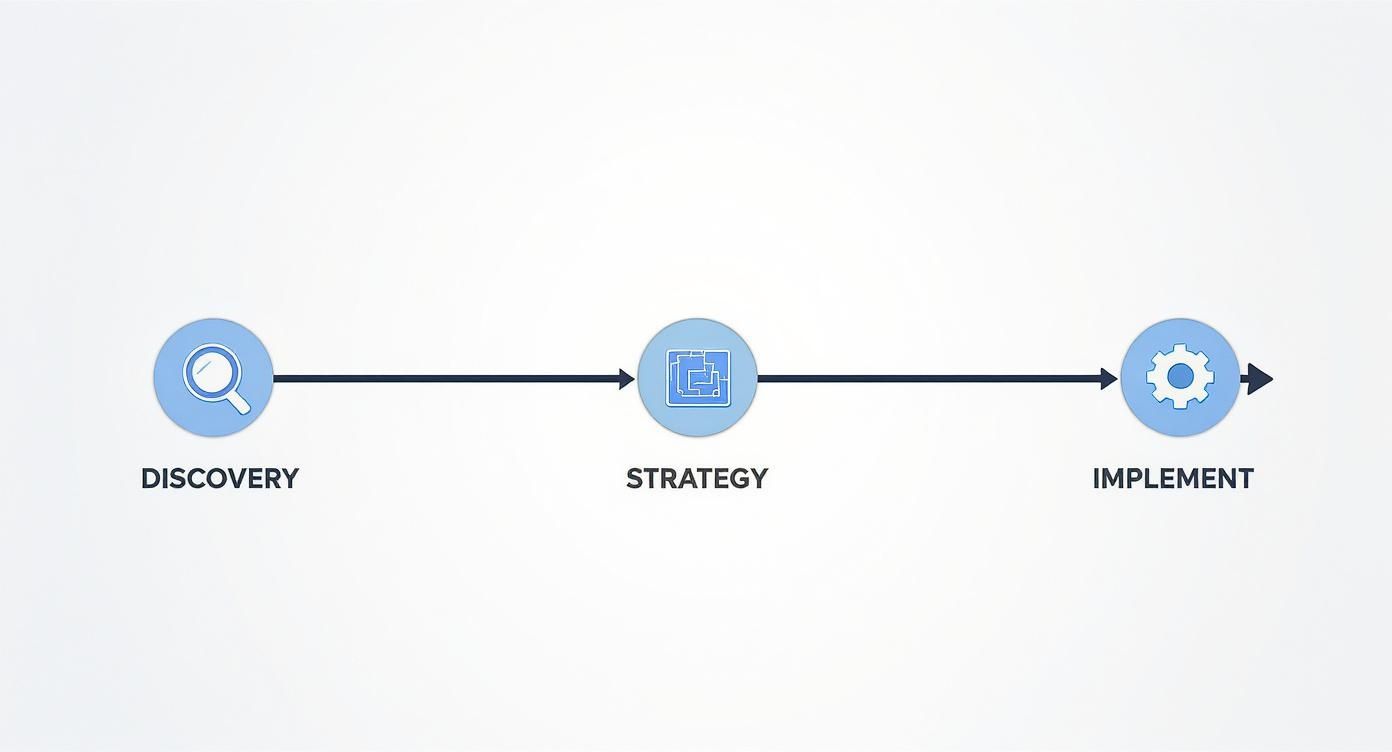
This process is all about delivering value incrementally. We start by deeply understanding your business before we build a single thing.
Phase 1: Discovery And Assessment (Weeks 1-2)
The first two weeks are a deep dive into your current world. This isn't just about looking at spreadsheets; it's about understanding how your business actually runs. We sit down with your key people—from finance to sales—to map how information really flows between departments.
We'll conduct a full audit of your key data sources, whether that's your CRM, accounting software like QuickBooks, or other operational platforms. The goal here is to find the real sources of data chaos, pinpoint where the numbers get disconnected, and understand your biggest reporting headaches. This groundwork is absolutely critical for building a solution that solves your actual problems.
Phase 2: Strategy And Design (Weeks 3-4)
With a crystal-clear picture of your data landscape, we shift into strategy. This is where we design a data governance framework that fits your business—not some clunky, one-size-fits-all corporate template. We work with you to define simple but powerful rules for data quality and create a shared data dictionary so everyone is finally speaking the same language.
We'll also establish clear roles and responsibilities. A big part of this is identifying the best people on your team to act as Data Stewards—the folks who will "own" specific data sets, like customer or product info. This step builds accountability right into your daily operations. Finally, we recommend the right tools for the job, focusing on how platforms like Power BI can be used to create automated, trustworthy KPI dashboards.
Think of this as the blueprinting stage. We translate everything we learned in discovery into a practical, actionable plan that shows exactly how we’ll build your single source of truth.
Phase 3: Implementation (Weeks 5-8)
This is where the plan comes to life. We roll up our sleeves and start executing the strategy, focusing on quick wins to build momentum and show immediate value. This often starts with cleaning up your most critical data—like your messy customer list—and building your first automated Power BI dashboard for a key metric like daily sales.
We get to work configuring systems, automating all those manual data-pulling tasks, and providing hands-on training for your team. A crucial part of this phase involves integrating disconnected systems to ensure data flows smoothly without anyone having to copy and paste. For businesses looking to connect various sources into a unified view, understanding the role of specialized data integration consultants can shed light on just how powerful this process can be. Our goal is to empower your team, not create a dependency on us.
Phase 4: Monitoring And Improvement (Ongoing)
Data governance isn't a one-and-done project. The final phase is all about making sure the system you've built is sustainable and keeps delivering value for the long haul. We establish simple KPIs to monitor data quality and track the efficiency gains from your new automated reports.
We work with your team to embed these new data practices into your company culture, making data ownership a natural part of everyone's job. This cycle of ongoing monitoring and continuous improvement ensures your data remains a reliable, scalable asset—delivering a clear and lasting return on your investment.
The Real Business Impact of Good Data Governance
Let's be clear: a data governance framework isn’t just some technical, box-ticking exercise. It's a commercial strategy, plain and simple. For founders and operators, this is where investing in data governance consulting stops being a cost and starts generating real, tangible results. It’s about connecting the dots between clean, organized data and a healthier bottom line.
Think about all the time your team spends fixing errors, hunting for the right numbers, or arguing over which report is correct. When that stops, they get hours of productive time back every single week. That’s a direct boost to efficiency and a cut in operational costs. More importantly, it shifts their energy from tedious, manual work to the high-value strategic thinking that actually moves the needle.
But the impact goes far deeper than just saving time. It fundamentally changes how you run your business.
From Guesswork to Confident Decisions
The single biggest win from good data governance is the ability to make smarter, faster decisions with complete confidence. When you know, without a doubt, that the numbers in your Power BI dashboards are accurate, strategic planning flips from being reactive to proactive. You can finally create a reliable forecasting model, pinpoint your most profitable customers, and spot market trends before your competitors even know what's happening.
This kind of clarity is only possible when you have a single source of truth that everyone in the organization trusts. To see just how transformative this one concept can be, check out our guide on establishing a single source of truth for your data.
Good data governance gets rid of the ambiguity that kills momentum. It replaces "I think" with "I know," giving you the solid ground you need to steer the business with precision.
Building a Scalable Foundation for Growth
A solid governance framework is also the scaffolding you need to scale your business without everything falling apart. As you grow, your data volume and complexity will explode. The data chaos that’s a minor headache today will become an insurmountable bottleneck tomorrow if you don't get ahead of it.
Proper governance ensures your data systems can handle that complexity. You can add new products, enter new markets, and expand your team without creating a mess of disconnected data silos. This forward-thinking approach is exactly why the global Data Governance Solutions market is growing so fast. Valued at roughly USD 3.8 billion recently, it’s projected to climb at an annual rate of 21.8% to hit USD 15.8 billion in the next decade. Businesses are investing because they know governing data is the key to future success. You can find more insights on this growing market and its drivers here.
A Real-World Example in Retail
Let's make this tangible. Imagine a small retail business constantly struggling with stockouts of popular items while being overstocked on others. Their sales data from their e-commerce site, physical store, and wholesale channels were completely siloed. The reports were always late and never seemed to match up.
By bringing in a consultant to set up a simple data governance framework, they achieved three key wins:
- Unified Data: They created one trusted sales dashboard in Power BI that pulled from all sources.
- Clear Definitions: Everyone finally agreed on what "sales" and "inventory levels" actually meant across the business.
- Daily Automation: Reports were automated, giving them a real-time pulse on performance.
The result? They got a clear, unified view of sales and inventory, which led to a 15% reduction in costly stockouts and a major improvement in cash flow. This is a perfect, real-world example of how data governance consulting isn't an expense—it’s a direct investment in operational excellence and profitability.
Your First Steps Toward Data Clarity
Feeling overwhelmed by the data chaos? You’re not alone. Many businesses feel like they're drowning in numbers they can't trust. But the good news is you don't need a massive, disruptive overhaul to start taking back control. It all begins with a few focused, practical steps that build momentum and deliver immediate clarity.
The entire data governance consulting market is growing for a simple reason: businesses are realizing the high cost of doing nothing. This is part of a larger big data consulting market expected to hit USD 33.36 billion within a decade, growing at a 13.1% annual clip. While industries like finance are leading the charge due to heavy regulations, the core principles apply to any business ready to scale. You can find more insights on this expanding market on market.us.
Your Three-Step Action Plan
Forget trying to fix everything at once. That's a recipe for failure. Instead, focus on what hurts the most right now and build from there.
-
Identify the Pain: First, get brutally honest about the single biggest problem your bad data is causing. Are your financial forecasts so inaccurate that planning is a guessing game? Are unreliable sales reports leading to poor strategic calls? Isolate one or two high-impact issues to tackle first. This focus is critical.
-
Map Your Critical Data: Next, make a simple list of the information your business absolutely cannot run without. We're not talking about mapping every single data point—that comes later. For now, just focus on the crown jewels: customer contact details, sales transaction records, product inventory. Knowing what truly matters helps you put your energy in the right place.
-
Get Expert Guidance: You don’t have to figure this out alone. The most successful businesses partner with experts who can provide a clear roadmap and the right tools, like Power BI, to build a system that lasts. An expert can help connect the dots in your data and, more importantly, help you sidestep the common mistakes that trip so many companies up.
Moving from chaos to clarity is a journey of small, deliberate steps. By identifying your key pain points and most critical data, you create a focused starting point for building a governance framework that actually works for your business.
Want to automate your reporting and finally trust your data? Book your free BI consultation today to see how Vizule can help you take these first steps and build a foundation for scalable growth.
Got Questions About Data Governance?
It’s completely normal to have a few questions before diving into something like data governance consulting. We get it. Here are some of the most common ones we hear from founders and small business leaders, with some straight-talking answers.
Is My Business Too Small for Data Governance Consulting?
Absolutely not. In fact, getting your data house in order early is one of the biggest advantages a growing business can have.
For a smaller company, data governance isn't about shelling out for some complex, enterprise-level software. It's about building simple, repeatable habits—like agreeing on how customer names are entered into your CRM, or making sure everyone in the company defines "monthly recurring revenue" the same way. A consultant helps you build a framework that fits your size, preventing the data chaos that will inevitably slow you down later. It's all about building a solid foundation to scale on.
What Is the Difference Between Data Governance and Data Management?
Great question—people use these terms interchangeably all the time, but they're not the same. The easiest way to think about it is to imagine you're building a house.
- Data Management is the actual construction work. It's the "how"—the electricians wiring the house, the plumbers fitting the pipes, the builders laying the bricks. In data terms, this is the technical nuts and bolts of storing, moving, and processing your data.
- Data Governance is the architect's blueprint. It’s the "why" and "who"—the set of rules, standards, and roles that everyone on the job site has to follow. It’s the master plan that ensures the house is built correctly and safely.
You can't build a solid house without both. Governance provides the plan, and management executes it.
How Quickly Can We See Results from This?
While building a complete governance framework is a journey, not a flip of a switch, you should absolutely see tangible results quickly. Any good data governance consulting project focuses on scoring "quick wins" right out of the gate to build momentum and prove its value.
Our first move is always to tackle your biggest data headache in the first few weeks. That might mean cleaning up a critical customer list for a big marketing push or building a single, trusted Power BI dashboard for daily sales that everyone can rely on.
These early fixes solve immediate problems and build a ton of confidence across the team. From there, the bigger benefits—like major efficiency gains and strategic clarity—start to really take hold over the first few months as the new processes become second nature. It’s about delivering value at every step, not making you wait until the very end to see a return.
Ready to stop wrestling with messy spreadsheets and start making decisions with confidence? The team at Vizule specialises in building practical data frameworks that empower SMBs to automate reporting and unlock insight-led growth. Book your free BI consultation with our experts today to see how we can bring clarity to your data.


