


A data integration consultancy is the partner you call when your business is drowning in data but starved for answers. If you’re a founder or operator, you know the pain: you have numbers in your CRM, your accounting software, and a dozen spreadsheets, but getting a straight answer to a simple question feels impossible. A consultancy’s job is to untangle that mess, weaving all your scattered information into a single, automated reporting engine you can finally trust.
Why Your Data Is Everywhere but Answers Are Nowhere

If you run a small or medium-sized business, this probably sounds familiar. You have a mountain of data sitting in your CRM, your accounting software, various marketing platforms, and a labyrinth of Excel sheets. But when you need a straightforward answer to a question like, "What's our true customer acquisition cost?" it feels like an impossible quest.
You’re stuck manually copying and pasting numbers, hunting down discrepancies, and ultimately falling back on gut feelings instead of hard facts.
This all-too-common headache is caused by data silos. Think of it like trying to bake a cake with the flour at your house, the eggs at a neighbour's, and the sugar across town. You technically have all the ingredients, but they’re completely useless until you get them into one kitchen. Without a central place to work, you can't see the full recipe, let alone trust the final product.
The True Cost of Disconnected Data
This scattered approach does more than just waste time—it introduces serious risks into your business. When your finance team pulls numbers from one system and your sales team pulls from another, their reports will never line up. This inevitably leads to friction in meetings and a deep-seated lack of trust in the data itself.
The consequences are real and costly:
- Inaccurate Forecasting: Trying to predict cash flow without a unified view of your sales pipeline and financial actuals is just a guessing game.
- Wasted Time: Your team spends hours, maybe even days, every month just cobbling reports together instead of analyzing what's happening and planning their next move.
- Missed Opportunities: Crucial insights about customer behaviour or operational bottlenecks stay buried in separate datasets, meaning you can't act on them.
A data integration consultancy is like the master chef who designs a modern, efficient kitchen for your business. Their job is to build a system that automatically gathers all your ingredients (data) in one place, making sure everything is ready for you to cook up insightful reports and confident decisions.
This challenge is so universal that the global data integration market is on track to hit USD 36.16 billion by 2032, a clear sign of how many businesses are struggling to consolidate their data. This isn't just a "big company" problem; it's a make-or-break hurdle for any SMB looking to scale intelligently.
By finally connecting the dots between your systems, you can move from data chaos to a single source of truth that powers your entire operation.
What a Data Integration Consultancy Actually Delivers
So, you're tired of wrestling with scattered data and you're wondering what a data integration consultancy actually does. Let's clear that up. It's not about selling you another piece of software; it's about building a reliable, automated information engine for your business—a "single source of truth" you can finally trust.
Think of it less like a tech purchase and more like a service designed to solve deep-rooted business problems. A consultant’s real job is to translate your commercial goals into a technical reality. They make sure the right information gets to the right people, at the right time, without anyone having to lift a finger.
Instead of just handing over a tool and a manual, a consultancy delivers tangible results. They architect the entire system that turns raw, messy data from all your different platforms into clear, actionable insights on a dashboard.
Core Deliverables That Solve Business Pains
Working with a data integration consultancy shifts your business from constantly putting out fires to building a proactive strategy. The focus is always on the 'why' behind the technical work—how can we use this data pipeline to solve a specific commercial challenge?
Here’s what that looks like in practice:
- Automated Data Pipelines: Picture these as the superhighways for your company's information. A consultant designs and builds these pipelines to automatically pull data from your CRM, accounting software, and operational tools. This completely gets rid of the soul-crushing monthly task of exporting CSVs and copy-pasting everything into spreadsheets.
- A Unified Data Model: This is the central, organised library where all your once-siloed data now lives in perfect harmony. A consultant structures this so that a "customer" in your sales system means the exact same thing as a "customer" in your finance system. Getting this right is absolutely critical for accurate forecasting and seeing the true picture of your business.
- Interactive Power BI Dashboards: This is where you see the magic happen. Forget static, out-of-date reports. You get dynamic dashboards that answer your most pressing questions in real time. You can drill down from a top-level revenue number to see which product lines or sales reps are driving performance, all in just a few clicks. These dashboards become genuine assets—what some experts call data products—that your team will use every single day.
A good data consultancy doesn’t just connect your tools. They build a sustainable system that turns your messy, fragmented data into your most valuable strategic asset, giving you clarity and saving your team countless hours.
From Technical Blueprints to Commercial Wins
At the end of the day, all the technical work is just a means to an end. The real deliverables are the business outcomes you get from it. To see the full picture, it helps to think about the broader role of expert business IT consulting services. The goal is always to apply technology to drive measurable growth and efficiency.
For example, by integrating your sales pipeline data from your CRM with your actual financials, you can build a forecasting model in Power BI that is dramatically more accurate. This helps you manage cash flow with confidence and make smarter decisions about hiring and investment. Likewise, automating your board reporting pack frees up your finance team to focus on strategic analysis instead of tedious data-wrangling. That’s the real ROI.
Want to automate your reporting and finally trust your data? Book a free BI consultation with our consultants today.
A Proven Framework for Unifying Your Business Data
Hiring a data integration consultancy shouldn't feel like a shot in the dark. A successful project—one that delivers real business value, not just a technical fix—is built on a clear, structured process. We believe in a transparent framework that takes you from the chaos of disconnected data to the clarity of strategic insight, one logical step at a time.
This isn't just about hooking up different software systems. It's a method fine-tuned to understand your specific business goals first, then build a data engine that directly fuels them. Each phase is designed to produce a concrete outcome that simplifies how you work and sharpens your decision-making.
The infographic below gives you a high-level look at our process, from initial modeling and pipeline construction all the way to final dashboard delivery.
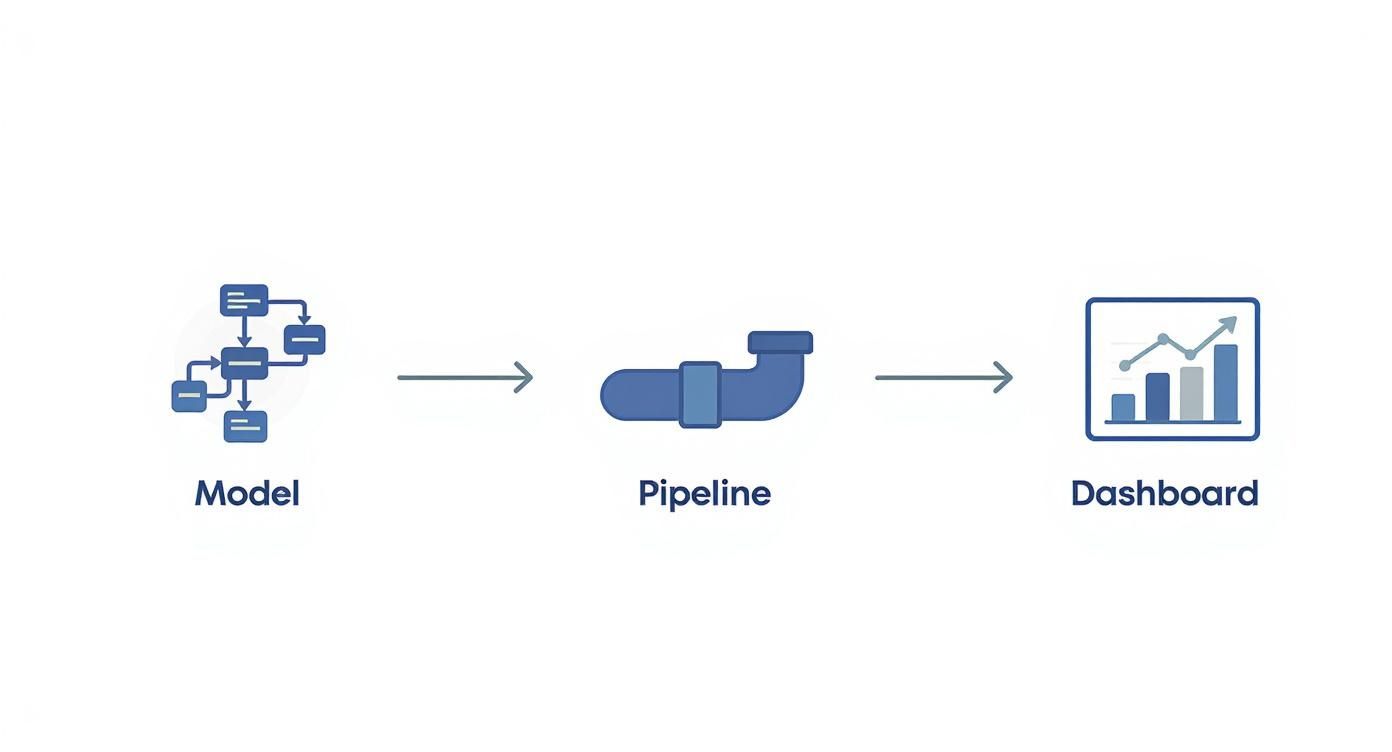
This workflow ensures every technical step we take is directly tied to the business insights you actually need.
Phase 1: Diagnostic and Discovery
The most important work happens before a single line of code is written. We kick things off with a deep dive, not just into your data, but into your business objectives, your biggest frustrations, and the strategic questions you're trying to answer.
We'll ask questions like:
- Which manual report wastes the most time and causes the biggest headaches each month?
- What are the key performance indicators (KPIs) you wish you could track daily, but can't?
- Where do your finance and operations teams always seem to disagree on the numbers?
This discovery phase makes sure we’re solving the right problems from day one. We map out all your data sources—from your accounting software and CRM to those critical-but-messy operational spreadsheets—to pinpoint all the gaps and inconsistencies.
Phase 2: Data Pipeline Design
Once we have a clear picture of your goals and your data landscape, we start architecting the solution. This is where we design the automated data pipelines that will become the central nervous system for your business information.
Think of it like drawing up the plumbing blueprints for a new house; you need a clear, efficient plan before you start laying any pipes. We figure out the best way to pull, clean, and merge your data so it flows automatically and reliably from every source into one central place. This design phase is also crucial for planning future growth, ensuring the system we build today can support you tomorrow. For a closer look at the nuts and bolts, check out our guide on how to build a data pipeline.
Phase 3: Building the Unified Data Layer
With the blueprint signed off, our team gets to work building your single source of truth. This is where we bring all your information together from those separate systems into one unified, structured data layer. Say goodbye to conflicting numbers and version-control nightmares in Excel.
This unified layer is the foundation for any reporting or analysis you can actually trust. By standardizing definitions—making sure a "customer" or a "sale" means the exact same thing everywhere—we eliminate the data arguments that kill productivity in meetings. As businesses connect more tools, this is becoming non-negotiable. The number of connected devices is set to explode from 18.8 billion to 40 billion by 2030, which will only create more integration headaches for companies that don't have a unified strategy.
This unified data layer is the single most important asset for becoming a data-driven business. It’s the clean, organised, and trustworthy foundation upon which all insightful decisions are built.
Phase 4: Power BI Dashboard Automation
The final step is where your data comes to life. We connect your new unified data layer to Power BI and build interactive, automated dashboards that give you answers to your most important questions at a glance.
This is where you see the real, tangible payoff. That manual month-end report that used to take three people two days to compile? It now updates itself every single morning. The cash flow forecast you were never quite sure you could trust? It's now powered by real-time, reliable data. We work side-by-side with you to design visuals that aren't just slick, but are built to help you spot trends, flag outliers, and make smarter decisions, faster.
This four-phase framework demystifies the entire process, ensuring any engagement with a data integration consultancy like Vizule is focused squarely on delivering measurable results for your business.
Moving From Data Chaos to Strategic Clarity and ROI

It’s one thing to understand the mechanics of pulling your data together, but it's another thing entirely to see that work translate into real-world business results. As a founder or operator, you’re not just buying a data pipeline; you're investing in strategic clarity, operational efficiency, and a tangible return on that investment. The endgame isn't the tech—it's the commercial outcomes that push your business forward.
Bringing in a data integration consultancy is really about turning clean, reliable data into measurable wins. It’s about taking the hours your team wastes wrestling with spreadsheets and converting that time into high-value analysis. It's the difference between guessing your cash flow and forecasting it with genuine confidence.
The Tangible ROI of Integrated Data
When your data finally starts working for you, the impact ripples across the entire business. This goes way beyond just having nice-looking dashboards; the benefits are measured in saved time, lower costs, and smarter, faster decisions.
And this isn't just theory. Studies show that organisations with mature data integration practices see an average ROI of 295% over three years. On the flip side, a massive 95% of organisations point to integration problems as a primary roadblock to adopting new tech like AI, which shows just how critical expert guidance really is.
Here’s a breakdown of the commercial benefits you can realistically expect:
- Drastic Reduction in Manual Reporting: Imagine clawing back 10, 20, or even 40 hours of your team's time every single month. By automating financial and operational reports, you kill the tedious, error-prone cycle of exporting and merging data. This frees up your key people to focus on strategy, not spreadsheets.
- Improved Forecast Accuracy: When the sales pipeline data from your CRM speaks directly to your financial actuals, your forecasting models become exponentially more reliable. This leads to sharper cash flow management, smarter hiring decisions, and strategic planning you can actually stand behind.
- Alignment Across Teams: Finally, get your sales, marketing, and finance teams singing from the same hymn sheet. A single source of truth cuts out the friction and wasted time that comes from arguing over which data is "correct," creating a culture of trust and collaboration.
A successful data integration project isn't measured by the complexity of its technology, but by the simplicity and clarity it brings to your most critical business decisions. It’s about getting the right numbers to the right people, automatically.
A Real-World Scenario
Let’s look at a common pain point. The founder of a growing SaaS company used to spend the first week of every month manually pulling data from Stripe, HubSpot, and their product analytics tool just to build a board report. It was a painful process, and by the time the report was finished, the data was already a week out of date. Key metrics like customer churn and lifetime value were little more than educated guesses.
After working with a data integration consultancy, they built an automated pipeline that fed all this data into a single, unified model. This powered a live Power BI dashboard that gave them:
- Real-time churn rates, broken down by customer segment.
- Accurate customer acquisition costs (CAC) and lifetime value (LTV).
- A clear view of the sales pipeline measured against financial targets.
The founder didn't just save days of work each month; they uncovered a critical insight. A specific customer segment was churning at a much higher rate than others. This discovery allowed them to launch a targeted retention campaign that directly improved their bottom line. This is the true power of a well-executed data strategy.
This kind of shift from reactive reporting to proactive insight is completely achievable. To see how this could apply to your own business, check out our guide on building a powerful data analytics strategy that drives growth.
How to Choose the Right Data Integration Partner
Picking a partner to untangle your business data is a huge decision. This isn't just about hiring a vendor who can plug a few apps together; it's about finding a strategic advisor who actually understands your business goals and can build a data system that helps you hit them. The best data integration consultancy always puts business outcomes first and tech second.
You're looking for someone who will feel like an extension of your own team, not just another contractor. They should be just as obsessed with nailing your forecast accuracy and killing off manual reports as you are. That requires a rare mix of deep technical skill, sharp business sense, and a battle-tested process.
What to Look for in a Consultancy
As a founder or operator in a small or medium-sized business, you need a partner who cuts through the noise and delivers value, fast. Steer clear of consultancies that hide behind jargon or try to sell you overly complex, enterprise-level tools that you just don't need.
Here’s a practical checklist to keep you on the right track:
- Focus on Business Outcomes, Not Just Tools: The first conversation should be about your pain points—"Our month-end reporting is a two-week nightmare"—not their favorite software stack. A great partner translates your business challenges into a clear, actionable data strategy.
- Proven Experience with SMBs: A startup's data problems are a world away from a multinational corporation's. Look for case studies and testimonials from businesses your size. They’ll get your resource constraints and the urgent need for high-impact, practical solutions.
- Deep Power BI Expertise: A tool is only as powerful as the person wielding it. A partner with serious Power BI chops can build more than just pretty dashboards; they can construct robust financial models and automated reporting engines that truly work for your business.
- A Transparent and Structured Process: Ask them to walk you through their project plan, step by step. A reliable consultancy will have a clear framework, from the first discovery call to the final handover and training, so you always know what to expect.
Critical Questions to Ask Any Potential Partner
Once you've got a shortlist, it's time to really dig in. The answers to these questions will tell you everything you need to know about their approach, their expertise, and whether they're the right fit for the long haul. Make sure you have these ready before you jump on a call.
- How will you ensure this solution can scale with my business as we grow? A good fix doesn't just solve today's problems. It has to be a flexible foundation that can handle more data sources and tougher questions as your company expands.
- Can you show me an example of how you've solved a similar reporting problem for another SMB? This cuts right through the sales pitch and gets you to the proof. They should be able to demo their past work and clearly explain the business impact it had.
- What does your process for knowledge transfer and team training look like? The project is only a success if your team can confidently use and understand the new dashboards. A great partner will have a solid plan to empower your people.
- How do you measure the ROI of a data integration project? Their answer needs to be grounded in real business metrics—hours saved, improved forecast accuracy, faster decision-making—not just technical checkmarks.
Choosing the right partner is the single most important step in moving from data chaos to strategic clarity. To see how Vizule approaches this, check out our complete guide on data integration consultants.
Ready to find a partner who gets your business? Book a free BI consultation with our team to discuss your specific data challenges and see how we can help.
Unlock Insight-Led Growth in Your Business

It’s time to stop wrestling with spreadsheets and start making decisions with real confidence. We’ve walked through the pain of siloed data, the strategic power a data integration consultancy brings to the table, and the real-world ROI you get from clear, automated reporting.
You don't have to keep running on guesswork or spending weeks pulling together manual reports that are stale the moment they’re finished. The next step is building a smarter, more resilient business on a foundation of data you can actually trust.
To truly 'Unlock Insight-Led Growth in Your Business', you need well-integrated data feeding into the right tools. A unified data layer is what ensures platforms for Mixpanel product analytics, for example, get the clean, complete data they need to uncover deep customer insights and drive your strategy forward.
Stop letting disconnected data dictate the limits of your growth. The clarity you need to scale effectively is within reach, and you don’t have to build it alone.
Take the Next Step Today
The journey from data chaos to strategic clarity is a lot more straightforward than you might think. We connect the dots in your data to put your reporting on autopilot and build a foundation for sustainable growth.
Connect with us to design your financial dashboard in Power BI and talk through your specific data challenges and map out a practical path forward.
Answering Your Data Integration Questions
We get it. Diving into data integration can feel like a big step, especially for a growing business. Here are some straightforward answers to the questions we hear most often from SMB owners.
Is My Business Too Small for a Data Consultancy?
Honestly, not at all. Getting a solid data foundation in place early is one of the smartest moves a growing business can make. It's the best way to prevent the dreaded "Excel chaos" from spiralling out of control later on.
Think of it as building your reporting processes to scale with you, not break when you do. We specifically work with SMBs, focusing on practical wins that solve immediate headaches—like endless manual reporting—while building a system that’s ready for your future growth.
How Long Does a Typical Integration Project Take?
This really depends on how many data sources you have and how complex they are. That said, a foundational project for a small or medium-sized business usually lands somewhere in the 4 to 12-week range.
Every project kicks off with a clear discovery phase where we map everything out and give you a realistic timeline. We always aim to deliver value fast, often by automating your single most painful manual report first. This gives you an immediate, tangible win and shows the ROI right away.
What Tools Do You Use? Am I Going to Be Locked In?
We’re big fans of the Microsoft Power Platform, especially Power BI, because it’s powerful, flexible, and genuinely cost-effective for SMBs. But our priority is always to build a solution that fits your tech stack and budget, not ours.
Our goal is simple: recommend the most practical tools for your specific needs. We make sure you own the final solution, so you're never locked into proprietary software that doesn't serve you in the long run.
How Is This Different From Just Buying a BI Tool?
This is a crucial question. A BI tool like Power BI is brilliant for visualising data, but it's only as good as the data you feed it. If your data is messy, disconnected, and full of inconsistencies, your dashboards will be too.
It’s the classic 'garbage in, garbage out' problem. A data integration consultancy does the essential work before the visualisation. We clean, combine, and structure your data from all your different systems into one reliable source of truth. By handling this critical groundwork, we ensure your BI tool actually delivers insights you can trust to run your business.
Ready to stop wrestling with spreadsheets and start using your data to drive growth? Vizule helps you connect the dots and build an automated reporting engine that just works. Book your free BI consultation and let's build a plan for your specific challenges.
