


Are you trying to map out your startup's future while buried in a tangled mess of Excel tabs? You're not the only one. For any founder, a financial model is the bedrock of your strategy. It’s the process of taking your vision—all your plans for revenue, expenses, and cash flow—and translating it into a concrete, numerical plan. It's the one tool you absolutely need to make smart, insight-led decisions and get serious investors to pay attention.
Why Spreadsheets Are Holding Your Startup Back
Too many founders get trapped in spreadsheet chaos, leading to a cascade of problems: outdated reports, critical errors you only find when it’s too late, and a ton of missed opportunities. This isn't just a minor administrative headache; it's a massive strategic liability that keeps you stuck in reactive mode.
Relying on a static spreadsheet is like trying to navigate a new city with a paper map from a decade ago. It’s clunky, full of mistakes, and completely blind to what’s happening in real time. When your reports are always out of date, you're forced to react to old news instead of proactively shaping what comes next. That manual grind turns your data from a powerful asset into a source of pure anxiety.
From Reactive Reporting to Proactive Strategy
This is where a proper financial model for startups completely changes the game. It shifts your entire focus from just accounting for what already happened to building a clear, dynamic roadmap for growth. Suddenly, you can answer critical "what if" questions in an instant:
- What happens to our runway if we hire two more developers?
- How does a 15% drop in customer retention impact our cash flow in six months?
- Can we actually afford that big marketing push next quarter?
This is about so much more than just crunching numbers. It's about stress-testing your entire business plan and creating a story that investors can actually get behind.
A financial model is the numerical expression of your startup’s goals—how many customers you’ll have, how many people you’ll hire, how your margins will improve. The differences between projections and actual results can drive incredible insight into your company’s potential.
In a tough funding environment, a solid, dynamic model is simply non-negotiable. For instance, in Q2 2023, venture capitalists invested just $31.8 billion into US and Canadian startups—the lowest quarterly figure in over three years. This trend just underscores how critical it is for founders to stand out with financial storytelling that’s both credible and compelling. You can dive deeper into the latest financial modeling statistics on digitaldefynd.com.
Let's quickly break down the difference between the old way and the new way.
Spreadsheet Chaos vs. Dynamic Financial Model
Relying on static spreadsheets creates strategic blind spots and operational headaches. A dynamic financial model, on the other hand, becomes your strategic co-pilot, enabling proactive, data-driven decisions that are crucial for navigating the uncertainties of startup growth.
| Limitation | Traditional Spreadsheet | Dynamic Financial Model |
|---|---|---|
| Scenario Planning | Manual, cumbersome, and error-prone. "What-if" analysis is a nightmare. | Instantly run multiple scenarios (best, worst, base case) to understand potential outcomes. |
| Data Integrity | High risk of formula errors, broken links, and version control issues. | A single source of truth with built-in logic checks and automated updates. |
| Collaboration | Difficult for teams to work on simultaneously, leading to conflicting versions. | Cloud-based and collaborative, allowing teams to work from the same live data. |
| Investor Readiness | Often looks unprofessional and lacks the depth to answer tough diligence questions. | Builds credibility with sophisticated, easy-to-understand projections and assumption tracking. |
| Real-Time Insight | Always out-of-date, reflecting past performance rather than future possibilities. | Provides a live, forward-looking view of the business, connecting operations to financials. |
Ultimately, a well-built financial model acts as your single source of truth. It gets your operations and finance teams on the same page, preps you for any question an investor throws your way, and gives you the confidence to lead with insight.
Ready to escape spreadsheet chaos and build a financial model that actually drives growth? Book your free BI consultation with a Vizule expert today and see how we can help automate your reporting stack.
Building the Three Core Financial Statements
A solid financial model is really built on three core statements that, together, tell your startup's complete financial story. If you're a non-finance founder, this might sound a bit daunting, but it’s more straightforward than you think.
Think of them as three different camera angles on your business. Each one gives you a unique perspective, but they’re all filming the same scene. When you put those three views together, you get a coherent narrative that gives you, your team, and any potential investors a crystal-clear understanding of your business's health and potential. Flying blind is not a strategy.
This infographic nails the journey from a mess of spreadsheets to the clarity a proper financial model provides.
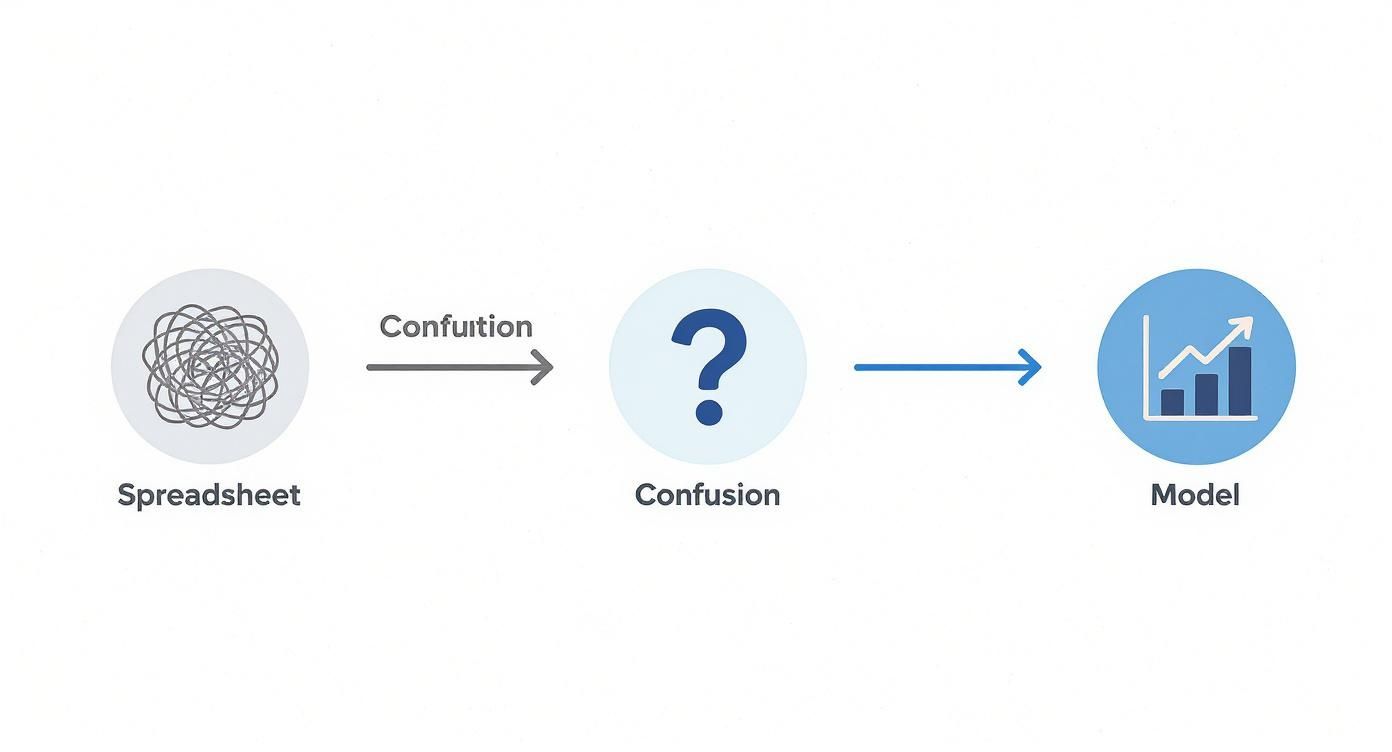
This visual shows a common pain point—spreadsheet chaos—and the strategic clarity you gain from a structured model. Let's break down the components that get you there.
The Income Statement: Your Profit and Loss
First up is the Income Statement, which you'll often hear called the Profit and Loss (or P&L). This statement answers one simple, crucial question: "Is my business actually profitable?" It does this by adding up your revenues and subtracting all your expenses over a set period—be it a month, a quarter, or a full year.
This is where you'll project your revenue streams and map out every single cost tied to running the business.
- Revenue: This is your top line. How much cash are you bringing in from sales? For a SaaS startup, this is your subscription revenue. For an e-commerce brand, it's the total value of all the products you sold.
- Cost of Goods Sold (COGS): These are the direct costs tied to delivering your product. For a software company, think server hosting or third-party API fees. If you're selling a physical product, this is your manufacturing and materials cost.
- Operating Expenses (OpEx): These are the costs of keeping the lights on, no matter how much you sell. We're talking salaries, office rent, marketing spend, and all those software subscriptions you have.
Subtract your COGS from your Revenue, and you get your Gross Profit. Then, subtract your OpEx from Gross Profit, and you've got your Net Income (or loss). That final number is the famous "bottom line" that tells you if you made or lost money.
The Balance Sheet: A Snapshot of Company Health
While the P&L shows your performance over time, the Balance Sheet is a snapshot of your company's financial health at one specific moment. It’s built on a simple, unbreakable formula: Assets = Liabilities + Equity.
This statement tells you exactly what your company owns and what it owes.
The Balance Sheet is a health check-up for your startup. It tells you if you have a strong financial foundation or if you're over-leveraged and at risk. An unbalanced balance sheet is a major red flag for investors.
Let’s quickly demystify the parts:
- Assets: These are the valuable resources your company owns. This includes cash in the bank, accounts receivable (money customers owe you), and physical equipment.
- Liabilities: This is what your company owes to others. Think accounts payable (bills you haven’t paid yet), loans, and deferred revenue (when a customer pays you for a service you still need to deliver).
- Equity: This is the net worth of the company. It’s what would be left for the owners if you sold all your assets and paid off all your liabilities. It includes the initial capital from founders and any funds from investors.
The Cash Flow Statement: The Lifeblood of Your Startup
Finally, we get to the Cash Flow Statement—and honestly, for an early-stage company, this might be the most critical document of all. Being "profitable" on your P&L is great, but cash is what pays the bills. This statement tracks the actual movement of cash in and out of your business.
It breaks down your cash activities into three main buckets:
- Operating Activities: Cash from your core business operations, like payments from customers or paying employee salaries.
- Investing Activities: Cash spent on or gained from long-term assets, like buying new computers or selling a piece of property.
- Financing Activities: Cash from investors or lenders, or cash you pay out for things like loan repayments.
A startup can easily be profitable on paper but still run out of cash because clients are slow to pay or they had to make a big upfront investment. The Cash Flow Statement brings these risks out into the open. For a deeper look at this, here are some helpful steps to create a robust cash flow statement.
These three statements don't operate in a vacuum; they're deeply interconnected, creating a dynamic model that tells the whole story. Ready to build a model that connects these dots and gives you a single source of truth? Connect with us to design your financial dashboard in Power BI.
Defining Assumptions That Investors Will Believe
A slick financial model with perfectly linked statements means nothing if the numbers are pure fantasy. I've seen it time and time again: a founder presents a beautiful "hockey stick" growth curve that isn't grounded in anything real. It's the fastest way to lose an investor's trust.
Your model is only as credible as the assumptions behind it. This is where we move from the mechanics of spreadsheets to the art of building a logical, defensible bridge between your grand vision and the numbers on the page.
Grounding Your Model in Reality
You need to anchor your projections using a combination of top-down market analysis and bottom-up operational planning. This dual approach shows investors you understand both the macro opportunity and the micro-level execution needed to actually capture it.
-
Top-Down Analysis (TAM, SAM, SOM): This is about sizing up your battlefield. You start with the Total Addressable Market (TAM)—the entire global demand for what you're offering. Then, you narrow that down to your Serviceable Addressable Market (SAM), which is the slice of the TAM you can realistically reach. Finally, you define your Serviceable Obtainable Market (SOM), the piece of the SAM you can actually capture. This shows you've thought strategically about market penetration.
-
Bottom-Up Analysis: This is where the rubber meets the road. Instead of just claiming you'll grab 1% of a massive market, this approach builds your revenue forecast from the ground up. It's based on tangible drivers you can control, like your planned marketing spend, expected website traffic, conversion rates, and average deal size. This directly connects your financial projections to your real-world marketing and sales plans.
Frankly, the bottom-up approach is far more compelling. You can directly influence your conversion rates or marketing budget; you can’t single-handedly change the size of the entire market.
Forecasting Key Startup Metrics
With that foundational approach in place, you can zero in on the specific metrics that truly drive your business. Investors will scrutinize these numbers, so they need to be realistic and backed by evidence—either from your own early data or solid industry benchmarks.
You absolutely need to forecast:
- Customer Acquisition Cost (CAC): How much does it really cost in sales and marketing to get one new customer? Be brutally honest with yourself and include every associated cost.
- Lifetime Value (LTV): How much gross profit will an average customer bring in over their entire relationship with your company? A healthy business needs an LTV that is multiples higher than its CAC, usually a ratio of at least 3:1.
- Churn Rate: What percentage of customers are you losing each month or year? For any subscription business, high churn is a silent killer that will completely undermine your growth.
A classic mistake is being way too optimistic about these core metrics. If your projected CAC is a fraction of the industry average and you don't have a revolutionary acquisition strategy to back it up, you'll face intense skepticism. Use benchmarks as a reality check, then adjust based on what makes your business unique.
Building a flexible, transparent model is what separates the amateurs from the pros. In fact, over 300 startups have used this kind of advanced modeling to raise more than $3 billion in funding. The common thread? Their models all had customizable assumptions that instantly flowed through all three financial statements and provided at least 12 to 18 months of clear cash flow forecasting.
Creating a Dedicated Assumptions Tab
If you take one thing away from this section, let it be this: create a dedicated 'Assumptions' tab in your spreadsheet. This is the central control panel for your entire financial forecast.
Instead of hard-coding a number like "0.05" for a conversion rate directly into a formula, list every key driver on this tab. Then, reference those cells throughout your entire model. If you need more guidance on setting this up, check out our guide on financial forecasting for startups.
This one practice accomplishes two critical things:
- It makes your logic transparent. An investor, advisor, or new team member can go to one single tab and immediately understand the core drivers of your business. No one has to go on a treasure hunt through your formulas.
- It makes scenario analysis effortless. Want to see what happens if your churn rate increases by 10%? You change one cell in the Assumptions tab, and your entire model—from revenue straight down to cash flow—updates instantly.
By meticulously defining and isolating your assumptions, you transform a fragile spreadsheet into a dynamic, strategic tool. It’s a model that builds confidence and invites the right kind of conversation.
How to Stress-Test Your Business Plan
A financial model with a perfect set of assumptions is a great starting point, but let's be honest—it's just one version of the future. Any smart investor knows that plans rarely survive first contact with the market. They'll immediately start probing for weaknesses, asking tough questions your static model simply can't answer.
What happens if a key client churns out of the blue? Or if a scrappy new competitor forces you to slash your prices by 15%? This is the moment your financial model needs to evolve from a simple forecasting tool into a strategic command center for navigating the unknown. It's time to put your plan under pressure.

This isn't just about passing due diligence; it's about arming yourself with the tools to make critical decisions when things get messy. By building flexibility directly into your model, you're proving you've anticipated market shifts and have a game plan ready to go.
Building Scenarios: Base, Best, and Worst Case
Scenario planning is all about creating multiple, distinct versions of your financial future. This exercise forces you to think beyond your baseline plan and actually quantify the impact of both opportunities and threats. For any startup, there are three essential scenarios to build out:
- Base Case: This is your primary forecast, the one built on the realistic, defensible assumptions we covered earlier. It's what you genuinely believe is the most likely outcome.
- Worst Case: Think of this as your "break glass in case of emergency" scenario. What happens if sales are 30% lower than you planned and customer churn doubles? This model will show you your absolute minimum cash needs and helps define your survival runway.
- Best Case: This is your blue-sky, optimistic outlook. What if a new marketing channel absolutely crushes it, or you land a massive enterprise contract months ahead of schedule? This helps you figure out how much capital you'd need to pour fuel on the fire and really seize a growth opportunity.
The real magic is being able to switch between these scenarios by changing just a few key variables in your assumptions tab. When an investor sees that, it instantly shows them you've thought through a range of outcomes and understand exactly which levers to pull in each situation.
Identifying Your Most Sensitive Drivers
While scenario planning looks at broad, sweeping changes, sensitivity analysis is much more surgical. It’s about isolating individual variables to see which ones have the most dramatic impact on your bottom line. You might be shocked to find that a small tweak in one metric can have a much bigger effect than a massive change in another.
For a SaaS startup, for instance, you might discover that:
- A 5% increase in your monthly churn rate actually shortens your runway by four whole months.
- A 10% drop in the sales team's conversion rate has a bigger impact on your cash position than a 20% spike in server costs.
This kind of analysis is incredibly powerful because it tells you exactly where to focus your team's attention. The variables that cause the biggest swings in your cash flow are the metrics your entire team needs to live and breathe every single day. For a detailed walkthrough, you can explore our guide on how to perform sensitivity analysis and apply the concepts to your startup's model.
By identifying the two or three most sensitive drivers in your model, you're not admitting weakness. You're demonstrating a sophisticated understanding of your business and showing investors that you know exactly which metrics to manage obsessively to ensure survival and success.
Ultimately, stress-testing your model is about replacing anxiety with preparedness. It transforms your forecast from a fragile house of cards into a resilient, adaptable tool for making smarter strategic decisions.
Ready to build a model that doesn't just predict the future but helps you navigate it? See how Vizule can help automate your reporting stack and build the dynamic tools you need for growth.
From Excel Chaos to Power BI Clarity
Let's be honest. Manually updating your financial model is a soul-crushing chore, and it’s a process just begging for human error. It’s the digital version of balancing a chequebook by hand—painfully slow, wildly inefficient, and a single misplaced decimal can send your entire forecast off a cliff. For founders, this usually means late nights wrestling with CSV exports and broken formulas right before a board meeting.
It's time to graduate from the spreadsheet trap. This is where modern business intelligence (BI) and automation completely change the game. We're talking about moving from a static, historical document to a living, breathing dashboard that tells you what’s happening in your business right now.
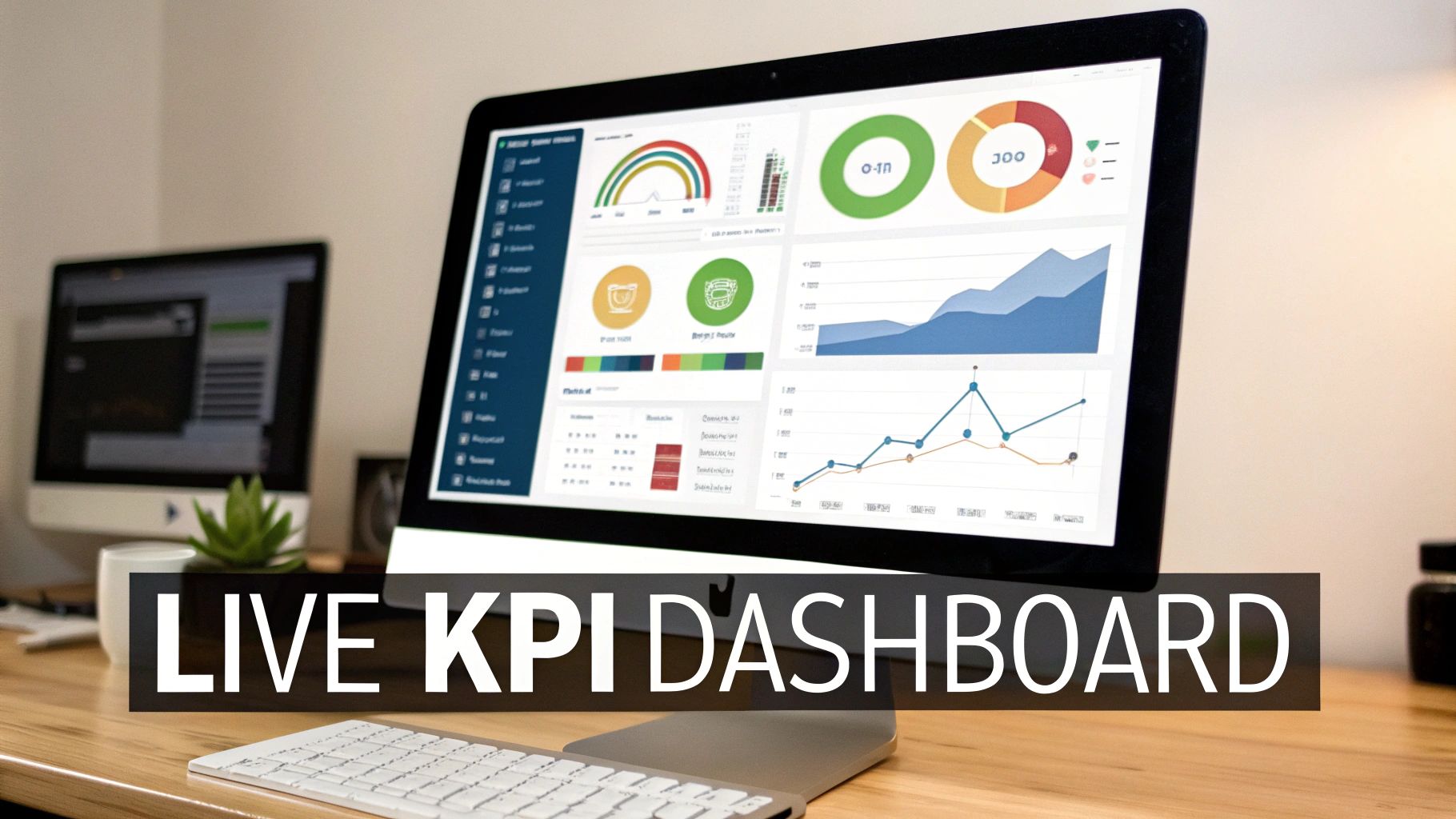
This shift isn't just about clawing back a few hours a week. It's about gaining the confidence to make daily decisions based on hard facts, not gut feelings.
Connecting Your Data Sources in Real Time
Imagine a financial model that updates itself. That's not science fiction; it's what tools like Microsoft Power BI are built for. Power BI can connect directly to the platforms you already use to run your business, acting as a central hub that pulls all your disparate data into one unified, clear view.
This means you can set up automated reporting pipelines from:
- Your Accounting Software: Pull real-time actuals on revenue and expenses directly from QuickBooks or Xero. No more manual entry.
- Your Payment Processor: See up-to-the-minute subscription data, including new MRR and churn, straight from a source like Stripe.
- Your CRM: Track your sales pipeline, conversion rates, and customer acquisition costs from platforms like HubSpot.
When your model is plugged directly into these sources, your forecasts are always grounded in today's performance, not last month's stale numbers. The "actuals vs. forecast" variance is no longer a quarterly surprise—it becomes a live metric you can watch every single day.
From Static Reports to Interactive Dashboards
The real magic happens when you move beyond endless rows and columns into visual, interactive dashboards. A well-designed Power BI dashboard doesn't just present data; it tells a story. You can visualize your most critical startup KPIs and finally see the connections between them.
For example, a founder can instantly see:
- Cash Runway: A simple, clear chart showing exactly how many months of cash you have left. It updates automatically as invoices are paid and revenue lands.
- MRR Growth: A visual breakdown of new, expansion, and churned monthly recurring revenue, letting you pinpoint precisely what’s driving growth (or holding it back).
- Customer Acquisition Cost (CAC) vs. Lifetime Value (LTV): A dynamic ratio that shows the health of your customer acquisition engine in real time.
Instead of emailing different versions of a spreadsheet back and forth, you can share a single, interactive dashboard with your team and investors. This creates a single source of truth, ensuring everyone is working from the same numbers and focused on the same goals.
This approach fundamentally changes how you interact with your financials. You stop dreading the monthly reporting cycle and start using your model as a strategic tool that's always ready to answer your most pressing questions with just a few clicks. If you're ready to make this leap, our guide on revamping your reporting with Power BI is the perfect place to start.
Making Insight-Led Decisions with Confidence
Ultimately, automating your financial modeling for startups with a tool like Power BI is about more than just efficiency. It’s about gaining clarity and control. When you trust your numbers because you know they're always up-to-date, you can make bold, informed decisions with real confidence.
You can spot a negative trend in customer churn and react within days, not weeks. You can see a marketing campaign delivering a fantastic CAC and decide to double down on the budget instantly. This is the agility that separates fast-growing startups from the ones stuck in Excel chaos. It’s about turning your financial model from a historical artifact into your most powerful strategic co-pilot.
Want to automate your reporting and finally trust your data? Book a free call with our BI consultants today.
Answering Your Toughest Financial Model Questions
Even with the best tools, founders always have a few lingering questions. That's natural. Your financial model isn't just a spreadsheet—it's a core piece of your strategic toolkit, and you want to get it right.
Let's tackle some of the most common questions we hear from founders every single day. The goal here is to give you clear, practical answers so you can build and use a model that actually works for your business.
How Far Out Should My Startup Financial Model Project?
For any early-stage company, a three-year projection is the standard. But the real, granular focus has to be on the first 12 to 18 months. This is the period investors will absolutely tear apart.
That initial timeframe needs a detailed, month-by-month breakdown. Why? Because it’s critical for managing your cash flow and calculating your runway. It's the operational plan that proves you can survive and execute right now.
Once you get past the 18-month mark, your projections can comfortably shift to a quarterly or even annual basis. The level of uncertainty just explodes the further out you look, so the goal isn't perfect accuracy. It's about showing a credible, near-term operational plan and a high-level strategic vision for the years that follow.
What Are the Biggest Mistakes Founders Make in Financial Models?
It’s surprisingly easy to get lost in the weeds of a model. But a few common missteps can instantly destroy your credibility with investors. Avoiding these pitfalls is just as important as building the model correctly in the first place.
Here are the most frequent mistakes we see:
- The Unrealistic "Hockey Stick": This is a classic. Projecting explosive, exponential revenue growth without any data or a clear, scalable customer acquisition strategy to back it up.
- Underestimating Costs: Forgetting to account for the true cost of growth is another big one. This happens all the time with hiring, marketing spend, and all those unforeseen operational expenses that pop up.
- Ignoring Cash Flow: So many founders focus only on profitability from the income statement while neglecting the cash flow statement. Remember: profit doesn't pay salaries; cash does.
- Hard-Coding Assumptions: This is a technical but critical mistake. Plugging key drivers like churn rate or conversion percentages directly into formulas instead of listing them in a separate assumptions tab makes the model rigid and impossible to audit.
- Overly Complex Models: Building a labyrinth of formulas and tabs that only you can understand. A good model should be clear enough for an investor or team member to follow the logic without a two-hour walkthrough.
The purpose of your model is communication. If an investor can't understand the logic behind your numbers in a reasonable amount of time, they won't invest the effort to decipher it. Simplicity and clarity build trust.
Can I Use a Template for My Financial Model?
Templates can be a fantastic starting point, no doubt. Especially if you're new to this. They give you a solid structure and help you see how the three core financial statements—the P&L, balance sheet, and cash flow statement—all connect.
But you have to use them with caution. Every business is unique. A generic, one-size-fits-all template will almost certainly fail to capture your specific revenue streams, unique cost structure, or key business drivers.
Relying too heavily on a template can lead to a model that doesn't actually reflect your business. Worse, it becomes incredibly difficult to defend during investor due diligence. The best approach? Use a template for inspiration, but build your own model from scratch or work with an expert to customize one that truly fits your startup.
How Do I Accurately Model Headcount and Salaries?
Since payroll is almost always a startup's biggest expense, getting this part right is non-negotiable. The best practice is to create a separate "Hiring Plan" or "Headcount" tab within your model.
For each role you plan to hire, you should list out:
- Job Title
- Department
- Planned Start Date
- Annual Salary
Use industry benchmarks from sites like Glassdoor or Payscale to make sure your salary data is grounded in reality. This dedicated tab lets you easily shift your hiring timeline around and immediately see the impact on your cash flow and operating expenses.
And crucially, don't forget to factor in the extra employee-related costs. Things like taxes, benefits, and payroll fees can easily add another 20-30% on top of the base salary. Linking this tab directly to your P&L and Cash Flow statements automates these critical calculations and keeps everything clean.
Ready to build a financial model that answers every question and drives your startup forward? The team at Vizule specializes in transforming messy data into clear, automated financial models and Power BI dashboards. We help founders gain the visibility they need to scale smart.


