


So, what exactly is dimensional modeling?
Think of it as the strategic blueprint for organizing your business data so that reporting tools, like Power BI, can deliver insights that are fast, flexible, and—most importantly—trustworthy. It’s the method for creating a single, reliable source of truth, allowing you to stop second-guessing your numbers and start making confident, insight-led decisions.
Escape Excel Chaos With Smarter Data Organization

If you’re running a small or medium-sized business, you've likely felt the pain of wrestling with disconnected spreadsheets. Your finance report shows one sales number, while the operations dashboard tells a completely different story. This constant data wrangling is more than just frustrating; it drains your team's time, erodes confidence in your data, and makes getting a clear picture of performance feel impossible.
You're not alone. Many founders and operators are trapped in this cycle of manual report updates and painful data reconciliation. The real problem isn't your data itself, but how it's structured. Most systems are built to record transactions quickly, not to make analysis easy.
The Strategic Shift From Spreadsheets to Structure
This is precisely where dimensional modeling comes in. Don’t think of it as complex technical jargon. See it as a strategic move to finally gain clarity and control over your business information. It provides a logical framework that turns messy, raw data from siloed systems into a clean, intuitive structure that business intelligence tools love.
The core idea is surprisingly simple. You separate your data into two distinct categories:
- Measurable Events: These are your numbers—the quantifiable business actions you track, like sales revenue, website clicks, or support tickets resolved.
- Descriptive Context: This is the "who, what, where, and when" behind those numbers—details like customer names, product categories, store locations, or sales dates.
Organizing your data this way builds a rock-solid foundation for all your reporting and is a fundamental step toward automating your reporting stack. While dimensional modeling is perfect for analytical queries, it's one of many ways to organize data; some systems use other approaches like Nonrelational Databases for different kinds of tasks.
Many businesses are caught in the endless loop of exporting, copying, and pasting data just to get a basic cash flow report. This process is not only slow and prone to errors, but it also creates multiple "versions of the truth" that lead to confusion and mistrust in the numbers.
Here’s how dimensional modeling flips the script.
From Excel Headaches to Power BI Clarity
| Common Challenge in Excel | How Dimensional Modeling in Power BI Solves It |
|---|---|
| Manual Data Updates: Spending hours copying and pasting new data from different sources into one massive spreadsheet. | Automated Data Refreshes: The model connects directly to your sources (like QuickBooks or your CRM), pulling in new data automatically on a schedule. |
Inconsistent Formulas: Different team members use slightly different calculations (e.g., SUM(A1:A50) vs. SUM(A1:A51)), leading to conflicting reports. |
Centralized Business Logic: Calculations and KPIs are defined once in the model, ensuring everyone sees the exact same, correct numbers. |
Fragile VLOOKUPs: Complex VLOOKUP or INDEX/MATCH functions break easily if a column is moved or a file is renamed. |
Stable Relationships: Data tables are connected through stable relationships, making reports robust and reliable. No more broken formulas. |
| Slow Performance: Reports grind to a halt or crash as your spreadsheets grow with more and more data. | Optimized for Speed: The structure is specifically designed for high-speed querying, handling millions of rows of data with ease. |
| Difficult to "Slice and Dice": Answering a new business question often requires rebuilding the entire report from scratch. | Flexible, Interactive Analysis: Users can intuitively filter, drill down, and explore data from any angle without needing to build a new report. |
Ultimately, adopting this structure means you can finally move from a reactive state of fighting data fires to a proactive one. You can trust your numbers, explore your data freely, and focus on what really matters: growing your business.
Understanding Facts and Dimensions
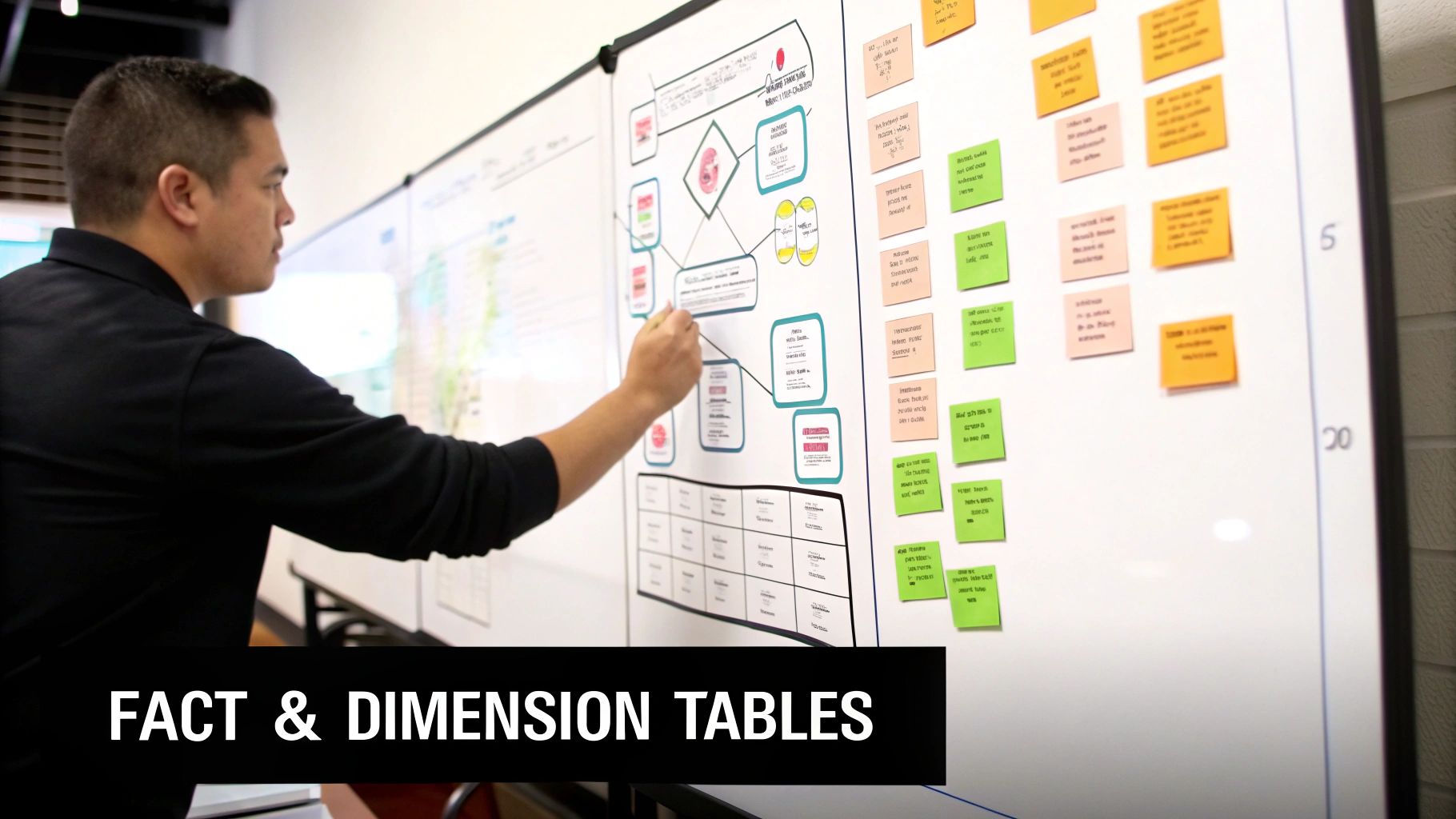
To really grasp what dimensional modeling is, let's strip away the jargon and look at its two core building blocks: facts and dimensions. The best way to picture this is with something we all know—a simple store receipt. It's just a mix of numbers and words, but each part tells a different story.
Think about the numbers on that receipt: the quantity of an item you bought (2), the price of each one (£5.00), and the final total (£10.00). Those are your facts. Facts are the hard numbers, the measurable data points that track what’s happening in your business. They’re the "how much" and "how many."
Then you have all the descriptive context giving those numbers meaning. The product name ("Espresso"), the date ("October 26th"), the customer who bought it ("Jane Doe"). These are your dimensions. They provide the crucial "who, what, where, when, and why" behind the facts.
The Power of Separating Numbers from Context
If you've ever worked with a massive spreadsheet, you know how facts and dimensions get jumbled together into one messy table. It works for a little while, but analysis quickly becomes a nightmare. This is where dimensional modeling works its magic. Its secret is simple: it strategically pulls these two types of data apart into separate, but connected, tables.
This separation is exactly what makes reporting tools like Power BI so incredibly powerful. It lets you slice and dice your data from any angle you can think of, answering critical business questions in seconds. You can instantly look at total sales (a fact) by region, by product category, or by a specific quarter (all dimensions).
A dimensional model is built for one main reason: to make your data dead simple to understand and lightning-fast to query. It organizes information the same way a business leader thinks, closing the gap between raw data and genuine insight.
Your business generates events all day long—a sale is closed, a lead is captured, an invoice gets paid. Every single one of these is a fact. The dimensions are simply the different lenses you use to look at all those facts.
Key Components of a Dimensional Model
- Fact Tables: This is the heart of your model. Fact tables are usually very long and contain all the numerical measurements from a business process. A sales fact table, for example, would have columns like
OrderQuantity,UnitPrice, andTotalSalesAmount. They capture the action. - Dimension Tables: These tables are the opposite—usually wider and much shorter than fact tables. They hold all the descriptive context. Think of a
Productdimension with details likeProductNameandCategory, or aCustomerdimension withCustomerNameandLocation.
By linking a central fact table to several of these dimension tables, you build a structure that’s both perfectly organized and super flexible for analysis. This is the foundation that allows a tool like Power BI to deliver the clear, reliable financial and operational reports you need to scale your business.
Star vs. Snowflake: Which Schema Is Right for You?
Now that you have a handle on the building blocks—facts and dimensions—it's time to decide how to arrange them. In the world of dimensional modeling, this conversation boils down to two main structures, or "schemas": the star schema and the snowflake schema.
This might sound like more technical jargon, but for a business owner who just wants reports that work, getting this right is crucial. Your choice here directly impacts the speed and simplicity of your entire reporting system.
This image gives you a quick visual of the two competing structures.
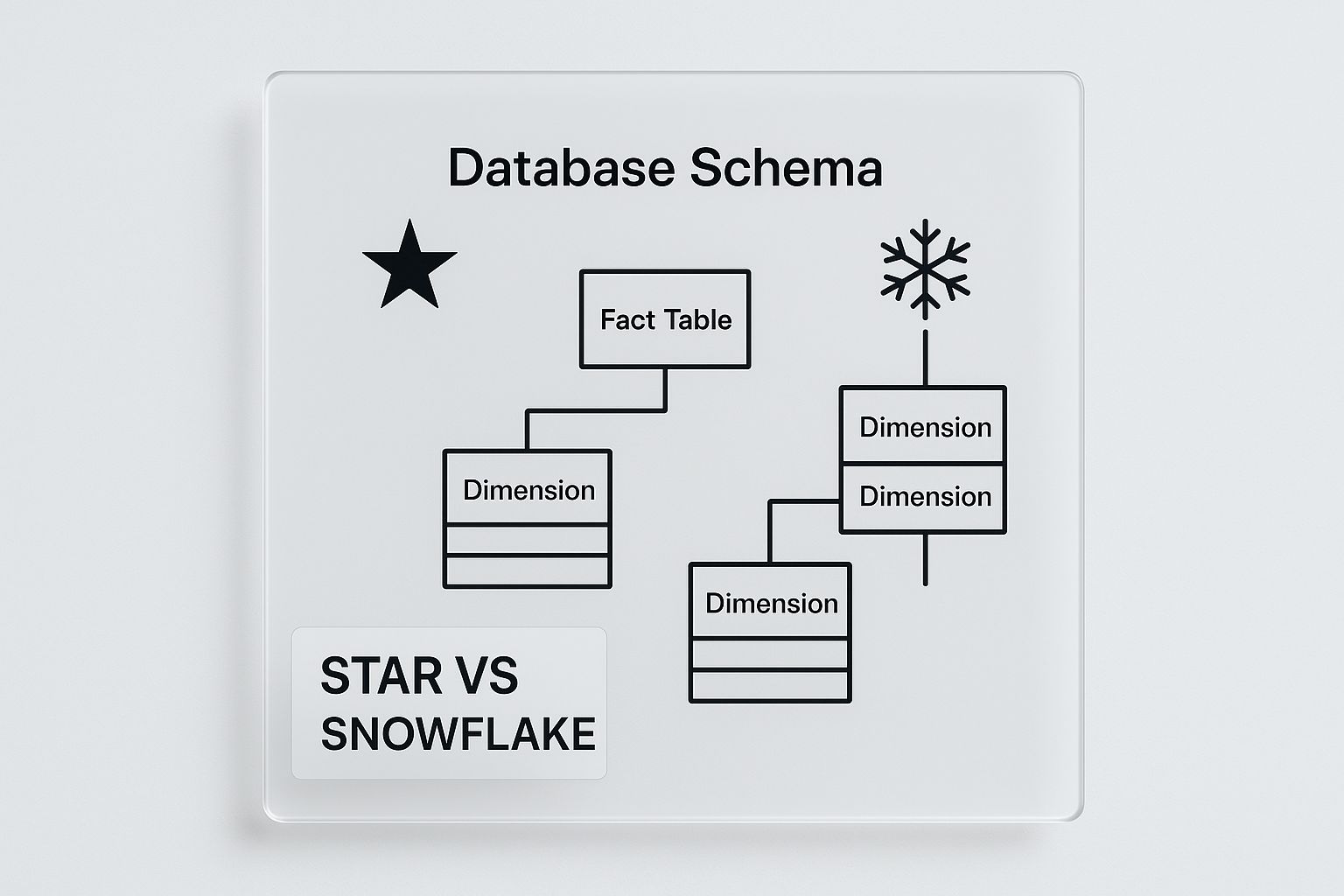
As you can see, the star schema has simple, direct connections, while the snowflake schema has a more fragmented, branching structure. Let's break down what that really means for your business.
The Star Schema: Your Go-To for Power BI
Imagine your main fact table (like "Sales") is the sun. All your dimension tables—"Products," "Customers," "Dates"—are planets orbiting it. Each planet is connected to the sun by a single, direct line. That's the star schema in a nutshell.
It's clean, simple, and incredibly efficient.
Business intelligence tools like Power BI are built to thrive on this structure. Queries run faster, calculations are more straightforward, and the entire model is far easier for anyone on your team to understand and maintain.
For 99% of small and medium-sized businesses, the star schema is the best—and frankly, the only—choice you should be considering. It nails the perfect balance of performance and usability you need for fast, insightful reporting.
This approach became the gold standard after it was introduced in the 90s, and for good reason. It simplifies complex data into an intuitive format that works perfectly for both business analysts and the reporting tools they rely on. You can read more about the foundational concepts of dimensional modeling to see how this came to be.
What About the Snowflake Schema?
So if the star schema is so great, why does the snowflake schema even exist? The snowflake schema takes the star schema's dimensions and breaks them down even further. For example, instead of a single "Product" dimension, you might split it into separate tables for "Product Category" and "Product Subcategory."
This creates a complex, branching structure that resembles, you guessed it, a snowflake.
In theory, this approach can save a tiny amount of data storage space. But that benefit comes at a massive cost. The model becomes far more complex, requiring many more connections (or "joins" in database speak) just to get a simple answer.
This complexity slows your reports to a crawl and makes the data model a nightmare for your team to navigate. It's typically only used in massive, enterprise-level systems where data architects have very specific, and often legacy, data storage requirements to worry about.
Choosing Your Data Model Structure
To make it crystal clear, here’s a breakdown of how these two models stack up for a typical business owner looking for reliable reports.
| Attribute | Star Schema (Recommended for Most Businesses) | Snowflake Schema (For Specific Complex Cases) |
|---|---|---|
| Performance | Fast. Queries are simple and direct, leading to quick-loading reports. | Slow. Requires multiple complex "joins" that can bog down your system. |
| Simplicity | Easy to understand. The logic is intuitive, making it accessible to your team. | Complex. The web of tables is confusing and hard for non-experts to navigate. |
| Maintenance | Simple to maintain. Adding new metrics or dimensions is straightforward. | Difficult to maintain. A small change can have a ripple effect across many tables. |
| Best For | Business intelligence, analytics, and KPI dashboards for SMBs. | Niche, large-scale enterprise data warehouses with storage constraints. |
For small and medium-sized businesses, the snowflake schema is a classic case of over-engineering. It introduces complexity that directly works against the goal of fast, clear reporting.
By sticking with the star schema, you ensure your data foundation is built for speed and clarity. This lets you focus on pulling insights from your data, not getting lost in a maze of tables.
Ready to build a clean, fast data model that finally gives you trusted numbers? Book your free BI consultation with a Vizule expert today.
How Dimensional Modeling Drives Business Growth
Connecting the dots between a well-built data model and real business results is where theory turns into profit. For founders and operators, dimensional modeling isn't just an IT project; it’s a strategic investment in clarity, speed, and ultimately, growth. It's what shifts your business from reactive data wrangling to proactive, insight-led decision-making.
A properly designed model delivers game-changing benefits that directly impact your bottom line. It transforms reporting from a slow, manual chore into a powerful engine for discovery. This structure is the difference between guessing what happened last quarter and knowing exactly which levers to pull next week.
Unlock Incredible Speed and Performance
Have you ever waited minutes—or even hours—for a critical spreadsheet to finish calculating? That delay is a direct cost to your business. It slows down decisions and frustrates your team. Dimensional modeling is specifically engineered to eliminate this bottleneck.
By pre-organizing data for analysis, queries that once crawled now execute in seconds. This isn't just a convenience; it's a competitive advantage. This speed empowers your team to ask more questions and explore data interactively. Instead of running one report and calling it a day, they can drill down, filter, and pivot on the fly, uncovering insights that would have stayed hidden in a slow, clunky system.
Establish a Single Source of Truth
Nothing paralyzes a growing business faster than teams arguing over whose numbers are right. When finance, sales, and operations all pull data from different spreadsheets, you get multiple versions of the truth. This erodes trust and leads to poor, misaligned decisions.
A dimensional model fixes this by creating one central, governed source for all your key metrics. When a KPI like "customer acquisition cost" is defined once in the model, everyone in the company sees the exact same number. This alignment is critical for everything from accurate board reporting to building an effective forecasting model.
A single source of truth isn't a buzzword—it's a business necessity. It ensures that every strategic conversation starts from a shared, trusted understanding of performance, eliminating confusion and fostering real collaboration.
Empower Self-Service Analytics
As a founder, you can't be the only person who understands the data. A key benefit of dimensional modeling is how it supports robust analytics platforms, forming the bedrock for advanced AI-powered Business Intelligence solutions. This empowers your team to find their own answers without creating a technical bottleneck.
With modern cloud platforms, a well-designed dimensional model can run queries up to 10 times faster than older, more complex structures. It's no surprise that 70–80% of data professionals worldwide still rely on its principles to build scalable data warehouses supporting thousands of users.
This intuitive structure allows non-technical users to easily explore data in tools like Power BI, building their own reports and dashboards. When your team can answer their own questions, you free up leadership to focus on high-level strategy, confident that day-to-day decisions are still guided by sound data.
Tracking Historical Performance Accurately
Your business isn’t static. Products get revamped, sales territories get redrawn, and customer profiles are constantly updated. This is all great news for growth, but it creates a massive reporting headache. How do you track performance over time without losing the story of what actually happened? Trying to wrestle this kind of change in a spreadsheet is a recipe for disaster.
This is where a sharp dimensional model really shines, specifically through a technique called Slowly Changing Dimensions (SCDs). Think of SCDs as a built-in time machine for your data. Instead of just overwriting old information and pretending it never existed, SCDs preserve the past so you can see the complete, accurate picture of your business journey.
A Practical Example: Sales Territory Changes
Let’s imagine Sarah, one of your star salespeople, moved from the North region to the West region in July.
Without a proper data model, your system would likely just update her record to "West." The problem? Suddenly, all her sales from January through June now look like they happened in the West. Just like that, your regional and individual performance reports are completely skewed and untrustworthy.
A dimensional model using SCDs handles this beautifully. When Sarah moves, it doesn’t overwrite her old record; it creates a new version:
- Sarah (Version 1): Region = North, Valid from Jan 1st to June 30th
- Sarah (Version 2): Region = West, Valid from July 1st onwards
This simple but powerful structure lets you answer critical business questions with confidence. You can see exactly what she sold in the old territory before the move and precisely track her performance in the new one after.
This isn't just a nice-to-have; it's essential for any business that relies on trend analysis. It ensures your historical reports are always accurate, letting you compare apples to apples even as the ground shifts beneath your feet.
SCDs are a cornerstone of effective business intelligence. It’s no surprise that studies show around 65% of data warehouses use this technique to maintain historical integrity. This is vital for accurate forecasting everywhere from finance to retail. You can discover more about historical data preservation methods and why they matter. Without this capability, you’re essentially flying blind, making big decisions based on a flawed version of your own history.
Build Your First Power BI Model the Right Way
Knowing the principles of dimensional modeling is a great first step. But turning that theory into a robust, scalable reporting system? That’s where the rubber really meets the road. Expert implementation bridges the gap between raw data and the kind of actionable insights that actually drive your business forward.
This is where you move from concepts to concrete action. A well-built model doesn’t just happen by accident; it demands a deep understanding of your unique business logic and commercial goals. The whole point is to translate your operational processes into a powerful data structure—one that fuels automated, insightful, and completely trustworthy reports in Power BI.
Avoid Costly DIY Pitfalls
Many businesses try the DIY route, and it often ends in frustration. They end up with models that are slow, a nightmare to maintain, and spit out numbers that just don't feel right. The initial setup might seem simple, but common mistakes—like defining relationships incorrectly, choosing the wrong level of detail, or mishandling historical data—create deep-rooted problems that are expensive and time-consuming to unravel later.
A proper dimensional model is a strategic asset. Think of it as the engine behind your entire reporting stack. Getting it right from the start saves countless hours of frustration and prevents bad decisions based on flawed data.
Your data model is the foundation of your analytics strategy. A weak foundation will eventually crack under the weight of your growing business, forcing you to start over. Building it right the first time is one of the smartest investments you can make.
This is exactly where Vizule comes in. We connect the dots in your data by applying best practices from day one. Our expertise is in designing and implementing dimensional models tailored to your specific needs, whether it’s for sales performance, operational efficiency, or financial reporting. We help you create that single source of truth you need to scale with confidence.
Learn more about how we apply these principles in our guide to business intelligence for finance teams.
Ready to transform your scattered spreadsheets into a powerful, automated reporting system you can finally trust?
See how Vizule can help automate your reporting stack. Book a free discovery call with our BI consultants today.
Your Questions About Dimensional Modeling, Answered
As you start thinking about how to get more from your business data, a few questions always pop up. It's completely natural. Here are some straightforward answers to what we hear most often from founders and operators about what dimensional modeling actually means for their business.
Is Dimensional Modeling Only for Big Companies?
Not at all. In fact, it’s a secret weapon for small and growing businesses. Why? Because it sets you up with a scalable foundation from the get-go.
When you organize your data the right way now, you sidestep the reporting chaos and tangled spreadsheets that inevitably bog down businesses as they scale. It’s about building a solid data foundation for growth, preventing the very problems that hinder it.
Do I Need a Separate Data Warehouse for This?
While dimensional models are the classic blueprint for data warehouses, you absolutely do not need one to get started. You can apply the exact same principles right inside modern tools like Power BI.
Power BI is more than capable of connecting to your different data sources—QuickBooks, your CRM, even a folder of spreadsheets—and building a clean, powerful model internally. This gives you all the benefits of a solid data structure without the cost and headache of managing extra infrastructure.
The real goal here is to get you trusted answers, fast. For most growing businesses, applying dimensional modeling inside Power BI is the quickest and most cost-effective path to making that happen.
How Long Does It Take to Build a Dimensional Model?
This depends on the complexity of your business and the current state of your data. However, it's often much faster than people imagine.
A foundational model focused on a critical area—like sales performance or financial reporting—can often be designed and built in just a few weeks. At Vizule, we focus on quick wins by tackling your most urgent business questions first. This way, you start seeing real value right away, which builds momentum and proves the power of a well-structured data model from day one.
Ready to get a clearer picture tailored to your specific needs and finally put your reporting on autopilot? The team at Vizule can help you map, model, and mobilize your data for genuine insight.
