

A data integration consultant is a specialist who designs systems to automatically connect all your business software—your CRM, accounting tools, and operational platforms. But what they really do is stop the soul-crushing cycle of exporting and merging spreadsheets. They empower you with accurate, real-time reports you can finally trust, turning disconnected data into your sharpest competitive edge.
Tired of Drowning in Data Chaos?

If you're like most founders and operators, you're buried in information. Data pours in from your CRM, accounting software, marketing platforms, and operational tools. It creates a mess of conflicting spreadsheets, wasted hours building manual reports, and a constant, nagging fear that you don't really know your numbers.
This fragmented reality makes every strategic decision feel like a shot in the dark. You’re left wondering if your sales data lines up with your financial statements or if your marketing spend is actually driving profitable growth. The time you burn copying and pasting data is time stolen directly from scaling your business.
From Data Chaos to Clarity
A data integration consultant is the architect who brings order to this chaos. Think of them as the specialist who builds digital bridges between your disconnected systems. They make sure information flows automatically and reliably into one central hub, creating a single source of truth for your business data.
This isn’t just about plugging one piece of software into another; it’s about transforming raw, scattered data into a genuine strategic asset. By automating the flow of information, a consultant wipes out the manual errors and frustrating delays that plague so many growing businesses.
The ultimate goal is to move you from reactive data clean-up to proactive, insight-led decision-making. When your systems talk to each other, you gain a clear, unified view of performance across finance, sales, and operations.
To make this more concrete, here's a look at the common frustrations we see every day from business owners and how a consultant provides a direct solution.
Common SMB Data Problems and a Consultant's Solution
| Your Problem | A Consultant's Solution |
|---|---|
| Manual, time-consuming reporting | Automates data pipelines to create self-updating dashboards in Power BI, saving hours of weekly work. |
| Conflicting data and "dueling spreadsheets" | Establishes a single source of truth, so everyone works from the same verified numbers. |
| Lack of visibility into key business drivers | Connects financial and operational data to reveal true profitability and performance metrics. |
| Data systems don't scale with the business | Designs a flexible and robust data foundation that supports future growth without breaking. |
Ultimately, a consultant's job is to take these headaches off your plate for good, giving you back the time and the reliable data you need to steer the ship confidently.
The Real Work of a Data Integration Consultant

So, what does a data integration consultant actually do day-to-day? Forget the jargon for a moment. Their real job is to be the translator between your business goals and the tech that makes them happen. They are the architects who look at a tangled mess of disconnected software and see a smooth, automated system that fuels your growth.
Imagine your sales data from Shopify could automatically talk to your financial forecasts in QuickBooks. You’d get a live, up-to-the-minute picture of your profitability without lifting a finger. That's the kind of practical solution a data integration consultant builds. It’s not just about moving data around; it’s about making sure that data tells a story that matters to your bottom line.
This kind of hands-on expertise is why the services side of data integration—consulting and professional services—made up a whopping 63.9% of total U.S. revenue in the market. It shows how vital these experts are in getting these complex systems designed and running properly.
Architecting Your Data Blueprint
The first—and most important—job for a consultant is to draw up a blueprint. This isn't about picking software off a shelf; it's a deep dive into how your business actually runs. They sit down with you to understand what you’re trying to achieve, whether that’s a clearer handle on cash flow or aligning your sales and marketing teams.
This process involves a few key steps:
- Identifying Key Data Sources: They pinpoint exactly where your most valuable information is hiding—in your CRM, your ERP system, or a dozen different spreadsheets.
- Defining Business Logic: This is where they translate your company’s unique rules—like how you calculate customer lifetime value or gross margin—into a set of instructions for the data.
- Designing the End Goal: They help you envision the final reports and KPI dashboards in a tool like Power BI that will finally answer the critical questions you ask to run your business better.
Building Your Data Pipelines
Once the blueprint is set, the consultant rolls up their sleeves and starts building. This is where they create the automated connections, or data pipelines, that pull all that information from your different systems together. A consultant’s core task is often defining and building out the right strategy for application integration, making sure everything works in harmony.
This is the hands-on work that finally puts an end to manual exports and endless copy-pasting. We have a guide that gets into the nitty-gritty of how to build a data pipeline, but for a business owner, the outcome is simple: your data just flows where it needs to go, automatically.
A consultant acts as the bridge between your commercial needs and the technical solution. They ensure the final system doesn't just work—it works for you, answering the specific questions you ask every day.
Ensuring Data Integrity
Lastly, a great consultant makes sure the numbers you’re looking at are solid. They’re responsible for putting systems in place to clean, validate, and quality-check the data as it flows through. This is the final, crucial piece of the puzzle. It’s what allows you to stop second-guessing your spreadsheets and start making decisions with real confidence.
How Data Integration Drives Real Business Growth
Connecting your data isn't just a technical fix—it’s a direct catalyst for growth. For small and medium-sized businesses, the benefits of working with a data integration consultant move far beyond tidy databases. They translate directly into tangible, bottom-line results that give you a serious competitive edge.
Forget abstract concepts and think about concrete wins. Imagine saving 10-15 hours of manual work every single week by fully automating your financial reporting. Picture your marketing team creating sharper campaigns with a unified customer view, boosting ROI because they finally see the whole picture.
This is the real-world impact of getting your data integration strategy right.
Achieve a Single Source of Truth
The most immediate win is creating a single source of truth. When your CRM, accounting software, and operational tools are all telling the same story, you eliminate the guesswork. Decisions are no longer based on conflicting spreadsheets but on solid, reliable data everyone in the company trusts.
This alignment means your sales forecasts finally match your financial reports, and your operational metrics accurately reflect your business health. It’s the essential foundation for confident, data-driven leadership.
Automate Manual Tasks to Free Your Team
So much of a founder's time is lost to repetitive, low-value work—exporting CSVs, cleaning data, and copy-pasting numbers into reports. A data integration consultant builds automated workflows that handle all that grunt work for you.
This frees up your best people to focus on what they do best: analyzing trends, talking to customers, and actually driving the business forward. This process often involves sophisticated data transformation, which is the 'magic' that turns raw, messy data from multiple sources into clean, analysis-ready information without anyone lifting a finger.
Enable Proactive Decisions with Real-Time Insights
When your data is integrated, you move from looking in the rearview mirror to seeing what’s ahead. Instead of waiting for month-end reports, you can have a live KPI dashboard in Power BI that shows you exactly what’s happening in your business, right now.
You can spot a cash flow issue before it becomes a crisis, identify your most profitable customer segments in real-time, and get your entire team aligned on the metrics that truly matter for growth.
This shift from reactive to proactive decision-making is perhaps the most powerful outcome. It allows you to operate with agility, seizing opportunities and mitigating risks faster than your competitors. By building this automated, scalable data foundation, a consultant doesn't just solve today's problems—they prepare your business for tomorrow's growth.
What to Expect When Working with a Consultant
Hiring a data integration consultant can feel like stepping into the unknown, especially if you're not a technical founder. You know you need help connecting the dots with your data, but the process, costs, and timelines can seem intimidating.
At Vizule, we believe in pulling back the curtain. Our goal isn't to sell you complicated software; it's to act as an extension of your team, delivering a solution that achieves your commercial goals.
We’ve broken down our engagement into a clear, collaborative four-step process. This isn’t a rigid template; it's a roadmap designed to eliminate surprise costs and complexity. You'll know exactly what to expect from our first chat to the final handover.
The infographic below gets to the heart of our philosophy: turning chaotic data into a clear path for business growth.
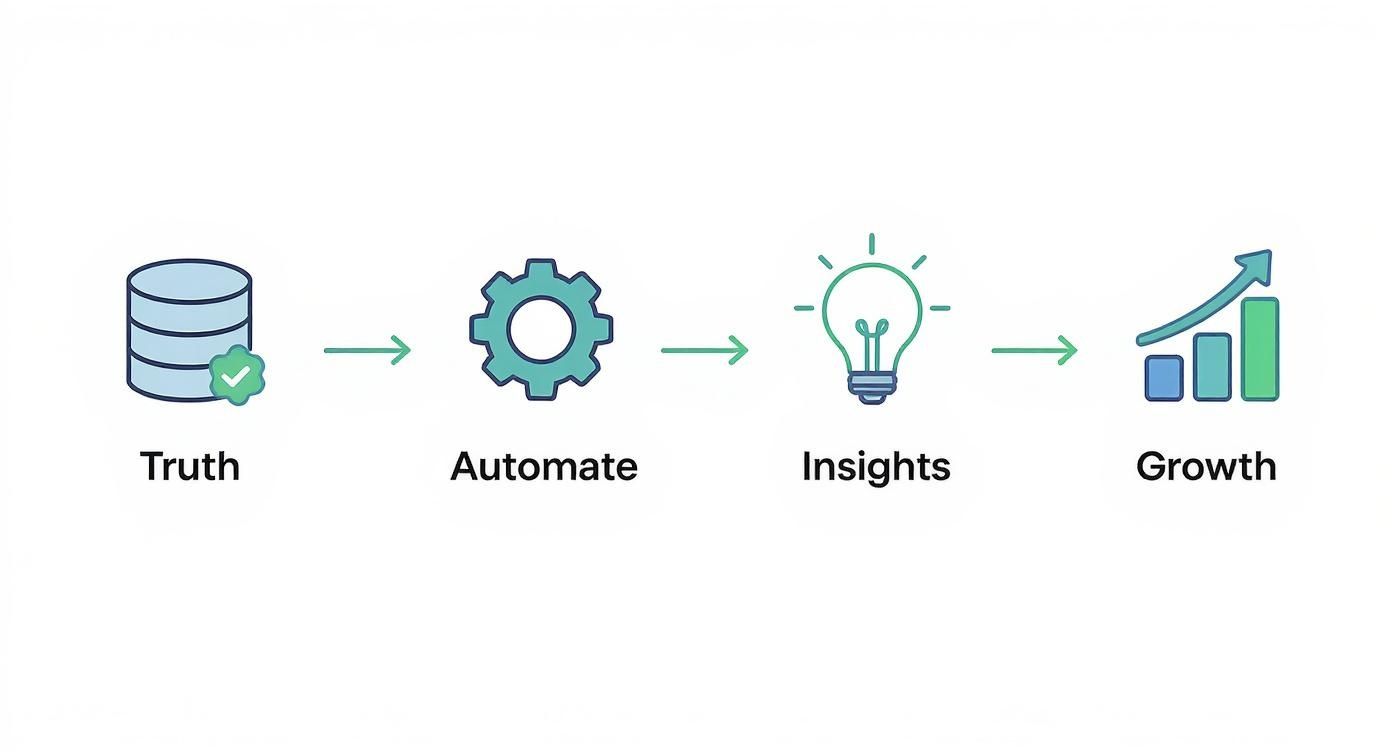
It all starts with establishing a single source of truth. From there, we automate data flows to unlock insights and pave the way for sustainable growth.
Our Collaborative Four-Step Process
We treat every engagement as a partnership. This is the only way to ensure the final solution is perfectly tuned to your business needs, not just a one-size-fits-all tech project.
-
Discovery and Strategy
First, we listen. This initial phase is a deep dive into your business objectives, operational headaches, and current data frustrations. We map out your existing systems and work with you to pinpoint the key questions you need answers to. -
Solution Design
Once we have a crystal-clear understanding of your goals, we'll present a straightforward, actionable roadmap. No jargon, no fluff. This includes the proposed architecture, a realistic timeline, and a fixed-scope proposal. You'll see exactly how we plan to connect your systems and what the final dashboards will look like in a tool like Power BI. -
Implementation and Build
This is where we roll up our sleeves. Our team builds the automated data pipelines and interactive dashboards we designed together. We operate with regular check-ins, so you have full visibility into our progress every step of the way. Laying a solid groundwork here almost always involves putting a clear data governance strategy in place to maintain data quality for the long haul. -
Team Empowerment and Handover
Our job isn't finished when the tech is built. We provide comprehensive training and support to ensure your team feels completely confident using their new tools. The ultimate goal is to empower you to ask questions of your data and get real value from your new automated reporting system.
This push for expert-led data projects is why the global data integration market is set to explode to $30.87 billion by 2030. With data coming from everywhere—CRMs, marketing platforms, IoT devices—businesses are increasingly looking for partners who can turn all that complexity into clarity.
By making our process transparent and collaborative, we take the guesswork out of the equation and deliver a solution that works for your business.
How to Choose the Right Data Integration Partner
Picking a data integration consultant isn’t like hiring a typical IT provider. The wrong choice can leave you with an over-engineered, expensive mess that completely misses what your business actually needs. You need a partner who speaks your language—the language of growth, profitability, and operational efficiency—not just technical jargon.
As a founder or operator, your focus is on the bottom line. The questions you ask should gauge a consultant's business sense and strategic thinking, not just their technical skills.
Before you sign on the dotted line, make sure you get clear answers to these critical questions:
- Do you understand my business goals, or just the tech? A great consultant starts with your objectives—like getting a real-time view of your cash flow or aligning sales and finance data. The technology is the solution, not the starting point.
- Can you show me examples of work with businesses my size? Enterprise-level solutions are often overkill for SMBs. You need a partner who knows the tools that are right-sized for your scale and budget, like Power BI. Learn more about the right tools in our modern data stack for SMBs in our guide.
- How will this project deliver a tangible return on investment? The entire conversation should be about business outcomes. We're talking about real results, like the hundreds of hours your team will save on manual reporting or the new revenue opportunities you'll uncover with better insights.
Specialist Consultant vs. General IT Provider
The data integration market is constantly shifting, making the vendor landscape feel like a maze. Staying on top of these changes requires serious specialisation. You can discover more insights about this evolving market on openpr.com.
This is where the difference between a specialist consultancy and a generalist IT firm comes into focus. A boutique firm like Vizule brings a business-first, strategic approach. In contrast, many larger IT firms or freelance developers might focus solely on the technical build, without a deep appreciation for your commercial reality.
To help you see the difference clearly, we've put together a quick comparison.
Choosing Your Partner: Specialist BI Consultant vs. General IT Provider
Understand the key differences to ensure you hire the right expertise for automating your business reporting and unlocking growth.
| Factor | Specialist BI Consultant (Vizule) | General IT Provider |
|---|---|---|
| Primary Focus | Solving specific business problems (e.g., automating financial reporting, building KPI dashboards). | Implementing and managing broad IT infrastructure and software. |
| Approach | Strategic and consultative. We start with your commercial goals to design a truly tailored solution. | Technical and task-oriented. Focused on executing a pre-defined IT project. |
| Expertise | Deep expertise in business intelligence, financial modeling, and tools like Power BI. | Broad knowledge across many technologies but may lack deep specialization in BI. |
| Outcome | An automated reporting system that provides actionable insights to actively drive growth. | A functional technical system that may not directly solve your core business needs. |
Choosing the right data integration partner means finding a team that acts as a strategic advisor, not just a technical vendor. This partnership ensures the solution you build becomes a true asset for growth, not just another piece of software.
Ready to Automate Your Reporting?
Let's be honest, the goal is to move from constantly putting out fires to proactively planning your next move. But that journey has a roadblock: disconnected data.
Too many founders and their teams get stuck wrestling with conflicting spreadsheets, spending hours on manual reports, and making crucial decisions without a complete picture. This data chaos doesn't just eat up your time; it caps your potential.
This is where a data integration consultant comes in. They build the automated bridges between your scattered systems, creating a single source of truth that feeds reliable, real-time dashboards in tools like Power BI. This isn't just about tidying up your data—it's about building a smarter, more resilient business where every decision is backed by numbers you can finally trust.
Stop letting siloed information dictate your limits. The clarity you need to scale is waiting in your data. It's time to connect the dots and unlock the insights that will fuel your next chapter of growth.
Want to automate your reporting and finally trust your data? Book your free BI consultation with a Vizule expert today and let's map out your path to clarity.
Frequently Asked Questions
Thinking about bringing in a data integration consultant is a smart move, but it naturally comes with questions. Here are straightforward answers to what we hear most often from founders and operators.
How Much Does Data Integration Cost?
This is always the first question, and the honest answer is: it depends. The price tag changes based on what you need. A simple project hooking up Shopify to QuickBooks will cost less than weaving together five custom operational platforms.
But here’s how we think about it: the investment should always pay for itself, and then some. We focus on the ROI, whether that’s measured in the dozens of hours you'll save on manual reporting or the new revenue you'll generate from sharper insights. After a free discovery call, we provide a detailed, fixed-scope proposal. You'll know the exact cost upfront—no surprises.
Is My Business Too Small for This?
Not at all. In fact, getting your data house in order while you're growing is one of the biggest advantages you can give yourself. It sets up a solid foundation that can scale with you, helping you sidestep the "data chaos" that trips up so many businesses as they expand.
Modern tools like Power BI have made powerful data analytics more affordable and accessible than ever. You don’t need an enterprise budget to get enterprise-level insights. Think of it as a proactive investment in your future growth.
How Long Does a Typical Project Take?
We know you need results, not endless projects. For most small to medium-sized businesses, a standard engagement—from our first chat to you seeing your first live dashboard—typically takes between four to eight weeks. We believe in transparency, so we’ll lay out a clear, realistic timeline for you right from the start.
Do I Need a Technical Person on My Team?
Absolutely not. That’s what we’re here for. We specialize in working with non-technical founders and business leaders who are experts in their field, not in data engineering.
Our job is to be your technical partner. We handle the complexity behind the scenes and explain everything in plain English. You'll always understand the "what" and the "why" without getting bogged down in the "how."
Ready to stop wrestling with spreadsheets and start making decisions with confidence? The team at Vizule is here to build the automated reporting system your business deserves. Book your free BI consultation today and let's map out your path to data clarity.


