


A data strategy consultant is the partner you bring in to turn your messy, disconnected data into your most valuable asset for growth. They don’t just build tools; they create a clear roadmap to automate reporting, unify information, and deliver insights you can actually trust. The whole point is to move from frustrating guesswork to confident, data-backed decisions.
From Data Chaos to Business Clarity
For most small business owners and startup founders, the daily reality of data is "Excel chaos." You know there's valuable information sitting in your CRM, accounting software, and a dozen different spreadsheets. But getting a single, up-to-date picture of the business feels like a constant, manual struggle. This is the exact problem a data strategy consultant is hired to solve.
Think of them less as a technical expert and more as a business architect who uses data as their primary building material. Their main job is to connect your big-picture business goals to a practical, automated data system that works. They build the bridge between the questions you're asking ("Which of our products are actually the most profitable?") and the raw data scattered across your platforms. A huge part of their role involves understanding structured vs unstructured data so they can build a system that handles all your information, not just the easy stuff.
The Consultant's Core Mission
Ultimately, a consultant's job is to design a repeatable system that gives you clarity on demand. Instead of your team wasting 10-20 hours a week manually pulling and cleaning data for the same old reports, they build an automated engine to do all that heavy lifting. This frees up your best people to focus on analyzing the insights, not just chasing down the numbers.
The impact is felt everywhere in the business:
- For Founders: It delivers a single source of truth that’s ready for investors and board meetings. No more last-minute scrambling.
- For Finance Leaders: It automates financial reporting, sharpens forecast accuracy, and finally connects P&L data with operational KPIs.
- For Operations Managers: It provides real-time dashboards for tracking everything from inventory and sales performance to team productivity.
A great data strategy consultant doesn’t just hand you a dashboard; they deliver a scalable system that makes your entire organization smarter and more agile. It’s about building a solid foundation for sustainable, insight-led growth.
In the end, they turn data from a time-consuming chore into a real strategic advantage. Our entire approach to business intelligence consulting services is built on this very principle—making powerful insights accessible and actionable for operators just like you.
The table below breaks down the before-and-after picture of their impact.
From Data Chaos to Business Clarity: The Consultant Impact
Many businesses don't realize how much time and opportunity is lost to inefficient data practices until they see the alternative. Here’s a look at the common struggles we see and how a consultant flips the script.
| Challenge Without a Consultant (Before) | Solution With a Consultant (After) |
|---|---|
| Reports are manual, time-consuming, and often outdated. | Automated reporting pipelines deliver real-time insights. |
| Data is siloed in different systems (Excel, CRM, finance tools). | A unified data source creates a single source of truth. |
| Decision-making is based on guesswork and gut feelings. | Decisions are backed by reliable, accessible data and KPIs. |
| Inconsistent data leads to a lack of trust in the numbers. | Data governance rules ensure information is accurate and reliable. |
| Scaling the business creates more data chaos and complexity. | A scalable data foundation supports growth without breaking. |
This shift isn't just about efficiency; it's about building a business that can confidently navigate its future.
Your Data Transformation Journey Explained
Ever wondered what it actually looks like to work with a data strategy consultant? It's a common fear for business owners—that you're signing up for some overwhelming, super-technical project with no clear finish line.
The reality is quite different. A good consultant doesn't just throw technology at you. They guide you through a structured, results-focused process that’s designed to deliver real value at every single step.
Think of it like building a custom home. You wouldn't just show up and start pouring concrete without a detailed blueprint. A data consultant follows a similar, structured path to build your analytics foundation, making sure the final result is a perfect fit for your business needs. This journey turns abstract data problems into a manageable, high-impact project.
This is the transition a data strategy consultant facilitates—moving your business from the chaos of messy data to the clarity of strategic insight.
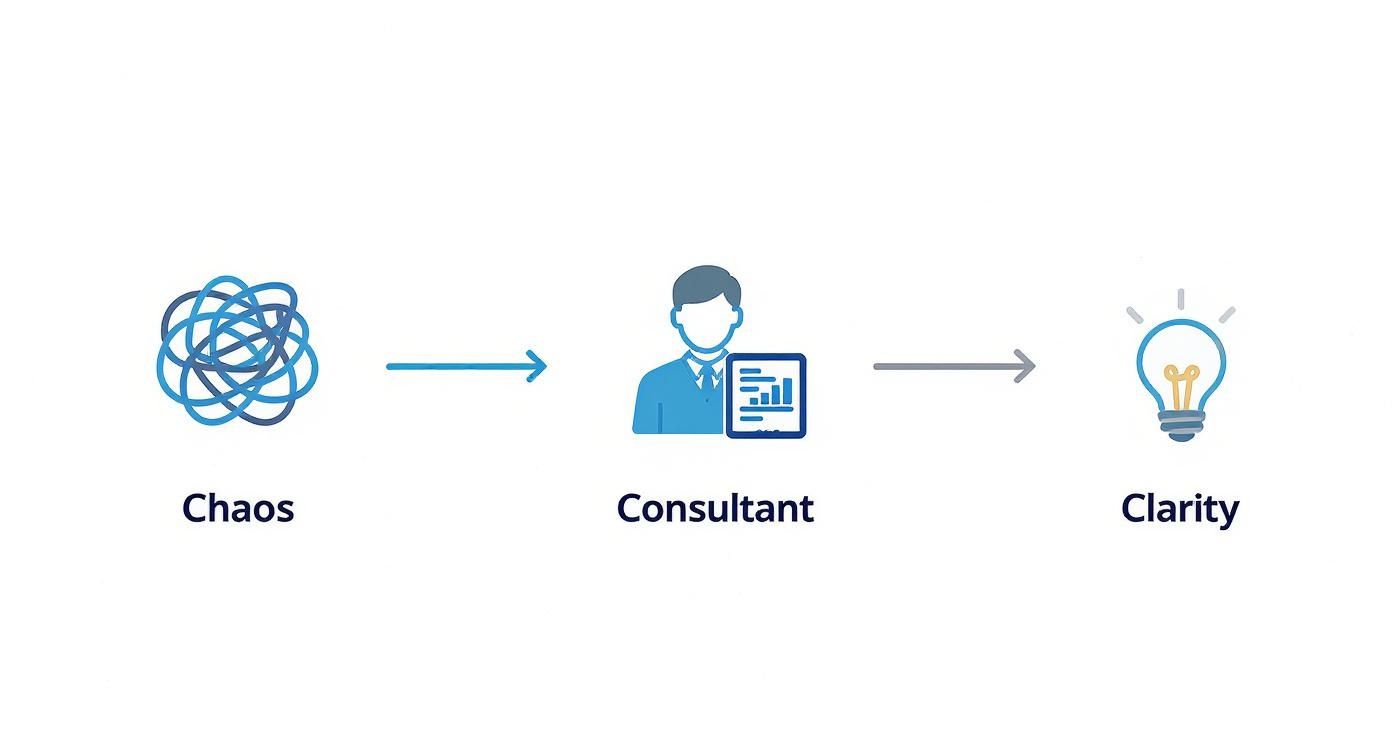
The consultant is the bridge, applying a proven process to untangle complexity and produce insights you can actually use. Let's break down the three core phases of this journey.
Phase 1: The Diagnostic Phase
The first stage is all about deep listening and discovery. Before a single solution is even considered, a consultant needs to get under the hood of your business. This isn't just a technical audit; it's a commercial deep-dive to connect your biggest strategic goals with your current data reality.
During this phase, we map out everything:
- Business Objectives: What are the key questions keeping you up at night? Are you trying to nail down true profitability, slash customer churn, or get a grip on inventory?
- Current Data Sources: Where does your information live right now? We'll look at your CRM, accounting software, marketing platforms, and, of course, the countless spreadsheets holding it all together.
- Team Workflows: Who needs what information to do their job? We identify the key decision-makers and get to the bottom of their daily reporting frustrations.
This initial deep dive ensures the entire project is anchored to real-world business outcomes, not just chasing the latest tech trend.
Phase 2: The Roadmap Phase
Once we have a crystal-clear picture of your goals and challenges, the next step is to design the blueprint. This is where the "strategy" in data strategy consultant really comes to life. The main output here is a comprehensive data strategy roadmap.
This isn't a vague wish list. It's a detailed plan that outlines every piece of the puzzle, including:
- The architecture for a unified data layer that finally brings all your information together.
- A governance plan to lock in data quality and security from day one.
- The specific designs for your interactive Power BI dashboards and financial models.
- A clear project timeline with defined milestones and deliverables.
This is a critical alignment phase. It gives you a complete picture of the final solution and the step-by-step plan to get there, so there are absolutely no surprises down the line. To learn more, check out our detailed guide on what data transformation is and how it works.
Phase 3: The Implementation Phase
With the blueprint approved, the consultant rolls up their sleeves and gets to building. This is where the strategic plan becomes a tangible, automated reality. Using tools like Power BI, they construct the automated reporting pipelines, build out the dashboards, and configure the financial models defined in the roadmap.
But implementation is more than just writing code and connecting APIs. A crucial part of this phase is empowering your team to actually use the new tools effectively. This almost always includes hands-on training and collaborative sessions to make sure the solution is adopted across the business and doesn't just sit on a server.
The demand for this kind of expertise is exploding. The Big Data Consulting market is projected to skyrocket from USD 9.74 billion in 2024 to a massive USD 33.36 billion by 2034. Businesses are increasingly relying on specialized guidance to get a real edge, and this structured, phased approach is exactly how consultants deliver tangible ROI.
The Key Deliverables That Drive Business Growth
After mapping out the journey, it's time to talk about the destination. What tangible, high-value outcomes should you actually expect from a data strategy consultant? It’s not about getting a stack of confusing technical diagrams or jargon-filled documents; it’s about practical, business-focused assets that save time, improve decisions, and drive growth.
A great consultant connects every technical action to a real-world business result. Instead of talking about complex ‘ETL pipelines,’ they deliver Automated Data Workflows that give your team back hours of valuable time each week. The entire goal is to build a system that works for you, not the other way around.
Let’s unpack the four core deliverables that form the bedrock of a successful data strategy, explained in terms of the business impact you actually care about.
A Unified Data Source
For many SMBs, data lives in silos—sales numbers are in the CRM, financials are in QuickBooks, and operational metrics are scattered across a dozen different spreadsheets. A primary deliverable from any good data strategy consultant is a unified data source, often called a 'single source of truth'.
Think of it as building a central library for all your company’s knowledge. Instead of having information scattered in different places, everything is organized in one place, making it easy to find exactly what you need. This unified layer brings information together from all your systems, ensuring everyone—from finance to operations—is working from the same set of numbers.
This consistency eliminates the endless debates over which report is "correct" and builds universal trust in the data.
A Data Governance Framework
"Garbage in, garbage out" is a cliché in the data world for a reason. If your source data is inaccurate, incomplete, or inconsistent, any report you build on top of it will be fundamentally flawed. This is why a data governance framework is such a critical deliverable.
This isn't just a stuffy policy document; it's a practical set of rules and processes that keep your data clean, secure, and reliable over time.
A solid governance framework includes:
- Clear Ownership: Assigning responsibility for different data sets, so someone is always accountable for its quality.
- Standardized Definitions: Making sure that a "customer," a "sale," or a "lead" means the same thing across every single department. No more arguments.
- Access Controls: Establishing clear rules for who can view, edit, and use sensitive information, protecting your business and your customers.
This framework is the quality control system for your data, making sure the insights you rely on are built on a foundation of trust.
A data strategy consultant’s work is to transform data from a simple byproduct of your operations into a managed, reliable business asset. These deliverables are the building blocks for that transformation.
An Automated Reporting Stack
Imagine a world where your weekly and monthly reports build themselves. That’s the promise of an automated reporting stack. A consultant will replace your manual, copy-paste reporting processes with continuous, automated data pipelines.
This means no more pulling data from five different systems, cleaning it in Excel, and then pasting it into a PowerPoint deck. The system does all the heavy lifting in the background, freeing up your team to focus on strategic analysis rather than tedious data collection. The time savings alone often provide a clear and immediate return on investment.
Interactive Power BI Dashboards
The final, and most visible, deliverable is often a set of interactive Power BI dashboards. These are not your typical static, lifeless reports. They are dynamic, visual tools that put your business's performance right at your fingertips. You can explore trends, drill down into details, and answer follow-up questions in real-time.
A well-designed dashboard brings your key metrics to life, allowing you to:
- Track financial performance against your budget and forecasts.
- Monitor sales team activity and pipeline health.
- Analyze operational efficiency and identify bottlenecks instantly.
These dashboards are more than just reports; they are tangible data products designed to make complex information intuitive and actionable for everyone on your team. You can learn more about how we think about what data products are and how they create value in our detailed guide. Ultimately, these deliverables work together to create a system that drives smarter, faster, and more confident decision-making across your entire business.
Unlocking Real-World Benefits for Your SMB
So, how do technical deliverables like a "unified data layer" or a "governance framework" actually help your business? For SMB owners and founders, the real value of hiring a data strategy consultant isn't found in complicated diagrams—it’s seen in reclaimed time, smarter decisions, and a clear path to scalable growth.
A data strategy isn't just some abstract expense; it's a direct investment in your company's operational fitness. It’s all about turning scattered information into a reliable engine for progress.

Let's break down the powerful, real-world benefits a well-executed data strategy delivers, using scenarios that will hit home for any ambitious business operator.
Reclaiming Valuable Time Through Automation
For many growing businesses, the single biggest drain on high-value employees is manual reporting. Your best people are probably spending hours every week exporting CSVs, wrestling with spreadsheets, and copy-pasting data just to answer the same basic questions.
Imagine your finance lead saving 20 hours a week because the monthly close process is automated. Picture your sales manager instantly seeing team performance without spending half of Monday building reports. This is often the first and most immediate win from a sound data strategy.
By building automated data pipelines and self-refreshing Power BI dashboards, a consultant eliminates this repetitive, low-value work. This frees up your team to focus on what actually moves the needle: analysing trends, talking to customers, and making strategic moves to grow the business.
Gaining True Financial and Operational Visibility
Do you know your true customer acquisition cost? Can you see which product lines are the most profitable when you factor in all operational expenses? For many SMBs, these critical questions are surprisingly hard to answer because their financial and operational data simply don't talk to each other.
A data strategy consultant is there to break down these silos. By connecting your accounting software, CRM, and operational platforms into a single, unified model, you finally get true end-to-end visibility.
This connected view is where the magic happens. You can finally align your P&L with your operational KPIs, giving you a holistic understanding of your business's health and performance drivers.
Suddenly, you can confidently answer complex questions like:
- How does marketing spend directly impact sales for a specific customer segment?
- What is the real-time cash flow impact of our current inventory levels?
- Which operational bottlenecks are hurting our gross margins the most?
This deep visibility is the foundation for making smarter, more profitable decisions across the entire organisation.
Making Confident, Data-Backed Decisions
Gut instinct can get a startup off the ground, but you can't scale on guesswork. When you can’t trust your numbers, decision-making becomes slow, contentious, and risky. A core benefit of working with a data strategy consultant is building a culture where people have confidence in the data.
Consider an operations leader who improves inventory forecast accuracy by 30% using a new driver-based model. This isn’t just a technical achievement; it means less capital tied up in slow-moving stock and fewer lost sales from stockouts. It's the perfect example of moving from reactive guesswork to proactive, data-informed strategy.
The demand for this kind of strategic guidance is surging as businesses see the impact. The global strategy consulting market, which includes data strategy consulting, was valued at USD 39.15 billion in 2024 and is projected to nearly double to USD 96.25 billion by 2032. You can read the full research about these market dynamics to understand why so many companies are investing here.
Ultimately, a robust data foundation empowers your team to test hypotheses, measure results, and pivot quickly with conviction. It’s about building a business that learns and adapts faster than the competition.
How to Choose the Right Data Strategy Consultant
Picking the right data strategy consultant is one of the most important decisions you’ll make on the journey from data chaos to clarity. A great partner feels like a natural extension of your team—a trusted advisor who can turn your business goals into a technical reality. The wrong one can lead you down a rabbit hole of expensive, over-engineered solutions that don't actually solve your core problems.
The consulting market is massive and continues to expand. The management consulting space in the US, which includes data strategy, is projected to hit a market size of about USD 407.3 billion by 2025. With that many choices, you absolutely have to know what you’re looking for. This guide is here to help you become an educated buyer and find the perfect fit.
Look For Business Acumen, Not Just Pure Technical Skill
For a non-technical founder or operator, there’s nothing more frustrating than a consultant who speaks an entirely different language. While deep technical knowledge is certainly important, it's pretty much useless if they can’t connect it to your business reality. The best consultants always lead with business questions, not a barrage of technical jargon.
You want a partner who is genuinely curious about your business model, what drives your revenue, and what your biggest operational headaches are. They should be just as comfortable talking about your P&L and cash flow as they are about data architecture.
Find a Specialist, Not a Generalist
Data strategy is a huge field. Some consultants are tool-agnostic generalists, while others are deep specialists in a specific ecosystem like Microsoft Power BI. For a small or medium-sized business, going with a specialist offers some major advantages.
- Faster Time to Value: A Power BI specialist isn't learning on your dime. They know the platform inside and out and can deliver results quickly.
- Deeper Expertise: They get the nuances and best practices for building efficient, scalable models and dashboards in that specific environment.
- Focused Solutions: They can build solutions that maximize your investment in the Microsoft ecosystem, something many businesses are already using.
A generalist knows a little about everything; a specialist knows everything about the one thing that can solve your problem most effectively. For SMBs looking to automate reporting with Power BI, the choice is clear.
A Quick Checklist For Evaluating Consultants
To make the process a bit easier, here’s a simple checklist to help you size up potential partners and compare them on the points that truly matter.
Data Consultant Evaluation Checklist
| Evaluation Criteria | What to Look For | Red Flags to Avoid |
|---|---|---|
| Business Fluency | Do they ask about your revenue model, operations, and pain points first? | Jumps straight into technical jargon and buzzwords. |
| Specialized Expertise | Do they have deep experience in the specific tools you use (e.g., Power BI)? | Claims to be an expert in everything; a "jack of all trades." |
| Proven Track Record | Can they show you relevant, anonymized examples of past work? | Has no portfolio or only shows generic, templated examples. |
| Focus on Adoption | Do they have a clear plan for training your team and ensuring the solution gets used? | Their plan ends at implementation, with no mention of handoff or training. |
| Communication Style | Can they explain complex concepts in simple, understandable terms? | You leave conversations feeling more confused than when you started. |
This checklist isn't exhaustive, but it provides a solid framework. A consultant who ticks the right boxes here is far more likely to be a true partner who delivers real value, not just a temporary fix.
Killer Interview Questions to Ask Any Consultant
Once you’ve narrowed down your list, a focused interview is your best tool for separating the true experts from the pretenders. It's time to go beyond the surface and dig into their actual process and past work. Here are a few practical, hard-hitting questions to get you started.
-
"Walk me through how you would approach unifying our messy sales data from our CRM and our financial data from our accounting software."
This question gets right to the heart of a core challenge for most SMBs: data integration. A good answer will involve a discovery process, data mapping, and a clear plan for creating a single, unified model. You can learn more about this in our detailed guide on the role of data integration consultants. -
"Can you show me an anonymized example of a dashboard you built for a business with similar reporting challenges to ours?"
This one is non-negotiable. Any experienced consultant worth their salt will have a portfolio of relevant work. Seeing a real-world example gives you a feel for their design style, how clearly they visualize data, and the kinds of insights they focus on. -
"Our team is not very technical. How do you ensure the solutions you build are actually adopted and used by everyone?"
A great consultant knows that implementation is only half the battle—adoption is what drives the ROI. Their answer should include a plan for team training, clear documentation, and a collaborative handoff process designed to empower your staff. For an outside perspective on what makes a great data hire, check out these Insights for Recruiters on Data Strategy Talent.
By focusing on business acumen, seeking out specialized expertise, and asking the right questions, you can confidently choose a data strategy consultant who will become a true partner in your growth.
Time to Build Your Data-Driven Future?
The journey from data chaos to genuine clarity is a big one for any business. Bringing in a data strategy consultant is about so much more than just building a few dashboards; it’s about finally getting control, sharpening your focus, and carving out a real competitive edge in your market. Think of it as a proactive investment in building a smarter, more resilient business.
If you’re tired of wrestling with disconnected spreadsheets and you're ready to start leading with insight, it's time to take the next step. Moving forward means committing to a structured approach that turns your data into your most reliable asset.
Your Path to Data Clarity
Making this change doesn’t have to be some overwhelming, bank-breaking overhaul. It all starts with a single, focused conversation about your goals. A clear plan is what gets you from where you are today to where you need to be, without burning through your budget or wasting time.
The goal of a great data strategy is simple: get the right information to the right people at the right time, so they can make better decisions. It replaces ambiguity with certainty and empowers your entire team.
For most SMBs, this kicks off with a data strategy roadmap. This is a practical blueprint we design to deliver value quickly while building a solid foundation for the long haul. Our guide on what a data strategy roadmap entails shows you exactly what that process looks like. Honestly, this initial planning phase is the most critical part of the entire journey.
Want to automate your reporting and finally trust your data? Book a free discovery call with our BI consultants today and let's start building your data roadmap together.
Frequently Asked Questions
When you start exploring data consulting, a lot of questions pop up. It's totally normal. Here are some of the most common ones we hear from founders and SMB owners, with straightforward, no-fluff answers.
How Much Does a Data Strategy Consultant Cost for an SMB?
This is usually the first question on everyone's mind, and the honest answer is: it depends on what you need. Most experienced consultants have moved away from hourly billing. It just doesn't align with delivering real business value.
Instead, you’ll typically see two models:
- Project-Based Fees: This is the go-to for specific, well-defined outcomes. Think building a unified financial dashboard in Power BI or designing a complete data roadmap from scratch. You agree on a fixed price for a clear scope, which gives you total cost certainty. No surprises.
- Retainers: If you need ongoing strategic guidance, help with data governance, or just a seasoned expert on call, a monthly retainer is perfect. It gives you consistent access to top-tier talent without the overhead of another full-time executive.
The right way to think about the cost is as an investment, not an expense. A solid project should deliver a clear, measurable return. We’re talking about automating tasks that are currently eating up 10-20 hours of your team's week, dramatically improving your forecast accuracy, or finding new pockets of revenue you didn't know existed.
Our Business Data Is a Complete Mess. Can a Consultant Really Fix It?
Yes, absolutely. In fact, if your data wasn't a mess, you probably wouldn't need one.
No founder ever comes to us with perfectly organized, pristine data warehouses. That's a myth. The reality for almost every growing business is a tangled mess of disconnected spreadsheets, siloed software that doesn't talk to each other, and wildly inconsistent information. Resolving that chaos is precisely why we exist.
A consultant's job is to step into that complexity and create order. They are hired precisely because the data is a mess; that's the problem they are built to solve.
A good consultant has a systematic process for this. They'll map out all your data sources, work to clean and standardize the information, and then build a unified system that finally gets everything speaking the same language. It’s a methodical journey from chaos to clarity.
Will I Need to Hire a Full-Time Analyst Afterwards?
Not necessarily, and in many cases, the goal is the exact opposite.
A great data strategy consultant aims to build sustainable, automated systems that empower your existing team. They design self-service dashboards and automated reporting workflows so that your current, non-technical staff can get the answers they need on their own. The whole point is to make your team more self-sufficient, not to create a new dependency or force you into another hire.
What Is the Difference Between a Data Analyst and a Data Strategist?
This is a really important distinction, and it’s one that causes a lot of confusion.
Here’s a simple way to think about it:
- A Data Analyst is fantastic at working within a system. They run reports, dig into datasets, and answer specific business questions using the tools they're given. They are experts at interpreting data.
- A Data Strategy Consultant is the person who designs and builds the entire system from the ground up. They figure out the architecture, create the rules for data governance, and develop the strategic roadmap that an analyst will eventually use.
An analyst is the expert driver of a high-performance car. The strategist is the engineer who designed the car, built the engine, and paved the road it drives on.
Ready to transform your reporting from a painful chore into a strategic advantage? At Vizule Ltd, we build the automated systems that give you clarity and control.
