


Staring at a mountain of unpaid invoices is a familiar frustration for any founder. This isn't just an accounting headache; it's a direct threat to your company's cash flow and its very ability to grow.
This guide will demystify aged accounts receivable, not as dry industry jargon, but as a critical vital sign for your company's financial health. We'll show you how to move from chaotic spreadsheets to a clear, automated system that puts you back in control of your cash.
Why Your Aged Accounts Receivable Is Costing You Money
Picture your revenue as a pipeline, delivering essential cash to your bank account. Every invoice you send is fresh water entering that system. In this picture, aged accounts receivable are the clogs—the unpaid invoices that slow that flow to a trickle, starving your business of the cash it needs to operate, pay bills, and invest in growth.
This isn't just a passive report; it's an active threat. The longer an invoice sits unpaid, the less likely you are to ever see that money. This directly squeezes your working capital, forcing you into tough corners and difficult decisions about payroll, inventory, or your next marketing campaign.
Flying blind with your AR means you can't accurately forecast what's coming. As too many founders learn the hard way, revenue on paper means absolutely nothing if the cash isn't in the bank.
The True Cost of Inaction
So many small and medium-sized businesses fall into the trap of wrestling with this process in chaotic Excel sheets, relying on manual email follow-ups. This approach isn't just a time sink; it's riddled with risks that quietly bleed your business dry:
- Delayed Cash Flow: When tracking is manual, it’s frighteningly easy for invoices to slip through the cracks. This stretches your payment cycles and puts a constant strain on your finances.
- Poor Decision-Making: Outdated spreadsheets give you a foggy, rearview-mirror look at your finances. What you need is a clear, forward-looking dashboard to steer the ship.
- Wasted Resources: Your team ends up burning hours chasing payments and trying to reconcile messy data instead of focusing on high-value work that actually drives the business forward.
An unmanaged aged accounts receivable report isn't just a list of debts; it's a direct drain on your company's potential. Every dollar stuck in a 90+ day bucket is a dollar you can't use to hire, innovate, or scale.
Understanding this financial logjam is the first step toward fixing it. The goal is to transform your AR report from a source of anxiety into a powerful strategic tool.
When you start analyzing why certain payments are overdue, you can uncover deep insights into your customers' payment habits and the effectiveness of your own internal processes. This guide will show you a clear path from that manual chaos to automated, insightful reporting.
It’s about building a system that not only helps you collect cash faster but fundamentally improves your ability to plan. You can see how critical this is for financial planning in our detailed guide on cash flow forecasting methods.
Decoding Your Accounts Receivable Aging Report
Your Accounts Receivable (AR) aging report is one of the most powerful tools you have for managing cash flow, but let's be honest—it can be a dense, confusing wall of numbers if you're not an accountant. The trick is to stop seeing it as a simple list of debts and start treating it like a strategic dashboard that guides your financial decisions.
The magic of the report lies in how it sorts unpaid invoices into aging buckets. These are just time-based categories that group invoices by how long they've been unpaid since their due date. This simple sorting instantly tells you which customers need a nudge and, more importantly, how likely you are to ever see that cash.
This is a classic problem for any business: aged accounts receivable act like a dam, blocking cash from flowing back into your company where it belongs.
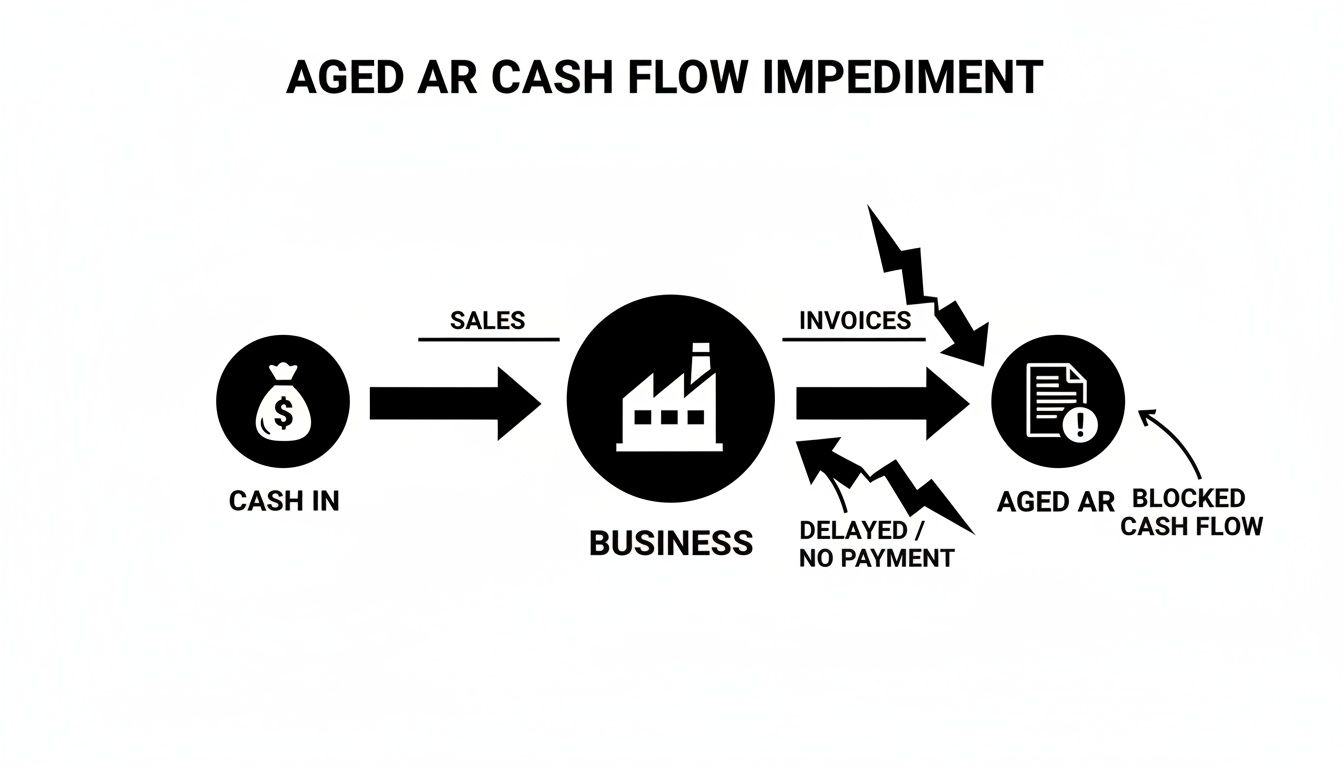
As the diagram shows, when payments get held up, the cash you need to fund operations gets trapped. This stalls growth and puts a real strain on the entire company.
The Story Behind the Buckets
Think of each aging bucket as a chapter in your customer’s payment story. A healthy balance in the "Current" or "1-30 Days" bucket is business as usual. But as an invoice creeps into the older buckets—like 61-90 days or the dreaded 91+ days—the story shifts from a routine transaction to a high-risk drama.
The hard truth is that the probability of collecting an invoice drops off a cliff after 90 days. An invoice in the 91+ bucket has a shockingly low chance of ever being paid. This is why you can't treat all outstanding revenue the same; a $10,000 invoice that's 10 days past due is far more valuable to your business than one that’s 100 days old.
The table below breaks down the typical aging buckets and what they signal about your collection risk.
Understanding AR Aging Buckets and Collection Risk
| Aging Bucket (Days Past Due) | Description | Likelihood of Collection | Recommended Action |
|---|---|---|---|
| Current (0-30) | Invoices that are not yet due or are freshly overdue. | Very High (95%+) | Standard automated reminders. |
| 31-60 | Invoices that are one to two months past due. | High (80-90%) | Automated reminders and a personal follow-up call. |
| 61-90 | Invoices that are two to three months past due. | Moderate (50-70%) | Immediate, persistent follow-up. Escalate internally. |
| 91+ | Invoices that are over three months past due. | Very Low (<50%) | Consider a formal demand letter or a collection agency. |
As you can see, the older the invoice gets, the more aggressive your collection strategy needs to become. Time is literally money here.
Turning Data Into Actionable Insights
Your aging report should do more than just list numbers; it needs to trigger specific actions. A quick scan of the bucket totals is a great way to take your company's financial pulse. See a growing balance in the 61-90 day column? That’s a huge red flag that your collection process is broken somewhere.
An effective aging report doesn't just show you what is owed; it tells you where to focus your energy. It helps you prioritize the largest, oldest, and most strategic accounts before they become write-offs.
Instead of getting lost in a sea of data, a well-structured report helps you ask the right questions:
- Which customer is always paying late? This probably means it’s time for a direct conversation about their payment terms or credit limits.
- Is a huge invoice about to tip into a higher-risk bucket? That calls for an immediate, personalized follow-up before it's too late.
- Are our payment terms even clear? If you have a ton of invoices sitting in the 1-30 day bucket, it might be a sign of customer confusion.
By moving this report from a static spreadsheet into a dynamic dashboard, you gain real-time visibility. Many founders get started on this path with our free and easy-to-use management reporting templates before graduating to a fully automated system. The goal is always the same: make managing aged AR a proactive, strategic part of your daily operations.
Tracking the Metrics That Truly Matter
An accounts receivable aging report is a crucial snapshot, but to really understand what's happening, you need to look at a few key performance indicators (KPIs). These numbers tell the dynamic story of your collection health. This is where you shift from just tracking debt to strategically managing your company’s lifeblood: cash.
These metrics aren't just for your accountant; they are vital signs for any business owner. Getting a handle on them empowers you to spot troubling trends early, ask smarter questions, and make better decisions about the cash fuelling your company's future.
Days Sales Outstanding (DSO)
The most fundamental AR metric is Days Sales Outstanding (DSO). Put simply, DSO tells you the average number of days it takes your company to get paid after you make a sale. Think of it as your business's average payment cycle.
A high DSO means your cash is tied up in unpaid invoices for longer, money that could be used for growth, inventory, or payroll. A low DSO signals an efficient collections process and much healthier cash flow.
Calculating DSO is straightforward:
(Total Accounts Receivable / Total Credit Sales) x Number of Days in Period = DSO
For example, if you have $100,000 in receivables and made $300,000 in credit sales over a 90-day quarter, your DSO would be 30 days. On average, you're getting paid about a month after the sale. The real insight, however, comes from tracking this number month-over-month, not just looking at it in isolation.
Collection Effectiveness Index (CEI)
While DSO measures the speed of your collections, the Collection Effectiveness Index (CEI) measures the quality. This metric shows what percentage of your collectible receivables you actually brought in during a specific period. It's a direct reflection of your team’s performance.
A CEI close to 100% means you have a rock-solid, highly effective collection process. A consistently lower number suggests you're leaving money on the table and that older receivables are slipping through the cracks. Nailing your CEI is a key step when you use financial analytics to drive SMB growth.
Why These Metrics Are So Critical Right Now
Keeping a close eye on these KPIs has never been more important. In early 2025, global working capital—the time it takes to spend cash and then get it back—peaked at 78 days, the highest it's been since 2008. This directly inflates aged accounts receivable, as businesses are forced to float unpaid invoices for much longer.
The same analysis found that U.S. firms were sitting on a staggering $1.7 trillion of excess working capital trapped in receivables. This puts immense pressure on AR teams to get cash in the door faster. You can dig into more of the data in this in-depth analysis of the current AR landscape.
Putting It All Together
So, what does 'good' actually look like? Industry benchmarks vary, but a solid rule of thumb is to keep your DSO below 1.5 times your standard payment terms. For instance, if you offer Net 30 terms, you should aim for a DSO under 45 days. For CEI, anything above 80% is considered decent, but elite teams consistently hit over 95%.
The real power comes from monitoring these metrics together in a dynamic dashboard, not a static report.
- Is DSO climbing while CEI is dropping? This is a major red flag. It means you're not only taking longer to get paid, but you're also collecting less of what you're owed.
- Is one customer consistently wrecking your DSO? It might be time to have a serious conversation about their payment terms or credit limit.
By tracking these core metrics, you transform aged accounts receivable from a passive accounting report into an active, strategic tool for managing your company’s cash flow.
Diagnosing the Root Causes of Late Payments
A growing aged accounts receivable balance is rarely the real problem. Think of it more as a symptom—a flashing red light on your business dashboard signaling a deeper issue under the hood. Pinpointing why your invoices are going unpaid is the first step toward fixing the problem for good, rather than just chasing overdue payments after the fact.
The reasons for late payments usually fall into two big buckets: internal process failures on your end or issues on the customer’s side. Figuring out which is the main culprit means taking an honest look at your entire process, from the moment a deal closes to the day the cash lands in your bank account.
Internal Process Breakdowns
More often than not, the source of aging receivables is sitting right inside your own office. As a business scales, the manual systems that worked for a handful of clients start to buckle. Invoices slip through the cracks, and suddenly, you've outgrown your trusty Excel spreadsheet. It’s a classic growing pain.
Imagine a small consulting firm that just landed its biggest client. The team is all-hands-on-deck, focused on delivering amazing work. Invoicing becomes an afterthought. The invoices that do go out are late, miss crucial purchase order numbers, and get sent to a generic "accounts@company.com" inbox. Fast forward 60 days, and they're staring at a huge unpaid bill. The client isn't trying to avoid payment—the firm’s own chaotic process has made it nearly impossible for them to pay on time.
Here are the most common internal culprits:
- Unclear Payment Terms: Are your terms (like Net 30) clearly stated on every single invoice? Any ambiguity is an open invitation for someone to pay you later.
- Inaccurate or Confusing Invoices: Simple errors, missing PO numbers, or vague descriptions give a client's finance team a legitimate reason to put your invoice on hold while they investigate.
- Inconsistent Follow-Up: Without a systematic, automated follow-up process, chasing payments is a manual chore that’s easy to ignore when things get busy.
- No Clear Point of Contact: Does your client know exactly who to call with a question? If not, that invoice is likely to get set aside.
Diagnosing your internal process isn't about placing blame. It's about finding and eliminating the friction that makes it hard for good customers to pay you on time.
Customer-Side Challenges
Of course, sometimes the problem really is with the customer. These challenges can range from simple disputes all the way to serious financial trouble. Getting a handle on your client’s situation is the key to picking the right collection strategy.
- Invoice Disputes: Maybe the customer disagrees with a line item, questions the total amount, or feels the work wasn't completed. This is often the easiest problem to solve if you address it with prompt and clear communication.
- Cash Flow Problems: Your client might be in a cash crunch of their own, forcing them to triage their vendor payments. You might not be at the top of their list.
- Lost Invoices: In big companies, it’s surprisingly easy for an invoice to get lost in a manager's overflowing inbox or misrouted between departments.
- Financial Distress: In the worst-case scenario, the client could be on the verge of insolvency. At that point, getting paid might require significant intervention, if it's possible at all.
By digging into the root cause, you shift from being a reactive bill collector to a proactive business operator. You start building a payment process that’s clear, consistent, and easy for everyone to follow. Ready to fix the process, not just the symptom?
Book your free BI consultation, and we’ll show you how to build an automated system that prevents late payments before they start.
Building a Proactive Collections Strategy That Works
You've diagnosed the root causes behind your aged accounts receivable. That's a huge step. Now it's time to move from analysis to action. This is where you build a proactive, systematic collections strategy that turns your AR process from a reactive headache into a reliable engine for consistent cash flow.

Let's be clear: a robust strategy isn’t about aggressively hounding customers. It’s about creating clarity, consistency, and a clear path to payment that actually strengthens your client relationships. The goal is to build a repeatable process that prevents invoices from getting old in the first place.
Establish a Rock-Solid Foundation
Before you even think about collecting payments, you need to set crystal-clear expectations from day one. This foundation is built on well-defined policies that kill ambiguity and create a predictable financial relationship.
Your core foundational elements must include:
- Clear Credit Policies: Define who gets credit and what their limits are. This isn't about being restrictive; it's about smart risk management, especially with new clients.
- Ironclad Payment Terms: Make sure your terms (Net 30, Net 60, etc.) are on every single quote, contract, and invoice. There should be absolutely zero confusion about when you expect to be paid.
- Easy Payment Options: Make it ridiculously simple for clients to pay you. Offer multiple options like ACH, credit cards, or online portals. Payment friction is a common—and completely avoidable—cause of delays.
A proactive collections strategy starts long before an invoice is ever sent. It begins with clear communication and mutually understood terms that set the stage for timely payments.
Design a Structured Communication Cadence
Once an invoice is out the door, your communication needs to be predictable and systematic. This is where automation is a game-changer. Manual follow-ups are inconsistent and are the first thing to get dropped when things get busy.
A well-designed communication cadence keeps you top-of-mind without being annoying. For instance, our guide on business process automation examples shows how simple automated triggers can drive massive results in finance ops.
Think about a multi-stage reminder system like this:
- Gentle Pre-Reminder: An automated email sent 3-5 days before the due date. It’s a friendly, professional nudge that often prevents late payments altogether.
- Day-Of Reminder: A simple automated ping on the actual due date.
- First Overdue Notice: A slightly firmer automated email sent 1-3 days after the due date.
- Personal Follow-Up: A phone call from your team around 7-10 days past due. The goal here is to understand the hold-up and get a firm payment date.
Implement Smart Collection Tactics
Beyond reminders, you can use a few smart tactics to motivate faster payments and get a better handle on your aged AR.
- Offer Early Payment Incentives: A small discount, like 2% off for paying within 10 days (often written as "2/10 Net 30"), can do wonders for your cash flow by encouraging prompt action.
- Segment Your Approach: Not all overdue accounts are created equal. Focus your efforts based on the invoice amount and how old the debt is. A huge, 60-day old invoice needs more immediate, personal attention than a small, 5-day old one.
Your approach should also factor in what's normal for your industry. Some sectors just have longer payment cycles. For example, management companies can average 125.1 days of AR outstanding, while oil and gas extraction is around 110.9 days. Knowing this helps you set realistic expectations and tailor your strategy.
Know When to Escalate
Most payment issues can be sorted out with persistent, professional follow-up. But you will have times when you need to escalate. A clear escalation path is a non-negotiable part of any serious collections strategy.
Your escalation process should be defined and triggered by specific milestones:
- Internal Escalation (30-60 Days Past Due): The account gets flagged for a manager or senior team member to review. This might lead to a more formal communication or a temporary hold on the customer’s account.
- Formal Demand (60-90 Days Past Due): This is when you send a formal demand letter. It clearly outlines the debt and states your intent to take further action if the invoice isn't paid.
- External Collections (91+ Days Past Due): By this point, the chance of you collecting that money has dropped off a cliff. It's often time to hand the account over to a third-party collections agency or bring in legal help. To keep accounts from ever getting this old, learn some practical tips on how to collect unpaid invoices and get paid faster.
Automating Your AR Reporting in Power BI
If you're still wrestling with manual spreadsheets to track aged accounts receivable, you're not just wasting time—you're flying blind. That manual grind is a massive barrier to healthy cash flow, creating a blind spot right where you need total clarity. It's time to close the gap between reactive data entry and proactive, automated insight.
This is where a tool like Power BI becomes a game-changer. By connecting directly to your accounting software (think QuickBooks or Xero) and other data sources, Power BI becomes the engine for a dynamic, automated AR dashboard. It turns your static aging report into a live command centre for your company's cash.
From Static Reports to Dynamic Dashboards
Imagine this: with a single click, you drill down from a high-level Days Sales Outstanding (DSO) trend to a specific customer's payment history, and then right into an individual overdue invoice. This isn't about making a prettier report; it's about gaining the power to ask and answer critical questions in real-time.
An automated dashboard gives you at-a-glance clarity on the metrics that truly matter.

A live dashboard like this one instantly visualizes overdue amounts, flags high-risk accounts, and tracks your collection effectiveness over time—all without anyone lifting a finger for a manual update.
The real value here is making faster, smarter collection decisions that directly pad your cash position. You can instantly see which accounts need a phone call today and point your team's efforts where they'll make the biggest splash.
Key Features of an Automated AR Dashboard
A well-designed Power BI dashboard for aged accounts receivable is much more than a few charts. It’s an analytical tool that helps you spot patterns and take decisive action.
Here are the essential components we build into every AR dashboard for our clients:
- Interactive Aging Buckets: Click on the "91+ Days" bucket to instantly filter the entire dashboard to show every invoice and customer in that high-risk category. Say goodbye to manual sorting in Excel.
- Customer-Level Drill-Down: Zero in on the payment performance of your largest or most chronically late customers. This gives you the hard data needed for productive conversations about payment terms.
- Trend Analysis: See exactly how your DSO and CEI are trending over the last six or twelve months. Are those process improvements you made actually working? The data will tell you.
- Real-Time Alerts: Set up automated flags for when a large invoice hits 30 days overdue or when a key customer's balance blows past their credit limit.
By automating your AR reporting, you shift your team's focus from compiling data to using data. The conversation changes from "Is this report up to date?" to "What's our action plan for these five overdue accounts?"
This shift is fundamental to scaling your business. It shatters the manual bottlenecks that hold back so many growing companies and replaces them with a single source of truth everyone can trust. An automated system guarantees your aged AR data is always current, accurate, and ready for action.
This level of control allows you to manage cash flow proactively, not reactively. You can spot trouble long before it becomes a crisis, giving you the time and insight needed to keep your finances healthy and your growth on track.
Your Aged Accounts Receivable Questions Answered
Even with a solid strategy in place, founders always have a few lingering questions about managing aged accounts receivable. Nailing these details is what turns your AR process from a chore into a cash-generating engine.
Here are some practical, no-fluff answers to the most common questions we hear from business operators just like you.
How Often Should I Review My Aged Accounts Receivable Report?
For most small to medium-sized businesses, a weekly review is the gold standard. This rhythm is frequent enough to let you jump on new overdue invoices right away and spot any ugly trends before they can hurt your cash flow.
When this is automated in a Power BI dashboard, it becomes a quick, five-minute check-in. It's no longer a soul-crushing manual data pull that eats up hours of your week. This simple habit means a single invoice slipping into the 31-60 day bucket gets immediate attention, preventing a small problem from snowballing into a major one.
What Is a Good Days Sales Outstanding (DSO) Ratio?
While this varies by industry, a solid benchmark to aim for is a DSO that's less than 1.5x your standard payment terms. For example, if you offer Net 30 terms, you'd want your DSO to be under 45 days.
But honestly, the more important thing to watch is the trend. A consistently rising DSO is a flashing red light that your collections process needs a tune-up, regardless of what the "industry average" is.
The absolute DSO number isn’t nearly as important as its trajectory. A steady, predictable DSO means you have a healthy, predictable cash flow—and that’s the real prize for any founder.
When Should I Consider an Invoice Uncollectible?
The chance of collecting an invoice drops off a cliff after 90 days.
Most businesses will officially write off an invoice as bad debt after 120 to 180 days of failed collection attempts. A well-built AR dashboard should be screaming at you about these high-risk invoices long before they ever get to that point, giving you a fighting chance to recover that cash.
Can Power BI Connect Directly to My Accounting Software?
Yes, and this is one of its biggest strengths. Power BI has built-in connectors for all the major players like QuickBooks, Xero, and tons of others. This creates a fully automated data pipeline.
What does that mean for you? Your aged receivables dashboard is always up-to-date, with zero manual exports or copy-pasting required. This direct connection is the foundation of the automated reporting systems we build for our clients at Vizule. It completely eliminates manual errors and frees your team up to focus on strategy, not tedious data entry.
Ready to stop chasing down payments and start proactively managing your company's cash flow? We can help you connect the dots in your financial data and build an AR dashboard that actually drives action.
