


Are you a founder drowning in data from a dozen different places? It's a familiar feeling of chaos—jumping between sales spreadsheets, marketing platforms, and financial software just to get a straight answer. You're asking "Why are my reports always out of date?" and getting frustrated with the manual effort it takes to connect the dots.
A data analytic strategy isn’t a complex, technical project reserved for large corporations. Think of it as a practical business roadmap designed to bring order to that chaos, automate your reporting, and finally make your data work for you. It's the key to unlocking insight-led decision-making and scaling your business smartly.
From Data Chaos to Strategic Clarity

If you're running a small or medium-sized business, you know the daily battle for reliable information. One report shows one thing, but an Excel export from another system tells a completely different story. This is the reality of siloed data and Excel chaos.
This constant disconnect makes confident, fast decisions feel impossible. You end up falling back on gut instinct when you'd much rather rely on hard facts.
Think of it like being a ship's captain. You wouldn't set sail using scattered, conflicting star sightings from different crew members. You'd use a single, reliable navigation chart. A data analytics strategy is that chart for your business. It’s the deliberate plan for deciding what to measure, why it matters, and how you'll use that information to scale smartly.
Why a Strategy Is Your First Step
Without a plan, businesses tend to just collect data without any real purpose. They generate reports that no one reads or track metrics that don’t connect to actual business outcomes. This reactive approach keeps you stuck in the weeds, manually pulling numbers and second-guessing their accuracy.
A strategic approach flips this entire process on its head. It’s the foundational step in turning raw, disconnected data into your most valuable asset.
The goal is to move from guesswork toward an insight-driven operation where every decision is backed by clear, trustworthy information. This shift is critical for aligning your finance and ops teams, creating a single source of truth for your data, and building a business that can scale.
A data analytic strategy forces you to answer the most important question first: "What business problems are we trying to solve?" This focus ensures your efforts directly contribute to growth, efficiency, and profitability.
Turning Data Into an Asset
Ultimately, this strategy is all about connecting the dots. It helps you understand your customers on a much deeper level, pinpoint operational inefficiencies, and forecast financial performance with far greater confidence.
For instance, a crucial first step in any data analytics strategy is often building a robust customer segmentation strategy to truly understand who you are serving.
Ready to stop wrestling with spreadsheets and start making data-driven decisions? A clear strategy is your path forward. It’s how you build a business that not only survives but thrives on information.
What a Data Analytic Strategy Really Is
Let's cut through the jargon. A "data analytic strategy" is simply your company's game plan for how you collect, analyze, and—most importantly—act on data. This isn't just about buying fancy software. It's a deliberate framework that hooks your day-to-day data activities directly into your core business goals.
Think of it as the architectural blueprint for your company's "data house." You wouldn't just start throwing up walls without a plan, right? The same logic applies here. A solid strategy makes sure every dashboard you build and every metric you track has a clear purpose, saving you from chasing vanity metrics that lead nowhere.
To really get it, it helps to see where it fits within the bigger picture of a comprehensive data strategy. While they're related, an analytics strategy is laser-focused on the final step: turning raw data into concrete insights that actually drive decisions. You can learn more about the distinction in our detailed post about what a data strategy is.
The Four Types of Analytics
At its heart, a strong data analytic strategy is a journey. It guides your business from basic reporting toward sophisticated, forward-looking insights. This path is built on four distinct types of analytics, each answering a progressively more powerful question.
Let's walk through a common scenario for an SMB founder: figuring out what happened to quarterly sales.
-
Descriptive Analytics ("What happened?"): This is ground zero. It’s all about summarizing historical data to get a clear picture of the past. It’s the most common form of analytics out there.
- SMB Example: Your Power BI dashboard shows total sales hit $500,000 this quarter. That’s a 10% decrease from the last one. This is pure reporting—it tells you the result, but not the why.
-
Diagnostic Analytics ("Why did it happen?"): Now we're playing detective. You dig into the data to find the root cause behind the numbers you saw in the descriptive stage.
- SMB Example: After slicing the sales data, you find the 10% drop wasn't across the board. It was driven entirely by a 30% decline in your top product category. Everything else was stable.
-
Predictive Analytics ("What will happen next?"): This is where you shift from being reactive to proactive. Using historical data and statistical models, you start forecasting what the future might hold.
- SMB Example: Your forecasting model, looking at the last three years of sales and current market trends, predicts that if this slide continues, total sales will fall another 15% next quarter.
-
Prescriptive Analytics ("What should we do about it?"): This is the final frontier of analytics. It doesn't just predict the future; it recommends specific actions you can take to change it for the better.
- SMB Example: The system suggests a targeted marketing campaign for that struggling product category, recommending a 15% discount for past buyers. It even simulates that this move has a 70% probability of reversing the decline and boosting revenue by 5%.
This progression—from understanding the past to actively shaping the future—is where the real power of a well-executed strategy lies. It turns your data from a static rearview mirror into a dynamic GPS for growth.
The rush to adopt frameworks like this is fueling massive market growth. The global data analytics market, valued at around USD 64.99 billion in 2024, is projected to explode to USD 402.70 billion by 2032. This isn't just a big-business game anymore; companies of all sizes are looking for that competitive edge. You can find more on the growing data analytics market on Fortune Business Insights.
The Four Pillars of a Winning Analytics Strategy
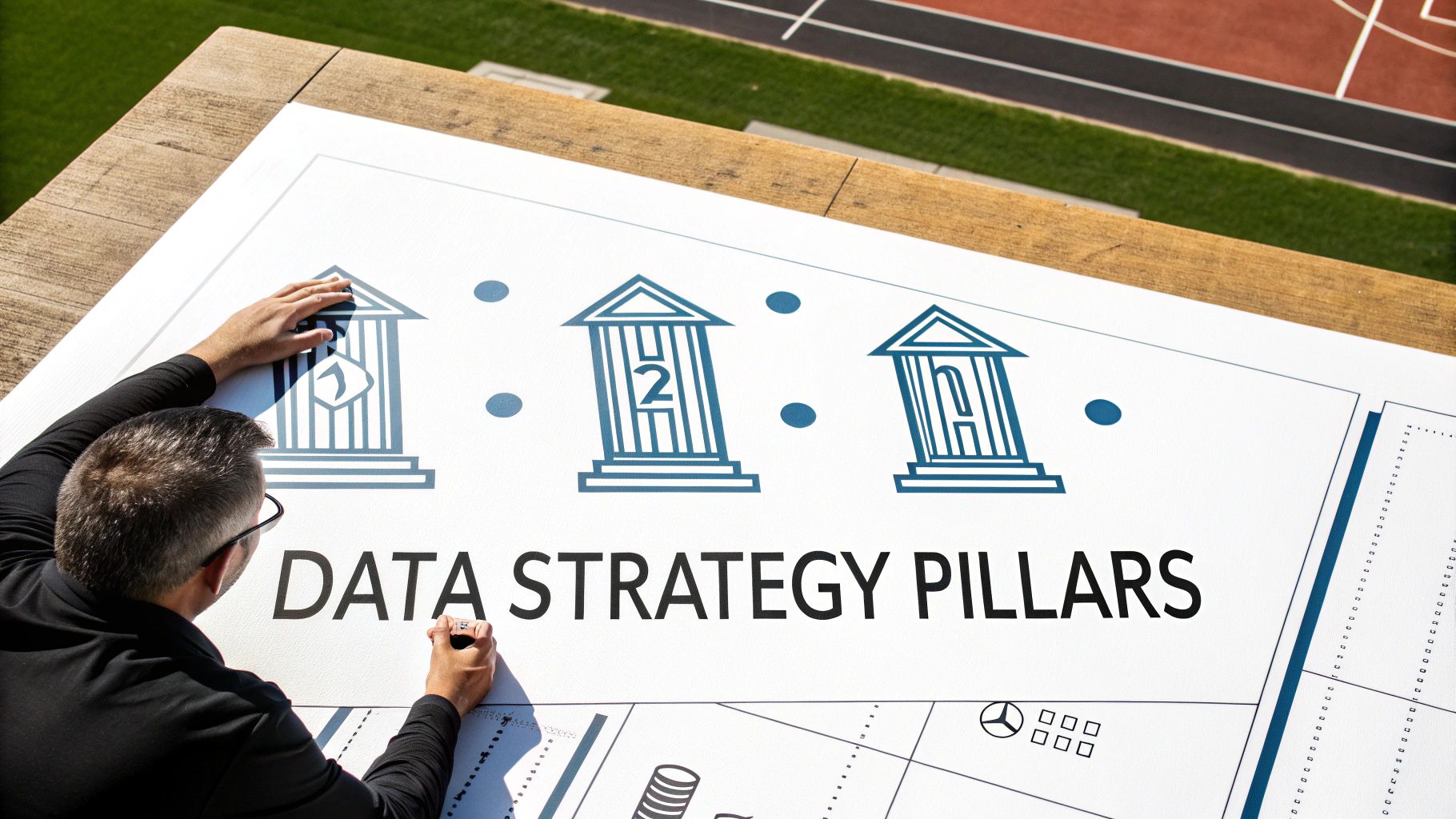
A solid data analytic strategy doesn't just materialize out of thin air. It’s built, piece by piece, on a strong foundation. Think of it like a building—without strong supports, the whole thing is unstable. Your strategy leans on four of these essential pillars.
Nail these four, and you’ll create a stable, scalable framework that turns your data into a real competitive advantage. But if you neglect even one, the whole structure gets wobbly and unreliable. Let’s break down what each of these pillars means for a founder or SMB operator.
To simplify, a data strategy is all about answering a few core questions in the right order. We've seen countless SMBs get this wrong by jumping straight to the shiny new tools.
Here’s a quick overview of the pillars and the common traps to avoid.
Key Pillars of Your Data Analytic Strategy
| Pillar | Core Question for Your Business | Common SMB Pitfall |
|---|---|---|
| Business Objectives | What problem are we actually trying to solve? | Chasing vanity metrics (e.g., website clicks) that don't connect to revenue or profit. |
| Data & Governance | Where is our data, and can we actually trust it? | Relying on siloed, conflicting spreadsheets, leading to a "single source of truth" that no one agrees on. |
| Technology & Tools | What's the right toolkit for our current needs and future growth? | Buying an overly complex, enterprise-level system that requires a full-time expert to manage. |
| People & Process | How do we get our team to actually use this stuff? | Believing the tool alone is the solution, without investing in training or building a data-curious culture. |
Getting these pillars right transforms your data strategy from an abstract idea into a concrete, actionable plan. Let's dig a little deeper into each one.
Pillar 1: Business Objectives and Key Questions
Before you even glance at a spreadsheet or a dashboard, you have to start with your business goals. Technology is just a tool; it's not the destination. The first pillar is all about asking, "What problem are we trying to solve?" or "What critical question do we need an answer to, right now?"
This single step grounds your entire effort in real-world value. Without that clarity, you'll fall into a common SMB trap: chasing vanity metrics. Sure, likes, clicks, and web traffic might look impressive on a report, but if they don't tie directly to revenue, customer retention, or operational efficiency, they're just noise.
A winning strategy always begins with the end in mind. It defines what success looks like in business terms first, then works backward to figure out which data points will actually light the way.
Pillar 2: Data Sources and Governance
Once you know what you need to measure, the next logical question is, "Where is all our data, and can we even trust it?" This pillar is all about identifying your different data sources—your CRM, accounting software, marketing platforms, and yes, all those disconnected Excel spreadsheets.
But simply locating the data isn't the whole story. Data governance is the unglamorous but vital process of making sure your data is accurate, consistent, and secure. It’s about setting the rules of the road for how data is collected, stored, and used. This is the bedrock of building trust in your numbers. If your finance and ops teams are constantly pulling different figures for the exact same metric, you have a governance problem, not a reporting one. Our guide on data governance best practices provides a clear roadmap for getting this right.
Pillar 3: Technology and Tools
With your goals defined and your data mapped out, now it’s time to pick your toolkit. For many SMBs, this is the moment they make the leap from manual, error-prone spreadsheets to a more automated and powerful business intelligence platform like Power BI.
The trick is to choose tools that fit your needs today but can also grow with you. A classic mistake is overinvesting in a complicated, enterprise-grade system that needs a dedicated team just to keep the lights on. Your tech stack should make your life simpler, not harder.
- Data Collection: Tools that can automatically pull information from your various platforms.
- Data Storage: A central repository, like a simple data warehouse, to establish a single source of truth.
- Data Visualization: A platform like Power BI to build interactive, easy-to-digest dashboards.
The move toward accessible, cloud-based tools is a massive trend. In fact, the cloud segment holds a 58.6% market share in the global data analytics market in 2024, showing just how many businesses are moving away from clunky on-premise infrastructure. You can discover further insights into the data analytics market on imarcgroup.com.
Pillar 4: People and Process
This final pillar is arguably the most critical: your team. You can have the perfect strategy and the most sophisticated tools on the planet, but if your people don’t use them, it’s all a wasted investment. This pillar is about fostering a data-curious culture.
It's about empowering your team to ask questions and look for answers in the data. It involves providing the right training, setting up clear workflows for how reports are used in meetings, and celebrating wins that came from insights. This is the cultural shift from making decisions based on "I think" to decisions based on "The data shows." A great strategy isn't just implemented; it's adopted and championed by the people who rely on it every single day.
Moving from Reactive Reporting to Proactive Insights
For most businesses, data reporting feels like you're driving a car while only looking in the rearview mirror. Your weekly sales reports, monthly financial summaries, and quarterly performance reviews are all backward-looking. They tell you exactly what has already happened, often with a frustrating delay.
This is reactive reporting. It's the default mode for businesses stuck in the chaos of spreadsheets, where pulling data is a manual, soul-crushing chore. While you need these reports, they trap you in a constant cycle of reacting to past events instead of getting ahead of what’s coming. A real data analytic strategy is designed to break this cycle for good.
The goal is to shift your entire operation from reacting to problems to proactively shaping your future. It's about using your data not just to understand the past, but to anticipate what's next and make decisions that actually influence it.
The Power of Predictive Analytics for SMBs
This kind of forward-looking thinking isn't just for massive corporations with huge data science teams anymore. The tools and techniques to make it happen are more accessible than ever, especially for small and medium-sized businesses. This is where predictive analytics comes in.
Predictive analytics uses your historical data, statistical algorithms, and machine learning to pinpoint the likelihood of future outcomes. In simple terms, it finds patterns in what you’ve already done to make a very educated guess about what will happen next. This is a massive leap from just looking at a simple report.
For an SMB, this could mean:
- Forecasting Sales: Going beyond a simple "we grew 5% last quarter" to predicting which specific product lines are likely to see a spike in demand next month.
- Predicting Customer Churn: Identifying which customers are showing behaviors that suggest they’re about to cancel their subscription or stop buying from you.
- Optimizing Inventory: Using sales trends to forecast exactly how much stock you’ll need for the upcoming season, preventing costly overstock or missed sales from stockouts.
The importance of this shift is clear across the market. Predictive analytics has become a cornerstone of modern data strategies, accounting for a massive 40.12% of the global market revenue in 2024. Businesses are rapidly adopting these methods to get a serious leg up on the competition. You can discover more insights about the data analytics market on Grand View Research.
A Relatable Scenario: The Subscription Box Company
Imagine you run a popular subscription box service. For months, your customer numbers looked great on your standard reports. But lately, you've noticed a worrying trend: customer churn is creeping up. Reactive reporting tells you that you lost 100 subscribers last month. Diagnostic analytics might help you figure out why (maybe it was that price increase).
But what if you could have stopped many of them from leaving in the first place?
This is where a proactive strategy changes the game. By analyzing the behavior of customers who churned in the past, a predictive model built in a tool like Power BI could identify clear patterns. Maybe it finds that customers who skip a delivery, visit the cancellation page without finishing, or haven't logged into their account in 60 days have a 90% probability of churning in the next 30 days.
With this insight, you are no longer reacting to lost revenue. You are proactively identifying at-risk customers before they leave.
Now, your marketing team can take specific, targeted action. Instead of a generic email blast, they can send a personalized offer to that high-risk group—perhaps a discount on their next box or early access to a new product. You can learn more about how to implement these forward-thinking approaches in our guide to predictive and prescriptive analytics.
This is the essence of a modern data analytic strategy: turning your historical data into a powerful tool that helps you make smarter, forward-looking decisions that directly protect and grow your bottom line.
Putting Your Strategy into Action with a Practical Roadmap
A well-defined data analytic strategy is a great blueprint, but it's just an idea on paper until you bring it to life. For many SMB founders, the thought of actually implementing it can feel like a massive, overwhelming project. Where do you even begin?
The key is to avoid trying to boil the ocean.
Instead, a phased approach lets you lock in some quick wins, prove the value of what you’re doing, and build momentum. This isn’t about a multi-year, budget-draining overhaul; it's about making real, tangible progress in weeks, not years. By breaking the journey down, you can get from Excel chaos to actionable insights much faster than you think.
Your First 90 Days From Excel Chaos to a Power BI Dashboard
To make this feel more concrete, here’s a sample 90-day plan. This is a common path we see small and mid-sized businesses take to get meaningful results in just one quarter.
| Phase | Key Actions | Expected Outcome |
|---|---|---|
| Phase 1: Foundations (Days 1-30) | Identify the #1 reporting headache (usually sales or finance). Connect your CRM and accounting software to Power BI. | Your first real dashboard is live. It’s a single, trusted view of performance, ending the daily grind of manual report-building. |
| Phase 2: Expansion (Days 31-60) | Build out specific dashboards for key teams (sales, finance, operations). Empower managers with the exact data they need. | Department heads are using data to guide their daily decisions. The culture starts shifting from guesswork to data-backed actions. |
| Phase 3: Automation & Scale (Days 61-90) | Automate every remaining manual report. Start building simple predictive models (e.g., sales forecasts) in Power BI. | Your team's time is freed up for strategic work. You’re now using data to look forward, not just backward. |
This roadmap turns a daunting project into a series of manageable, value-driven steps. Each phase builds on the last, ensuring you see a return on your investment quickly and sustainably.
Phase 1: Quick Wins and Foundations (The First 30 Days)
Your first month is all about laying the groundwork and delivering immediate value. The main goal here is to centralize your most critical data, finally moving away from siloed spreadsheets and establishing a single source of truth.
- Key Action: Pinpoint your most painful reporting process—this is often sales or financial reporting. Connect those core data sources (like your CRM and accounting software) into a tool like Power BI.
- Expected Outcome: You’ll have your first foundational dashboard. It might be simple, but it gives everyone a unified view of performance. This kills the frustrating daily task of manually stitching different reports together. You’ll finally have one number everyone on the team can agree on.
This initial step is all about building trust in your data. It proves that automation isn’t some far-off dream and sets the stage for much deeper analysis.
Phase 2: Deeper Insights and Departmental Dashboards (Days 30-60)
With a trusted data foundation in place, the next 30 to 60 days are all about expanding access and digging deeper. Now, you can move beyond high-level KPIs and start building out tailored dashboards for key departments like finance, sales, and operations.
The goal here is to empower team leaders with the specific information they need to make smarter decisions. A sales manager might get a detailed view of their pipeline and team performance, while the finance lead gets an automated cash flow report. This is where you see a real cultural shift, as teams start using data to guide their daily work.
The journey from basic reporting to advanced analytics involves a clear progression in data maturity. It starts with answering "what happened?" and moves toward predicting "what will happen?" to proactively shape business outcomes.
This diagram shows the typical path businesses take as they level up their data capabilities.
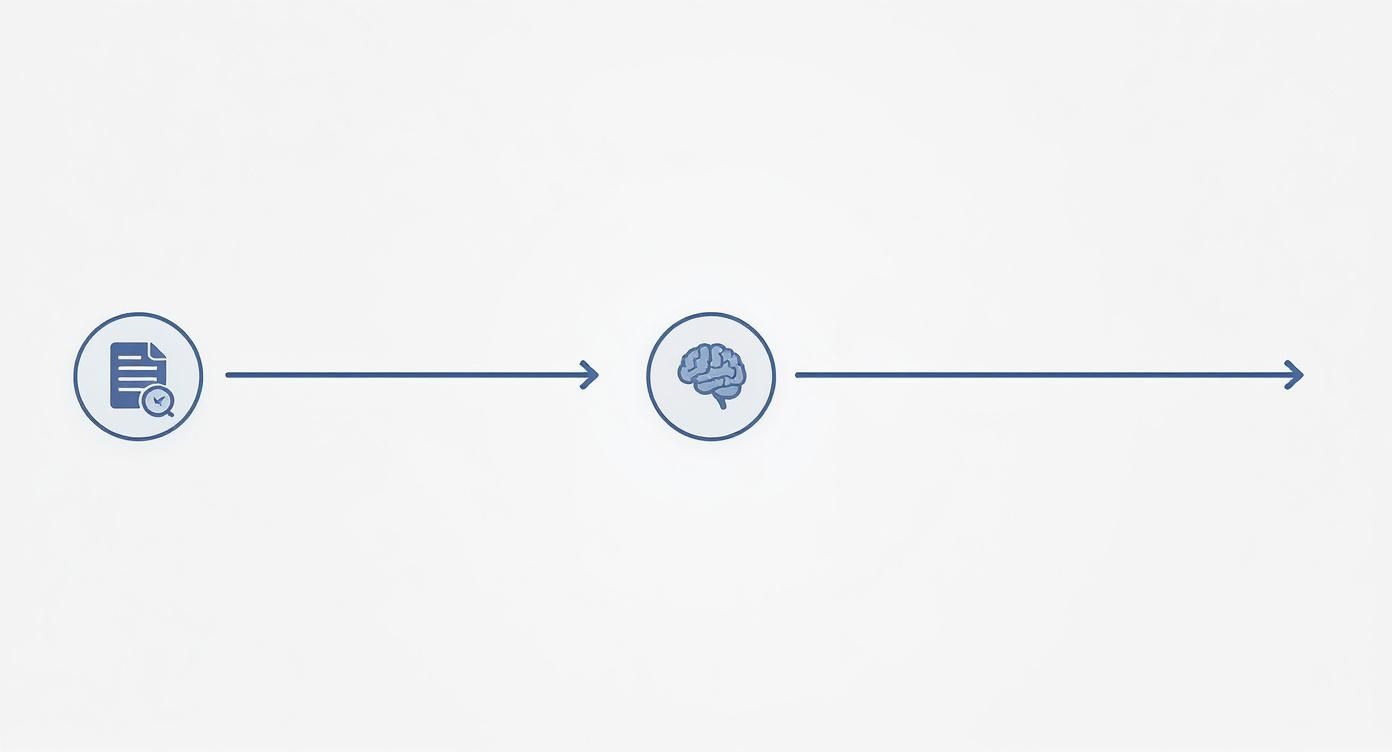
Moving from left to right on this maturity curve is the core objective of a successful data analytics strategy.
Phase 3: Scaling Automation and Predictive Power (Day 90 and Beyond)
Once your core reporting is automated and your teams are using data consistently, the final phase is about scaling that success and looking to the future. This means automating every manual report you can find, freeing up countless hours for your team to focus on strategic work instead of copy-pasting data.
This is also where you can start to introduce predictive elements. Using the historical data you've already consolidated, you can begin building simple forecasting models in Power BI. This could be anything from projecting next quarter's sales to identifying customers at high risk of churn. Understanding how to build a data pipeline is a crucial technical step that underpins this entire scaling process.
Of course, navigating this roadmap has its potential pitfalls, from choosing the wrong tools to struggling with team adoption. Getting an expert in your corner can help you sidestep these common mistakes and accelerate your journey to data maturity.
Taking the Leap: From Data Overload to Strategic Action
Making the shift from data chaos to strategic clarity comes down to one fundamental change in perspective. It's about stop seeing your data as a collection of disconnected reports, and start treating it as an ongoing business function—one dedicated to smart, sustainable growth.
A powerful data analytics strategy isn't some complex, one-off project you set up and then forget about. Think of it more like the operating system for your entire business. Its real job is to give you a crystal-clear view across every department, get your finance and ops teams aligned around a single source of truth, and give you the confidence to make the right call, every single day.
It’s the difference between driving while only looking in the rearview mirror and having a live GPS guiding you toward your destination.
Stop Struggling and Start Strategizing
Are you tired of the weekly grind, manually pulling numbers from siloed spreadsheets? Fed up with getting reports that are already stale by the time they hit your desk? You’re not alone, but you don't have to be stuck in that reactive loop.
The path to automated reporting, predictive forecasting, and genuine business intelligence is much clearer than you might think. It all starts with a practical roadmap built around your specific business goals, designed to deliver quick wins and build momentum from day one.
Imagine a future where your team spends its time uncovering game-changing insights, not wrestling with data entry. Where every strategic conversation is grounded in accurate, real-time information. That's not a pipe dream; it's what a solid strategy and the right tools make possible.
It’s time to stop guessing. Let’s connect the dots in your data and unlock the insights you need to scale with confidence.
Want to automate your reporting and finally trust your data? Book your free BI consultation with a Vizule expert today, and we’ll help you map out the first steps on your journey to data-driven growth.
Data Analytics Strategy FAQs
Let's tackle some of the most common questions founders and SMB owners have when they're thinking about building a data analytics strategy.
What's the Difference Between Reporting and Analytics?
Let's use a simple car analogy.
Think of reporting as your car's dashboard. It’s giving you the critical, real-time stats: your speed, your fuel level, your engine temperature. It tells you what is happening right now. It's a static snapshot of the past.
Analytics, on the other hand, is your GPS. It’s using historical and real-time data to tell you why you're stuck in traffic, predicting your arrival time, and even suggesting a smarter route to avoid future delays. Reporting looks backward; a real data analytics strategy uses that history to help you shape what happens next.
How Much Does Implementing a Data Strategy Cost?
This is always the first question, and the answer is usually a pleasant surprise: it's far more affordable than you'd think. Not long ago, this meant shelling out for massive servers and expensive software licenses upfront.
Today, with cloud tools like Power BI, the game has completely changed. You can start small on a subscription and scale your investment as you grow and start seeing a return. The biggest cost is often the time wasted trying to DIY a solution and making expensive mistakes. Partnering with a consultant ensures you get the foundations right, fast.
How Do I Get My Team to Actually Use the New Dashboards?
This is a people problem, not a tech problem. A shiny new dashboard is totally useless if no one logs in. The secret to getting your team on board is to start by solving a genuine, painful problem for one specific team.
Don’t try to build a massive, do-it-all dashboard on day one. Instead, work with your sales team to kill the one report they waste three hours building every single Monday morning. When you give them that time back, they’ll become your biggest cheerleaders.
Getting this right comes down to a few simple actions:
- Provide Hands-On Training: Don't just send a link. Show them exactly how these tools make their daily grind easier.
- Start Small and Iterate: Launch with one high-impact dashboard. Get feedback, make it better, then build the next one.
- Lead by Example: Make data a core part of your own decision-making. Bring the dashboards up in meetings and ask questions based on what you see.
When you focus on quick wins and bring your team into the process early, you build momentum. That’s how a data-curious culture starts to grow on its own.
Tired of answering business-critical questions with stale data and guesswork? The team at Vizule specialises in building practical, powerful data analytic strategies that deliver clarity and drive growth. Book your free BI consultation to see how we can transform your reporting in weeks, not years.
