


You’ve been there. Another late night staring at spreadsheets, trying to force the sales forecast to line up with the cash flow projections. It’s a story I hear all the time from founders and operators: your business is built on data, but that same data feels scattered, contradictory, and just plain untrustworthy.
This isn’t just a minor headache; it’s a silent tax on your growth. It forces you to rely on gut feelings precisely when you need cold, hard facts. Concepts like data governance and data quality might sound like dry corporate jargon, but for SMBs, they are the practical solution to this exact problem.
The Real Cost of Untrustworthy Data
Every business owner knows that sinking feeling of looking at two reports that should be identical but tell completely different stories.
Let’s picture a founder—we’ll call her Sarah—prepping for a crucial investor meeting. Her sales CRM is showing fantastic monthly recurring revenue growth. Awesome. But her accounting software? It paints a much bleaker picture of actual cash collections. Which one is right?
This single discrepancy kicks off a fire drill. Sarah and her finance lead are now stuck manually reconciling records, digging through transactions to find where things went wrong. Was it a simple data entry error? A different definition of "customer" in each system? Or a sync issue that no one caught?
The Hidden Price Tag of Bad Data
Sarah's situation is more than just frustrating; it carries real, tangible costs that quietly bleed resources from small and medium-sized businesses. The fallout from poor data quality touches every corner of the company.
- Wasted Time and Resources: Your most valuable people—yourself included—are pulled from high-impact work to do manual data cleanup. This "data janitor" work is expensive, tedious, and terrible for morale.
- Eroded Confidence: When leaders and investors can't trust the numbers, decision-making grinds to a halt. Big opportunities are missed not because of a lack of vision, but because of a lack of reliable information to act on.
- Strategic Blind Spots: Bad data gives you a funhouse mirror view of your business. You might be pouring money into marketing channels that are duds or failing to spot a drop in customer retention until it’s a five-alarm fire.
Bad data doesn’t just create bad reports; it leads to bad decisions. It fosters a constant state of uncertainty, making you second-guess your strategy and crippling your ability to scale with confidence.
From Chaos to Clarity
The root of Sarah’s problem isn’t a broken spreadsheet or a buggy app. It’s the lack of a clear, intentional system for managing her company's data.
Data governance and data quality are the two pillars that support that system. Together, they create the framework that ensures your data is accurate, consistent, and reliable, no matter where you look.
This isn't about building some complex, enterprise-level bureaucracy. For an SMB, it’s about setting simple ground rules, defining who owns what data, and using smart tools like Power BI to automate reporting and build trust. This guide will walk you through how to move from data chaos to clarity, creating a foundation of trusted information that empowers smart, confident growth.
Understanding Data Governance and Data Quality
To get from data chaos to real clarity, we first need to pull apart two ideas that often get tangled up: data governance and data quality. They’re deeply connected, but they do very different jobs in making your business information something you can actually trust and use.
The easiest way to think about it is like building a house.
Data Governance is your architectural blueprint. It’s the master plan that lays down all the rules, standards, and who’s responsible for what. It answers questions like: Who has the authority to change the foundation? What type of wiring is approved? What are the exact measurements for every room? The blueprint makes sure the whole project is organised, up to code, and results in a solid building.
Data Quality, on the other hand, is all about the materials you're using. Are the bricks solid and uniform? Is the wood straight and free of rot? Are the windows sealed properly? You can have the best blueprint in the world, but if your materials are garbage, the house will be unstable. Simple as that.
You need both a solid blueprint and high-quality materials to build a house that lasts. In exactly the same way, you need strong data governance and high data quality to build a business on a foundation of trust.
Distinguishing the Blueprint from the Building Blocks
At its core, governance is proactive and strategic. It’s about setting up the "how" and "who" of managing your data. Quality is more reactive and tactical—it’s about the "what" and measuring the actual state of the data against the rules you’ve set. One makes the rules; the other checks if the rules are being followed.
To make this crystal clear, let's look at them side-by-side.
Data Governance vs Data Quality at a Glance
This table breaks down the core differences, helping you see exactly where each one fits into the puzzle. Governance provides the framework, and quality fills it with reliable, trustworthy information.
| Aspect | Data Governance (The Blueprint) | Data Quality (The Building Blocks) |
|---|---|---|
| Primary Focus | Defines policies, roles, and standards for data management. | Measures and improves the condition of data based on defined standards. |
| Objective | To create a consistent, secure, and accountable framework for data assets. | To ensure data is accurate, complete, consistent, and fit for use. |
| Key Question | "Who is responsible for this data, and what are the rules for using it?" | "Is this data correct, and can we trust it for our reports?" |
| Example Action | Establishing that the Head of Sales is the official "owner" of all CRM data. | Running a check to find and merge duplicate customer records in the CRM. |
Ultimately, establishing clear, simple standards for your most important data is the first step toward creating that single source of truth everyone talks about. Defining who owns what is a huge part of that. We've put together a detailed guide on how to assign clear data governance responsibilities that shows how this works in the real world.
Why This Matters More Than Ever
Getting a handle on data isn't just a nice-to-have anymore; it’s a full-blown business imperative. The numbers don't lie. Data governance adoption has skyrocketed, with 71% of organisations now having a formal program in place. That's a huge 18% jump in just one year, because companies are finally waking up to the fact that bad data is a dead end.
In fact, 62% of firms say governance gaps are the #1 thing holding back their AI plans, and 58% report that putting it in place directly boosts the quality of their analytics.
Your data governance framework is the engine for data quality. Without the policies and ownership defined by governance, any effort to clean up data is just a temporary fix—like patching a crack in a wall without addressing the faulty foundation.
And for businesses running on cloud infrastructure, these principles are even more critical. Well-managed cloud data governance is what keeps your data secure and reliable, no matter where it lives. Now that you understand these two concepts, you’re ready to build a system that turns raw data into your most powerful strategic asset.
A Practical Roadmap to Reliable Reporting
Theory is one thing, but in the real world, you need a plan that actually works—one that delivers results without the corporate red tape. For small businesses and founders, getting a handle on data governance and data quality isn’t about launching some massive, multi-year project. It’s about starting small, focusing on what truly matters, and building momentum with quick, visible wins.
That’s exactly why we use a straightforward, three-phase framework: Map, Model, and Mobilise. This approach is designed to cut through the complexity and get you to reliable reporting fast.
Phase 1: Map Your Critical Data Assets
Before you can fix anything, you need to know what you’re working with and why it’s important. The "Map" phase is all about identifying that handful of data assets absolutely essential to running your business. Forget about cataloging every single spreadsheet; we're pinpointing the numbers that drive your most critical decisions.
Start by asking some simple, powerful questions:
- What are the top five metrics we obsess over in our weekly leadership meetings? (Think new leads, conversion rates, cash balance).
- Which numbers are non-negotiable for our monthly investor or board reports? (e.g., Monthly Recurring Revenue, Customer Acquisition Cost).
- If a report is consistently wrong, which one causes the biggest fire drill? (Maybe it's inventory levels or project profitability).
The answers will immediately point you to your high-impact data domains. For most SMBs, this list is surprisingly short, usually revolving around sales pipeline data from a CRM, financials from your accounting software, and operational data from one key business application.
Phase 2: Model the Rules of the Road
Once you’ve identified your mission-critical data, it’s time to set some ground rules. The "Model" phase is where you define the standards and ownership that will become the backbone of your data governance framework. Again, keep it practical.
The goal isn't to write a 50-page policy document nobody will ever read. It’s to establish clear, common-sense guidelines that stop the most common data errors before they even happen.
Kick things off with two key activities:
- Assign Clear Data Owners: Give a single person accountability for each critical data asset. For example, the Head of Sales owns all CRM lead and opportunity data. The Finance Controller owns everything in the accounting system. This simple step puts an end to the "who's responsible?" finger-pointing for good.
- Define Simple Quality Checks: Create basic rules for how data should be entered. A rule might be, "all new client records in the CRM must have a valid address and contact email," or "all sales entries must be tied to a specific product SKU." These aren't complex algorithms; they are basic guardrails that dramatically improve data quality at the source.
By modeling these simple rules, you create a lightweight but effective blueprint for how data should be managed. For a deeper dive into creating a plan that fits your business, explore our guide on building a data strategy roadmap.
Phase 3: Mobilise Your Plan with Automation
Finally, you need to bring your plan to life. The "Mobilise" phase is all about using technology—especially powerful tools like Power BI—to automate your rules, monitor data quality, and deliver reports you can actually trust. This is where your governance framework goes from being a document to a dynamic, value-driving system.
A key outcome of getting data governance and quality right is the ability to use business intelligence consulting to turn raw numbers into the kind of insights that fuel reliable reporting and growth.
In this phase, you can:
- Automate Data Quality Checks: Use Power BI to build dashboards that automatically flag any data that breaks your rules. Imagine a report that instantly shows you every customer account missing a phone number or sales records without a proper close date.
- Create a Single Source of Truth: Connect Power BI to your various systems (CRM, finance, ops) to build a unified data model. This ensures everyone is looking at the same numbers, killing the classic "my report says this, but yours says that" problem.
- Build Proactive Alerts: Set up notifications that ping data owners the moment a quality issue pops up. This empowers your team to fix problems in real-time and keep your data integrity high.
This process flow shows how a strong blueprint (governance) and quality materials (data) come together to build a solid structure of data integrity.
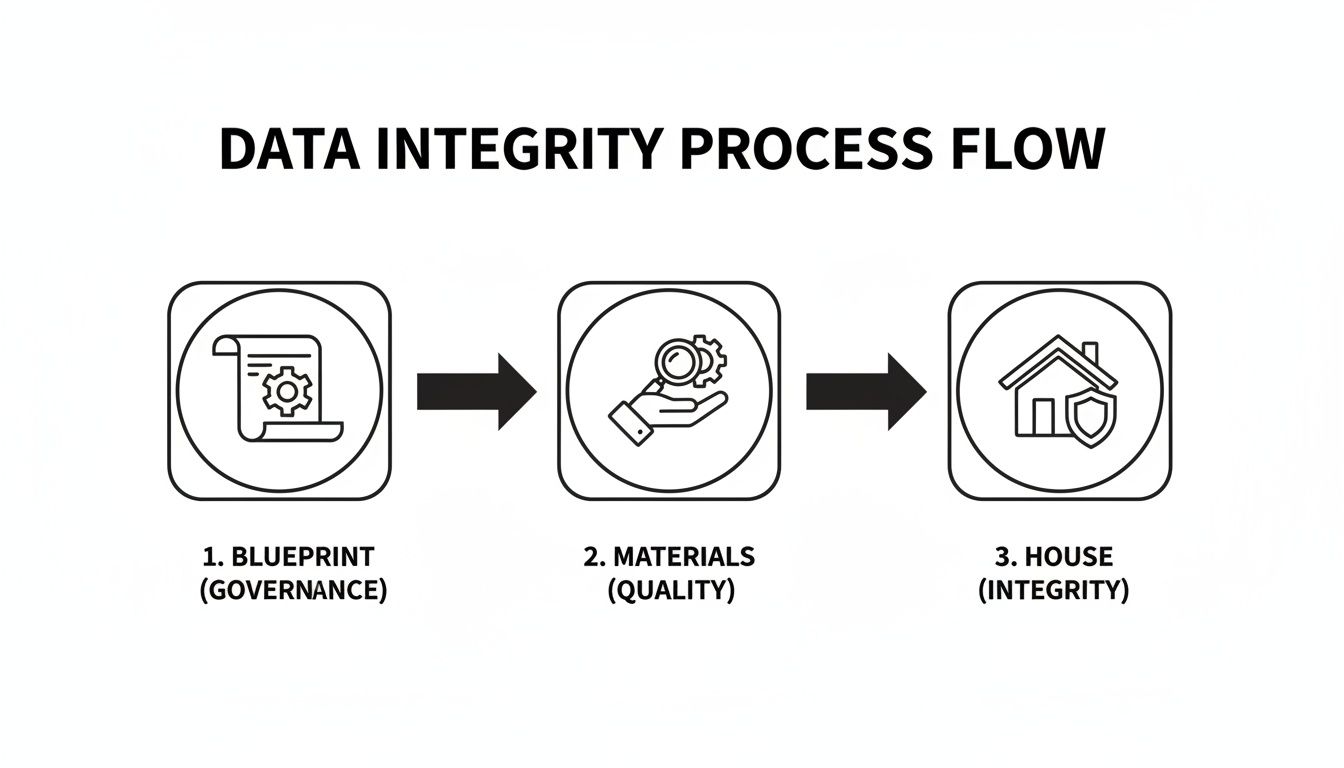
The image drives home a key point: you can't get to trustworthy reporting (integrity) without first setting the rules and then making sure your data actually meets those quality standards. By following this Map-Model-Mobilise roadmap, you build a sustainable system for reliable data that drives confident decision-making and supports scalable growth.
The Six Data Quality Metrics That Actually Matter
So, we have a roadmap, but how do you actually measure the health of your data? When your reports just feel "off," you need a simple diagnostic toolkit to figure out exactly what’s broken. Forget complex algorithms; this is about asking straightforward business questions.
Thinking about data governance and data quality in abstract terms can be a real headache. Instead, let's break it down into six core metrics, or what we call dimensions. These are the practical standards you can use to grade your own information and have real conversations with your team about making things better.
Each dimension answers a simple, fundamental question about whether you can rely on your data. Mastering them is the key to building dashboards and financial models you can finally trust.
Accuracy and Completeness
The first two dimensions are the ones people grasp most easily. Accuracy asks a simple question: Does our data reflect what's actually happening in the real world? It’s the difference between a P&L that matches your bank statement and one that sends you on a wild goose chase for a phantom expense. Honestly, inaccurate data is worse than no data at all—it gives you the confidence to make the wrong call.
Completeness tackles a different problem: Are we missing critical pieces of the puzzle? An incomplete customer record without an email address means your marketing team can't reach them and your finance team can't send an invoice. It's all about making sure you have every piece of information you need to operate smoothly.
Consistency and Timeliness
Next up, let's look at how uniform and up-to-date your data is. Consistency is the silent killer of reliable reporting. It asks: Is the same piece of information recorded the same way across all our systems? If your CRM lists a client as being in the "United States" but your accounting software uses "USA," you'll end up double-counting them. This kind of small error can distort everything from your total sales figures to regional performance reports.
Timeliness is all about relevance. It asks a simple question: Is our data ready when we need it to make a decision? Yesterday's sales figures are incredibly powerful this morning; by next week, they’re just history. Slow, manual reporting processes rob you of the chance to react quickly to what's happening in your business right now.
The challenge of maintaining data quality is growing like crazy. By next year, unstructured data like emails and contracts will make up over 90% of all data generated. Without strong governance, this flood creates huge quality issues, with 56% of leaders saying data quality is their top data integrity concern. Learn more about how to prepare for these data governance trends on Dataversity.
Uniqueness and Validity
Finally, we have two dimensions that focus on stopping errors before they even start. Uniqueness makes sure you aren't double-counting. Are you counting the same customer twice because they have two slightly different entries in your system? Duplicate records are a classic source of inflated metrics and wasted marketing budget.
Validity is your rule-checker. It asks: Does our data follow the rules we've set for it? A valid phone number should only contain numbers and follow a specific format. Invalid data, like putting "N/A" in a number field, breaks your calculations and messes up your reports.
For a deeper look into fixing these issues, check out our guide on how to improve data quality.
To tie all this together, think of the following table as a simple checklist. It translates these abstract concepts into tangible, everyday business examples.
The Six Pillars of High-Quality Business Data
This table gives you a simple overview of the essential data quality dimensions, with practical examples you can apply directly to your own small or medium-sized business.
| Data Quality Dimension | Simple Definition | Example in Your Business |
|---|---|---|
| Accuracy | Does the data match the real world? | Your monthly sales report in Power BI exactly matches the deposits in your company bank account. |
| Completeness | Is all the necessary information present? | Every customer record in your CRM has a valid email address and phone number for invoicing and follow-ups. |
| Consistency | Is the same data represented the same way everywhere? | The product name "Pro Plan" is spelled and capitalized identically in your sales, finance, and support systems. |
| Timeliness | Is the data available when it's needed? | Daily sales performance data is refreshed and available in your dashboard by 9 AM every morning. |
| Uniqueness | Is each record one of a kind? | A search for a specific customer in your database returns only one entry, not three different versions. |
| Validity | Does the data follow the right format? | All postal codes entered into your system adhere to the correct five-digit format, preventing shipping errors. |
By keeping these six pillars in mind, you're not just cleaning data—you're building a foundation of trust that allows you to make smarter, faster decisions for your business.
Achieving Quick Wins with Better Data
Theory is great, but in business, you live and die by results. All the frameworks and metrics in the world don’t mean a thing until they solve a real-world problem. So, let's get practical and look at the immediate return you can get from applying even the most basic principles of data governance and data quality.
Let’s imagine a startup founder—we’ll call her Alex. The first week of every month is pure, controlled chaos. Her mission: build the monthly investor report.
This isn’t a simple download. It means manually pulling CSV files from her CRM, payment processor, and accounting software. She then loses hours in Excel, painstakingly merging spreadsheets and trying to match customer names to subscription IDs, and payments to invoices. It’s a tedious, error-prone mess that she dreads.

Worse, the final numbers often create more questions than they answer. Last month, the report showed 15 new customers, but only 12 new payments were logged. That kind of discrepancy completely erodes trust with investors and forces Alex to spend her meeting time defending numbers instead of discussing strategy.
The Power of a Simple Rule
Frustrated and at her wit's end, Alex makes one small but powerful change. She implements a single data governance rule: the CRM will now be the one and only source for all new customer and sales data. All other systems must sync from it.
This simple act of defining a single source of truth for your data is a foundational governance step. Right away, it eliminates the confusion from conflicting reports. There’s no more debate about which system is right because the rule has been set.
Next, she connects her systems to Power BI, creating an automated dashboard that pulls from the CRM as the master record. This one dashboard visualises her key metrics—new customers, revenue, and churn—all in real-time.
The change is immediate and profound. Alex's reporting process flips from a week-long manual nightmare to a task that takes just a few minutes. The data is trusted because everyone knows it flows from a single, defined source.
From Data Janitor to Business Strategist
This "after" state is where the real value of good data practices shines through. The benefits are about so much more than just saving time.
- Increased Speed: Decisions happen instantly. When a new sales trend emerges, Alex sees it that same day, not weeks later after the report is finally cobbled together.
- Restored Trust: Investor meetings become forward-looking and strategic. The conversation shifts from, "Are these numbers even right?" to, "What should we do next based on these numbers?"
- Reduced Stress: The monthly reporting panic is gone. Alex is no longer a data janitor; she’s a founder focused on growth, using reliable insights to steer the ship.
This scenario holds a critical lesson for every business owner: improving your data governance and data quality doesn’t have to be a massive, complex project. It starts with small, deliberate changes that deliver significant, immediate value. By defining clear rules and automating your reporting, you reclaim countless hours, cut out the stress, and finally unlock the strategic insights that were always buried in your business.
Your Data-Driven Future Starts Now
The journey to data you can actually trust begins with one clear decision. As we've seen, data governance and data quality aren't just buzzwords for giant corporations; they are absolutely critical for any SMB that’s serious about scaling up. You don't need to boil the ocean—you just need a smart, focused plan.
Think of this as a strategic move, not just a back-office chore. The global data governance market is on track to hit a staggering USD 15.86 billion by 2032. That explosion in growth, detailed in this GlobeNewswire market report, is a direct response to the trillions of dollars businesses lose to bad data every year.
By setting up clear rules and making sure your data is reliable, you can finally shift from putting out fires to driving proactive, insight-led growth. A well-defined process is your best friend here, and our guide on how to build a data pipeline is the perfect next step for getting your information flow structured correctly.
If you're tired of data chaos and ready to unlock what your business is truly capable of, it's time to act. Let us help you connect the dots and build a reporting system you can finally trust.
Ready to automate your reporting and get numbers you can stand behind? Book your free BI consultation with Vizule today, and let’s build your roadmap to data clarity.
Frequently Asked Questions
Even with a solid plan, jumping into data governance and data quality can feel a bit overwhelming. Let’s tackle some of the most common questions we hear from founders and operators who are ready to get their data house in order.
Do I Need a Dedicated Person for Data Governance in My Small Business?
Not at the start. For most small and medium-sized businesses, good data governance isn't about hiring a new person—it's about creating a culture where everyone takes responsibility for the data they use.
The most practical way to begin is by assigning 'data ownership' to people already on your team. For instance, your Head of Sales is now officially accountable for the quality of your CRM data. Your finance manager owns the accuracy of the numbers in your accounting software. The trick is to be crystal clear about who is responsible for what. As you scale, a more formal role might make sense, but you can see massive improvements today just by building these duties into your existing structure.
What Is the First Step I Should Take to Improve My Data Quality?
Start small. Seriously. The temptation is to try and boil the ocean, but that’s a recipe for burnout. The best first step is a small-scale data audit in one, high-impact area.
Pick a single critical report that always makes you second-guess things. Maybe it's your monthly sales performance dashboard or that crucial cash flow forecast. Manually go through the underlying data for just one period. Are there duplicate customer entries? Is contact info missing? Do the sales figures actually match what’s in your payment system? This simple exercise will shine a spotlight on your most common data quality headaches and give you a tangible, manageable starting point.
Can Tools Like Power BI Help with Data Governance?
Absolutely. Modern BI tools like Power BI are a game-changer for both data governance and data quality. First off, they help you establish a 'single source of truth' by pulling data from all your different systems—your CRM, accounting software, random spreadsheets—into one unified view.
Even better, you can build automated data quality checks and alerts right inside your dashboards.
For example, you could set up a report that automatically flags any customer record with a missing phone number or any sales entry that looks suspiciously high or low. This flips data quality from a tedious, reactive chore into an automated, proactive process that builds real trust in your numbers.
Tired of reports you can't trust? The team at Vizule helps founders and operators automate their reporting stack and build a single source of truth that drives confident decision-making. Book your free BI consultation to see how we can help you connect the dots in your data.


