

Are you drowning in spreadsheets?
If you're a founder or an operator, you know the feeling. Your business runs on a patchwork of Excel files, each one a potential landmine of conflicting data. Your team torches hours every week on manual reporting—copying, pasting, and just trying to get finance and operations on the same page.
You’re swimming in data but starving for actual insights.

This spreadsheet chaos isn't just a time-waster; it creates a massive blind spot in your business. When you can’t trust your numbers, you can’t make confident decisions. This is the exact pain point where Data Science as a Service (DSaaS) steps in to connect the dots.
What DSaaS Actually Means for Your Business
Forget the jargon. At its core, DSaaS is about getting straight, actionable answers from your data without hiring an expensive in-house team. It's an agile, modern way for SMBs to access the exact expertise and tools they need, right when they need them.
Instead of the costly and lengthy process of hiring a full-time data scientist, you partner with a specialist consultancy that brings everything to the table.
Think of it as your on-demand data team, providing:
- Expert Analysis: Seasoned data scientists, financial modellers, and business intelligence pros ready to dive into your numbers.
- Advanced Tools: The horsepower of platforms like Power BI to build automated, interactive dashboards that do the heavy lifting for you.
- Flexible Engagement: A model that scales with your business needs. Need a one-off forecasting model? Done. Need ongoing, automated reporting? No problem.
It's no surprise the market for these services is growing. The global data science platform market is projected to hit $271.7 billion by 2025, which highlights how quickly businesses are moving away from manual, outdated methods.
From Data Chaos to Business Clarity
Imagine swapping out all those disconnected spreadsheets for a single, reliable source of truth. That’s what a good DSaaS partner does—they connect the dots in your data.
This shift empowers you to move from constantly putting out fires to making proactive, insight-led decisions. It’s about seeing what’s coming around the corner instead of just reacting to what’s already happened.
For a practical starting point, our guide on data analytics for small business is a great primer. By embracing a model like DSaaS, you’re not just cleaning up your reports; you’re unlocking the insights you need to scale your business the smart way.
DSaaS vs. In-House Teams: A Practical Comparison for SMBs
As a founder or operator, you’re constantly juggling trade-offs between cost, speed, and expertise. The decision to hire an in-house data team versus partnering with a Data Science as a Service (DSaaS) provider is a classic example of this balancing act. For a growing business, the best path is usually the one that delivers the most impact with the least friction.
While building your own team feels like a solid long-term investment, it comes with a hefty price tag upfront, long recruitment cycles, and the risk of hiring someone without the specific skills you need. The DSaaS model presents a much more agile and commercially savvy alternative.
Speed to Value and Expertise
The most glaring difference is how quickly you can start getting answers from your data. Hiring, onboarding, and ramping up a single data analyst can easily take months. With a DSaaS partner, you get immediate access to an entire team of specialists—from data engineers who untangle your tech stack to financial modeling pros who live and breathe Power BI.
This instant access to a diverse skillset is a game-changer for SMBs. You're not just hiring one person; you're plugging your business into a fully-formed data function on day one. They're ready to jump on your most urgent challenges, whether that’s building a cash flow forecast or finally automating your sales reporting.
A key advantage of the DSaaS model is its focus on outcomes, not just activities. A trusted external partner is incentivised to deliver tangible business results quickly to demonstrate value.
Cost and Scalability Considerations
Let’s be honest: building an in-house data team is expensive. It’s not just the six-figure salaries. You also have to factor in recruiter fees, benefits, software licenses, and continuous training. A DSaaS engagement neatly converts all that heavy capital expenditure into a predictable, manageable operational expense.
This model also offers flexibility that an in-house team simply can't match. You can ramp up services during a critical project—like preparing for a funding round or a market expansion—and then scale back down when things quiet down. An in-house team is a fixed cost, no matter how much work is on their plate.
The market is clearly voting for this flexibility. The global Data as a Service market was valued at $14.36 billion in 2023 and is on a steep growth trajectory, proving just how much businesses want agile data solutions.
DSaaS vs. In-House Data Team: Key Differences
To make the choice clearer for founders and small business owners, let's break down the key differences side-by-side.
| Factor | Data Science as a Service (DSaaS) | In-House Data Team |
|---|---|---|
| Cost Structure | Predictable operating expense (OpEx) with no hidden fees for recruitment or benefits. | High capital expense (CapEx) including salaries, benefits, and recruitment costs. |
| Speed to Value | Immediate access to a full team, enabling projects to start in days or weeks. | Long lead times for hiring, onboarding, and integration, often taking months. |
| Expertise | Access to a diverse team of specialists in BI, financial modeling, and data engineering. | Skills are limited to the specific individuals hired, often creating knowledge gaps. |
| Scalability | On-demand flexibility to scale services up or down based on current business needs. | Rigid structure; scaling up or down requires lengthy hiring or difficult downsizing. |
Ultimately, choosing DSaaS means you can stay focused on what you do best—running your business—while your data partner focuses on delivering the insights you need to grow.
To clarify the landscape of external service models, it's worth understanding the nuances between staff augmentation versus managed services. And if your immediate challenge is getting all your data to talk to each other, our team of data integration consultants can help.
Real-World Benefits of Using DSaaS
Let's move past the theory. The real test of any model like Data Science as a Service (DSaaS) is what it actually does for your business. For founders and SMBs, this isn’t just a technical fix—it’s a commercial strategy that improves your bottom line, makes you more agile, and sharpens your decision-making.
The most obvious win is how cost-effective it is. Hiring even one full-time data scientist is a major financial commitment. Once you add up the salary, benefits, and recruitment fees, you're looking at a serious investment. DSaaS flips that model, turning a huge capital expense into a predictable operational cost. You get the brainpower without the financial headache.
Gain Instant Access to Expert Talent
A DSaaS partnership isn't about hiring one person; it's about plugging your company into a whole team of specialists. Suddenly, you have access to a diverse group of experts who live and breathe this stuff:
- Data Engineers who can finally connect your scattered data sources, from your CRM to your accounting software.
- Business Intelligence Experts who are masters at building the automated, interactive dashboards in Power BI you've always wanted.
- Financial Modellers who can build the kind of sophisticated forecasting models that guide real strategy.
This on-demand expertise means you're never bottlenecked by a skills gap. For example, picture a startup founder gearing up for a Series A round. They need a rock-solid cash flow forecast in two weeks, not three months. A DSaaS partner can deploy a financial modeling expert right away to build exactly what investors want to see. You get critical insights at speed.
By bringing in an external team, you get to skip the entire learning curve. You’re working with seasoned pros who have seen and solved these exact problems for businesses just like yours. They apply proven best practices from day one.
Accelerate Your Time to Value
Perhaps the biggest benefit of all is how quickly you start seeing a return. Traditional in-house data projects can get bogged down for months, stuck in hiring limbo or technical setup. A DSaaS engagement, on the other hand, is built for speed. You go from data chaos to clear, actionable insights in weeks, not quarters.
A huge part of this is its direct impact on increasing operational efficiency. By automating manual reporting, your team is freed from the soul-crushing work of data wrangling. Instead, they can focus on the strategic work that actually drives growth. This speed is at the heart of the benefits of data-driven decision-making, letting you react faster to market shifts and jump on opportunities before your competitors even see them.
Your Data Transformation Journey Explained
So, how does a Data Science as a Service (DSaaS) partnership actually turn a mess of spreadsheets into a clear growth plan? For many founders, the process can feel like a black box. But it's really a structured, collaborative journey designed to get you from data confusion to strategic clarity—fast.
It’s not about just handing over your data and hoping for the best. Think of it as a partnership where we work with you to understand your business inside and out before a single dashboard is built. The entire process is built on clear communication and tangible progress.
This infographic breaks down how DSaaS delivers value through cost-effectiveness, expert access, and scalability.
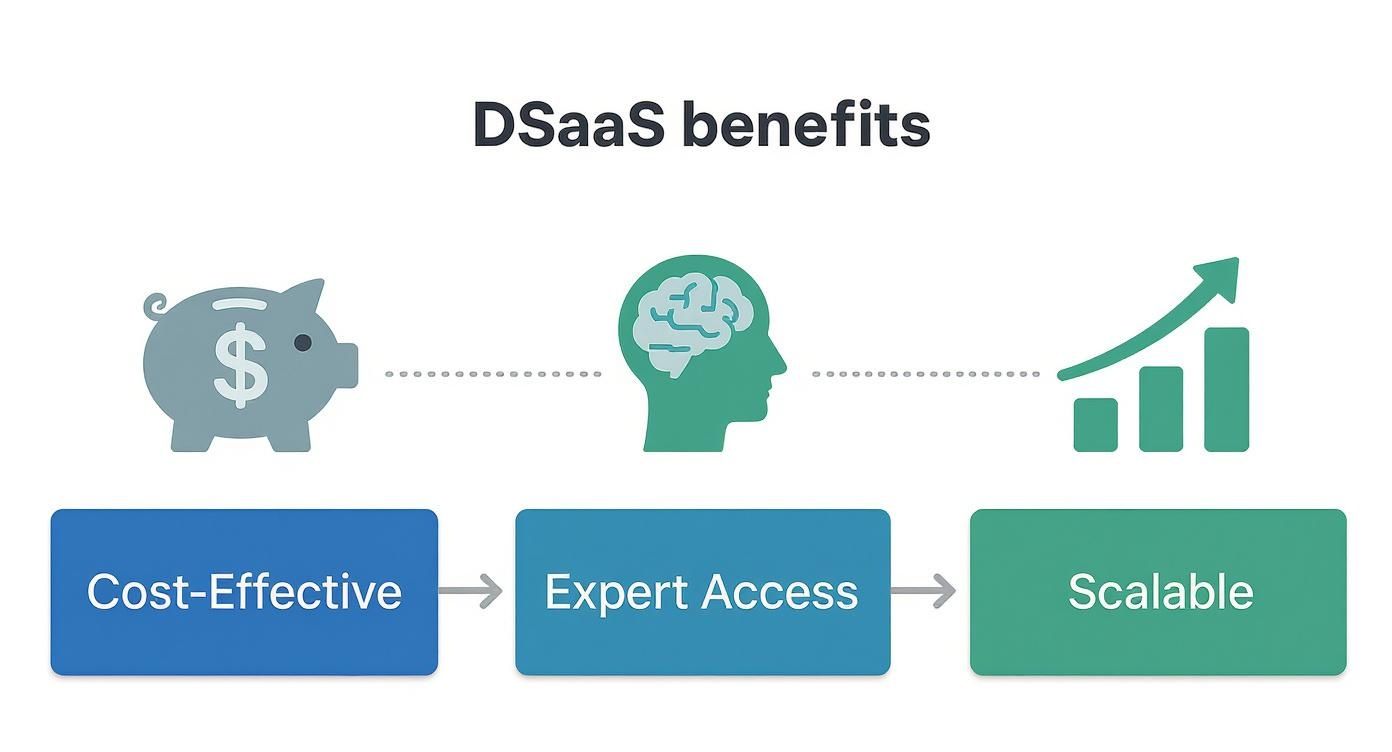
Each step is designed to build on the last, ensuring you see immediate benefits while setting up a scalable foundation for future growth.
Our Proven Four-Step Process
We break the journey down into four distinct, manageable stages. This approach demystifies the process and ensures we’re always laser-focused on your commercial goals.
-
Discovery and Goal Setting: It all starts with a conversation. We kick things off with a discovery call to get under the skin of your biggest challenges and business goals. Are you struggling with cash flow forecasting? Do you need to align sales and finance reports? This initial step ensures we're solving the right problems from day one.
-
Data Integration and Transformation: Next, we get our hands dirty. We connect your siloed data sources—your CRM, accounting software, operational platforms—into a single, unified view. This is where we clean, structure, and prepare your data for analysis. To see how critical this stage is, check out our guide on what is data transformation.
-
Modeling and Analysis: With a clean, reliable dataset in place, the real analysis begins. Our experts build custom models to uncover the trends and insights hiding in your numbers. This could be a driver-based financial model in Power BI to predict future performance or a deep dive into customer segmentation to identify your most profitable clients.
-
Dashboarding and Ongoing Support: Finally, we bring the insights to life. We build automated, interactive Power BI dashboards that are a world away from static reports. These are dynamic tools you and your team can use daily to track KPIs and make genuinely informed decisions. And we don't just disappear; we provide ongoing support to make sure the dashboards evolve with your business.
The growth of the data science platform market, projected to rocket to $897.77 billion by 2033, shows just how critical these end-to-end capabilities are becoming. By following this proven path, you get more than just reports; you get a reliable system for steering your business where you want it to go.
How to Choose the Right DSaaS Partner
Picking a partner for data science as a service is one of the most important decisions you'll make. Get it right, and the consultancy becomes a true extension of your team. Get it wrong, and you're left with generic solutions that don't move the needle.
You need a partner who speaks your language—the language of business outcomes, not just dense technical jargon. So, how do you sort the real experts from the pretenders? It comes down to asking the right questions.

Key Questions to Ask Potential Partners
Before signing anything, arm yourself with questions that dig into their capabilities and approach. Your goal is to see how they turn technical work into tangible, commercial value.
Start with these essentials:
- Can you show me examples of Power BI dashboards you’ve built for businesses like mine? This immediately tests their industry experience and their knack for creating user-friendly, relevant tools. A generic demo won't cut it.
- How do you measure the success of a project? Listen for answers that focus on business metrics—like better forecast accuracy, less time spent on reporting, or higher profit margins—not just ticking off technical milestones.
- What's your process for understanding our specific business challenges? A great partner will put a huge emphasis on a deep discovery phase. They should be more interested in your business goals than in showing off their own tools.
Your ideal partner should feel like a strategic advisor, not just another service provider. They need to show a crystal-clear understanding of how to connect data insights directly to your balance sheet.
Non-Negotiable Partner Qualities
Beyond the questions you ask, there are a few qualities that should be non-negotiable. Finding a consultancy with proven expertise in your niche is critical if you want solutions that work in the real world.
When you're vetting potential partners, make these qualities your top priority:
- Industry Expertise: A partner who already understands the unique metrics and headaches of your sector will deliver value much faster.
- Specialized Technical Skills: For most SMBs, being a pro with platforms like Power BI for financial reporting is a must-have. It’s a powerful yet accessible tool your own team can use.
- A Clear Methodology: They should be able to walk you through their entire process, from the first audit to the final dashboard delivery and ongoing support.
Choosing the right firm is the first step in building a solid data foundation. Our experts in data strategy consulting can help you map out that journey and ensure your investment delivers real, measurable returns.
It’s time to move on from reactive, manual reporting and step into proactive, insight-led decision-making. For SMBs, the journey from data chaos to automated, trustworthy insights is more straightforward and affordable than ever. Data Science as a Service is the most efficient way to finally make your data work for you.
Stop guessing. Start knowing.
The answers you need to scale your business, align finance with operations, and get a leg up on the competition are already in your systems. A DSaaS partnership is about connecting the dots and turning that siloed information into a clear roadmap. Imagine having your financial forecasts, operational KPIs, and sales trends all in one dynamic, automated dashboard.
This isn't about getting bogged down in complex tech; it’s about getting clear, commercial answers to your most important questions.
The real value isn't in finding the data—it's in acting on it. When you automate your reporting stack, you free up your team to focus on strategy and growth, not spreadsheets.
Want to automate your reporting and finally trust your data?
Book your free BI consultation with one of our experts today and we’ll show you exactly how Vizule can solve your reporting challenges.
Got Questions About DSaaS? We've Got Answers.
When you're running a small or medium-sized business, jumping into something new like Data Science as a Service (DSaaS) always brings up questions. Here are straightforward answers to the questions we hear most often.
How Quickly Can We See Results?
This is where the DSaaS model really shines. Forget waiting months for an in-house hire to get up to speed. A good DSaaS partner hits the ground running.
For most projects, like building an automated financial dashboard in Power BI, you can expect to see tangible results and initial insights within 30 to 60 days. It's all about rapid, iterative delivery—not long, drawn-out projects that never seem to end.
Is My Business Too Small for This?
Absolutely not. In fact, DSaaS is the perfect solution for small and medium-sized businesses.
Think of it this way: you get access to a level of data expertise and powerful tools that would otherwise be far too expensive to bring in-house. Instead of a massive budget for a full-time data team, you get a flexible, subscription-based service that grows with you. It’s a cost-effective way for growth-stage companies to compete.
How Secure Is My Data?
Data security is a top priority for any DSaaS provider, and it's something you should ask about from day one. A reputable partner will have strict data governance protocols to ensure your sensitive information is locked down.
Here’s what that typically looks like:
- Secure Data Handling: All data transfers and storage are done through encrypted channels.
- Strict Access Control: Role-based access is implemented so only authorized people can ever view or manage your data.
- Compliance and Best Practices: They should be following key industry regulations to keep your data private and maintain its integrity.
A partner you can trust will be completely transparent about their security practices. They should be able to walk you through exactly how they plan to protect your company’s most valuable asset—its data.
How Do We Measure Success?
Success isn't about how many lines of code were written or reports built. It's measured by the real business outcomes you achieve. A great DSaaS partner will sit down with you at the very beginning to define clear Key Performance Indicators (KPIs).
We're talking about metrics that actually move the needle:
- Time Saved: How many hours are you getting back now that manual reporting is automated?
- Improved Accuracy: How much more confidence do you have in your financial models and forecasts?
- Deeper Insights: Are you finally able to answer critical business questions that used to be a mystery?
At the end of the day, the goal is to deliver a clear return on your investment. That return shows up as better efficiency, smarter decisions, and a clearer path to growth.
Ready to stop wrestling with spreadsheets and start getting clear answers from your data? The team at Vizule can help you design and deploy an automated reporting stack that gives you the visibility you need to scale.
