


As a founder, you know the feeling: you have data everywhere, but clear answers are hard to find. The real difference between a data warehouse and a data lake comes down to a simple trade-off: immediate clarity versus future flexibility. Think of a data warehouse as your pristine, automated financial dashboard in Power BI. Every number is cleaned, organized, and ready to give you a trusted answer instantly. A data lake, on the other hand, is a vast reservoir. It holds all your raw, unfiltered business data—from website clicks to customer emails—giving you the raw material to ask entirely new questions down the road.
Why This Choice Matters for Your Business
You're constantly swimming in information from sales, marketing, finance, and operations. But the real challenge isn't collecting data; it's getting it to tell a clear, actionable story that drives growth. So many leaders get stuck wrestling with messy spreadsheets and disconnected tools, leading to slow, unreliable, and frankly, frustrating reporting.
Choosing the right central data hub is your first step toward automating reports and gaining genuine visibility into your business. This decision directly impacts how quickly you can get answers to critical questions, like:
- How is our cash flow really trending month-over-month?
- Which marketing channels are bringing in our most profitable customers?
- Are our operational costs actually in line with our revenue growth?
Getting the fundamentals right between a data warehouse and a data lake is crucial. One is precision-built for the reliable, routine reporting you need today, while the other is designed for the deep, open-ended discovery you might need tomorrow.
Data Warehouse vs Data Lake at a Glance
To cut through the jargon, let’s use a simple analogy: a warehouse is a structured library for trusted reports, and a lake is an unfiltered reservoir for future exploration. For busy founders who just need the bottom line, this table breaks down the essential differences.
| Characteristic | Data Warehouse (The Library) | Data Lake (The Reservoir) |
|---|---|---|
| Primary Data | Structured, processed, and validated data (e.g., from your CRM, accounting software) | Raw data in any format—structured, semi-structured, and unstructured |
| Best For | Business intelligence, KPI dashboards, and financial reporting in tools like Power BI | Big data analytics, machine learning, and storing massive volumes of diverse data |
| Data Structure | Highly organized and defined before data is stored (schema-on-write) | Stored in its native format; structure is applied when data is used (schema-on-read) |
| Key Users | Business analysts, finance teams, and operations managers—the people running the business. | Data scientists, data engineers, and advanced analysts—the people exploring future possibilities. |
| Main Goal | Providing a single source of truth for consistent, trusted reporting and analysis. | Storing all company data in one place for future, undefined analytical needs. |
The choice isn't about which one is "better" in a vacuum. It's about which is better for the job you need done right now. A warehouse gives you reliable answers to known questions, while a lake gives you the raw material to ask entirely new ones.
Understanding the Data Warehouse for Trusted Reporting
Think of a data warehouse as your company’s single source of truth—a highly organized, digital library for your most important metrics. It’s not just a database; it’s a system purpose-built to store clean, processed, and reliable data specifically for reporting and analysis.

Imagine taking a shoebox full of crumpled receipts from sales, marketing, and ops and turning it into a pristine, balanced ledger. That’s what a data warehouse does for your business data. It takes raw, often messy information from your different systems and methodically cleans and organizes it before it’s allowed in.
This upfront work is crucial. It ensures that when you ask a question, everyone gets the same, trustworthy answer.
The Foundation for Your Single Source of Truth
The magic behind a data warehouse is a process called ETL (Extract, Transform, Load). For a business owner, this is a powerful concept:
- Extract: First, data is pulled from all your different sources—your CRM like HubSpot, accounting software like Xero, or operational spreadsheets.
- Transform: This is where the real work happens. The data gets standardized. For example, entries like “United States,” “USA,” and “U.S.” are all converted to a single, consistent format. Currencies are aligned, and key calculations are pre-computed to make reporting faster.
- Load: Finally, this clean, transformed data is loaded into the warehouse, ready to power your dashboards.
This structured approach is why businesses depend on these systems. They are optimized for the kind of business intelligence for finance and operations that absolutely demand accuracy and speed.
A data warehouse isn’t just about storing data; it’s about storing trust. When your Power BI dashboard pulls from a warehouse, you know every number has been vetted. This creates the reliable 'single source of truth' you need for confident decision-making.
This commitment to reliability is the core difference in the data warehouse vs. data lake debate. While a data lake gives you flexibility for future exploration, a data warehouse provides the immediate certainty needed for day-to-day operations. It’s built to answer your most critical business questions quickly and accurately.
When your leadership team looks at a sales performance dashboard, everyone sees the same validated numbers. This stops the arguments over whose spreadsheet is right and shifts the conversation to what the data means for the business. It’s the bedrock of a scalable reporting stack.
Exploring the Data Lake for Future Insights
While a data warehouse delivers structure and reliability for today's reports, a data lake offers a flexible foundation for tomorrow's big questions. Think of it as a massive reservoir, collecting every drop of data from your business in its raw, native format. It holds everything—structured numbers from databases, semi-structured files from apps, and even unstructured information like customer support emails or social media comments.

Unlike a warehouse that cleans and organizes data before storage (a schema-on-write model), a data lake uses a “schema-on-read” approach. This simply means you store everything first and only apply structure when you have a specific question to answer. That flexibility is its superpower.
For a growing business, this is a huge advantage. You can start collecting potentially valuable data now, even if you don't have a clear use for it yet. You’re essentially future-proofing your analytics.
Capturing Untapped Potential
A data lake's ability to hold diverse, raw information makes it the perfect playground for advanced analytics and machine learning. Because the data isn't forced into a rigid structure, data scientists can explore it from different angles, hunting for hidden patterns and predictive insights that would otherwise be lost.
Here’s where that flexibility becomes a competitive edge:
- Deep Customer Behavior Analysis: A SaaS startup can mix raw website clickstream data with subscription histories to build a truly complete picture of the customer journey and predict churn.
- Operational Efficiency: A small manufacturer could collect raw sensor data from its equipment to predict failures before they happen, saving a fortune in downtime.
- Sentiment Analysis: An e-commerce brand can store raw customer feedback from emails and reviews, then run analysis to spot sentiment trends and improve its products.
It's no surprise the global data lake market is projected to explode, driven by the need for AI and deep analytics that only raw, unfiltered data can power. While platforms like Kyve's Web3 Data Lake Solution show how advanced this tech is getting, the core principle remains simple.
A data lake operates on a powerful principle: collect everything now, because you can't go back in time to capture data you didn't save. It’s an investment in your ability to ask more complex and valuable questions in the future.
This forward-looking approach is a key differentiator, turning raw information into a genuine strategic asset for long-term growth.
How to Choose the Right Path for Your Business
Choosing between a data warehouse and a data lake feels like a heavy technical decision, but for a founder, it’s a business one. The right answer comes down to the problems you need to solve right now and the questions you want to ask tomorrow.
For most SMBs, the immediate pain is a lack of reliable, automated reporting. You're likely wrestling with siloed data, drowning in manual Excel work, and struggling to get a clear, consistent view of business performance. If that sounds familiar, your path is clear.
Start with Structure for Immediate Wins
If your main goal is to build consistent, trusted reports, a data warehouse is your best starting point. It’s purpose-built to solve the most common data frustrations founders face.
A data warehouse is the right choice if you need to:
- Automate Financial Reporting: Generate accurate, up-to-date monthly P&L, balance sheet, and cash flow statements in a tool like Power BI.
- Track Operational KPIs: Build solid dashboards that monitor key metrics like customer acquisition cost (CAC), lifetime value (LTV), or inventory turnover without manual data pulls.
- Unify Sales and Marketing Data: Combine data from your CRM and ad platforms into a single view to actually measure campaign ROI and sales performance.
A data warehouse gives you the clean, structured foundation required for this kind of business intelligence. It’s the fastest path from data chaos to clear, actionable insights.
Plan for Flexibility for Future Growth
On the other hand, a data lake offers the flexibility you need for more advanced, exploratory analytics. If your business model generates massive volumes of diverse data, or if your goals are more predictive than descriptive, a lake is the right choice.
A data lake is a better fit if you want to:
- Analyze Raw User Behavior: Store and analyze clickstream data from your app or website to understand user journeys in granular detail.
- Leverage Unstructured Data: Mix customer support emails with sales data to uncover trends you didn't know existed.
- Build Machine Learning Models: Create predictive models for customer churn or demand forecasting, which require huge volumes of raw, unfiltered data.
The decision boils down to this: A data warehouse helps you expertly answer the questions you already have. A data lake allows you to store the raw materials you'll need to ask entirely new questions in the future.
This decision tree infographic helps visualize the core criteria that should guide your storage strategy.
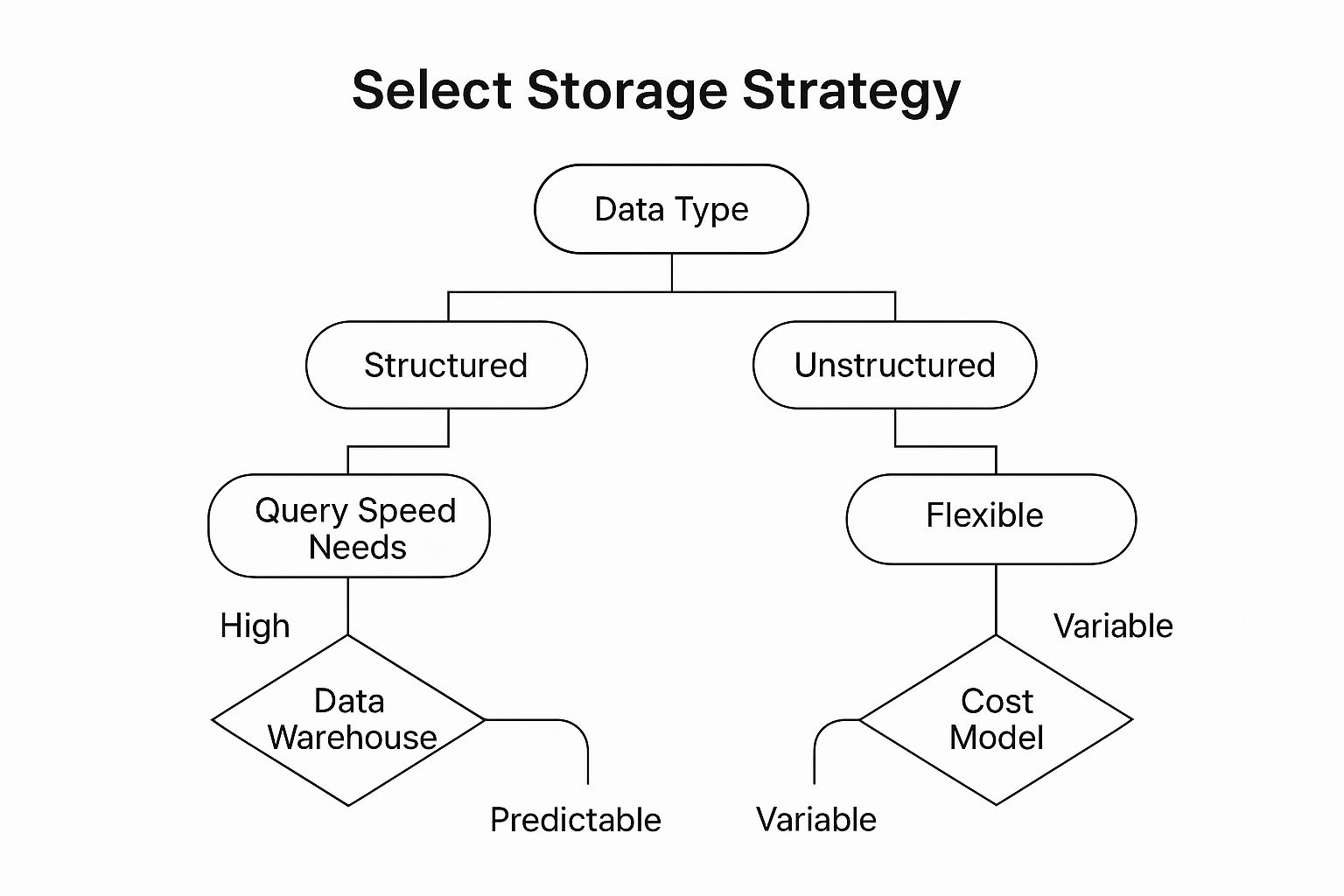
As you can see, if your world revolves around structured data and you need high-speed queries for predictable reporting, a data warehouse is the logical first step.
For most SMBs, the journey begins with a warehouse to solve today’s critical reporting pains. It delivers immediate value by automating manual work and creating a single source of truth. Once that foundation is solid, you can explore adding a data lake for future strategic analysis. And when you're ready to make a move, understanding data migration best practices is critical.
Don't Choose—Combine Them for a Modern Strategy
Framing the discussion as "data warehouse vs data lake" is a bit misleading. The smartest, most scalable data strategies use them together. A modern data architecture lets these two systems play to their strengths, giving you a solution that’s rock-solid for today and flexible enough for whatever comes next.
This hybrid approach is perfect because different teams have different needs. Your finance and ops teams get the clean, validated data they require for pinpoint-accurate reporting. Meanwhile, your future data science projects have a massive sandbox of raw information to play in.
A Best-of-Both-Worlds Workflow
In a modern setup, the data lake and data warehouse work in concert. The workflow is designed to shepherd data from its raw, messy state into a polished, actionable insight.
A typical process looks like this:
- Ingest into the Data Lake: The data lake is the first stop for everything. All data—from structured sales figures to unstructured customer support logs—gets stored here in its original format. This ensures you never throw away something that might be valuable later.
- Transform and Load: Next, you select the high-value datasets from the lake. This is where the data gets cleaned, structured, and transformed to meet your business rules. Understanding how to build data pipelines is crucial for making this step efficient and automated.
- Power the Data Warehouse: This newly processed, reliable data is then loaded into the data warehouse. It now becomes the "single source of truth" for all your business intelligence, feeding directly into your Power BI dashboards, financial models, and KPI reports.
The hybrid approach delivers the best of both worlds. You get the immense storage flexibility of a data lake combined with the speed and reliability of a data warehouse for your most critical daily reporting.
For a founder, this means you aren’t locking yourself into a restrictive choice. You're building an adaptable system that solves your immediate reporting headaches while setting your business up for more advanced analytics down the road. It’s about building a data foundation that grows with you.
From Data Chaos to Trusted Insights
Feeling stuck in the technical weeds of the data warehouse vs. data lake debate? You're not alone. It's a common roadblock for founders trapped by scattered data, endless manual Excel reports, and a frustrating lack of visibility into business performance.
The goal isn't to become a data architect overnight. It's about getting clear, reliable answers to grow your business.
At Vizule, we connect the dots in your data. We help founders design practical data strategies that start with the right foundation for your specific goals—not just what’s trending.
Whether that means building a solid data warehouse to automate financial reporting in Power BI or planning a system that can scale with you, our focus is on delivering real business outcomes. A well-defined data analytics strategy ensures every technical decision serves your commercial goals.
This clarity turns your data from a headache into your most powerful asset. By building the right system, you can finally stop wrestling with spreadsheets and start making confident, insight-led decisions that drive growth.
Want to automate your reporting and finally trust your data? Book your free BI consultation today and see how Vizule can help design your financial dashboard in Power BI.
Common Questions Answered
When you're weighing the data warehouse vs. data lake decision, a few practical questions always come up. Here are the answers we give founders to connect these concepts to your goals.
Can a Small Business Really Use a Data Lake?
Yes, absolutely. In the past, this tech was out of reach, but cloud platforms have made data lakes far more accessible. An SMB can start collecting valuable raw data—like website clickstreams or social media interactions—without a massive upfront investment.
The key is to have a clear purpose. Without a plan for how you might eventually use that raw data, an unmanaged data lake can quickly turn into a costly and confusing 'data swamp'.
Do I Need a Full-Time Data Engineer to Manage a Data Warehouse?
For the traditional, on-premise data warehouses of the past, the answer was yes. Thankfully, things have changed. Modern cloud data warehouses like Snowflake, Google BigQuery, and Amazon Redshift have dramatically simplified management.
These platforms automate much of the complex maintenance. While you still need technical expertise for the initial setup and building data pipelines, it's no longer a full-time job for many SMBs. Working with a BI consultancy is often a more cost-effective way to get the build right without hiring in-house.
For most SMBs, the biggest challenge isn’t day-to-day management; it’s designing a data warehouse that correctly models your unique business logic. A consultant can bridge that gap, making sure the foundation is built for scalable, trusted reporting from day one.
Which Is Better for Power BI?
This one is straightforward. For standard business intelligence—building the KPI dashboards and financial reports you need to run your business—a data warehouse is almost always the superior choice.
Power BI thrives on clean, structured, and reliable data, which is exactly what a warehouse is designed to provide. This direct connection means you get fast, trustworthy reports. While you can connect Power BI to a data lake, it often requires more complex and slower data preparation steps before the data is usable.
Ready to build a data strategy that delivers clear, automated insights instead of more confusion? Vizule specializes in creating practical data solutions for SMBs. Book your free BI consultation to connect with our experts and start building a reporting stack you can trust.
