


The core difference between Inmon and Kimball boils down to this: Inmon's top-down approach builds a single, consistent source of truth for the entire company first, while Kimball's bottom-up method delivers fast, department-specific reports for quick wins. For a founder, the choice depends on whether you need long-term data integrity from day one or immediate insights to solve a burning problem right now.
Your First Big Data Decision

If you’re a founder or an operator drowning in a sea of messy spreadsheets and conflicting reports, the idea of a "data warehouse" probably sounds like the lifeline you've been searching for. It’s the engine that finally powers automated reporting, aligns finance with operations, and gives you a clear, unified view of business performance.
But as you step into this world, you’ll immediately run into a foundational debate that can feel overly technical, yet is absolutely critical to your success: Inmon vs Kimball.
Getting this choice right isn't just an IT problem; it's a strategic business decision. It dictates how quickly your teams get answers, how much you can trust the data you're seeing in your Power BI dashboards, and how easily your analytics can scale as your company grows.
-
Bill Inmon’s approach is like building the complete foundation and framework of a house before you even think about decorating a single room. It’s a top-down philosophy focused on creating one highly structured enterprise data warehouse. This ensures maximum consistency and becomes the undisputed source of truth for the entire organization, slashing data redundancy to a minimum.
-
Ralph Kimball’s approach is more like building and furnishing one critical room at a time—say, the kitchen or home office—so you can start using it immediately. This bottom-up philosophy creates business-specific data marts (e.g., for Sales, Finance, or Marketing) that are optimized for fast reporting and analysis. These individual marts are then connected over time to form a broader warehouse.
To make this decision more tangible, you have to understand how these philosophies impact your immediate business needs. Crafting a solid plan is the first step, something we detail in our guide to building a comprehensive data strategy.
Inmon Vs Kimball: A Quick Comparison For Business Leaders
For business leaders who need to cut through the technical jargon, this table translates the core differences into practical outcomes. Think of it as your cheat sheet for making the right call.
| Business Need | Inmon (Top-Down) | Kimball (Bottom-Up) |
|---|---|---|
| Speed to First Report | Slower, as the full enterprise model must be built first. | Faster, as individual department reports can be delivered quickly. |
| Initial Project Cost | Higher, due to extensive upfront planning and modeling. | Lower, as you can start small with a single business area. |
| Long-Term Consistency | Excellent, as it establishes one version of the truth from day one. | Can be challenging; risks creating disconnected "data silos" if not managed. |
| Best For | Stable, mature companies needing enterprise-wide data integrity. | Agile, fast-growing businesses needing quick insights for specific teams. |
Ultimately, there's no single "correct" answer. The best approach is the one that aligns with your company’s current stage, budget, and strategic priorities.
Understanding The Two Titans Of Data Warehousing
To make a smart decision between these two data warehousing giants, you first have to understand their core philosophies. The Inmon vs. Kimball debate isn't just a technical squabble; it's a fundamental split in how to best organize a business's information for real insight. Their competing ideas emerged in the 1990s and have been shaping business intelligence ever since.
The rivalry kicked off when Bill Inmon introduced his top-down approach in 1992, establishing the idea of a normalized enterprise data warehouse as the single source of truth. Just a few years later, Ralph Kimball fired back in 1996 with his massively influential book, 'The Data Warehouse Toolkit.' He championed a bottom-up strategy using dimensional modeling to get results faster.
This history reveals the classic trade-off. Inmon's comprehensive method often meant initial projects took 9-18 months to get off the ground. Kimball's focus on departmental needs, however, let businesses launch their first reports in just 3-6 months, a big reason it gained so much traction with businesses eager for quick results.
Bill Inmon And The Corporate Information Factory
Think of Bill Inmon's approach as building a central, perfectly organized library for your entire company—what he called the "Corporate Information Factory." In this model, every last piece of data from across the business is funneled into one central repository.
Before anyone can use this data, it's meticulously cleaned, standardized, and structured into a highly normalized format. This is like a librarian cataloging every single book, making sure there's only one official copy and that it's placed in its exact, logical spot on the shelf.
The primary goal of the Inmon model is to create an undisputed, enterprise-wide single source of truth. This ensures ultimate data integrity and consistency, minimizing redundancy to rates often under 5% in well-managed systems.
From this massive central warehouse, smaller, more user-friendly data marts are spun off for specific departments like Finance or Sales. These teams don't just browse the main library; instead, they get curated collections of books specifically relevant to their jobs. This top-down flow guarantees that everyone, no matter their department, is working from the very same foundational data.
Ralph Kimball And Dimensional Modeling
Ralph Kimball took a completely different, more pragmatic path. His approach, known as dimensional modeling, is like building specialized, high-speed workshops for individual business teams right from the get-go.
Instead of building the giant central library first, you start by building a workshop for the sales team, giving them exactly the tools and materials they need to analyze sales performance. Then you build another one for the finance team, optimized purely for cash flow reporting.
These workshops, or data marts, are built directly from your source systems (like your CRM or accounting software) and are designed for one thing: fast, intuitive analysis.
They use a structure called a star schema, which is perfectly suited for business intelligence tools like Power BI. This structure is incredibly easy for non-technical users to grasp because it mirrors how they think about the business—for example, looking at "sales figures" (the facts) broken down by "product," "region," and "time" (the dimensions). We dive into the nuances of this powerful structure in our guide to data modeling in a data warehouse.
Eventually, these individual data marts are connected using shared, or "conformed," dimensions to piece together an enterprise-wide data warehouse.
A Detailed Comparison For SMB Decision Makers
Choosing between Inmon and Kimball isn't just a technical debate for the IT department; it's a strategic call that impacts your budget, your timelines, and how your team operates every day. Before you talk to a consultant, you need a handle on the real-world trade-offs.
Let's break down the Inmon vs. Kimball showdown across the criteria that actually matter to a growing business. This isn't about which one is "better" in a textbook, but which one fits your reality right now.
Time-To-Value And Initial Reporting Speed
When you're trying to scale smart, the biggest question is always, "How fast can I get reports I can actually use?" This is where the two philosophies couldn't be more different.
The Kimball approach is all about speed. You pick one business area—say, sales—and focus on building a data mart just for that. This lets you get actionable dashboards into the hands of your sales team in weeks, not months. It’s a bottom-up method that delivers a fast ROI and builds momentum for your BI initiatives.
On the other hand, the Inmon model requires patience. There's significant upfront work to design and build the large, centralized enterprise data warehouse. That foundation is incredibly solid, but it means you'll be waiting a lot longer to see that first comprehensive financial model or performance report.
The Takeaway: If you need to fix a critical reporting gap and prove the value of BI fast to get your team on board, Kimball’s quick, iterative style is almost always the winner for an SMB.
Flexibility And Long-Term Scalability
Your business is going to change. You'll launch new products, expand into new markets, or pivot your strategy. How well will your data architecture keep up?
This is where the Inmon model really flexes its muscles. Because it starts with a single, enterprise-wide view, its centralized and normalized structure is built to handle major business shifts. Adding new data sources or updating business rules is a much cleaner process because the core foundation was designed for integration from day one.
The Kimball method, while nimble at the start, can create headaches down the road if not managed with care. Without a clear, long-term vision, you can easily end up with a collection of disconnected data marts. These "data silos" make it a nightmare to get a single view of the business—the exact problem you were trying to solve in the first place.
Data Integrity And The Single Source Of Truth
Nothing kills a data project faster than when the finance and sales reports show different revenue numbers. Trust is everything, and data integrity is the foundation of that trust.
Inmon's top-down approach is the gold standard here. By forcing all data through a single, highly structured enterprise data warehouse, it creates one undisputed source of truth. The rigorous process weeds out inconsistencies long before an analyst ever sees the data.
Kimball’s model tackles integrity using what are called "conformed dimensions." This just means you have to be disciplined about making sure concepts like 'Customer,' 'Product,' and 'Date' are defined the exact same way across every data mart. It works, but it demands strong governance to stop different teams from creating their own conflicting definitions. Understanding how these dimensions and facts are built is crucial, which is why getting a solid grasp of the star schema data modeling technique is so vital for any Kimball project.
Maintenance Overhead And Ongoing Costs
Once your data warehouse is live, the work isn't over. It needs constant care to add new data, update business logic, and keep everything running smoothly.
An Inmon architecture often has more complex ETL (Extract, Transform, Load) processes. You have to load data into the central warehouse and then push it out to the departmental data marts. While the structure itself is stable, that two-step loading process can mean more maintenance work for your team.
A Kimball architecture typically has simpler data pipelines, with data flowing straight from the source systems into a star-schema data mart. The real maintenance headache, however, comes as you add more and more data marts. Statistically, Inmon’s low-redundancy structure keeps update anomalies under 2%, compared to 15-20% in Kimball's denormalized schemas.
Kimball’s edge is speed—68% of projects deliver initial value in under four months. But a 2022 survey found that 28% of Kimball setups ran into major integration problems during cross-departmental reporting, which inflated their maintenance costs by an average of 22%.
Ready to cut through the complexity and choose the right foundation for your reporting? Book your free BI consultation, and our experts will help you design a data strategy that delivers both quick wins and long-term value.
Which Data Model Fits Your Business Scenario?
The whole "Inmon vs. Kimball" debate isn't about finding the one true winner; it’s about finding the best fit for your specific business reality. The right answer hinges entirely on your company's stage, complexity, and most pressing needs. Let's make this real by walking through a few common scenarios for SMBs and founders.
This flowchart can help you quickly visualize which path might be a better starting point based on what's driving your business right now.
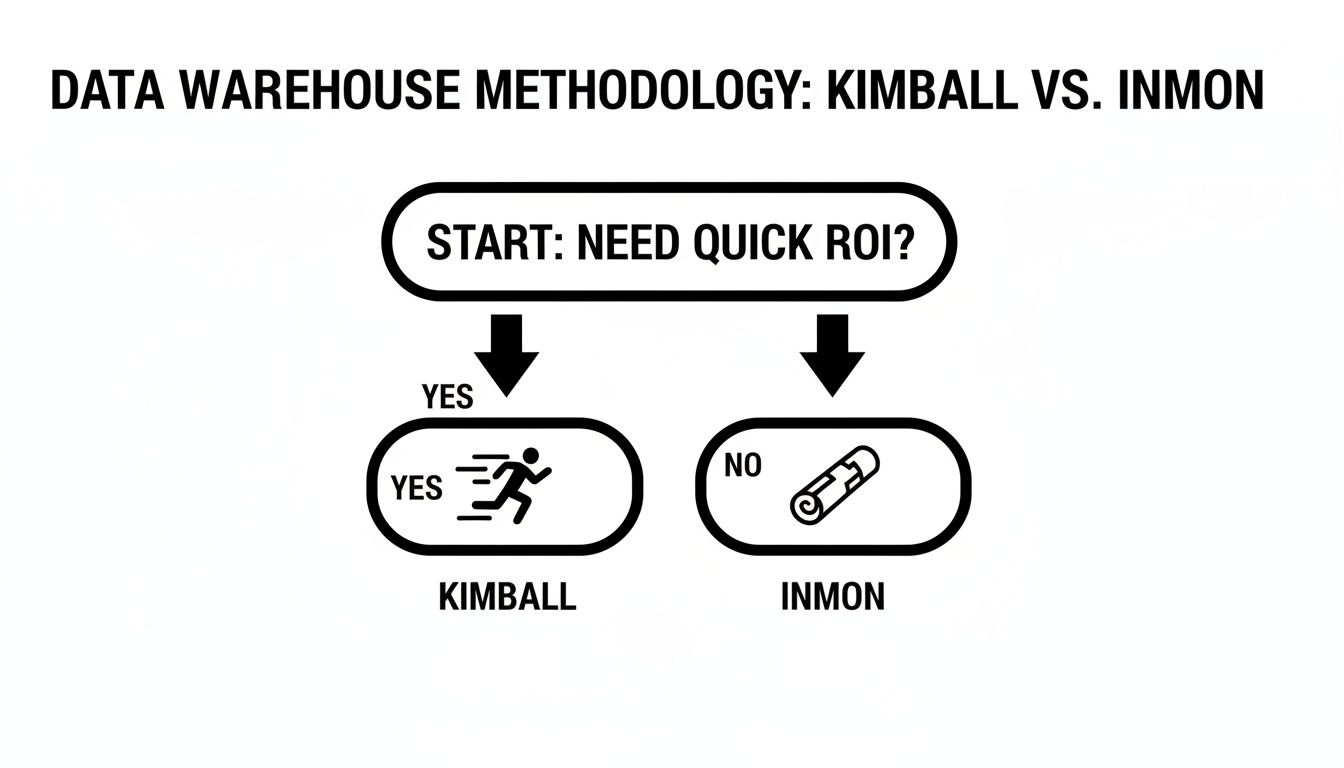
As you can see, the decision often comes down to a classic trade-off: do you need immediate, tactical ROI, or are you building for long-term, strategic data integrity?
Scenario 1: The Fast-Growing E-commerce Startup
Pain Point: "I'm drowning in Excel chaos. We're manually pulling data from Shopify, Google Ads, and Klaviyo just to answer one crucial question: Is our marketing spend actually driving profitable sales? We need answers yesterday."
For this startup, the Kimball approach is a no-brainer.
- Why it works: They can get a sales and marketing data mart up and running fast, focusing squarely on immediate ROI. This lets them connect ad spend directly to customer lifetime value and sales trends in a matter of weeks, not a year.
- The Outcome: The team gets a Power BI dashboard showing their marketing funnel performance. This empowers them to make smarter, faster decisions on where to put their budget. It's a quick win that proves the value of BI and builds momentum.
Scenario 2: The Established Manufacturing Firm
Pain Point: "Our data is siloed across systems for inventory, supply chain, production, and finance. We can't get a single, reliable view across the entire operation to boost efficiency and ensure our financial reporting is accurate."
In this case, the Inmon model's top-down philosophy is the way to go.
- Why it works: The company’s greatest need is a single source of truth. By taking the time to build a centralized enterprise data warehouse first, they ensure data from logistics, finance, and operations is fully integrated and consistent.
- The Outcome: This foundational data layer makes enterprise-wide reporting accurate and trustworthy. The C-suite can confidently track metrics like overall equipment effectiveness (OEE) and cost of goods sold (COGS) without second-guessing whether different departments are using conflicting numbers. This is where you truly learn how to create a data warehouse that becomes the bedrock of your business.
Scenario 3: The Service-Based Business
Pain Point: "We need to connect project profitability from our accounting software with client satisfaction scores from surveys. Our goal is to identify which types of projects are most profitable and have the happiest clients, but right now it's all manual."
A hybrid approach often delivers the best long-term solution here.
This blended strategy combines Inmon's integrity with Kimball's speed. It involves building a normalized, central data repository (the Inmon part) and then creating agile, subject-specific data marts on top for easy analysis in Power BI (the Kimball part).
Adoption numbers back this up. Kimball tends to dominate in tactical situations, with 75% of retail giants launching department-specific marts within 90 days. Inmon, on the other hand, is the leader for strategic reporting, which is critical for sectors like manufacturing that face strict compliance rules. Hybrid models are surging, with 70% of Fortune 1000 firms now combining an Inmon core with Kimball marts to gain both cost savings and agility.
Ultimately, the best path forward depends on whether you're trying to solve a specific, urgent pain or build a long-term strategic asset.
The Modern Hybrid Approach: Getting The Best Of Both Worlds

The classic Inmon vs. Kimball debate can feel a bit dated. For years, data professionals have argued the merits of each, but sticking rigidly to one philosophy today is like choosing between a hammer and a screwdriver when you need a full toolkit. The smartest approach for most growing businesses isn't an "either/or" choice—it's a hybrid model.
This isn't about compromise. It's about strategically combining the strengths of both methodologies to get exactly what you need: the bulletproof, enterprise-grade integrity of Inmon and the fast, user-friendly agility of Kimball. It’s about building a data foundation that is both completely reliable and genuinely practical for day-to-day decisions.
How A Hybrid Model Works In Practice
So, what does this look like on the ground? A hybrid model typically involves two core layers designed to work in perfect harmony.
First, you build a centralised data warehouse using the Inmon approach. Think of this as your "single source of truth." It's a highly structured, normalised repository where all your business data is integrated, cleaned, and validated. This is your rock-solid foundation.
Second, you layer agile, Kimball-style data marts on top of that central warehouse. Each data mart is custom-built for a specific team—like sales, finance, or operations—and is optimised for fast analysis. This is the layer your teams will actually interact with using tools like Power BI, giving them the quick, intuitive access they crave without ever compromising the integrity of the underlying data.
This two-tier structure gives you a clear set of advantages:
- Rock-Solid Data Integrity: Your foundational data is clean, consistent, and centrally governed. This puts a stop to the "data silo" problem for good.
- Speed to Insight: Departmental teams get purpose-built, star-schema data marts that are incredibly easy to query and visualise, letting them build reports in hours, not weeks.
- Built-in Scalability: As your business grows, you can simply add new data marts for new departments without having to re-engineer your entire data architecture.
Making Enterprise-Grade Architecture Accessible
Not long ago, this kind of sophisticated, two-layer architecture was the exclusive domain of large corporations with massive IT budgets. The sheer complexity and cost of building and maintaining an Inmon-style enterprise data warehouse were simply out of reach for most small and mid-sized businesses.
That's all changed. Modern cloud platforms like Microsoft Azure and AWS have completely levelled the playing field, making enterprise-grade data infrastructure more accessible and affordable than ever. You no longer need to pour capital into expensive on-premise servers; instead, you can tap into the power of the cloud to build a scalable, future-proof system. As you consider this flexible data architecture, it's also worth understanding multi-cloud and hybrid cloud strategies to see how they complement your data model.
The rise of the cloud means SMBs can now implement a hybrid data model that was once exclusive to Fortune 500 companies. This gives you the power to build a truly robust data foundation that scales with your ambition.
This shift has also made the role of a strategic partner more critical than ever. A consultancy like Vizule can help you navigate the complexities of cloud platforms and design a hybrid architecture tailored to your specific business goals. By using a modern data stack, we help SMBs build systems that not only solve today's reporting headaches but also provide the flexibility to adapt to whatever challenges and opportunities come next.
The key takeaway is to move beyond the simple Inmon vs. Kimball choice. A hybrid strategy delivers both long-term stability and immediate business value, and it’s the most effective way to build a data foundation you can truly trust.
Build a Data Foundation You Can Trust
Choosing between an Inmon or Kimball approach—or even a hybrid model—is far more than a technical debate. It’s a foundational business decision that will dictate your ability to make clear, data-driven calls for years to come.
The right architecture is the antidote to the spreadsheet chaos and siloed data so many businesses are stuck with. It’s what automates your critical financial and operational reporting, gives you an unambiguous view of performance, and finally gets the entire team aligned around a single source of truth.
Get it wrong, though, and you’re looking at wasted investment, persistent data silos, and a fundamental lack of trust in your own numbers. You’ll be stuck with conflicting reports, unable to connect the dots between your operations and financial outcomes—the very problems you were trying to solve in the first place.
Your Path to Actionable Insight
You don’t have to navigate this decision alone. Making sense of the Inmon vs. Kimball debate and turning it into a practical, scalable solution is exactly what we do.
At Vizule, we specialize in designing and implementing BI solutions that work for SMBs and founders. Our focus is on building data foundations that are both robust enough for the future and pragmatic for your current stage of growth.
A well-designed data warehouse isn't just a place to store data. It's a reliable engine for insight that fuels confident decision-making and sustainable scaling.
We connect the dots buried in your data, helping you graduate from manual, time-consuming reporting to automated, reliable systems in Power BI. Our goal is simple: give you the clear, trustworthy insights needed to scale your business with confidence.
End the cycle of conflicting spreadsheets and unlock what your data is really trying to tell you. The journey to a single source of truth starts with a single conversation.
Want to automate your reporting and finally trust your data? Book your free BI consultation with our BI consultants today.
Frequently Asked Questions
When you're running a small or medium-sized business, it's easy to get buried in the technical jargon of data warehousing. Let's cut through the noise and answer the most common questions we hear about what the Inmon vs. Kimball debate really means for your business.
Is Kimball Better For Power BI Users?
In a word, yes. The Kimball model’s star schema is a natural fit for BI tools like Power BI. Its design—a central fact table (think sales transactions) surrounded by descriptive dimension tables (products, customers, dates)—is exactly how business users think about their data.
This setup makes for faster reports and way simpler dashboard building. Your team can drag and drop fields to create visuals without needing a deep technical background.
Which Approach Is More Expensive For An SMB?
This is the classic "pay now or pay later" dilemma.
- Kimball usually has a lower upfront cost. You can get started with a single data mart for a critical area like sales, which delivers a faster return on investment and helps prove the project's value quickly.
- Inmon demands a lot more planning and modeling to build the entire enterprise data warehouse from the get-go. This makes the initial project longer and more expensive.
But here’s the catch: a poorly managed Kimball setup with a dozen disconnected data marts can become a nightmare to maintain. The long-term costs of fixing data conflicts can easily eclipse what you would have spent on a well-planned Inmon architecture from day one.
The real cost isn't the initial software or consulting fees. It's the hidden expense of rebuilding trust when your sales and finance teams show up with completely different numbers. A little more planning upfront saves a mountain of headaches down the road.
Can I Switch From One Model To The Other Later?
Trying to migrate from a fully built-out Inmon model to a Kimball one (or the other way around) is a massive undertaking. It's expensive, disruptive, and honestly, almost never worth it. This is why getting the initial choice right is so important.
What happens far more often is an evolution. Many businesses start with the Kimball approach for some quick wins. As they scale and their data gets more complex, they might decide to build an Inmon-style enterprise data warehouse that feeds their existing data marts. This helps enforce consistency and leads to a hybrid model.
If you know your business is on a high-growth trajectory, a smarter move is to plan for a hybrid architecture from the beginning. You get the immediate speed of Kimball while laying a foundation that can support the enterprise-wide integrity of Inmon as you grow.
Choosing the right data foundation can feel like a huge decision, but you don't have to make it alone. At Vizule, we specialize in creating practical data strategies for SMBs that deliver immediate results and long-term stability.
Book your free BI consultation and let's talk about building a data foundation you can actually trust.


