


Data-driven decision-making (DDDM) is the practice of using facts, metrics, and data to guide strategic business decisions that align with your goals, objectives, and initiatives. It means moving beyond gut feelings, anecdotes, or outdated spreadsheets and instead relying on the information your business generates every day—sales figures, customer behaviour, and operational metrics—to make choices with confidence.
As a founder or operator, you’re constantly asking high-stakes questions: Which marketing channels are actually profitable? Do we have enough cash flow for the next quarter? Where are the hidden operational bottlenecks slowing us down? Data-driven decision-making provides the framework to answer them.
The Difference Between Guesswork and Growth
Many small and medium-sized businesses (SMBs) run on intuition. You make calls based on experience, a few customer conversations, and a messy collection of Excel files. But as you scale, this approach becomes a liability. It’s stressful, prone to expensive errors, and impossible to replicate.
Data-driven decision-making is the antidote to this operational chaos. It’s not about becoming a data scientist overnight. It’s about building a simple, reliable system to harness the data you already have to get clear, actionable answers. Think of it as upgrading from a paper map to a GPS—you get a real-time view of where you are, where you’re going, and the best route to get there.
Let’s break down the practical difference this shift makes.
Intuition vs. Data-Driven Decisions
| Aspect | Intuition-Based Approach (The Old Way) | Data-Driven Approach (The New Way) |
|---|---|---|
| Foundation | Gut feelings, anecdotes, past experience. | Verifiable data, trends, and performance metrics. |
| Risk Level | High. Prone to personal bias and costly errors. | Low. Decisions are backed by objective evidence. |
| Speed | Can be fast, but often reactive and inconsistent. | Faster and more proactive with automated reports. |
| Scalability | Poor. Relies on one person's "feel" for the business. | Excellent. Creates a repeatable process for smart growth. |
| Clarity | Murky. It's hard to know why something worked or failed. | Crystal clear. Pinpoints exact causes and effects. |
Moving from guesswork to data-backed choices doesn't just reduce risk—it builds a more resilient, predictable, and profitable business.
From Data Chaos to Strategic Clarity
The goal is to stop wrestling with disconnected data from all your different systems—your CRM, accounting software, and operational tools—and turn it into a powerhouse asset. When you connect those dots, you create a single source of truth that gives you a clean, real-time picture of your business's health.
This changes everything. You stop putting out fires and start thinking strategically. Suddenly, you can spot trends before they take off, identify your most profitable customers, and fix small operational hiccups before they become massive headaches.
This isn't just a niche trend. Globally, about 25% of organizations now make nearly all their big decisions based on data. Another 44% rely mostly on data-driven insights. It’s a clear signal that flying blind just doesn't cut it anymore.
How This Approach Benefits Your Business
Bringing a data-driven framework into your business pays off in very real ways that hit your bottom line and give you peace of mind. It truly changes how you see and run your company.
Here are a few of the biggest wins:
- Increased Confidence and Accuracy: You swap assumptions for hard evidence. This cuts down on expensive mistakes and makes sure your choices are grounded in what's actually happening in your business.
- Improved Operational Visibility: By connecting your financial and operational data, you finally see the whole picture. You’ll understand how marketing spend impacts cash flow or how sales cycles affect inventory.
- Faster, More Agile Decisions: With clear dashboards and automated reports, you get the critical numbers you need instantly. That means you can react to market changes in hours, not weeks.
- Enhanced Profitability: This clarity shows you exactly what's working and what's not. You can confidently invest more in profitable activities and cut the dead weight, driving real, sustainable growth.
The momentum is undeniable. A recent survey showed that 90% of enterprise businesses now see data as essential to their core strategies. If you want to dive deeper, you can learn more about the rise of data-driven business strategies.
The Real-World Impact on Business Growth
So, what does becoming "data-driven" actually mean for your bottom line? Let's cut through the buzzwords. It’s about using the data you already have to put your resources—time, money, and people—where they’ll generate the biggest return.
This shift turns abstract numbers into tangible, profitable actions. Instead of just reacting to problems, you start anticipating them. Suddenly, you can spot an operational bottleneck before it grinds things to a halt or finally understand customer behaviour well enough to reduce churn. It’s all about making faster, more confident decisions that directly fuel growth.
And the evidence backing this up is staggering. Research shows that organizations that truly embed data into their operations don't just do a little better; they pull away from the pack.
Data-driven companies are 23 times more likely to acquire new customers, 6 times more likely to retain them, and 19 times more likely to be profitable than their less data-savvy peers.
From Theory to Tangible Wins
Let's ground this in scenarios that founders and SMB owners face every day. These are practical wins that come from simply connecting the dots in your data.
-
For a local retailer: Imagine pulling sales data from your POS system into a simple dashboard. You quickly see your most loyal customers aren't who you thought they were. With that one insight, you can stop wasting cash on broad marketing and create targeted promotions that resonate with your best buyers, driving up repeat business.
-
For a service-based business: By analysing appointment and project data, you might discover a mismatch between your staffing levels and peak demand. That insight lets you optimise schedules, cutting unnecessary labour costs during slow hours and ensuring you're ready for the rush. The result? Higher profits and happier customers.
-
For a growing startup: Instead of guessing which features to build next, you analyse product usage data to see what users actually do. This lets you focus your precious development resources on improvements that matter, saving time and money while building a product people love.
These are the kinds of quick wins that come from turning raw information into a clear story about your business. Every company, no matter its size, can find this kind of clarity.
By moving from reactive fire-fighting to proactive, strategic growth, you can finally take control. You can find out more by reading our complete guide on what is data driven decision making.
Your Blueprint for a Data-Driven Strategy
Building a culture around data can feel like a massive undertaking, but it’s not an all-or-nothing leap. Think of it as a practical, step-by-step process—a roadmap to guide you from the chaos of disconnected spreadsheets to the clarity of real, actionable insights.
The journey breaks down into four manageable stages. Each one builds on the last, creating a solid foundation for growth.
Step 1: Data Collection
This is the starting line. Before you can analyse anything, you need to identify what information actually matters to your business. This means looking across your entire tech stack—your CRM, accounting software, sales platforms, and operational tools—to define the key metrics that truly reflect the health of your company. The key is to start small and focus on the data that can answer your most urgent questions.
Step 2: Data Integration
Next up is the most critical step for many businesses stuck in data chaos: data integration. This is all about breaking down those frustrating data silos. It’s the process of connecting all your different systems so that information can flow freely into a central hub, often called a data warehouse. This creates your single source of truth.
Without this, you're constantly trying to piece together conflicting reports from Excel, which kills trust and grinds decisions to a halt. A well-designed system ensures everyone is looking at the same, up-to-date numbers. Building a robust data analytics strategy is essential here to ensure your integration efforts line up with your long-term business goals.
The visual below shows how these distinct stages connect to form a cohesive decision-making process.
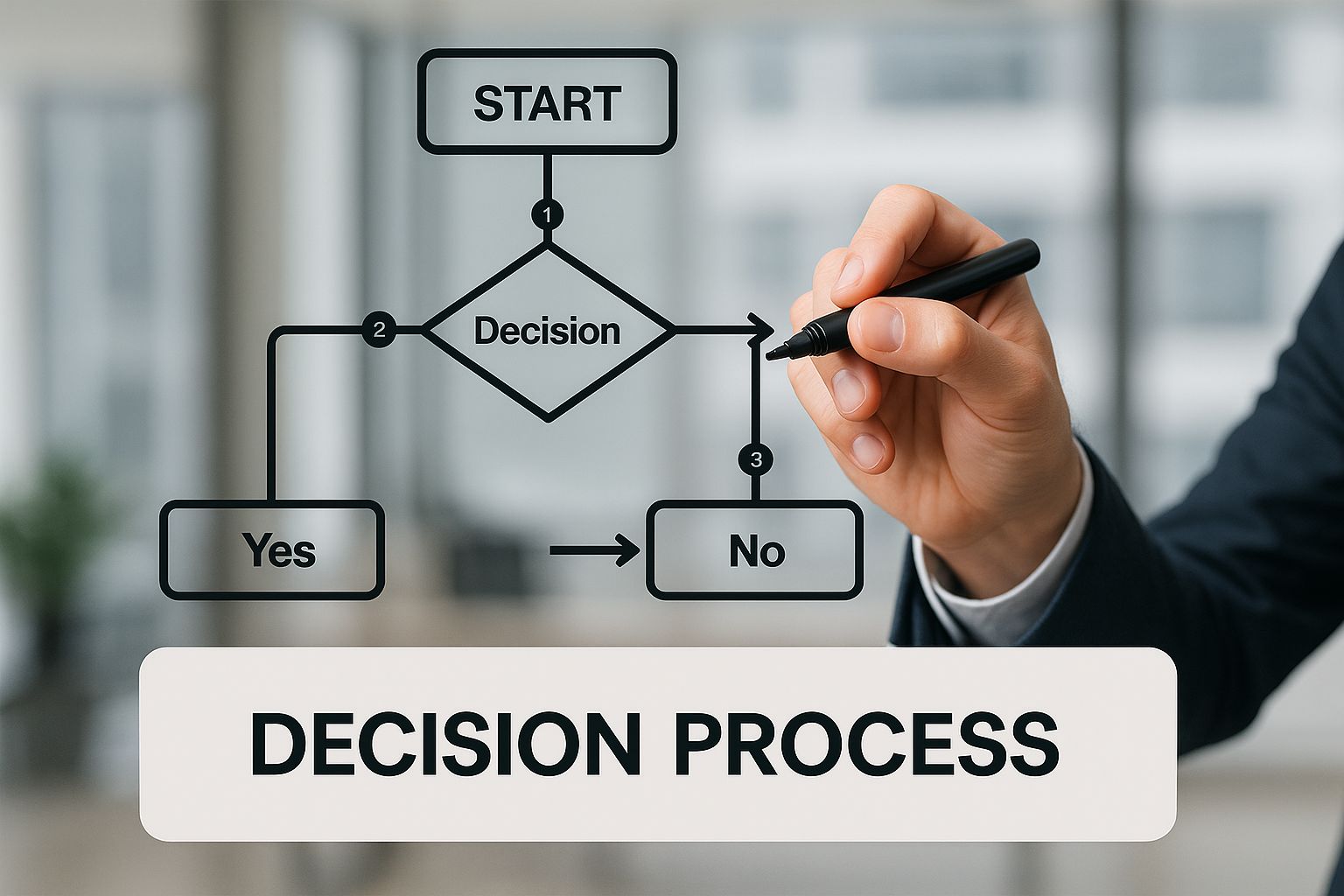
This workflow illustrates how raw data is systematically turned into strategic action, moving from collection and integration all the way to insight and final implementation.
Step 3: Data Visualization
Raw data in a table is just a bunch of numbers; it doesn’t tell a story. This is where data visualization comes in. We translate that raw, integrated data into clear, interactive visuals.
Using powerful tools like Microsoft Power BI, we build dashboards that bring your performance to life. Instead of hunting through spreadsheets, you get an at-a-glance view of your most important KPIs. This makes complex information digestible for everyone on your team, not just the finance experts. The goal is simple: make your data intuitive.
A well-designed dashboard doesn’t just show you data; it answers critical business questions. It’s the difference between seeing a list of sales figures and instantly understanding which product line is driving the most profit.
Step 4: Action and Iteration
Finally, we get to the most important part—the human element. All the data and dashboards in the world are useless if you don't act on them. This final stage is all about using the insights you’ve gained to make confident, informed decisions.
But it doesn’t stop there. True data-driven decision-making is a continuous feedback loop. After you act on an insight, you measure the results, learn from what happened, and refine your strategy. This iterative process of action and refinement is what drives sustainable growth and keeps your business agile.
Transforming Your Financial Planning and Reporting
For most founders, financial reporting feels like looking in a rearview mirror. It's a static, month-end spreadsheet that’s already out of date the moment it's exported from your accounting software. This reactive approach makes it impossible to be proactive.
A data-driven approach completely flips this script.
Imagine swapping that manual Excel export for a dynamic Power BI dashboard. This isn't just a prettier report; it's a living, breathing view of your business that connects your sales pipeline directly to your cash flow reporting. Suddenly, finance shifts from a backward-looking chore into a forward-looking strategic advantage.
From Static Reports to Dynamic Insights
The real power here is connecting your day-to-day operational metrics to your high-level financial outcomes in real time. Instead of waiting until the end of the month to see how your marketing spend actually affected revenue, you can track its impact daily.
This unlocks a whole new level of control and foresight.
- Real-Time KPI Dashboards: Build a single source of truth that links operational drivers (like website traffic or sales calls) to financial results (like customer acquisition cost or monthly recurring revenue).
- Integrated Forecasting: Automatically pull data from your CRM and sales tools straight into your cash flow forecasting model. This gives you a constantly updated picture of what’s coming.
- Profitability Analysis: Instantly drill down into your data to see which products, services, or customer segments are truly driving profits—and which are quietly draining resources.
An integrated view like this eliminates nasty surprises. It empowers you to make adjustments on the fly, rather than weeks after a problem has already cost you money.
Building Scenarios with Interactive Models
Beyond just reporting on what happened, a data-driven approach lets you confidently model what could happen. Instead of being locked into a single, rigid budget, you can build interactive financial models to simulate different scenarios.
What happens to your cash flow if a major client churns? How would a 10% bump in marketing spend impact your Q3 profitability targets? Answering these questions becomes a simple exercise, not a multi-day spreadsheet marathon.
This foresight is the secret sauce for intelligent scaling. It allows you to test assumptions, understand potential risks, and make bold investments with a clear-eyed view of the potential outcomes.
Building these interactive tools is a cornerstone of modern financial planning. To get started, check out our guide on how to build financial models that can adapt to your business needs. By turning your financial data into a dynamic asset, you can finally move from just reporting on the past to actively shaping your future.
Overcoming Common Data Roadblocks
Let's be honest: the path to becoming truly data-driven has its hurdles. For many business owners, the whole idea feels like a mountain too high to climb. But the most common challenges are surprisingly solvable. Once you know what to look for, you can create a practical plan to navigate them.
We typically see founders run into three major challenges right out of the gate.
The Problem of Data Overload
Businesses today are swimming in information. It's staggering. By 2025, the global amount of data is expected to hit an incredible 175 zettabytes—that's a 430% jump from 2020 alone. You can find more insights on this explosive growth of data on Number Analytics.
This data explosion leads to feeling completely swamped. You have the numbers, but no idea where to start or which metrics actually matter. This is "analysis paralysis."
The solution isn't to analyse everything. It's to start with one or two of your most pressing business questions. What’s the single biggest unknown keeping you up at night? Focus your energy there first.
Siloed and Messy Data
Right now, your most valuable information is likely trapped in different systems that don’t talk to each other. Your accounting software, your CRM, and your sales platform all hold a crucial piece of the puzzle. This creates "data silos."
It forces you into a manual copy-paste nightmare with spreadsheets—a process that’s slow, full of errors, and simply can't last as you grow. You can’t make confident decisions when you’re not even sure you’re looking at the right version of the truth.
The fix is to build a single source of truth by integrating these systems. Tools like Power BI can automatically connect to your various data sources, pulling them together into one unified, trustworthy view. This is the core of moving from Excel to Power BI.
The Expertise Gap
This is a big one. Many founders believe they need to hire an expensive, full-time data scientist to make any real progress.
This "expertise gap" is a common myth that stops many small and mid-sized businesses before they even begin. The reality is you don't need a dedicated data science team to start seeing the benefits locked away in your data.
Partnering with a consultancy like Vizule gives you access to specialized expertise without the overhead of a new hire. We handle the technical heavy lifting—from data integration to building your financial dashboards in Power BI. This lets you focus on running your business while we deliver the clear, actionable insights you need to grow.
To make this more concrete, let's break down the common data headaches we see every day and the simple first steps you can take to solve them.
Common Data Challenges and Solutions
| Common Challenge | Why It's a Problem | Your First Step |
|---|---|---|
| Too much data, not enough insight. | You're collecting data but don't know what to do with it, leading to "analysis paralysis" and missed opportunities. | Identify one key business question (e.g., "Which marketing channel has the best ROI?") and focus all your initial efforts on answering just that. |
| Data is scattered across platforms. | Your team wastes hours manually exporting and combining data from different tools, increasing the risk of human error. | Pick a central BI tool like Power BI to serve as your single source of truth. Start by connecting your two most critical data sources (like your CRM and accounting software). |
| Lack of technical skills in-house. | You feel you don't have the right people to build reports or analyse data, so you stick with guesswork. | Partner with an external expert or consultant. This gives you top-tier skills on a flexible basis, avoiding the cost of a full-time hire. |
| Inconsistent and "dirty" data. | Your reports are unreliable because data is entered differently across systems (e.g., "United States" vs. "USA"). | Create a simple data dictionary. Define how key terms should be recorded and share it with your team to ensure consistency going forward. |
These roadblocks might seem daunting, but every single one has a straightforward solution. The key is to start small, focus on a specific problem, and build momentum from there.
Take Your First Step Towards Data Clarity
You’ve seen how data-driven insights can shift a business from constantly reacting to proactively shaping its future, swapping guesswork for confident strategy. The path from wrestling with manual reports to the clarity of insight-led decisions is more direct than you might think. It all starts with one manageable step.
At Vizule, we specialise in guiding founders and SMB operators through this exact journey. We don't do one-size-fits-all templates. We start by understanding your unique operational headaches and most urgent business questions.
From there, we lay out a clear roadmap. The plan focuses on connecting your key data sources—like your CRM and accounting software—into a single source of truth. We then build custom Power BI dashboards that give you immediate answers and put your most painful reporting tasks on autopilot.
If you’re ready to stop battling spreadsheets and finally start trusting your numbers, the next step is simple. We can show you what data-driven decision making looks like in a practical, impactful way for your business.
Want to automate your reporting and finally trust your data? Book your free BI consultation today and let our experts show you how Vizule can help you find true data clarity and drive sustainable growth.
Frequently Asked Questions
Even with a clear roadmap, it’s completely normal to have questions about what a data-driven approach really means for your business. Let's tackle some of the most common ones we hear from founders and SMB operators.
Is my business too small for this?
Absolutely not. That’s one of the biggest myths out there. Being data-driven is about the quality of your decisions, not the size of your business.
Every business, no matter how small, is sitting on a goldmine of data from sales, marketing, and operations. The trick is to start small. Focus on answering one or two critical questions. You don't need "big data" — you just need the right data, which you almost certainly have already.
Do I need to hire a full-time data analyst?
Nope. For most small and medium-sized businesses, that would be a serious misstep. Sinking funds into a full-time hire is a huge commitment and often unnecessary.
The modern data landscape allows you to tap into deep expertise on a fractional basis by partnering with a specialist consultancy like Vizule. We handle the technical heavy lifting—connecting your data sources, cleaning things up, and building your Power BI dashboards—so you can focus on what you do best: running your business.
Think of it as having an on-demand data team. You get all the horsepower of a high-end analytics department without the long-term cost and overhead of another full-time salary.
How quickly can I expect to see results?
Faster than you probably think. This isn't a six-month ordeal. After an initial discovery session to pinpoint your biggest headaches and opportunities, we can often deliver a foundational KPI dashboard in just a few weeks.
That first version alone will give you more clarity than you've ever had from scattered spreadsheets. From there, it's an iterative process. We'll work with you to refine and expand your reports, ensuring you get immediate value and build on that momentum over time.
Ready to stop guessing and start making decisions with confidence? The team at Vizule can help you connect the dots in your data and build the automated reporting systems you need to scale smart. Book your free BI consultation to see how we can design a practical data strategy for your business.


