


If your sales team's revenue report never matches the numbers from your finance team, you're living with data silos. These isolated pockets of information are more than just a minor headache; for a growing SMB, they're a direct threat to your ability to scale, stay profitable, and make sound decisions. Breaking down data silos is the crucial first step to creating a single, reliable view of your business—the foundation for building a resilient, data-driven company.
This guide will walk you through the real costs of disconnected data, how to pinpoint silos in your own operations, and the practical steps to building an automated reporting engine that empowers you to lead with confidence.
The Real Cost of Disconnected Data

For small and medium-sized businesses, the true cost of siloed data isn't just about inefficiency. It's about the missed opportunities and flawed strategies that come from having an incomplete picture of what’s really going on.
When your data lives in separate, disconnected systems—your CRM, accounting software, marketing platforms—every critical business question turns into a major project.
Think about what it takes to build a reliable cash flow forecast. Your sales team has pipeline data in HubSpot. Your finance team is tracking invoices in Xero. And your operations team is managing projects in Asana. To get a single, accurate number, someone has to manually export spreadsheets, painstakingly piece them together, and just hope the data aligns.
By the time that report is finally ready, the numbers are already out of date. Sound familiar? This is the Excel chaos that holds founders back.
The Escalating Challenge for Business Leaders
This isn't a niche problem. Data silos have become a massive concern for modern companies, with 68% of business leaders naming them as a top priority. The challenge only gets bigger as data volumes explode.
A recent Forrester survey drives this home: a staggering 82% of participants reported that managing data and sharing insights across different parts of the business remains a significant hurdle. Read the full research about these data analytics trends.
This fragmentation creates several direct, tangible costs for your business:
- Wasted Time: Your team is burning hours on manual data consolidation instead of high-value analysis and strategic planning.
- Inaccurate Reporting: Conflicting numbers from different departments destroy trust in your data and make it impossible to know which metrics are correct.
- Delayed Decisions: When you can't get clear answers quickly, strategic decisions get pushed back, giving your competitors an opening.
- Limited Growth: You can't effectively scale operations, align finance and ops, or secure funding without a clear, unified view of your business performance.
The core issue with data silos is that they prevent you from establishing a single source of truth—the one reliable, consolidated view of your company’s performance that everyone can trust.
Ultimately, breaking down data silos is about more than just cleaning up your data. It's about building the operational foundation for confident, insight-led growth. By finally connecting the dots between finance, sales, and operations, you can move from reactive problem-solving to proactive strategy.
How to Pinpoint Data Silos in Your Business

Before you can tear down the walls, you have to find them. Spotting data silos isn't a complex technical exercise, at least not at first. For most businesses, it starts with a feeling—that nagging sense of inefficiency where simple tasks become frustratingly difficult.
The trick is to translate that vague feeling into a concrete problem. You need to follow the data trail. The best way to do that? Start by asking your team a few direct questions that cut right to the heart of the issue.
Starting Your Data Silo Audit
Get your key people from finance, sales, and operations in a room. The goal here is to map out how information actually moves between departments—or more importantly, where it gets stuck.
Kick off the conversation with these pointed diagnostic questions:
- "How many hours does it take to reconcile sales and finance numbers for our monthly reporting?" If the answer is measured in days instead of hours, you've got a classic silo problem.
- "Can we track a single customer’s journey from their first ad click to their final payment, all in one place?" If you get a "no," or a "yes, but it takes five different spreadsheets," your customer data is definitely fragmented.
- "If I ask for our current Customer Acquisition Cost (CAC), how long would it take to get a single number everyone agrees on?" A long pause or, even worse, conflicting answers from different teams, is a red flag. It points directly to siloed marketing and financial data.
These questions do more than just uncover problems. They start to quantify the cost of those problems in wasted hours, missed opportunities, and strategic guesswork. This is how you build a rock-solid business case for making a change.
From Symptoms to a Clear Map
Once the pain points are out in the open, it's time for a simple data flow mapping exercise. No fancy software needed—just grab a whiteboard. Trace a critical business process from start to finish, like "order to cash." Document every single tool, spreadsheet, and manual hand-off that happens along the way.
This exercise isn't about achieving technical perfection. It's about visualizing the journey your data takes. You want to spot every single point where it gets copied, pasted, or manually re-entered. Each of those points is a breeding ground for errors and delays.
This visual map makes the abstract idea of "silos" real and tangible. Suddenly, you can see exactly which systems aren't talking to each other and which manual processes are creating bottlenecks.
This process is also the first, crucial step in any effort to improve data quality across your organization. A clear map transforms that general feeling of frustration into an actionable list of priorities. You're no longer just complaining about the problem; you're setting the stage for a targeted and effective solution.
Data Silo Symptom Checker for SMBs
Think you might have data silos but aren't sure where to look? Use this quick checklist. If you find yourself nodding along to more than a couple of these, it's a strong sign that disconnected data is holding your business back.
| Symptom | Common Cause (Where to Look) | Business Impact |
|---|---|---|
| Inconsistent Reporting | Different departments (e.g., Sales vs. Marketing) pull data from separate sources like a CRM and an ad platform, leading to conflicting numbers. | Teams argue over whose numbers are "right," delaying decisions. Strategy is based on incomplete or inaccurate information. |
| Manual Data Entry | Staff spend hours copying and pasting information between systems, like exporting sales data from Shopify to a Google Sheet for financial analysis. | High risk of human error, wasted employee time, and slow reporting cycles. |
| Delayed Decision-Making | Getting a simple answer, like "What's our profit margin on Product X?", requires pulling reports from multiple systems and manually combining them. | Inability to react quickly to market changes. Missed opportunities because insights arrive too late. |
| Poor Customer Experience | Support team doesn't have access to sales or billing history, so customers have to repeat their story to multiple people. | Customer frustration, higher churn rates, and a damaged brand reputation. |
| Inaccurate Forecasts | Finance builds forecasts based on historical accounting data, while Sales uses a separate pipeline forecast in their CRM, with no single source of truth. | Unreliable financial planning, potential cash flow issues, and misaligned team goals. |
This checklist isn't exhaustive, but it covers the most common red flags we see. Recognizing these symptoms is the first step toward creating a unified data environment where everyone is working from the same playbook.
Want to automate your reporting and finally trust your data? Book your free BI consultation with our BI consultants today.
Choosing Your Data Unification Strategy
Once you've mapped out your data bottlenecks, the big question becomes, "Okay, how do we actually connect all this stuff?" For many founders, this is the point where they start seeing dollar signs and technical jargon. But here's the good news: breaking down data silos doesn’t have to mean signing a massive, enterprise-level check.
It's about picking a smart strategy that solves today's problems while giving you room to grow. You don't need to build a rocket ship for a trip to the grocery store. For most growing businesses, it boils down to two main game plans.
Direct Integrations: The Quick Fix
Picture your software stack—your CRM, accounting platform, e-commerce store—as separate rooms. A direct integration is like building a single, dedicated hallway that connects just two of those rooms.
This is often the fastest way to put out an immediate fire. Maybe you use a tool like Zapier to build a quick workflow: when a deal is marked "closed-won" in your CRM, a new customer profile automatically pops up in QuickBooks. Problem solved.
- Pros: It’s quick to set up for simple, one-off tasks and often relies on low-code tools. You get a fast win by automating a specific, painful manual process.
- Cons: This approach can turn into a "spaghetti junction." As you add more software, you end up with dozens of these individual hallways. Suddenly, managing and troubleshooting this tangled web of connections becomes a nightmare. You've just traded one kind of complexity for another.
This strategy is great for targeted automation, but it’s not a scalable fix for true business intelligence. You've connected two apps, but you still have no central, unified view of your business.
The Central Data Warehouse: The Scalable Foundation
Now, let's imagine a totally different approach. Instead of building a maze of hallways, you build a central library for your business. Every night, a copy of every important document from every single one of your systems is sent to this library. It gets organized, catalogued, and stored in a perfectly consistent format.
That’s exactly what a central data warehouse does for your business data. It’s a dedicated system built to pull information from all your sources, clean it up, and arrange it in a way that’s purpose-built for analysis and reporting.
A data warehouse creates a single, reliable hub for all your business information. When you need to build a report, you go straight to the library—your single source of truth—instead of running from system to system trying to piece things together.
This model is the bedrock of real business intelligence. With everything in one place, you can finally plug in a tool like Power BI and build powerful KPI dashboards that give you a complete, 360-degree view of your business, from marketing spend all the way to cash flow reporting.
While this might sound like a heavy lift, modern cloud technology has made data warehouses incredibly accessible and affordable, even for smaller businesses. The key difference between this and other storage methods is structure. If you want to go deeper, we break down the specifics in our guide on data warehouse vs. data lake architectures.
Choosing between these two paths is a critical strategic decision. Direct integrations offer immediate relief, but a data warehouse builds a scalable foundation for genuine, insight-led decision-making for years to come.
Your Practical Data Integration Game Plan
Okay, you've picked your unification strategy. Now it’s time to stop planning and start building. This is where we connect the pipes and build an automated reporting engine that finally replaces those chaotic spreadsheets with reliable, on-demand insights.
The heart of this entire process is something called ETL (Extract, Transform, Load). It sounds technical, but the concept is actually pretty straightforward. Think of it as creating an automated journey for your data—taking it from its messy, siloed home and turning it into a clean, unified, and genuinely useful asset. You’re essentially teaching your systems how to talk to each other without your manual intervention.
ETL in Plain English
Let’s break down what this actually looks like for a typical business. We'll use a classic example: combining sales data from your CRM with financial data from QuickBooks to finally get a clear, undisputed picture of profitability.
- Extract: This is the "get" phase. Your system automatically reaches out and pulls the raw data from its source. For instance, it grabs all the new deal information logged in your CRM and every new transaction from QuickBooks.
- Transform: This is where the magic happens. The raw, messy data gets cleaned up, standardized, and combined. Dates are all put into the same format, customer names are matched between the two systems, and you can run calculations to create new metrics, like customer lifetime value (CLV) or a forecasting model.
- Load: Finally, this newly polished and unified data is loaded into its destination—your central hub. For most businesses we work with, this hub is a Power BI model, ready for deep analysis and clear visualization.
This ETL process is the engine that powers your single source of truth. It’s the behind-the-scenes workhorse that guarantees the numbers in your sales pipeline review actually match the numbers in your financial reports. No more manual reconciliation. No more arguments over whose data is "right."
The cost of ignoring this isn't trivial. The global economy loses an estimated $3.1 trillion annually in revenue and productivity due to data silos. It's a staggering figure that explains why the global ETL market is booming, projected to hit $18.60 billion by 2030, as businesses race to build these essential data connections.
Building Your Automated Reporting Engine
Here's the good news: with modern tools, you don't need a team of data engineers to build this. It's more accessible than ever before. Once your strategy is locked in, the next step is implementation.
Automation tools can make this surprisingly simple. For example, you can check out a complete beginner's guide to building your first automation with N8n to see just how straightforward it can be to get your data flowing automatically.
This kind of automated data pipeline transforms your static sources into a living, breathing reporting system. Instead of spending hours every month wrestling with CSV exports, you get a system that delivers trustworthy insights whenever you need them. If you want to dive deeper into the nuts and bolts, check out our guide on how to build a modern data pipeline.
This is your practical roadmap for breaking down those data silos for good. By focusing on a clear ETL process, you can finally move away from the constant pain of manual reporting and toward a streamlined system that enables genuinely insight-led decision-making.
Ready to design and build your own automated reporting engine? Connect with us to design your financial dashboard in Power BI.
Turning Unified Data into Actionable Insights
Connecting your data is a huge first step, but the real win comes when you turn that unified information into clear, actionable intelligence. This is the moment raw data starts telling a story about your business performance. The goal isn't just to display numbers on a screen; it’s to build reports that finally answer your most pressing questions.
Once you have a single, reliable data source, you can unlock the full potential of tools like Power BI. Imagine creating dynamic dashboards that give everyone an at-a-glance view of the company's health. It’s a game-changer. This simple act aligns your finance, sales, and operations teams around one set of metrics, ending those frustrating debates over whose spreadsheet is right.
Everyone looks at the same numbers, trusts the source, and can get back to focusing on what actually matters: driving growth.
From Raw Data to Clear Decisions
The journey from a messy, siloed dataset to an insightful dashboard follows a clear, automated process. This is what ensures the numbers you're looking at are always current, accurate, and ready for analysis.
It all comes down to a simple but powerful workflow: Extract, Transform, Load (ETL). This is the engine that powers modern business intelligence.
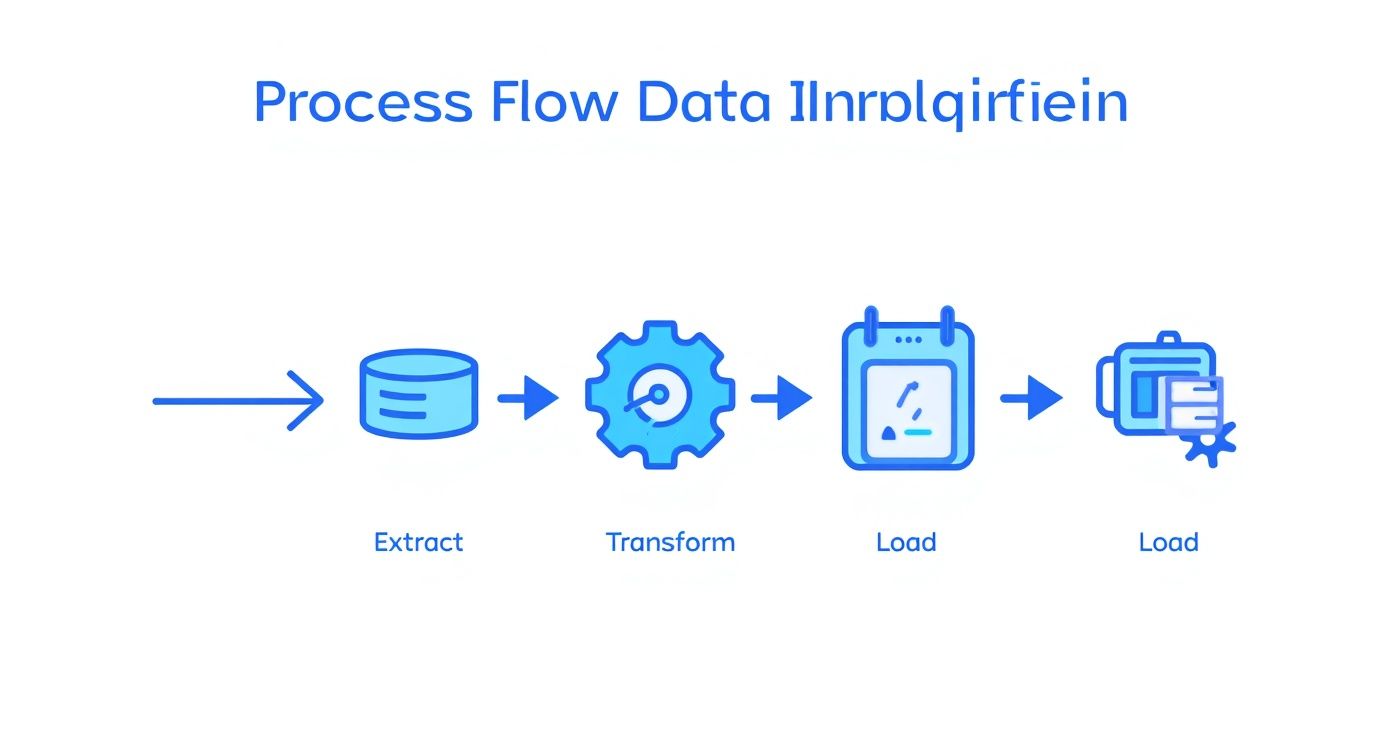
This automated pipeline is what moves information out of those isolated systems and into a clean, usable format that fuels smart decision-making.
A well-designed dashboard built on this foundation does more than just track KPIs—it reveals the why behind the numbers. Instead of just seeing that revenue is down, you can drill in to see which product line, sales region, or marketing channel is the culprit. This is the difference between reporting on the past and actively shaping the future.
Designing Dashboards That Drive Action
The design of your dashboards is every bit as important as the data behind them. A cluttered, confusing report is almost as bad as having no report at all. At Vizule, we focus on creating intuitive visualisations that lead directly to smarter, faster decisions.
Here are a few core principles we stick to:
- Focus on Key Questions: Every single chart and metric should answer a specific business question. Think "What is our current cash runway?" or "Which customers are actually our most profitable?"
- Prioritise Clarity: We use clean layouts, logical flows, and dead-simple labels to make the information easy to digest. Your most important numbers should jump right off the page.
- Enable Self-Service: Dashboards need to be interactive. Your team should be able to filter, slice, and explore the data themselves to find their own answers without having to call an analyst for every little thing.
A great dashboard tells a compelling story. It connects the dots between what your teams are doing day-to-day and the financial outcomes, giving you the confidence to act decisively.
This approach transforms your reports from static documents into dynamic tools for growth. By focusing on a user-friendly design, you make sure your entire team can unlock the value hidden in your newly unified data.
If you're ready to see what this looks like in practice, explore our guide to effective data visualization and dashboards.
Your Biggest Questions About Breaking Down Data Silos
Even when you know the benefits are massive, kicking off a project to break down data silos can feel like a huge undertaking. If you're a founder or operator, you need to know what you’re getting into. We hear the same practical questions from almost every growing business we talk to, so let's tackle the big ones head-on.
Most of the time, the concerns boil down to three things: the cost, the people you'll need, and how long it'll take. The good news? The answers are a lot more manageable than you probably think.
What's a Realistic Budget for This?
This is always the first question, and the best way to answer it is this: it’s an investment, not just a cost, and it's designed to scale with you. For most growing businesses, the solution isn't some massive, multi-year software overhaul. It’s about a targeted strategy, using flexible tools like Power BI to solve your most painful reporting problems first.
A specialised consultancy is all about delivering lean, high-impact results. The initial investment in a proper diagnostic and a phased rollout is often just a fraction of what you're already losing to inefficiencies and missed opportunities. Think of it as investing in operational clarity that delivers a clear, measurable ROI by saving hundreds of team hours and finally enabling smarter decisions.
Do I Need to Hire a Full-Time Data Engineer?
Absolutely not. For most SMBs, that would be total overkill and a poor use of capital.
Partnering with a fractional consultant or a specialised firm like Vizule is a much smarter, more cost-effective move. You get direct access to deep expertise in business intelligence and financial modelling, but without the six-figure overhead of a full-time salary.
This approach gives you the strategic guidance to get it right and the hands-on execution to get it done efficiently. We build the automated reporting engine, then we train your team to use the dashboards and insights themselves.
How Quickly Can I See Results?
You can get meaningful results in weeks, not months or years. A well-designed project always starts with the highest-impact, lowest-effort area to deliver a quick win. For many businesses, that means automating core financial reporting.
By connecting just two or three critical data sources—say, your accounting software, CRM, and maybe a key operational tool—we can build an initial dashboard that immediately saves you hours of manual spreadsheet work. This first step alone provides a level of clarity you just didn't have before. The goal is to deliver tangible value incrementally, proving the ROI at each stage and building momentum for lasting change.
Ready to stop wrestling with spreadsheets and start making decisions with confidence? The team at Vizule can help you map your data, automate your reporting stack, and unlock the actionable insights you need to scale smart. Book your free BI consultation and let's build your single source of truth.
