


A single source of truth (SSOT) database is a simple concept with a powerful impact. It's the one central, universally trusted hub where all your business data gets automatically pulled together, cleaned up, and kept current. For founders and operators drowning in spreadsheets, it’s the definitive playbook for your company's performance, ensuring everyone—from sales to finance to operations—is working from the very same set of reliable numbers.
Think of it as the end of data debates and the beginning of insight-led decisions.
Escaping the Chaos of Conflicting Data
Ever been in a meeting where the sales report completely contradicts the finance spreadsheet? It’s a classic, and incredibly frustrating, scenario for founders and operators.
One team pulls numbers from their CRM showing a record-breaking month. At the same time, the accounting software is telling a totally different story about cash flow. Just like that, a strategic planning session devolves into a debate over whose data is ‘right’.
This isn't really about people making mistakes; it's a classic symptom of disconnected systems. When your most important information is scattered across separate silos—think Excel files, QuickBooks, HubSpot, and a dozen other apps—you’re left with multiple, conflicting versions of reality. This is data chaos, plain and simple. It kills trust, wastes countless hours, and brings decision-making to a grinding halt.

The Solution to Mismatched Numbers
The only real way out of this mess is to establish a single source of truth (SSOT) database. Imagine one central repository where every piece of data from across your business is automatically consolidated, verified, and organized. This isn't just another spreadsheet; it's an intelligent system built for accuracy and easy access.
With an SSOT in place, when your marketing team discusses lead generation costs and your finance team analyzes customer acquisition cost (CAC), they are both pulling from the exact same validated data set. No more painful manual exports or risky copy-pasting into messy workbooks.
A single source of truth ends the debates over whose numbers are correct. It creates a unified view of business performance, empowering everyone from finance to marketing to operate from the same reliable playbook.
This unified approach has become more critical than ever. The explosion of data in recent years is a huge reason for this shift. Industry data shows that 64% of organizations now manage over one petabyte of data. Trying to manage that amount of information with disconnected tools is not just ineffective; it's impossible.
From Silos to Strategy
To give you a clearer picture, let's look at the day-to-day reality before and after bringing in a single source of truth.
Before and After Implementing a Single Source of Truth
| Business Challenge | The Old Way (With Data Silos) | The New Way (With an SSOT) |
|---|---|---|
| Reporting for Meetings | Teams spend hours manually exporting data from different systems and trying to reconcile mismatched numbers in spreadsheets. | Up-to-date, accurate reports and dashboards are generated automatically. Meetings start with strategy, not data debates. |
| Understanding Sales | The sales team's CRM data conflicts with the finance team's revenue reports, leading to confusion about actual performance. | A single, trusted view of sales performance, from lead to cash, is available to everyone in real-time. |
| Calculating Metrics | Key metrics like Customer Acquisition Cost (CAC) are inconsistent because marketing and finance use different data sets and formulas. | All key business metrics are calculated using standardized formulas and a single, validated dataset. Everyone trusts the numbers. |
| Strategic Planning | Decisions are delayed or based on guesswork because leadership can't get a clear, consolidated view of the business. | Leadership has a complete, reliable view of the company's health, enabling confident, data-driven strategic decisions. |
As you can see, implementing an SSOT database transforms your operations from reactive and chaotic to strategic and controlled. Instead of wasting time arguing over reports, your team can finally focus on what the numbers actually mean and what to do next. This shift is absolutely fundamental for any business that wants to scale intelligently.
By creating this central hub, you build the foundation for reliable business intelligence. It’s the first, and most crucial, step toward automating your financial reporting and unlocking the kind of insight that truly drives growth. A well-designed system, often built upon a data warehouse, provides the structure you need to finally trust your data. You can explore our guide on creating a data warehouse to see how this foundational piece fits into the bigger picture.
Ready to move from data chaos to clarity? A single source of truth database isn’t just an IT project; it’s a business strategy that delivers confidence and control.
The True Business Value of Unifying Your Data
Setting up a single source of truth database is about so much more than just tidying up your files. It’s a fundamental shift in how your entire business runs, turning raw data into real, bottom-line results. For any founder or operator, this isn't just another IT expense—it's a strategic investment in efficiency, clarity, and sustainable growth.
The value here isn't just theoretical. Research shows that more than 70% of Chief Financial Officers see a centralized, reliable data foundation as absolutely essential for making smart business decisions. Why? Because a single source of truth finally makes it possible to accurately calculate critical metrics like Customer Acquisition Cost (CAC) by pulling sales, marketing, and finance data together seamlessly.

Achieve Unshakeable Confidence in Your Numbers
When you're trying to scale a business, confidence is everything. With a single source of truth, the constant second-guessing just evaporates. No more wondering if the sales report from your CRM matches the revenue figures in your accounting software—they're one and the same.
This means you can walk into any meeting, glance at any dashboard, and know with total certainty that the numbers you’re looking at are accurate, current, and agreed upon by everyone. That confidence empowers your team to stop debating the data and start acting on it.
Reclaim Time by Automating Manual Reporting
Just think about the hours your team sinks every week into exporting data, pasting it into spreadsheets, and wrestling with formulas to build even the most basic reports. A single source of truth database, when hooked up to a BI tool like Power BI, automates that entire painful process.
I worked with an operator who used to lose 10 hours every single week to that kind of spreadsheet wrangling. With an automated system, those reports now build and update themselves in real-time. That operator suddenly has an extra day each week to focus on what actually matters: strategic analysis, improving processes, and pushing the business forward. The tangible accounts receivable automation benefits, for example, show just how unifying data translates into real business value.
A single source of truth isn't just a database; it's a productivity engine. It gives your team back their most valuable asset—time—by eliminating the manual, error-prone tasks that stifle growth.
Foster Strategic Alignment Across Departments
Misalignment is practically guaranteed when every department is working from its own version of the numbers. You’ve probably seen it: Marketing celebrates a huge lead-gen campaign, while Finance is worried about the low conversion rate and sky-high acquisition costs.
An SSOT tears down these departmental silos. It forces everyone to speak the same language using a common set of metrics that everyone understands and trusts.
- Sales and Marketing: Both teams can finally see the entire customer journey, from the first ad click to the final sale, creating a unified approach to bringing in revenue.
- Finance and Operations: Financial forecasts become dramatically more accurate because they’re built on real-time operational data, from inventory levels to project timelines.
- Leadership and Teams: Everyone is pointed in the same direction, tracking the same Key Performance Indicators (KPIs) and ensuring daily tasks are actually contributing to the company's big-picture goals.
This shared perspective is the bedrock of any truly collaborative and high-performing organization.
Enable Faster, Smarter Decision-Making
At the end of the day, the whole point of collecting data is to make better decisions. A single source of truth is the engine that drives this, giving you immediate access to reliable insights.
Instead of waiting days for a report, you can get answers in seconds. You can spot trends as they’re happening, catch problems before they blow up, and jump on opportunities with confidence. That kind of agility is what separates businesses that just survive from those that truly thrive.
By unifying your data, you're not just organizing it; you're building the foundation for a more resilient, efficient, and intelligent business. It’s the key to moving beyond guesswork and unlocking truly data-driven decision-making.
Understanding the Components of a Modern SSOT
Building a solid single source of truth might sound like a huge technical project, but it's a lot like building a house. You don't need to be an Enterprise Data Architect to grasp the blueprint; you just need to know what each part does to create a sturdy, functional home for your business data.
Let's pull back the curtain on the tech that powers a modern SSOT. It really boils down to four essential layers, each with a very specific job.
The Foundation: Your Data Sources
Every good house starts with a solid foundation. In the data world, your foundation is all the places your raw business data is born and lives. This is where every transaction, customer interaction, and operational event gets recorded first.
For most businesses, this is a mix of platforms where incredibly valuable information is often trapped in silos:
- Financial Systems: Think QuickBooks or Xero, holding all the critical numbers on revenue, expenses, and cash flow.
- CRM Platforms: Tools like Salesforce or HubSpot are treasure troves of information on your customers, leads, and sales pipeline.
- Operational Software: This can be anything from an e-commerce platform like Shopify to a project management tool.
- Marketing Platforms: Your ad accounts and tools like Google Analytics hold vital performance data.
These sources are the bedrock of your business intelligence. The entire point of an SSOT is to pour a single, unified concrete slab over this foundation, connecting them all.
The Plumbing: Automated Data Pipelines
Once your foundation is set, you need plumbing to move water where it needs to go. For your data house, this plumbing system is your ETL (Extract, Transform, Load) tools. These are the automated pipelines that do all the heavy lifting.
Here’s what they do, in plain English:
- Extract: They automatically reach into all your different sources—your CRM, accounting software, operational apps—and pull out the data.
- Transform: This is the magic step. They clean, standardize, and reformat the data so it all speaks the same language. This ensures a "customer" in your CRM is treated the same as a "client" in your financial system, killing inconsistencies.
- Load: Finally, they deliver this clean, unified data into your central storage system.
This automated plumbing gets rid of the painful, error-prone process of manually downloading CSVs and copy-pasting them into spreadsheets. It creates a constant, reliable flow of clean data you can trust.
The Frame: A Central Data Warehouse
With the foundation and plumbing handled, it's time to build a sturdy frame. This is your central data warehouse—the absolute heart of your single source of truth.
A data warehouse is a special kind of database built specifically for security, speed, and analytics. It’s the destination for all the clean data flowing through your ETL pipelines, where it's all stored and organized. This becomes the single, definitive vault for all your company's historical and current information.
Think of the data warehouse as your company's official library. Instead of messy stacks of conflicting books (spreadsheets) scattered everywhere, you have one organized, indexed, and universally trusted collection of information.
This central hub is a core piece of what's often called the modern data stack, giving you the scalable structure needed for any serious business intelligence work.
The Interior Design: Your BI Dashboard
A house is just a frame until you add the interior design that makes it livable and useful. In your SSOT, this is the job of Business Intelligence (BI) tools like Power BI.
Your BI tool connects directly to the data warehouse and does the final, most important job: it turns all that raw, structured data into the beautiful, interactive dashboards that actually give you answers. It’s the friendly interface that lets you see your business performance at a glance, drill down into the details, and spot trends without ever having to write a line of code.
This is where you see the return on your investment—the charts, KPIs, and financial models that drive smarter, faster decisions.
How to Build Your Single Source of Truth
Building a single source of truth database might sound like a massive technical project reserved for enterprise giants, but it’s actually a very achievable and critical step for any business looking to scale. This isn't about becoming a data engineer overnight. It's about following a clear, strategic roadmap that puts your most important business questions front and center.
Think of it less as an IT task and more as a strategic business project. The end goal is a rock-solid data foundation that kills off tedious manual reporting and finally gives you the clarity needed to make smart, confident decisions.
Let's walk through the five key stages of this journey.
Step 1: Start with Your Core KPIs
Before you even think about technology, you have to know what you’re trying to measure. An SSOT is pointless if it doesn't answer your most pressing business questions, so defining them is the absolute first step.
Get your leadership team in a room and ask a simple question: "What are the 5-10 numbers that tell us if we are winning or losing?" This isn't about tracking every metric under the sun. It's about zeroing in on the vital signs of your company's health.
- Are you laser-focused on Customer Lifetime Value (LTV)?
- Is Monthly Recurring Revenue (MRR) your north star metric?
- Do you need a painfully clear view of your Customer Acquisition Cost (CAC)?
By defining your core Key Performance Indicators (KPIs) first, you create the blueprint for your entire SSOT. This makes sure the project is driven by real business value from day one.
Step 2: Audit Your Data Sources
Once you know what you need to measure, the next logical step is figuring out where all that raw data actually lives. This means doing a simple but thorough audit of all your software platforms to map out your data landscape.
You’ll quickly find that your most important information is scattered everywhere:
- Financial Data: Tucked away in QuickBooks, Xero, or another accounting platform.
- Sales Data: Housed in your CRM, like Salesforce or HubSpot.
- Marketing Data: Spread thin across Google Analytics, various social media ad accounts, and email marketing tools.
- Operational Data: Living in your e-commerce platform like Shopify or even in project management tools.
The goal here is just to create an inventory. List what data is where, who is responsible for it, and how clean (or messy) it is. This map is absolutely essential for the next stages.
Step 3: Choose Your Central Data Hub
With your data sources mapped out, it's time to pick the central hub where everything will come together. For any growing business that's serious about analytics, a cloud data warehouse is the modern, scalable choice.
A data warehouse is the secure, organized, and high-performance heart of your SSOT. It's built specifically to store structured data for reporting and analysis, which means your queries run fast and your data stays reliable. This hub is what becomes the single, trusted repository for all your business information.
Think of your data warehouse as the official, organized library for your company's knowledge. All the messy, scattered notes and conflicting drafts are replaced by one definitive, indexed collection that everyone can trust.
Step 4: Automate Your Data Pipelines
This is where the real magic happens. Data pipelines are the automated bridges that connect your scattered sources (from Step 2) to your central data hub (from Step 3). They do all the heavy lifting of extracting, cleaning, and loading your data without anyone needing to lift a finger.
This process is often called ETL (Extract, Transform, Load), and it’s what completely eliminates the soul-crushing routine of manual CSV downloads and copy-pasting into spreadsheets. If you want to go deeper on the mechanics, you can learn more about what it takes to build a modern data pipeline and see how it powers a truly reliable reporting system.
This flow is what takes you from raw, disconnected sources to a final, insightful dashboard.
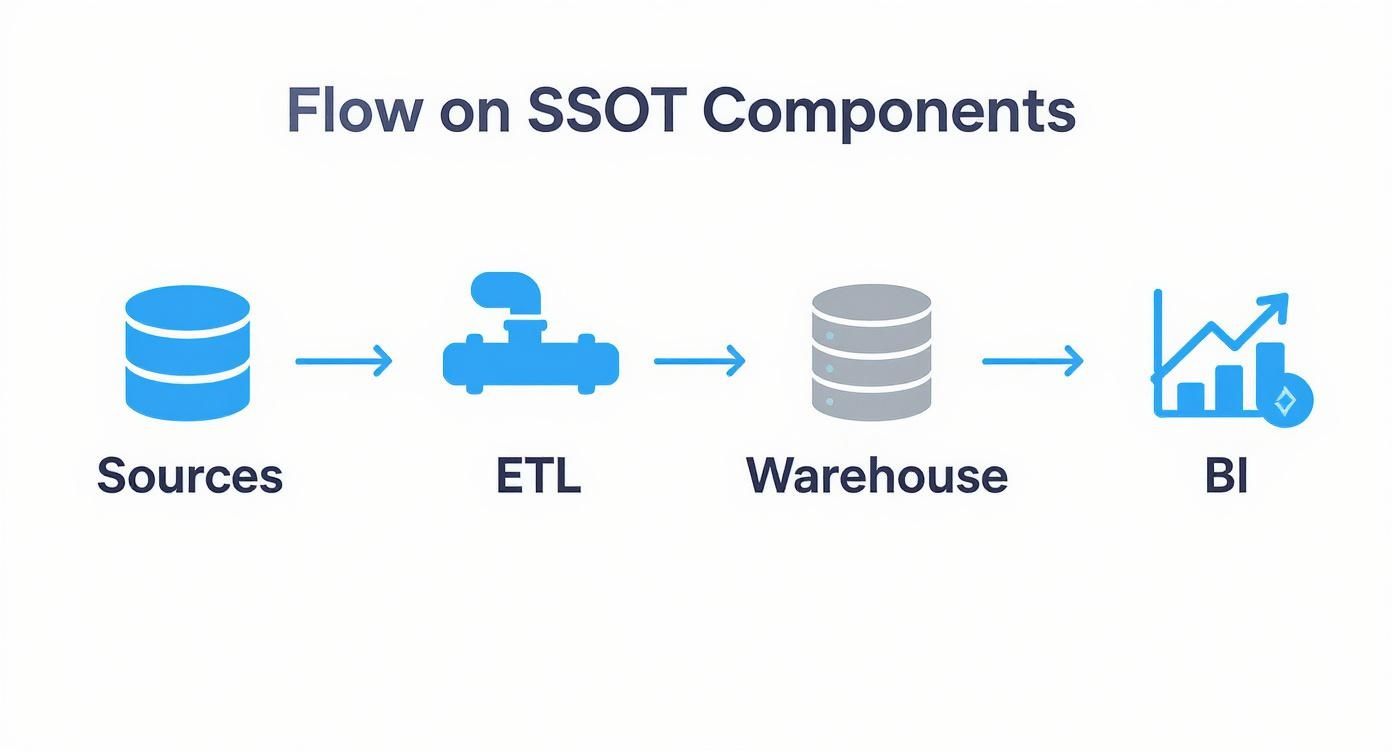
As the infographic shows, it’s a logical progression: Data flows from your various tools, gets processed through an ETL pipeline, is stored centrally in a warehouse, and is finally served up in a BI tool.
Step 5: Visualize Insights with Power BI
The final piece of the puzzle is bringing your unified data to life. This is where a business intelligence (BI) tool like Microsoft Power BI comes in, connecting directly to your new data warehouse.
Power BI is what turns all that raw, consolidated data into the interactive dashboards and financial models that give you answers at a glance. It's the user-friendly layer that lets your team explore trends, drill down into the details, and share insights—no technical skills required. This is where you see the real ROI: clear, trusted, and automated reports that empower smarter decisions across the entire company.
This journey from disconnected data to clear insight is manageable with the right partner and a clear plan.
Want to see how this process could work for your business? Book your free BI consultation and our experts can help you design a roadmap to your own single source of truth.
Common Implementation Pitfalls to Avoid
Building a single source of truth database is a genuinely powerful move, but the journey isn’t without its potential stumbles. Honestly, knowing where others have tripped up is the best way to make sure your own project stays on track and delivers the value you're expecting.
For small and mid-sized businesses, these aren't just abstract technical problems; they're real business risks that can sink your investment before it ever gets off the ground. Let's walk through the most common mistakes we see and, more importantly, how to get ahead of them.
Failing to Secure Stakeholder Buy-In
One of the fastest ways to kill an SSOT project is to treat it like it’s just an IT thing. If your sales, finance, and operations leaders aren't all in the same room, agreeing on the plan from day one, you’re building on quicksand. Each department has its own version of the "truth," and they absolutely have to be part of creating a unified one.
This isn’t a rare problem. In fact, a staggering only 18% of sales leaders feel confident their current systems give them a true SSOT, usually because there's no internal agreement on which numbers to trust. Getting buy-in isn't about sending a memo. It's about having structured, sometimes tough, conversations to build a shared understanding of which data sources will become the final word. You can see how other organizations are tackling this by building consensus around data reliability on Talend.com.
Ignoring Poor Data Quality
There’s a classic saying that couldn’t be more true here: "garbage in, garbage out." You can build the most sophisticated data warehouse and the slickest Power BI dashboards, but if the raw data feeding them is messy, incomplete, or just plain wrong, your insights will be useless. Even worse, they'll be dangerously misleading.
Any SSOT project worth its salt has to include a plan for cleaning and validating data before it gets into your central hub. This is a non-negotiable step in any serious data project and a cornerstone of our data migration best practices.
Solution: Don't push data quality to the end of your to-do list. Make it a central part of your implementation plan from the very beginning. Start by profiling your existing data to find the inconsistencies, duplicates, and empty fields. Then, build automated rules into your data pipelines to clean it up before it ever lands in your new single source of truth database.
Choosing Tools That Don't Scale
It’s tempting for a small business to grab the cheapest or simplest tools on the market. While that might patch an immediate hole, it often creates a much bigger one down the road. A system cobbled together with spreadsheets or a lightweight database will quickly buckle as your business grows, drowning under the weight of more data, more users, and more complex questions.
- Look for cloud-based solutions: Modern data warehouses are built to scale on demand. You only pay for what you use but have the horsepower to grow when you need it.
- Prioritize integration: Make sure the tools you choose play nicely with the other software in your stack, both now and in the future.
- Think long-term: Go with a BI platform like Power BI that can handle everything from simple daily reports to advanced financial modeling as your needs evolve.
Treating Data Governance as an Afterthought
Finally, a huge mistake is treating data governance—the rules for how data is managed, accessed, and used—as a one-and-done setup task. Too many businesses stand up the system and then just walk away, assuming it will run itself forever.
In reality, data governance is a living, breathing process. Without clear ownership and defined procedures, your pristine SSOT can quickly decay back into the data chaos you were trying to escape.
Solution: Assign clear roles and responsibilities from the start. Who owns the customer data? Who is responsible for signing off on the financial numbers each month? Document these processes and weave them into your team’s daily and weekly workflows. A well-governed SSOT isn't a project with an end date; it's a critical business asset that needs consistent care to maintain its value.
Ready to Finally Trust Your Data?
Moving from the constant stress of data chaos to the confidence that comes with data clarity is a game-changer for any business that's serious about growth. It’s about swapping the endless second-guessing for certainty. It's about trading clunky manual reporting for automated efficiency, and breaking down departmental silos to achieve real strategic alignment.
As a founder or operator, you’ve probably felt the frustration of mismatched spreadsheets and reports you just can't trust. A single source of truth database is the answer. It creates one reliable foundation for every critical decision you have to make. This isn't just another tech upgrade; it's a fundamental shift in how you operate, putting you back in control.
Your Path from Chaos to Clarity
At Vizule, we specialise in guiding SMBs through this exact transition. We don't just build systems; we partner with you to connect the dots in your data, turning fragmented information into your most powerful asset. Our entire approach is built for business leaders, not data engineers.
We help you:
- Map your data landscape to get a clear picture of where your critical information actually lives.
- Model a custom data warehouse that becomes your central, trusted hub for everything.
- Mobilise your insights with powerful, automated Power BI dashboards that tell you what's really going on.
This is how you get that single, reliable view of your entire business—from sales and marketing all the way to finance and operations.
Stop letting bad data dictate your strategy. It’s time to build a foundation that supports smart, scalable growth with numbers you can finally depend on.
Want to automate your reporting and finally trust your data? Book a free call with our BI consultants today to discover how a custom SSOT powered by Power BI can transform your reporting and unlock complete, data-driven control.
Frequently Asked Questions
Even with the best plan, investing in a foundational system like a single source of truth database is a big step that naturally comes with a few questions. For founders and operators, it’s only smart to dig into the practicalities—what it takes, what it costs, and what it really delivers. Let’s tackle the most common ones we hear.
Do I Really Need a Data Warehouse for This?
This is a great question, especially for smaller businesses watching every penny. And technically, no, you don't. You could connect a BI tool like Power BI directly to your source applications to get started.
But here’s the catch: that approach becomes brittle and unmanageable the moment your business starts to grow. It’s a short-term fix that creates long-term pain.
A data warehouse is the proper, scalable foundation for any serious business intelligence effort. Think of it as the stable, organized hub that can handle more data and more complex questions without breaking a sweat. Starting with a data warehouse from the get-go is the best practice that saves you from a costly and disruptive migration project down the line.
How Long Will This Implementation Take?
The phrase "data project" can conjure images of massive, year-long IT initiatives. I get it. But for a typical small or medium-sized business, the timeline is much, much shorter. We're talking weeks, not years.
At Vizule, we use a phased approach designed to get you value, fast. The initial setup—connecting your most important data sources and building out your first critical dashboards—can often be done in just a few weeks. After that, we build on that foundation iteratively, adding more data and refining your reports over time. This way, you start seeing a return on your investment almost immediately.
Is This Affordable for a Small Business?
This is probably the most important question, and the best way to answer it is to reframe it. This isn't just a cost; it's an investment with a very clear return. The real question is, what's the enormous and ongoing cost of inaction?
Think about the hidden costs you're already paying. How many hours does your team waste pulling manual reports? What's the price of a single bad strategic decision made on faulty data? What opportunities have you missed because you didn't have the right insights at the right time? Those costs are real, and they add up fast.
When you look at it through the lens of ROI, the value becomes obvious. A single source of truth database pays for itself simply by reclaiming dozens of hours of manual work each month. More importantly, it empowers your team to make smarter, faster decisions that directly boost revenue and drive growth. It's an investment in efficiency, confidence, and control over your business's future.
Ready to stop wrestling with spreadsheets and finally trust your numbers? Vizule can help you map out a clear, practical path to a single source of truth.


