


For many growing insurance businesses, Excel is the default. It's familiar, sure, but it's also a massive bottleneck. It creates data chaos, forces your team into manual reporting cycles, and leaves you making today's decisions based on last month's numbers.
So, what are analytics in insurance? It’s the shift from guesswork to data-backed confidence. It’s about using the data you already have—from policies, claims, and customer interactions—to make smarter, faster decisions across every part of your operation, from underwriting to financial planning. It's how you finally connect the dots and gain full visibility into your business performance.
Moving Beyond Spreadsheets in the Insurance Industry

If you're an insurance operator, founder, or manager, this probably sounds familiar. The endless cycle of exporting data, wrestling with VLOOKUPs, and manually stitching together reports isn’t just tedious—it’s a strategic risk. Decisions made on outdated or fragmented data lead to mispriced policies, inefficient claims handling, and missed growth opportunities. This is the core pain point that modern business intelligence solves.
This isn’t about bringing in some intimidating, enterprise-level behemoth. It's about taking the practical next step to sharpen your competitive edge, automate your reporting, and finally trust your data.
Turning Data Chaos into a Strategic Asset
Think of your current process as navigating with a blurry, folded paper map. It gives you a general sense of where you've been, but it can't warn you about the traffic jam just around the corner. Insurance analytics is your upgrade to a high-definition, live GPS for your business.
This means converting the raw data from your policy admin system, claims software, and CRM into clear, actionable intelligence. Instead of manually piecing together a backward-looking view, you get an automated, real-time picture of your business's health.
The goal is to move from asking, "What happened last quarter?" to confidently answering, "What is our most profitable policy type right now, and how can we sell more of it?" This shift from reactive reporting to proactive strategy is the heart of a successful data initiative.
To help frame this transition, here’s a look at the common pain points of manual reporting versus the clear benefits of an analytics-driven approach.
From Manual Reporting Frustrations to Automated Insight
| Challenge with Manual Reporting | Solution with Insurance Analytics | Direct Business Impact |
|---|---|---|
| Time-Consuming & Error-Prone: Hours spent on manual data entry and VLOOKUPs, leading to inevitable human error. | Automated Data Integration: Systems connect directly to your data sources, refreshing information automatically. | Increased Efficiency: Your team reclaims hours to focus on strategy, not spreadsheet maintenance. |
| Outdated Information: Decisions are based on data that's days, weeks, or even a month old. | Real-Time Dashboards: Get an up-to-the-minute view of KPIs for underwriting, claims, and sales. | Agile Decision-Making: Capitalize on opportunities and mitigate risks as they happen, not after the fact. |
| Data Silos: Information is trapped in different systems (policy, claims, CRM) with no unified view. | Centralized Data Hub: A "single source of truth" combines all data for a complete business overview. | Holistic Understanding: See the full picture of how underwriting decisions impact claims and retention. |
| Limited Insights: Basic reports show what happened but can't explain why it happened. | Advanced Visualizations & Analytics: Interactive charts reveal hidden trends, correlations, and root causes. | Deeper Profitability Insights: Uncover which policies, agents, or regions are truly driving growth. |
This table highlights a fundamental shift. It’s about moving from a state of constant catch-up to one of control and foresight. A well-designed analytics system automates this entire process, presenting critical information in intuitive dashboards. This frees your team from the drudgery of report building and empowers them to focus on what truly matters: improving profitability, enhancing customer retention, and scaling the business smartly.
As you consider how to make this shift, understanding the core principles of business intelligence for small business is a crucial first step. The true power of analytics in insurance lies in its ability to reveal the hidden patterns and trends that drive your business. By connecting the dots between underwriting decisions, claims outcomes, and customer behaviour, you can finally build a more resilient and profitable operation.
Driving Core Insurance Operations with Data

So, what happens when you graduate from spreadsheets to a real analytics framework? How does it actually translate into tangible business results? The impact is felt directly in the core functions that make or break your profitability and growth. Insurance analytics isn't some abstract concept; it's a set of tools that sharpens decision-making right where it counts.
Instead of running on gut feelings or poring over outdated reports, you can embed data directly into your daily operations. This shift moves you from simply reacting to past events to proactively shaping what happens next, giving you a serious competitive edge.
Sharpening Underwriting and Pricing Accuracy
Underwriting is the financial heart of any insurance business. Its health depends entirely on getting risk assessment right. Relying only on static actuarial tables is a gamble—you either price policies too high and watch business walk away, or price them too low and open the floodgates to huge losses.
Analytics completely changes this dynamic. By digging into historical claims data, market trends, and even external factors like weather patterns or economic indicators, you can build predictive models that offer a much more nuanced view of risk.
- Scenario: An SMB insurer focusing on commercial property sees a spike in water damage claims. A basic report just shows the total loss figure.
- With Analytics: An interactive dashboard instantly reveals the claims are clustered in specific areas with aging municipal infrastructure. This insight allows the underwriting team to adjust premiums for new policies in that zone, perfectly balancing risk with market competitiveness.
This data-driven approach ensures your pricing isn't just competitive but, more importantly, profitable and built to last.
Streamlining Claims and Detecting Fraud
The claims process is a make-or-break moment for customer relationships and a massive operational cost centre. Slow, manual processing not only frustrates policyholders but also leaves the door wide open for errors and fraud. According to the Insurance Information Institute, fraud can gobble up as much as 10% of property-casualty losses.
Analytics injects both speed and integrity into the workflow. Automated systems can instantly flag claims that don't fit the mould, like multiple claims from a single address or those filed suspiciously soon after a policy starts.
By automating the review of routine claims and flagging only the exceptions, you can drastically reduce settlement times. This not only cuts operational costs but also significantly improves the policyholder experience during a stressful time, building loyalty and trust.
Legitimate claims get fast-tracked, while the questionable ones are routed for a closer look. This protects your bottom line without punishing honest customers.
Boosting Retention and Financial Forecasting
Understanding why customers leave is just as crucial as knowing why they sign up. Analytics lets you move beyond simple renewal rates to spot the subtle behaviours that signal a customer might be at risk of churning. By tracking engagement levels, claim history, and policy changes, you can step in proactively with personalized offers or support before they start shopping around.
This connected view of your business data also has a profound impact on financial planning. When your claims, policy, and sales data all talk to each other, you can build far more reliable business models and forecasts. The insights you pull from operational analysis feed directly into your financial strategy, helping you put resources where they’ll have the biggest impact. For a deeper dive, exploring resources on financial services analytics can provide invaluable context.
Ultimately, putting analytics in insurance operations means creating a powerful feedback loop where underwriting, claims, and customer data constantly inform one another. This holistic view strengthens every decision, from pricing a single policy to mapping out your company's long-term growth. To see how you can truly use data for future-oriented decisions and reshape key areas, check out these insights on Predictive Analytics in Canadian Insurance Operations. By embracing this data-first mindset, you can build a more resilient, efficient, and profitable insurance business.
Building a Reliable Data Foundation for Analytics

You can't build a skyscraper on a foundation of sand, and you can't build powerful analytics on messy, disconnected data. For most insurance businesses, the biggest obstacle isn't a lack of data; it's that all this valuable information is trapped in different systems that refuse to talk to each other. This creates a fragmented, chaotic picture that completely undermines trust in your numbers.
The goal here is to establish a single source of truth. This isn't just a fancy tech term; it's about creating one central, reliable place where all your key business data lives. When everyone from underwriting to finance is pulling from the same numbers, you can finally stop arguing about whose spreadsheet is right and start making real decisions.
Connecting Your Disparate Data Sources
Your business probably runs on a few different, specialized platforms. Each one is a goldmine of information, but the real power is unleashed when you bring them all together.
For most insurance businesses, the main culprits are:
- Policy Administration Systems (PAS): This is the heart of your operation, holding all the details on policies, premiums, coverage, and customers.
- Claims Management Software: This system tracks the entire lifecycle of a claim, from the first notice of loss to settlement amounts and cycle times.
- Customer Relationship Management (CRM): Your CRM is packed with crucial info on leads, agent interactions, customer comms, and renewal efforts.
- Accounting Software: This is where the financials live—revenue, expenses, and the bottom-line profitability metrics.
The problem is, these systems were never built to play nicely together. Manually exporting CSVs from each platform to mash them up in Excel is a slow, painful process that's practically guaranteed to introduce errors. This is where a more structured approach is a game-changer.
From Chaotic Stockroom to Organized Library
Think of your current data setup as a messy, disorganized stockroom. Boxes are unlabeled, items are scattered everywhere, and finding what you need feels like a hopeless treasure hunt. A data warehouse is what transforms this chaos into a perfectly organized library.
A data warehouse is a central system that automatically pulls data from all your different sources—your PAS, CRM, claims software—and organizes it into a clean, consistent, and analysis-ready format. It’s the engine that powers reliable, automated reporting.
Instead of hunting for information, you can instantly find exactly what you need. You can ask tough questions like, "What's the combined ratio for policies sold by Agent X last quarter?" and get a trustworthy answer in seconds. This structured foundation is the key to unlocking dependable analytics in insurance.
The demand for this kind of organized data is exploding. The global insurance analytics market is projected to grow by USD 16.12 billion between 2025 and 2029, all driven by the need for better risk assessment. Cloud-based solutions are leading the charge because they can handle massive data complexity without a huge upfront investment. You can read more about the industry's growth trajectory and its drivers to see where things are headed.
The best part? You don’t need a massive IT department to make this happen. Modern business intelligence tools like Power BI are designed to connect these dots for you. By taking a methodical approach to creating a data warehouse, you can build the reliable foundation you need for automated analysis and, finally, trust your numbers.
Tracking the KPIs That Truly Matter in Insurance
You’ve probably heard the old saying, "What gets measured gets managed." It's a classic for a reason. But in the insurance world, it’s all too easy to drown in a sea of metrics that look important but don't actually tell you what you need to know. To really move the needle, you have to cut through the noise and focus on the key performance indicators (KPIs) that connect directly to profitability and operational health.
Think of it this way: raw data from your policy and claims systems is just static. It’s like having a pile of individual musical notes. An interactive dashboard, maybe built in a tool like Power BI, acts as the conductor, arranging those notes into a symphony that tells a clear story. It helps you stop just knowing your loss ratio and start understanding why it’s moving up or down.
Core Underwriting and Profitability KPIs
These metrics are the absolute foundation of your financial health. They tell you, in no uncertain terms, whether your core business of assessing and pricing risk is actually working. If you don’t have a solid grip on these, you're essentially flying blind.
-
Loss Ratio: This is the big one—the percentage of your earned premiums paid out in claims. If your loss ratio is consistently creeping up, it’s a massive red flag. It could mean your underwriting guidelines are too lax or you’re simply not charging enough for the risks you're taking on.
-
Combined Ratio: Calculated as (Incurred Losses + Expenses) / Earned Premiums, this is the ultimate gut check for underwriting profitability. A ratio below 100% means you're making money from your policies before any investment income. Anything over 100% signals an underwriting loss. Simple as that.
-
Expense Ratio: This KPI is all about your operational efficiency. It shows what percentage of your premiums is being eaten up by operating costs like salaries, rent, and marketing. A rising expense ratio is an early warning that bloated overhead might be silently killing your margins.
Claims Efficiency and Operational Metrics
An efficient claims process isn't just about keeping customers happy—it's a critical lever for cost control. These KPIs help you see how well your team is handling claims, from the moment that first call comes in all the way to settlement. Any delays or cost spikes here can quickly erode your bottom line.
For example, tracking your Claim Cycle Time—the average time it takes to settle a claim—can instantly reveal bottlenecks in your workflow. If it’s taking weeks to close out a simple property claim, you're not just frustrating customers; you're also racking up administrative costs.
The real magic happens when you can drill down from a high-level trend into the nitty-gritty details. A good dashboard doesn't just show you that your Average Claim Cost is up; it lets you filter by policy type, region, or even individual adjuster to find out exactly why.
By visualizing these numbers, you can spot patterns that would be completely invisible in a spreadsheet. This is where you can see the power of well-designed executive dashboard examples—they turn complex data into clear, actionable stories.
Customer and Growth-Focused KPIs
Being profitable today is great, but building a business that lasts requires a deep understanding of your customers. These metrics shift the focus to the long-term health of your business by measuring customer value, loyalty, and the effectiveness of your sales funnel.
-
Customer Lifetime Value (CLV): This forecasts the total net profit you can reasonably expect from a single customer over their entire relationship with you. Knowing your CLV helps you make much smarter decisions about how much you should spend to acquire new customers and keep the ones you have.
-
Customer Retention Rate: This is the percentage of customers who renew their policies year after year. A high retention rate is one of the most powerful drivers of long-term profitability, because keeping a customer costs a fraction of what it takes to find a new one.
-
Quote-to-Bind Ratio: This metric measures how effective your sales and pricing process is by tracking the percentage of quotes that actually become bound policies. A low ratio could mean your pricing is off, or maybe your follow-up game needs some work.
Bringing all these numbers together into a single, cohesive view gives you a complete picture of your business. You can start connecting the dots—seeing how an underwriting decision impacts claims, and how both of those affect customer loyalty. This is the real power of analytics in insurance; it helps you make confident, data-backed decisions that drive genuine growth.
Essential Insurance KPIs for Your Analytics Dashboard
To build an effective dashboard, you need to focus on metrics that answer your most pressing business questions. Here’s a quick breakdown of KPIs that every insurance leader should be tracking.
| KPI | What It Measures | Why It's Critical for Your Business |
|---|---|---|
| Combined Ratio | Overall underwriting profitability (Losses + Expenses) / Premiums. | The ultimate health check. Is your core business of writing policies profitable? |
| Loss Ratio | The percentage of premiums paid out in claims. | Tells you if your risk assessment and pricing are accurate. A rising ratio is a major warning sign. |
| Expense Ratio | The percentage of premiums used for operating costs. | Measures your operational efficiency. Are your overhead costs under control? |
| Claim Cycle Time | The average time from first notice of loss to claim settlement. | A direct measure of claims efficiency and a key driver of customer satisfaction. |
| Average Claim Cost | The average amount paid out per claim. | Helps you spot cost inflation and identify trends in claim severity by policy type or region. |
| Customer Retention Rate | The percentage of customers who renew their policies. | High retention is a powerful profit driver. Are your customers loyal, or are they leaving? |
| Quote-to-Bind Ratio | The percentage of quotes that become active policies. | Gauges the effectiveness of your sales funnel and pricing competitiveness. |
| Customer Lifetime Value (CLV) | The total projected profit from a single customer account. | Informs your marketing and retention strategies. How much is a customer truly worth? |
Ultimately, a dashboard built around these KPIs stops you from getting lost in the data and starts pointing you toward the insights that matter most for strategic decision-making.
Ready to see how a custom Power BI dashboard could bring your most important KPIs to life? Book your free BI consultation with Vizule today and let’s start turning your data into your most valuable asset.
Your Roadmap to Implementing Insurance Analytics
Getting started with analytics can feel overwhelming. For many founders and operators in the SMB space, the leap from wrestling with Excel spreadsheets to having clear, automated insights seems impossibly complex and expensive. But it doesn't have to be.
The secret is a structured, practical roadmap—one that delivers value quickly without a massive upfront investment.
At Vizule, we've boiled this journey down to a simple, three-step methodology: Map, Model, and Mobilise. This isn’t some rigid, year-long corporate project. It’s an agile framework designed to attack your biggest problems first and build momentum from there. Think of it as the low-risk, high-impact way to finally get your analytics off the ground.
Phase 1: Map Your Data and Define Your Goals
First things first: we need a destination. This is the Map phase, and it's where we sit down with you to understand your business inside and out. We don’t kick things off by talking about servers or software; we start by talking about your headaches and your ambitions.
Together, we get answers to the big questions:
- What are the reporting bottlenecks that are constantly slowing your team down?
- Which business questions can you just not answer with any real confidence right now?
- Where does all your critical data actually live? Is it in a policy admin system, claims software, or a chaotic web of spreadsheets?
- What would a "win" look like for you in the next 90 days?
This phase is all about creating a blueprint. By pinpointing your data sources and getting crystal clear on your business goals, we build an actionable plan. A well-defined data strategy roadmap makes sure that whatever we build is perfectly tuned to the outcomes you need to hit.
Phase 2: Model Your Business in Power BI
With our blueprint in hand, we move to the Model phase. This is where the technical magic happens, but the objective stays simple: connect your scattered systems and build your single source of truth. We take on the messy work of linking your policy, claims, and financial data into one cohesive, powerful structure.
This unified dataset becomes the engine for all your insights. Using Power BI, we build out the custom operational and financial models that actually mirror how your business runs. We’re not talking about generic, off-the-shelf templates here. This is about creating a tailored analytical engine that can answer your specific questions about profitability, efficiency, and growth.
This flow chart shows how these key performance areas are all interconnected.
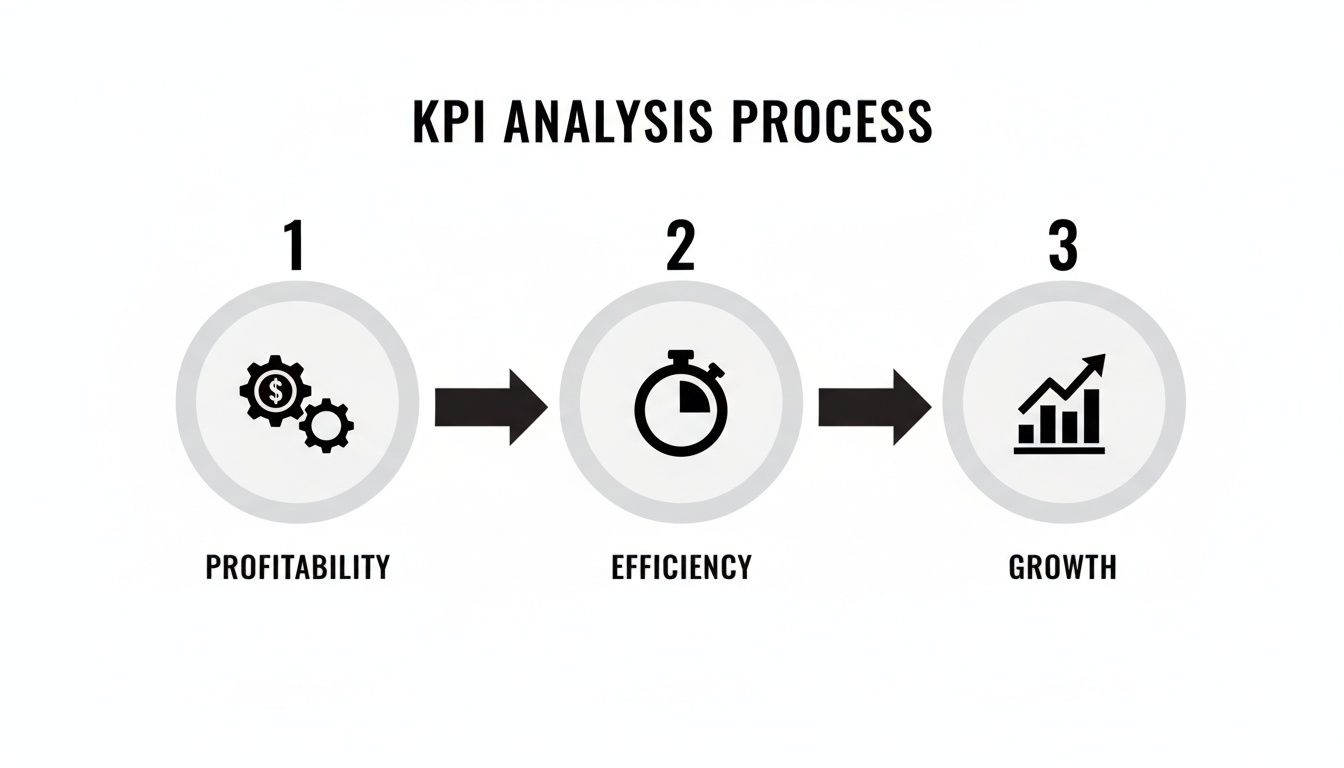
As you can see, a true grasp of performance comes from understanding how profitability, operational efficiency, and growth all pull on each other.
Phase 3: Mobilise Your Team with Actionable Insights
The final step is to Mobilise. A brilliant model is worthless if your team can’t use it. In this stage, we bring your data to life with intuitive, interactive dashboards. The focus is on clean visuals that don’t just spit out numbers but tell a compelling story about your business.
This is where everything clicks. Your team goes from spending hours pulling reports to spending minutes analyzing them. They can drill down from a high-level KPI like combined ratio to the specific policies or regions driving that number—all with just a few clicks.
We also make sure to empower your team with training, so they’re confident and ready to make data-led decisions. The results of this kind of approach are real and measurable. For instance, AI adoption has helped slash risk exposure by 20-30% in some pilots, while better fraud detection tools have flagged 15% more suspicious claims. On the customer side, analytics-driven personalization has been shown to bump satisfaction scores by 25%, proving a clear ROI on the investment.
This structured process de-risks your move into analytics in insurance and dramatically speeds up your time to value. You get the insights you need now while building a scalable foundation for whatever comes next.
Common Questions About Insurance Analytics
Jumping into business intelligence can feel like a big leap, especially when you're already swamped with the day-to-day. It’s completely normal to have questions about the cost, the complexity, and how long it actually takes to see a real return.
We hear these concerns all the time from founders and operators just like you. Here are some straight-up answers to help you move forward with confidence.
Is an Analytics Solution Too Expensive for My Business?
This is always the first question, and the answer is a firm "not anymore." The days when powerful analytics were only for massive corporations with huge IT budgets are long gone.
Modern cloud-based tools, especially platforms like Power BI, have made top-tier business intelligence affordable and accessible for small and mid-sized businesses. The cost is a tiny fraction of what traditional enterprise systems used to command. More importantly, working with a focused partner like Vizule means you see a high return on that investment, fast. We usually start by targeting one critical area—like claims analysis or underwriting profitability—to prove the value and deliver a real ROI before we even think about scaling it across your entire operation.
Can We Use Analytics if Our Data Is a Mess?
Absolutely. In fact, having messy, siloed data is one of the biggest reasons to bring in a BI solution in the first place. This is exactly the kind of problem we are experts at solving. Don't let imperfect data hold you back; think of it as the starting point, not a roadblock.
Our Map → Model → Mobilise process is built to tame this exact kind of chaos.
- First, we connect to all your different systems, no matter how disconnected they seem.
- Then, we pull it all together, clean it up, and centralize the information in a dedicated data model.
- The result? You get a reliable "single source of truth" that your whole team can finally trust for reporting and making crucial decisions.
How Long Does It Take to See Results?
You can start seeing genuine value in weeks, not years. Our approach is agile and focused, prioritizing speed-to-insight above all else. We kick things off by building a foundational dashboard that solves your single most painful reporting bottleneck right away.
This strategy delivers actionable insights and a clear, measurable ROI almost immediately. It builds positive momentum and shows your team the power of analytics firsthand, paving the way for more advanced capabilities down the road.
This way, you’re not waiting months for a payoff. You get a quick win that immediately improves how you see your business, creating a solid foundation to build on.
Ready to stop wrestling with spreadsheets and start making decisions with confidence? Vizule can help you map out your data strategy, model your business in Power BI, and mobilise your team with insights that matter.
Book your free BI consultation to see how we can design a clear, affordable analytics roadmap for your insurance business.
