


One of the biggest wins you get from a data warehouse is a single, reliable source of truth for your business data. This centralization kills off conflicting reports and manual errors, which means you can start making decisions faster and with more confidence. It’s the bedrock for automating your reporting and finally connecting the dots between your sales, marketing, and finance data.
Tired of Drowning in Spreadsheets?

Does this sound familiar? You’re prepping for a board meeting, staring down a file named Sales_Report_Final_v3_Updated.xlsx. You have a sinking feeling it doesn’t include the latest figures from marketing, finance, and operations. Even worse, you know your co-founder has another version saved somewhere, and the numbers just don't line up.
This is the daily grind for far too many small and medium-sized businesses. Founders and their teams burn hours manually copying, pasting, and trying to reconcile data from a dozen different systems. This "spreadsheet chaos" isn't just a headache; it's a genuine business risk that actively puts the brakes on growth.
The True Cost of Siloed Data
Relying on a patchwork of disconnected spreadsheets and siloed software tools creates a constant state of uncertainty. The time chewed up by manual report building is staggering—some teams spend up to 80% of their analytics time just wrestling with data instead of actually analyzing it.
This manual grind creates a few critical pain points that hit SMBs hard:
- Version Control Nightmares: When multiple people are editing the same file, it’s a guessing game to figure out which version is the right one. This inevitably leads to decisions based on stale or just plain wrong information.
- Constant Manual Updates: Your team wastes precious hours exporting CSVs, fixing broken formulas, and updating charts. It's a repetitive, soul-crushing process that’s a breeding ground for human error and kills productivity.
- An Incomplete Picture of the Business: Without a unified view, you can’t connect the dots. You might see sales numbers from your e-commerce store but have no easy way to link them to your marketing spend from Google Ads.
This lack of a single source of truth means you're always questioning your data's reliability. Instead of making strategic moves, you're stuck second-guessing the very numbers meant to guide you.
The Shift from Chaos to Clarity
Now, imagine a different reality. One where all your vital information—from your CRM, accounting software, and sales platforms—flows into one central, organized library. This is precisely the strategic fix a data warehouse delivers. It's not just another piece of tech; it's the operational foundation for scaling smart.
By establishing this reliable data hub, you finally set the stage to automate reporting, trust your metrics, and make decisions with unshakable confidence. The practical applications of data analytics for small business suddenly become achievable once your data is organized and accessible. This shift is the first real step toward building a truly data-driven organization.
What a Data Warehouse Actually Is (In Plain English)
Let's cut through the jargon. Think of your business data right now. It's probably scattered everywhere—customer info in your CRM, sales numbers in Shopify, and financial projections living in a dozen different Excel sheets. It’s like trying to get a clear answer by searching hundreds of different houses for a book you think might be there.
A data warehouse is the central library you build to house all those books. But it’s not just a dusty storage room.
This "library" is an active, intelligent system. It doesn’t just collect information; it meticulously vets it, cleans it up, standardizes the format, and organizes everything perfectly. This process is how you achieve the holy grail of business intelligence: a single source of truth.
Creating Your Single Source of Truth
A single source of truth means everyone in your company—from the CFO to the marketing intern—is working from the same, trusted set of numbers. When your sales team pulls a revenue figure, it perfectly matches the one your finance team is reporting on. No more conflicting reports. No more hour-long debates over which spreadsheet is the "right" one.
This consistency comes from a process called ETL (Extract, Transform, Load). It’s the engine running behind the scenes:
- Extract: The warehouse automatically pulls data from all your sources—accounting software, e-commerce platforms, marketing tools, you name it.
- Transform: It then scrubs and standardizes everything. Currencies are unified, date formats are made consistent, and duplicate customer entries are merged. This is the crucial cleanup step.
- Load: Finally, this clean, reliable data is loaded into the warehouse, ready for analysis.
This automated work creates a rock-solid foundation for tools like Power BI to build dashboards you can actually trust. The shift to this model is already well underway. As of 2024, an estimated 37% of companies have implemented a centralized data warehouse, moving away from fragmented data to gain a competitive edge.
Warehouse vs. Lake: What's the Difference for an SMB?
You've probably heard the term "data lake" thrown around. While it sounds similar, its purpose is completely different. A data lake is like a massive, unfiltered reservoir—it holds enormous amounts of raw, unstructured data. It's a powerful playground for data scientists, but it's often far too messy and complex for the day-to-day reporting an SMB founder or operator needs.
For an SMB operator, the structured, analysis-ready format of a data warehouse is the clear winner. It’s designed specifically to answer business questions quickly and accurately, making it the practical choice for driving insight-led decisions.
Understanding the distinction is key to investing in the right foundation for your business. For a deeper dive, check out our guide comparing a data warehouse vs. a data lake. It'll help you see why one is built for immediate business answers while the other is for deep, exploratory analysis.
The Top 7 Advantages of a Data Warehouse for Your Business
Moving beyond the chaos of spreadsheets isn't just an upgrade; it's a strategic leap. A data warehouse is the launchpad for that leap. But what does that really mean for your bottom line? The benefits go far beyond just having cleaner data—they fundamentally rewire how your business operates, decides, and grows.
This shift is precisely why the global data warehouse market, valued at $37.45 billion in 2025, is on track to nearly double to $88.36 billion by 2035. A huge part of this growth comes from the 72% of enterprises now using cloud-based solutions to get ahead. You can dig into the numbers yourself in this detailed data warehouse market analysis.
So, let’s break down the seven core advantages you’ll actually feel.
1. Achieve Unshakeable Data Consistency
The most immediate—and frankly, powerful—advantage is creating a single source of truth. When your sales, finance, and marketing data all flow into one central, standardized hub, the endless arguments over whose numbers are "right" simply disappear.
Think about it. Your finance team and sales department both report on monthly revenue. With separate systems, their numbers never quite match up due to timing quirks, currency conversions, or simple data entry mistakes. A data warehouse cleanses, unifies, and locks down this data. When someone asks for the official revenue figure, there's only one answer. This consistency builds trust across the entire organization. We cover this in more detail in our guide to building a single source of truth for your data.
2. Make Smarter Decisions, Faster
When you can trust your numbers, the quality and speed of your decisions skyrocket. You stop spending hours wrestling with CSV exports and manually cobbling together reports. Instead, you get instant access to pre-validated insights.
The founder of a growing e-commerce brand, for example, can open a Power BI dashboard connected to their data warehouse and see a real-time view of customer acquisition cost (CAC) versus customer lifetime value (LTV), sliced by marketing channel. They can spot which campaigns are actually profitable and reallocate budget on the fly—a decision that used to take a week of painful data crunching.
Data Warehouse vs. Spreadsheets: A Quick Comparison
It's easy to see why so many businesses start with spreadsheets, but it's just as easy to see where they fall short as you grow. Here’s a straightforward comparison to illustrate the difference a dedicated data warehouse makes.
| Feature | Spreadsheets (e.g., Excel) | Data Warehouse |
|---|---|---|
| Data Source | Manual imports; disconnected files | Centralized; automated connections to multiple sources |
| Consistency | Low; prone to errors and version control issues | High; enforces a single, standardized version of the truth |
| Performance | Slows down dramatically with large datasets | Optimized for fast queries on massive volumes of data |
| Security | Limited; difficult to control access at a granular level | Robust; role-based access, auditing, and centralized control |
| Scalability | Poor; breaks under growing data volumes and complexity | High; designed to scale seamlessly with your business |
| Historical Analysis | Difficult; limited capacity and performance for long-term trends | Excellent; built to store and analyze years of historical data |
Ultimately, while spreadsheets are great for quick, one-off tasks, a data warehouse is the bedrock for building a serious, scalable analytics function.
3. Strengthen Data Security and Control
Scattered data is a massive security risk. When sensitive information is sitting in dozens of spreadsheets on multiple employee laptops, controlling who sees what becomes a nightmare.
A data warehouse centralizes everything, which allows you to implement strict, granular security controls from a single point.
- Role-Based Access: You can give the sales team access to customer data while completely walling off their view of sensitive financial metrics.
- Centralized Auditing: It’s suddenly easy to track who accessed what data and when—a non-negotiable for governance and compliance.
- Reduced Risk: By consolidating your data, you minimize the number of potential weak spots and slash the risk of breaches from unsecured, floating files.
This centralized grip means you can share data with the right people confidently, without worrying about accidental leaks or unauthorized access.
4. Supercharge Your BI and Reporting Performance
Ever tried to run a complex analysis in Excel, only to watch it freeze and crash? Business intelligence tools like Power BI are incredibly powerful, but their performance is only as good as the data they’re connected to.
A data warehouse is like putting premium fuel into your BI engine. By feeding it clean, optimized, and pre-aggregated data, your dashboards and reports will load in seconds, not minutes.
This performance boost isn't just a "nice-to-have." Slow reports don't get used. Fast, interactive dashboards, on the other hand, encourage exploration and lead to much deeper insights. Your team can slice, dice, and drill down into the data without frustrating lag, making analysis a genuinely productive part of their day.
5. Build a Foundation That Scales With You
Your business is growing, which means your data volume is exploding. The spreadsheet system that worked fine with five employees will completely buckle under the weight of fifty. A data warehouse is built from the ground up to scale.
Modern cloud data warehouses can handle absolutely massive amounts of data without skipping a beat. As you add new product lines, enter new markets, or launch new marketing channels, the warehouse effortlessly accommodates the new data sources. This elastic scalability means your reporting infrastructure grows with you, ensuring you have the analytical horsepower you need today and five years from now.
6. Unlock Deeper Insights with Historical Data
A data warehouse truly shines when it comes to storing and analyzing historical data. While your operational systems—like your CRM—are focused on the here and now, a warehouse is built to look back and spot long-term trends.
This historical perspective is pure gold for strategic planning.
- Seasonality Analysis: An e-commerce business can analyze years of sales data to predict holiday season demand with stunning accuracy.
- Customer Behavior Trends: You can track how customer purchasing habits have changed over time, helping you fine-tune your product strategy.
- Long-Term Forecasting: Financial models become far more reliable when they're built on years of clean, consistent performance data.
This ability to look back with clarity is what allows you to forecast forward with real confidence.
7. Finally Automate Your Manual Reporting
At the end of the day, a data warehouse helps you break free from the soul-crushing cycle of manual reporting. The endless copy-pasting, formula-checking, and chart-updating can all be replaced with fully automated data pipelines.
Once it's set up, the data warehouse automatically pulls in new data, cleans it, and pipes it directly into your Power BI dashboards. Your weekly sales report, monthly financial summary, and operational KPI tracker all update themselves. This instantly frees up dozens of hours for your team to focus on what actually matters: analyzing the insights and taking action to grow the business.
How a Data Warehouse Powers High-Impact Power BI Reporting
Think of your Power BI dashboards as a high-performance race car. They can do amazing things, but only if you give them the right fuel. Feeding Power BI a messy diet of raw data from disconnected spreadsheets is like putting standard unleaded in a Formula 1 engine—it will sputter, lag, and eventually crash.
A well-structured data warehouse is the high-octane, perfectly refined fuel your BI engine needs. It feeds Power BI pre-cleaned, organized, and optimized data, turning your reporting from a clunky, slow process into a lightning-fast strategic tool.
From Lagging Reports to Real-Time Insights
When Power BI connects directly to a data warehouse, the performance difference is night and day. Complex calculations that would cause Excel to freeze are executed in seconds. This is because all the heavy lifting—the data cleaning, blending, and structuring—has already been done before the data ever reaches your dashboard.
The result? Your dashboards become truly interactive. You can drill down from an annual revenue summary to a single transaction's details without that frustrating loading screen. This speed encourages curiosity and exploration, allowing your team to ask deeper questions and uncover insights that were previously locked behind performance bottlenecks.
This diagram shows how a data warehouse provides the essential foundations—speed, validation, and security—that power effective reporting.
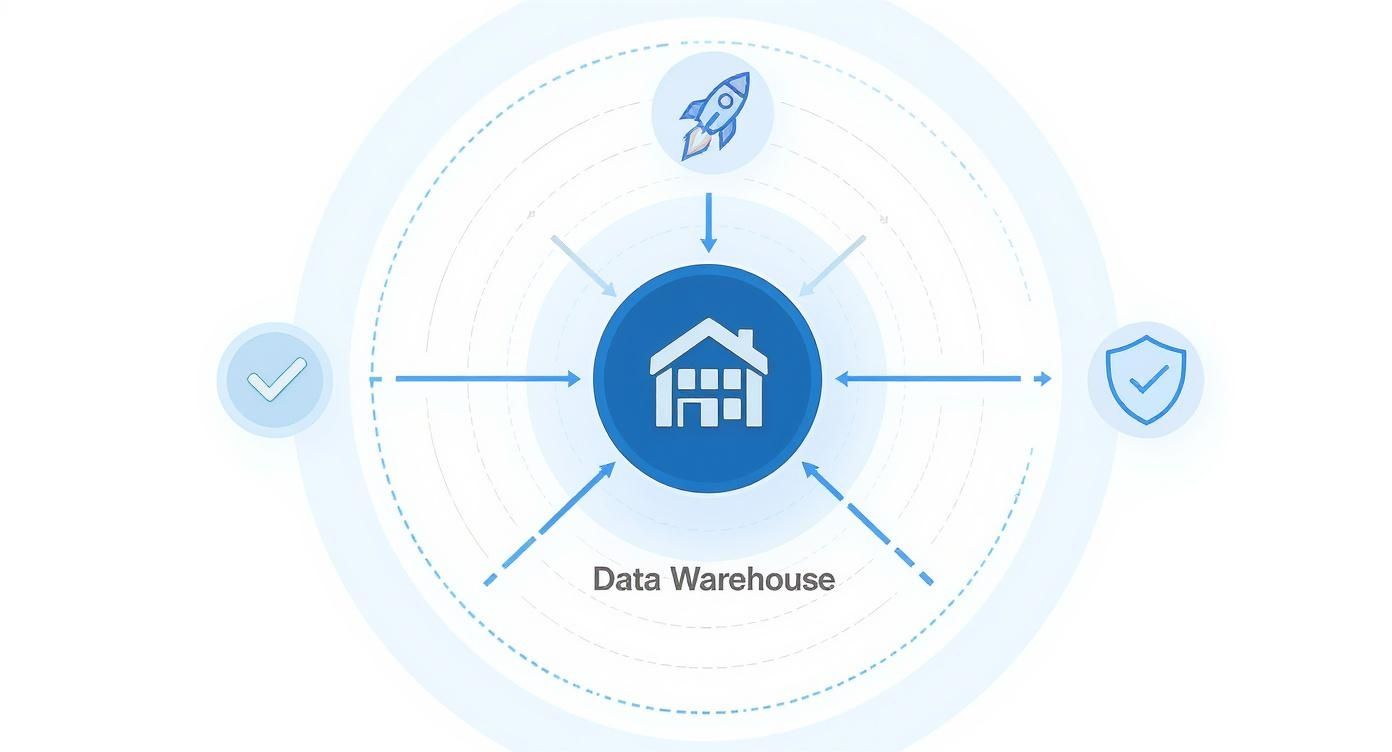
Each of these core advantages directly translates into faster, more reliable, and more secure Power BI dashboards.
The Power of a Single, Cohesive View
Perhaps the biggest win is the ability to seamlessly blend data from every corner of your business into one cohesive view. A data warehouse breaks down the silos that have traditionally separated your finance, sales, and marketing systems.
Imagine clicking a single button on a dashboard and seeing:
- Gross Margin from your accounting software.
- Customer Acquisition Cost (CAC) from your marketing platforms.
- Inventory Levels from your operations system.
All on one screen, updated in near real-time. This holistic view is where real strategic insights are born. You can finally see the direct impact of a marketing campaign on sales and profitability without spending a week manually piecing the data together in a spreadsheet. For a look at what's possible, explore these powerful business intelligence dashboard examples.
This isn't just about better reports; it's about running your business from a single, unified control panel. It empowers you to make smarter, faster decisions based on a complete and trustworthy picture of performance.
A Reliable Foundation for Growth
Modern cloud data warehouses also offer incredible reliability. They typically provide around 99.99% data availability, ensuring your critical reports are accessible whenever you need them with minimal downtime. It’s no surprise that 47% of IT managers now host their warehouses exclusively on public cloud platforms—a clear testament to their scalability and dependability.
Beyond just reporting, a solid data warehouse provides the robust foundation needed for advanced analytics and machine learning. Businesses aiming to unlock their data’s full potential often focus on finding skilled data scientists and AI/ML engineers who can turn this clean, structured data into predictive models. This reliable data layer is the first, most crucial step on that journey.
Getting Started Without the Overwhelm
After hearing about all the perks of a data warehouse, a single question usually pops into the heads of most founders: “This all sounds great, but is it way too complex or expensive for my business?”
It’s a fair question. Not long ago, data warehousing was a game reserved for massive enterprises with deep pockets and entire IT departments just to keep the on-premise servers humming.
The good news? That reality is ancient history. Modern cloud platforms have completely flipped the script, making this powerful technology accessible, affordable, and manageable for businesses of any size.
How Cloud Solutions Changed the Game
Modern cloud data warehouses like Snowflake, Google BigQuery, and Amazon Redshift operate on a totally different model than their old-school, wallet-draining predecessors. Instead of demanding a huge upfront investment in physical hardware, these solutions are built on a flexible, pay-as-you-go model.
For a small or medium-sized business, this changes everything:
- No Massive Upfront Costs: Forget about buying pricey servers or shelling out for hefty software licenses. You only pay for the data you store and the processing power you use, letting you start small and keep a tight grip on your budget.
- Infinite Scalability: As your business grows, your cloud warehouse grows right alongside you, effortlessly. You'll never hit that dreaded ceiling where you have to scrap everything and start over just because you're collecting more data.
- Reduced Technical Burden: The cloud provider takes care of all the gritty infrastructure management, maintenance, and security. This frees you from needing a dedicated database administrator on payroll.
This accessibility means you get enterprise-level analytical power without the enterprise-level price tag or headaches. The barrier to entry has been knocked down, putting sophisticated data capabilities well within reach.
A Practical 'Start Small and Scale' Approach
Kicking off a data warehouse project doesn't have to be a massive, all-or-nothing ordeal. The most successful projects we see always start with a single, clear goal that solves a real business headache. Don't try to boil the ocean by connecting every data source at once. Pick one high-impact area and nail it.
A fantastic first project is often consolidating sales and marketing data. So many businesses struggle to get a clean, unified view of their customer journey. By pulling data from your CRM (like HubSpot), your ad platforms (like Google Ads), and your e-commerce platform (like Shopify) into one central hub, you can finally answer questions like:
- What's our true customer lifetime value (LTV)?
- Which marketing channels bring in the most profitable customers, not just the most leads?
- How long is our average sales cycle, from first click to final purchase?
Answering just one of those questions accurately can deliver a serious return on your initial investment. Once you've proven the value there, you can methodically expand to bring in operational, financial, and product data, building out your single source of truth one piece at a time.
You Don't Need to Become a Data Engineer
Maybe the most important thing to remember is this: you and your team don't need to become technical wizards to get all the benefits. The point isn't to get lost in the weeds of database management; it's to get better insights to run your business.
This is exactly where a specialist partner like Vizule comes in. We handle the entire technical foundation for you—from designing the architecture to building the automated data pipelines. Our expertise in understanding the nuances of how to build a data pipeline that is both robust and efficient means you can sidestep the steep learning curve. We connect the dots in your data so you can focus on what you do best: making smart, insight-led decisions that drive growth.
Ready to Trust Your Data and Automate Your Reporting?
Let's be honest. The journey from spreadsheet chaos to genuine data clarity is one of the most fundamental investments a business can make. Moving past fragmented, conflicting data isn't just a technical upgrade—it's a strategic decision to build efficiency, unlock real scalability, and get a serious competitive edge.
When you establish a single source of truth, you stop wasting precious hours trying to reconcile conflicting numbers. Instead, you start making confident, data-backed decisions that actually move the needle.
A data warehouse is the bedrock of this entire shift. It's the engine that powers the automated, real-time Power BI dashboards that finally give you a complete picture of your business's health—across finance, operations, sales, and marketing. You can connect the dots, trust your metrics, and focus on the high-level strategy that drives growth.
It really boils down to this: a data warehouse means better data quality, faster reporting, and deeper insights. It’s what turns raw data from a liability into your most valuable asset.
If you’re ready to end the manual reporting grind and build a data foundation that can keep up with your ambition, the next step is a simple conversation.
Want to automate your reporting and finally trust your data? Book your free BI consultation with our BI consultants today.
Got Questions About Data Warehouses? We've Got Answers
Even when the benefits are clear, it’s natural to have a few practical questions. Here are the straight answers to the most common queries we hear from founders and operators thinking about a data warehouse for the first time.
How Is a Data Warehouse Different from a Database or a Data Lake?
It’s all about the job they’re built to do.
Think of a database as the cash register at a store—it’s designed for lightning-fast, one-at-a-time transactions happening right now. Its whole purpose is to keep daily operations running smoothly.
A data warehouse, on the other hand, is the company’s entire historical sales archive, meticulously organized to help you spot trends over months or years. You go there to ask the big-picture questions.
And a data lake? That’s like a giant, messy storage locker. You can throw anything in there—structured, unstructured, you name it. It holds incredible potential, but you need data scientists to sort through the chaos. For straightforward business reporting, a data warehouse gives you clean, analysis-ready information you can actually use.
Is a Data Warehouse Only for Big Enterprise Companies?
That used to be the case, but the game has completely changed. Modern cloud platforms like Snowflake and Google BigQuery have made data warehousing accessible to everyone.
They run on a pay-as-you-go model, which means you can start small and scale as your data grows. This gives small and mid-sized businesses the same analytical firepower as the big players, without the eye-watering upfront investment in hardware or a massive IT team to run it.
The move to the cloud has democratized data warehousing. It’s no longer about company size—it’s about your ambition to grow smarter.
How Long Does It Really Take to Set Up?
This is the best part—you can get value much faster than you think. The timeline hinges on your data's complexity, but the key is to not boil the ocean.
Start with a focused, high-impact goal. Let’s say you want to automate your monthly financial reporting. A project to pull data from just 2-3 key sources (like your accounting, sales, and marketing platforms) and feed it into a Power BI dashboard can be up and running in a matter of weeks, not months. The secret is a phased approach that delivers a tangible win right away.
Ready to stop wrestling with spreadsheets and start making decisions with confidence? The team at Vizule specialises in building the data foundations that let you automate reporting and unlock real-time insights.
