


If you feel like you're spending more time wrestling with Excel than actually running your business, you're not alone. This frustration is a classic roadblock for founders and operators stuck in a painful cycle of manual reporting, siloed data, and outdated insights.
For most small to medium-sized businesses, big data and analytics consulting isn't about some abstract, massive-scale tech. It's much simpler: getting a clear, trustworthy view of performance without burning days exporting CSVs and patching together fragile spreadsheets. This guide explains how it works and what it can do for you.
Tired Of Drowning In Spreadsheets?
Imagine trying to navigate a new city using a dozen torn, outdated maps taped together. One map shows the roads, another the landmarks, and a third has handwritten notes about traffic from last month. You'd spend more time trying to piece together a coherent route than actually driving.
This is exactly what it feels like to run a business on disconnected spreadsheets.
Each Excel file—from sales figures and marketing spend to financial statements and operational KPIs—is its own isolated map. They don’t talk to each other, they’re wide open to human error, and they’re almost always out of date by the time you've finished wrestling them into shape.
Your GPS For Business Growth
This is where big data and analytics consulting steps in to act as your business's GPS. Forget the overwhelming tech and confusing jargon. At its core, this is a practical service designed to pull all your scattered information into one clear, real-time view.
Instead of those disjointed maps, you get a single, interactive dashboard showing you exactly where you are, where you're headed, and the best route to get there.
The demand for this kind of clarity is exploding. The global Big Data Consulting market was valued at around USD 6.38 billion in 2024 and is expected to jump to USD 7.38 billion by 2025. This growth is being fueled by businesses just like yours, who are tired of being held back by outdated systems and are looking for expert help to find a competitive edge.
For a small business, "big data" doesn't have to mean petabytes of information. It simply means all the crucial data points that are currently scattered across your organization—in your accounting software, your CRM, your e-commerce platform, and endless spreadsheets.
The table below breaks down this shift from frustrating, manual work to automated, strategic insight.
From Manual Reporting Chaos To Automated Clarity
This table highlights the common struggles we see every day and how a proper analytics strategy solves them head-on.
| Common SMB Pain Point | How Analytics Consulting Solves It |
|---|---|
| Hours spent manually compiling reports from different sources every week or month. | Automates data pipelines to create a single, up-to-date source of truth. Reports are generated instantly. |
| Data is always out of date, leading to reactive decision-making based on old information. | Provides real-time dashboards that reflect what's happening in the business right now. |
| Inconsistent data and human error lead to a lack of trust in the numbers. | Creates standardised data models and validation rules, ensuring everyone is working from the same reliable information. |
| No clear connection between departments (e.g., marketing spend vs. sales results). | Integrates data from sales, marketing, finance, and operations into one unified view to reveal true performance drivers. |
| Important insights are buried in complex spreadsheets that are hard for the team to understand. | Develops intuitive, visual dashboards that make it easy for anyone to grasp key trends and make informed decisions. |
The goal is to connect these dots for you—automatically. A good consulting partner gives you back control, frees up countless hours, and delivers the visibility you need to make smarter, faster decisions.
Ultimately, it’s about moving from reactive fire-fighting to proactive strategy. It’s about empowering you to focus on scaling your business, not just reporting on it. You can explore our complete guide on data analytics for small business to see how these principles apply directly to companies like yours.
What A Data Analytics Consultant Actually Does
Ever heard the term "big data consulting" and pictured someone staring at lines of code that look like The Matrix? It's a common misconception. In reality, a great consultant's job is to translate your business headaches into clear, data-driven solutions. They’re the architects who turn your scattered data streams into an engine for serious growth.
Let me put it another way. Imagine you know you need a custom-built vehicle to win a race (that is, scale your business). You’re the expert driver—the operator—but you’re not a mechanic. The data consultant is your chief engineer. They’re the ones designing the engine, connecting the fuel lines, and building the dashboard that gives you every critical piece of information you need to cross the finish line first.
They don’t just dump a pile of parts in your garage; they deliver a fully-tuned, high-performance machine ready for the track. Let’s break down exactly how they build it.
Creating Your Data Roadmap
First things first: Data Strategy. Without a clear plan, collecting data is just digital hoarding. A consultant sits down with you to truly understand your core business goals. Are you trying to boost customer lifetime value? Or maybe slash operational costs? Whatever the objective, they map out precisely what information you need to track to get there.
This involves pinpointing your most valuable data sources and creating a blueprint for how everything will be collected, stored, and, most importantly, used. It's all about being intentional. Every single piece of data should serve a specific, strategic purpose. Building this foundation is non-negotiable, and you can dive deeper into our approach to developing a successful data strategy for your business in our detailed guide.
Building Your Automated Reporting Engine
Next up is Business Intelligence (BI) Implementation. This is where the strategy on paper becomes a powerful, tangible tool in your hands. Using platforms like Power BI, consultants construct the automated reporting engine that finally lets you ditch those soul-crushing manual spreadsheets. They design and build interactive dashboards that bring your key performance indicators (KPIs) to life in a way that’s actually intuitive.
Forget spending hours every Monday pulling reports from ten different systems. Instead, you get a single, unified dashboard that updates in real-time, showing you everything from daily sales figures to your marketing campaign ROI. This is the "vehicle's dashboard" we talked about—giving you the insights you need, exactly when you need them.
Connecting The Plumbing Behind The Scenes
For those slick BI dashboards to work their magic, the data has to flow seamlessly from all your different systems. This is the domain of Data Engineering. Think of it as the essential, often invisible, plumbing that connects everything behind the walls.
A consultant will build robust data pipelines that automatically pull information from all your disparate sources, such as:
- Your E-commerce Platform: Think Shopify or Magento, to track sales, orders, and customer behaviour.
- Your Accounting Software: Like QuickBooks or Xero, to monitor revenue, expenses, and cash flow.
- Your Marketing Tools: From Google Analytics to Meta Ads, to measure campaign performance and ad spend.
This process culminates in a single source of truth—a clean, reliable, and unified data warehouse where all your information lives, ready for analysis. No more conflicting numbers.
Forecasting The Future With Confidence
Once you have that solid data foundation, you can finally shift from just reporting on what happened to accurately predicting what will happen. Financial Modelling and Forecasting lets you build dynamic models that help answer your most critical business questions.
What happens to our cash flow if sales jump by 15% next quarter? How would a shift in supplier costs hit our profitability?
A consultant helps you build these driver-based models directly in Power BI, allowing for powerful scenario planning. This gives you the confidence to make forward-looking strategic decisions based on data, not guesswork, giving you a crystal-clear view of the road ahead.
Our Proven Framework to Achieve Data Clarity
Vague promises of "insights" just don't cut it. As founders and operators, your time is your most precious asset, and you need a clear, structured path from data chaos to reliable reporting. We’ve seen firsthand how generic, one-size-fits-all solutions fail to address the unique challenges of a growing business. That’s why we ditched the guesswork and developed our Map, Model, Mobilise framework.
This isn't just a process; it's a collaborative journey. We work with you to build a solution that fits your business like a glove, delivering tangible results quickly. The goal is to turn abstract data points into your most powerful tool for making strategic decisions. We believe a successful engagement has to be transparent, actionable, and laser-focused on your commercial goals.
Our three-step process is designed to move logically from discovery to a fully functional forecasting model, making sure every single action has a purpose.
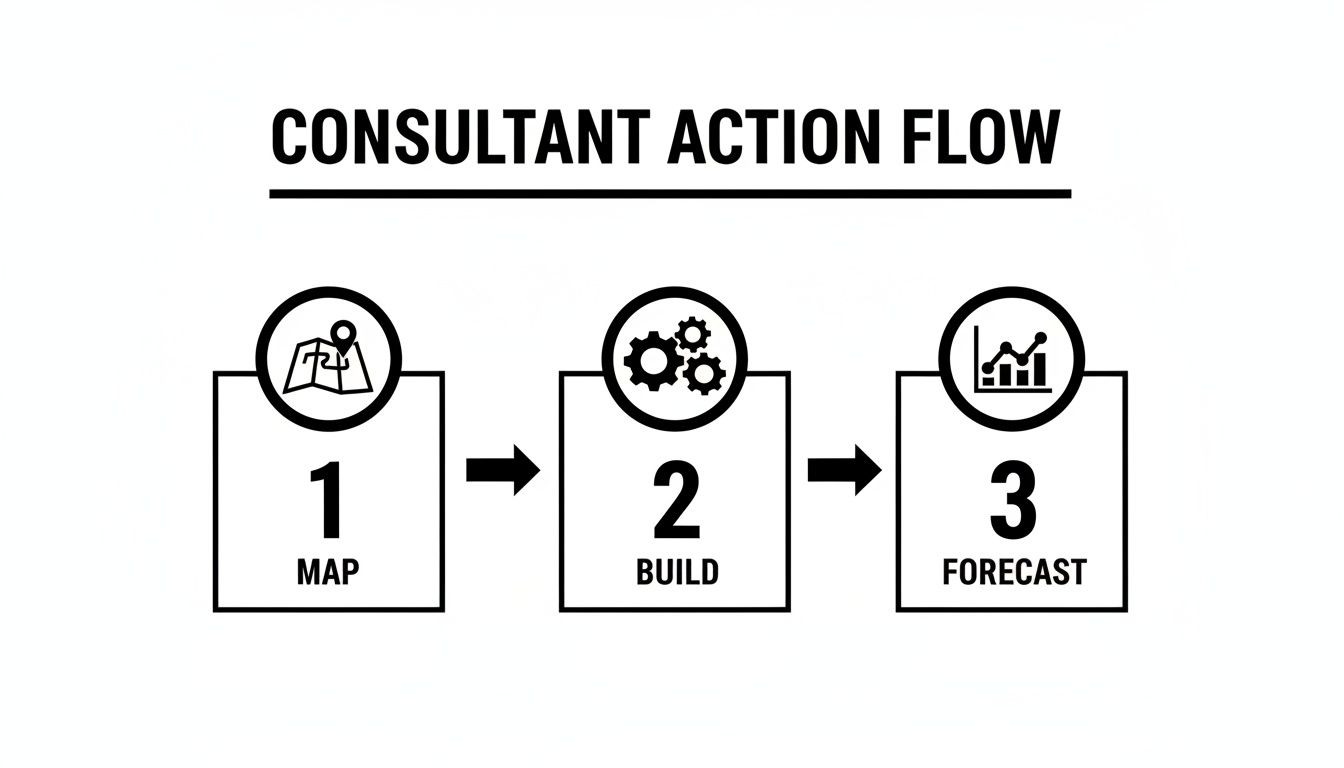
This simple flow shows our commitment to a structured plan. We start with a clear map, build a tangible solution, and end by giving you the tools to forecast your future.
Phase 1: Map Your Journey
The first phase, Map, is without a doubt the most critical. We start by diving deep into your business objectives—not your data systems. What are you actually trying to achieve? Is it boosting profitability, getting a handle on cash flow, or truly understanding customer lifetime value? Your goals become our North Star.
Only after we understand your destination do we conduct a thorough audit of your existing data ecosystem. We pinpoint where your crucial information lives, whether it's locked in QuickBooks, Shopify, your CRM, or a collection of forgotten spreadsheets. This diagnostic step lets us map out the current state of play and design a practical roadmap. It’s all about creating the blueprint before laying a single brick.
Phase 2: Model Your Data Engine
With a clear roadmap in hand, we shift into the Model phase. This is where our technical expertise really shines as we get to work building your custom data solution. Our team connects your disparate data sources, then cleans and structures the information to create a single source of truth.
This stage involves a few key activities:
- Building Data Pipelines: We construct the automated "plumbing" that pulls data from all your systems into a central data warehouse. This means no more manual exporting—ever. To see what goes into this crucial step, check out our detailed guide on how to build a data pipeline.
- Developing Robust Models: We build the logic that powers your reports. This could be anything from financial models that link your P&L and balance sheet to operational models that track inventory or sales performance.
- Creating Interactive Dashboards: We bring your data to life in Power BI. These aren't just static reports; they are dynamic, visual tools that let you drill down into the numbers, filter by date or product, and genuinely understand what's driving your business.
To get the most out of this, incorporating effective data visualization best practices is essential for turning raw numbers into something you can actually use.
Phase 3: Mobilise Your Team
A powerful dashboard is completely useless if your team doesn't know how to use it. The final phase, Mobilise, is all about empowerment and adoption. After all, technology alone doesn't solve problems; people do.
We believe the ultimate goal of any data project is not just to deliver a tool, but to embed a data-driven culture within your team. True success is when your new dashboards become an indispensable part of your daily and weekly operational rhythm.
We provide hands-on training tailored to your team’s needs, showing them how to interpret the dashboards, ask the right questions of the data, and use the insights to make better decisions. We also provide ongoing support to make sure the system grows with your business, delivering real value long after our initial project is complete. This focus on mobilisation is what ensures you see a genuine return on your investment.
What Are the Real-World Business Benefits of Analytics Consulting?
Investing in big data and analytics consulting isn’t about generating a few slick charts to show at a board meeting. It's about driving tangible, bottom-line results that directly impact your business's health and growth. For founders and operators, any investment has to have a clear, measurable return. This is about turning your data from a passive asset into an active driver of profitability and efficiency.
Let's get past the theory and talk about the practical outcomes you can actually expect. The core value is found in automating tedious manual processes, sharpening your financial oversight, and uncovering the hidden operational leaks that are quietly eating into your margins. Each benefit translates directly into more time, more profit, and more strategic control.
Reclaim Hundreds Of Hours Per Year
The most immediate and universal benefit we see is the automation of manual reporting. Just think about the hours your team—or maybe even you—spend every week exporting data from different systems, copying and pasting it into spreadsheets, and triple-checking formulas just to get a basic snapshot of performance. This isn't just a time sink; it's a major drag on your company's momentum.
By building automated data pipelines and interactive Power BI dashboards, a consultant can completely eliminate this kind of repetitive work.
- Before: Your finance lead spends 8-10 hours every single month manually piecing together the financial reporting pack.
- After: That reporting pack is now a live, interactive dashboard that updates itself, freeing up that time for high-value analysis and strategic planning.
This reclaimed time is a powerful asset you can reinvest directly into activities that actually grow the business, whether that's sales, marketing, or product development.
Achieve Real-Time Financial Clarity
For most small and medium-sized businesses, cash flow is everything. Yet, trying to run your company by looking at last month's financial reports is like driving while staring in the rearview mirror—you only see where you've been. This reactive approach makes it impossible to manage your cash flow proactively and jump on opportunities as they pop up.
A real-time financial dashboard connects directly to your accounting software (like QuickBooks or Xero) and your sales platforms (like Shopify). It gives you an immediate, up-to-the-minute view of revenue, expenses, and cash position, empowering you to make decisions based on what’s happening right now.
This kind of clarity isn't just a nice-to-have; it's a core pillar of building a resilient business. When you can see your cash flow in real time, you can anticipate shortfalls, manage your payables more effectively, and confidently decide when it’s the right time to invest in growth.
Pinpoint And Eliminate Profit Drains
Every single business has hidden inefficiencies. It could be a specific product line with surprisingly thin margins, a marketing channel that eats up budget with little to show for it, or an operational bottleneck that's slowing down your entire sales cycle. Trying to find these profit drains in a complex web of spreadsheets is nearly impossible.
This is where a consultant helps you connect the dots.
Here's a real-world example: An e-commerce client of ours suspected some of their products were underperforming but couldn't prove it. We built a Power BI dashboard that integrated their Shopify sales data with their supplier cost data. Within days, they discovered that two of their supposed "bestselling" products actually had a profit margin of less than 5% because of high shipping costs. By tweaking their pricing and marketing for those items, they boosted their overall profit margin by 12% in a single quarter.
The ROI from analytics consulting is often compelling, with clients seeing significant returns on their investments. This is driven by targeted improvements; for instance, as many as 90% of enterprises report data quality issues, and consulting firms help implement the governance needed to achieve these results. Dive into more research on how data consulting drives business improvements. Our focus on strategic data analytics is designed to uncover precisely these kinds of high-impact opportunities for your business.
How To Choose The Right Data Consulting Partner
Picking the right partner for your big data and analytics needs is probably the single most important decision you'll make on your journey to data clarity. Get it right, and your consultant becomes a true extension of your team—a trusted guide who's genuinely invested in seeing you win.
Get it wrong, and you could end up with an expensive, over-engineered system that doesn't actually solve your core business problems.
For SMB owners and founders, the stakes are even higher. You don't need a massive, impersonal firm that sees you as just another small account. You need a partner who gets the unique challenges and opportunities of a growing business—someone who speaks your language, not just a stream of technical jargon.
Key Questions To Ask Any Potential Consultant
To cut through the sales pitches and find a real partner, you have to ask the right questions. Bring this checklist to your discovery calls to figure out if a consultant is truly a good fit for your company’s needs and, just as importantly, your culture.
How they answer these questions will tell you everything you need to know about their approach and expertise.
-
Do you have direct experience with businesses my size and in my industry?
A consultant who mainly works with huge enterprises might not grasp the nimble, resource-conscious approach an SMB needs. Look for a proven track record with companies that look and feel like yours. -
Can you explain your process without leaning on heavy technical jargon?
This one is a critical test. A great partner can translate complex data concepts into clear business outcomes. If they can't explain what they do in simple terms, they'll likely struggle to understand your commercial goals. -
What is your specific expertise in Power BI and financial modelling?
Don't settle for a jack-of-all-trades. If your primary goal is to automate financial reporting and get a real-time view of performance, you need a specialist with deep, hands-on experience in the exact tools and methods that will get you there. -
How do you handle client training and long-term adoption?
A project isn't a success until your team is actually using the new dashboards and reports every day. A top-tier consultant will have a clear plan for training, handover, and ongoing support to make sure the solution delivers value long after they're gone.
Look For A Partner, Not Just A Provider
At the end of the day, you're looking for a consultancy that values a collaborative, bespoke relationship. Large firms often follow a rigid, one-size-fits-all playbook that might not suit your specific situation. A boutique consultancy, on the other hand, usually brings a more hands-on approach, working side-by-side with you to understand your unique data landscape and business objectives.
The right data partner acts as a guide, not just a builder. They should empower you with knowledge, challenge your assumptions, and be transparent about what’s achievable within your budget and timeline. It's a relationship built on trust and shared goals.
A huge part of this partnership involves connecting all your different systems into one cohesive whole. To get a better handle on this foundational work, you can learn more about the role of expert data integration consultants and how they create that all-important single source of truth for your business.
Finding this kind of partner ensures you’re not just buying a service; you’re investing in a long-term capability that will help you scale smarter and with more confidence.
Ready To Unlock Your Data's True Potential?
Let's be honest. You've seen the path forward, but the daily grind of wrestling with spreadsheets is more than just a minor headache—it's a genuine bottleneck holding your business back. That constant pain of manual reporting, siloed information, and making calls based on outdated numbers is a heavy anchor when you’re trying to move forward.
We've walked through how professional big data and analytics consulting carves a clear, structured road to data-driven growth. It's really about swapping guesswork for genuine confidence and replacing those wasted hours with strategic, decisive action. Staying put means accepting the status quo: more time lost, more opportunities missed, and more critical decisions made on gut feel alone.

Taking The First Step Towards Clarity
The journey from data chaos to data clarity doesn't need to be a massive, overwhelming project. It all starts with a single, simple step: acknowledging that the old way of doing things just isn't cutting it for your ambitions anymore. This is about finally getting the control and visibility you need to steer your business with precision.
When you partner with a specialist, you're investing in a system that works for you, not against you. The goal is to build an automated reporting engine that delivers insights you can finally trust. This frees you up to focus on leading your team and serving your customers—the work that actually moves the needle.
The cost of doing nothing is often invisible but always immense. It’s the sum of every hour spent on manual data entry, every strategic insight you missed, and every competitor who moves faster because their data works for them.
Your Path To Actionable Insights
So, what's next? The path to transforming your data is clearer than you might think. It’s a structured process we've refined to deliver value quickly and build a foundation that serves you for the long haul.
Here’s a simple look at how you can move from where you are now to where you want to be with Vizule.
Your Next Steps To Data Clarity
| Step | Action | Outcome |
|---|---|---|
| 1 | Book a Free Discovery Call | A no-obligation chat where we listen to your challenges, understand your goals, and see if we're the right fit to help. |
| 2 | Collaborative 'Map' Session | We'll work with you to audit your current data sources and create a clear, practical roadmap tailored to your business needs. |
| 3 | 'Model' and 'Mobilise' | Our team builds your automated dashboards in Power BI and empowers your team with the training to use them effectively. |
| 4 | Achieve Data-Driven Confidence | You gain a real-time, single source of truth, enabling you to make faster, smarter decisions to drive growth. |
This whole journey is about empowerment. It’s time to stop drowning in data and start using it as your most powerful asset.
If you’re ready to automate your reporting, finally trust your numbers, and unlock the insights that will drive your business forward, the next step is simple.
Book your free BI consultation with a Vizule expert today and let's start connecting the dots in your data.
Frequently Asked Questions About Data Consulting
Even after seeing the potential, it's completely normal to have a few questions before diving into big data and analytics consulting. We get it. Below, we’ve tackled some of the most common hesitations we hear from founders and SMB owners, with straightforward answers to help you decide if this is the right move for your business.
Is My Business Too Small For This?
This is the number one question we get, and the answer is a firm no. The value of data consulting isn't about the size of your company; it's about the complexity of your operations and the untapped potential hidden in your data.
If you're manually pulling reports together from different systems like QuickBooks, Shopify, and your CRM, you are a perfect candidate. It’s not about having "big data" in the classic sense. It's about having scattered data that, once connected, can tell a powerful story.
What Is The Typical Cost And Timeline For A Project?
The honest answer? It depends entirely on what you need. A project to build a single, focused sales dashboard will naturally be quicker and cost less than creating a full-suite financial model that pulls from five different data sources.
This is exactly why our initial discovery call is so important. It's a no-obligation chat where we focus on understanding your core challenges and what you want to achieve. From that conversation, we can give you a detailed proposal with a transparent scope, a clear timeline, and a fixed cost. No surprises.
Do I Need An In-House Technical Team?
Absolutely not. In fact, the vast majority of our clients are commercially-minded operators and founders, not tech experts. Our job is to be your dedicated data partner, handling all the technical heavy lifting for you.
We manage everything from building data pipelines and structuring databases to designing and rolling out your Power BI dashboards. Think of us as the team that translates your business goals into a technical solution, so you can stay focused on running your company.
If your team is currently bogged down trying to piece together insights from all over the place, looking into how AI-powered knowledge management to unleash value from scattered data can offer another angle on centralising your business intelligence.
Our goal is to empower your team, not create a dependency on technical staff. We build intuitive systems and provide thorough training so that everyone, regardless of their technical skill, can use data to make better decisions. We act as your outsourced BI team, giving you enterprise-level capabilities without the associated overhead.
Ready to stop wrestling with spreadsheets and start making decisions with confidence? Vizule is here to help you connect the dots in your data and build an automated reporting engine that drives real growth.


