


As a founder, you're constantly playing the 'what if' game. What if a key supplier hikes prices by 20%? What if a new marketing channel actually works and doubles your lead flow? This isn't just guesswork; it's the core of smart financial planning. Scenario analysis in finance is your playbook for exploring these realistic future outcomes—from best-case growth to worst-case downturns—and seeing the real impact on your cash flow and profitability.
This guide is for founders and operators who are tired of static, single-view forecasts and want to build a more resilient business that can navigate uncertainty with confidence. We'll show you how to move beyond fragile spreadsheets and turn your financial model into a dynamic tool for strategic decision-making.
Move Beyond a Single Forecast with Scenario Analysis

Does your financial forecasting feel like you're staring at one static, and usually overly optimistic, picture of the future? You're not alone. The problem with this single-threaded view is that it leaves you completely exposed. When the unexpected happens—and as a business owner, you know it always does—you're left reacting in a panic instead of responding with a clear, pre-vetted plan.
This is the exact pain point scenario analysis solves. It’s not about predicting the future with a crystal ball. It’s about building a more resilient business that can pivot intelligently because you've already considered a range of plausible outcomes and understand their financial implications.
For small and medium-sized businesses stuck in Excel chaos, this shift is a total game-changer. It elevates your financial planning from a simple budgeting exercise to a dynamic, strategic tool for navigating what's next.
Why It Matters for SMBs and Founders
Founders and operators in growing companies live with constant uncertainty. Making critical decisions based on a single, fragile forecast is like trying to navigate a storm with a compass that only points north. Scenario planning gives you a full GPS, showing multiple routes to your destination and highlighting the potential roadblocks along the way.
The practical benefits are immediate:
- Proactive Decision-Making: Instead of scrambling when a key client churns, you’ll have already modelled the impact. This lets you make confident decisions on hiring, spending, or pricing without the panic.
- Improved Capital Management: You can finally get a clear answer to "how long is our runway?" under different conditions, helping you decide exactly when to seek funding or conserve resources.
- Strategic Alignment: It provides a clear, data-backed narrative to share with investors, lenders, and your leadership team, proving you’ve stress-tested your business model and are prepared for multiple futures.
This process allows you to prepare for contingencies and map out courses of action for alternative futures. It transforms your financial model from a dusty reporting tool into a command centre for navigating uncertainty.
To give you a clearer idea of how this looks in practice, here’s a quick breakdown of common scenarios and the questions they help answer for a founder.
Scenario Planning At a Glance
| Scenario Type | Focus | Example Question for an SMB |
|---|---|---|
| Best Case | Optimistic but plausible growth | "If our new product launch exceeds sales targets by 15%, how much can we reinvest into marketing?" |
| Base Case | The most likely, "business as usual" outcome | "Assuming current market trends hold, what will our profitability be in 6 months?" |
| Worst Case | A significant downturn or major setback | "If we lose our largest client, how long is our cash runway and what immediate cost cuts are needed?" |
| Recession Scenario | Broader economic downturn | "If a recession hits and customer spending drops 25%, can we remain cash-flow positive?" |
Each scenario provides a different lens through which to view your business, ensuring you're prepared for more than just the sunny days. At Vizule, we integrate scenario analysis with comprehensive strategic budgeting and forecasting frameworks to provide a much more holistic perspective.
Ultimately, by embracing scenario analysis, you stop being a passenger to market forces and become the pilot of your business. This guide will walk you through exactly how to design, build, and use this powerful tool. By mastering the fundamentals, you can start to improve your forecasting accuracy and build a far more durable company.
Ready to trade Excel chaos for strategic clarity? Want to build a financial model that prepares you for anything? Book a free discovery call with a Vizule consultant today.
Pinpoint the Drivers That Actually Move Your Needle
Good scenario analysis isn't about modelling every single variable under the sun. That's a common trap founders fall into—building massively complex financial models in Excel that become impossible to use or maintain. The real goal is much simpler: find the handful of inputs—your key business drivers—that genuinely impact your financial health.
For an e-commerce brand, you're probably looking at customer acquisition cost (CAC), average order value (AOV), and churn rate. If you're running a SaaS company, it’s all about MRR growth, lead-to-customer conversion rates, and server costs. The trick is to separate the noise from the signal by homing in on 3-5 core metrics. This keeps your model focused, manageable, and most importantly, something you can act on.
Finding Your Core Metrics
The best place to start hunting for these drivers is in your own data. A proper deep dive into your past financials is the quickest way to see what levers have actually made a difference to your performance. Too often, this data is siloed in different systems, making it hard to connect the dots.
Looking at your historicals is crucial for getting your forecasts right and spotting what's happening in the market. In fact, studies show that by digging into 2-3 years of financial records and comparing them with market indicators, businesses can build forecasts with a much smaller margin of error, improving how they spot seasonal trends by 15-25%. You can get some great ideas on how to leverage past performance from Parameta Solutions.
This historical review lets you put numbers to the relationships in your business. For instance, you might find that for every £1,000 you pump into LinkedIn ads, new customer sign-ups jump by an average of 5%. Now that's a powerful, concrete driver you can plug straight into your scenarios.
Distinguishing Drivers from Outcomes
It's absolutely critical to know the difference between the inputs you control (the drivers) and the results they create (the outcomes). Revenue is an outcome, not a driver. The drivers are the individual activities that add up to that revenue number.
Think about it like this for different business models:
- Subscription Box Service: Your key drivers are things like monthly subscriber growth, what percentage of customers churn, and the cost of goods for each box.
- B2B Service Agency: You should be zeroing in on your sales pipeline conversion rate, the average fee you charge per project, and your team's utilisation rate.
- Physical Retail Store: For you, it might be the average number of people walking through the door each day, basket size (how many items people buy), and your rent per square foot.
By isolating these core variables, you simplify the entire process. Your model becomes a powerful tool for testing specific hypotheses, not a tangled web of interconnected assumptions.
This driver-based approach also sets you up perfectly for more advanced analysis. To really understand how a change in one of these drivers can ripple through your entire forecast, it's worth checking out our guide on how to perform sensitivity analysis. It's the next logical step to stress-test your model.
Build a Dynamic Financial Model, Not Another Rigid Spreadsheet
So many founders get trapped in 'Excel hell,' fighting with rigid spreadsheets jam-packed with hardcoded numbers. Let's be honest: these static files are totally useless for genuine scenario planning. They break, they're slow, and they can't adapt.
If you want to actually navigate uncertainty, you need something better: a dynamic, driver-based financial model.
This is a tool that truly works for you. Picture this: you change a single input in your model—say, you boost your ad spend by 15%—and you can watch the impact ripple automatically across your entire P&L, balance sheet, and cash flow statement. That's the magic of a living, connected model. It stops being a historical chore and becomes your strategic command centre.
The first step is identifying the key drivers that actually move the needle for your business.
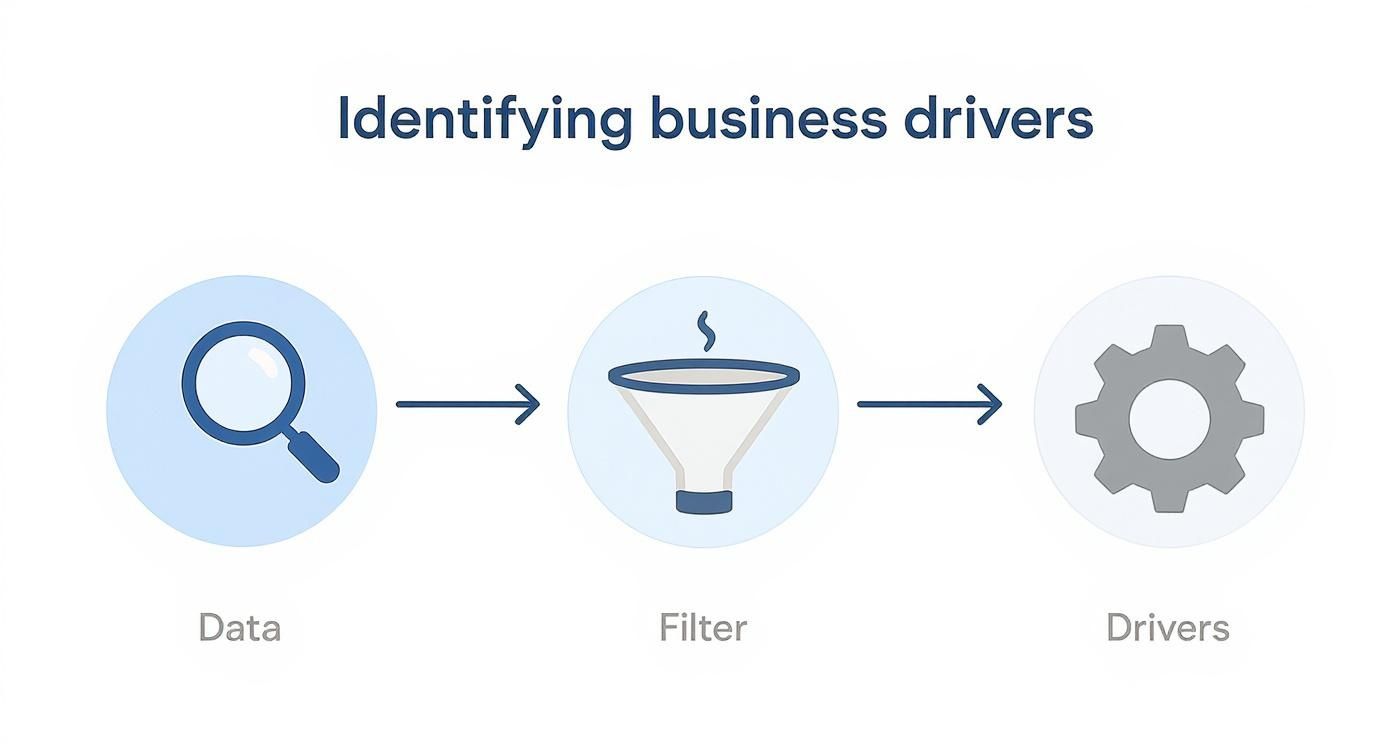
This simple flow—sifting through your data to find the most impactful variables—is the core principle. It’s how you build a model that's both powerful and manageable.
From Manual Updates to a Single Source of Truth
The biggest weakness in most spreadsheet models is the endless manual data entry. Every month, someone has to painstakingly copy and paste numbers from your accounting software, CRM, and other operational platforms. It's not just tedious; it's a recipe for disaster. One slip-up, one misplaced decimal, and your entire forecast is garbage.
This is where modern business intelligence tools come in. They create a single source of truth. By connecting a platform like Power BI directly to your data sources—think Xero, HubSpot, or your sales database—you can kill manual updates for good.
This connection establishes a continuous reporting pipeline. Your model is always refreshed with the latest actuals, which means you can perform scenario analysis in finance on real-time, reliable information.
The goal is to build a practical tool that fuels strategic conversations, not a complex academic exercise you build once and never touch again. When your model is automated and reliable, it becomes an active part of your decision-making rhythm.
Structuring Your Model for Flexibility
A well-structured model always separates inputs, calculations, and outputs into their own distinct sections. This is a non-negotiable best practice that stops common errors in their tracks and makes the model infinitely easier for anyone on your team to understand and audit.
Here’s a simple, clean structure you can follow:
- Inputs Tab: This is your control panel. It should house all your key drivers and assumptions—things like customer growth rate, average revenue per user (ARPU), and churn percentage. This is the only place anyone should ever change numbers.
- Calculation Engine: This is the "black box" where all the logic lives. It pulls from the inputs tab and runs everything through formulas to generate your three core financial statements (P&L, Balance Sheet, Cash Flow).
- Outputs/Dashboard: This is your summary view. It presents the key financial outputs and KPIs in a clean, easy-to-digest format. Think charts and summary tables that let you see the results of different scenarios at a glance.
Adopting this disciplined approach is absolutely critical. For a deeper dive on getting the structure right, check out our complete walkthrough on how to build financial models that are robust and built to scale. Building your model this way from the start ensures it can grow with your business and remain a trusted tool for years.
Define Plausible Scenarios from Bull to Bear Case
With your dynamic financial model built, it's time to shift from mechanics to strategy. This is where you get to blend the hard data with your deep operational insight to really map out what the future could hold. The goal isn't to make wild guesses, but to create a handful of meaningful, plausible scenarios.
For most businesses, sticking to three to five scenarios strikes the perfect balance. It gives you a realistic range of potential outcomes without bogging down your financial reporting with overwhelming complexity.
Crafting Your Core Scenarios
Think of each scenario as a story about your business's future. You need to start by defining a clear narrative for each one, grounded in specific business events or market shifts—not just randomly changing numbers in a spreadsheet.
- The Base Case: This is your "business as usual" path, the one you feel is most likely. It should track closely with your annual budget and assume current trends continue without any major surprises.
- The Upside (Bull) Case: Here's your optimistic—but still achievable—scenario. What happens if that new marketing campaign absolutely crushes its goals? Or if a major competitor stumbles, sending customers your way? Maybe you land two unexpected enterprise clients ahead of schedule.
- The Downside (Bear) Case: This is your stress test. It’s where you model what happens when significant headwinds pop up. Think about a key supplier jacking up prices by 30%, or a sudden slowdown in demand from your primary market.
The real objective here is to get a clear-eyed view of both your risks and opportunities. A well-defined bear case isn't about fear-mongering; it's about building resilience and having a plan in your back pocket before you actually need it.
This kind of preparation is vital, especially when you think about external shocks. History shows us that major corrections in the U.S. equity markets happen, on average, every 2.4 years. And as MSCI's historical look at market downturns points out, events driven by big macroeconomic shifts often lead to deeper downturns, with declines of 25-35% that can take years to claw back from. Understanding these patterns adds valuable, real-world context to your downside planning.
Quantifying Your Assumptions
Once you’ve got your narratives locked in, you have to attach specific, quantifiable values to your key drivers for each scenario. This is the step that brings them to life inside your financial model.
A subscription software company, for example, might lay out its scenarios like this:
| Driver | Downside Case | Base Case | Upside Case |
|---|---|---|---|
| New Monthly Sign-ups | -15% | As Forecasted | +20% |
| Monthly Churn Rate | 5.0% | 3.5% | 2.5% |
| Customer Acquisition Cost | +10% | As Forecasted | -5% |
When you plug these driver values into your model, you can instantly see the ripple effect on everything from revenue and cash flow to overall profitability. While this method gives you a clear range of outcomes, some founders want to explore the possibilities even further. If you're interested in analyzing thousands of potential outcomes based on probability, check out our guide on using a Monte Carlo simulation in finance.
Ultimately, building out these scenarios provides you with a powerful strategic playbook for whatever comes next.
Ready to build a financial model that stress-tests your business and uncovers growth opportunities? Book your free BI consultation with a Vizule expert today.
Turn Your Financial Model into Insightful Decisions
Let’s be honest, a brilliant financial model is completely useless if its insights stay trapped in a spreadsheet. You've done the hard work, now comes the most critical step: translating your complex numbers into clear, confident action. It’s all about storytelling with data.
Your stakeholders—whether they’re investors, board members, or your own leadership team—don't have the time or patience to wade through endless rows of data. They need to grasp the bottom-line impact, and they need to do it quickly. This is where visualisation becomes your most powerful tool.
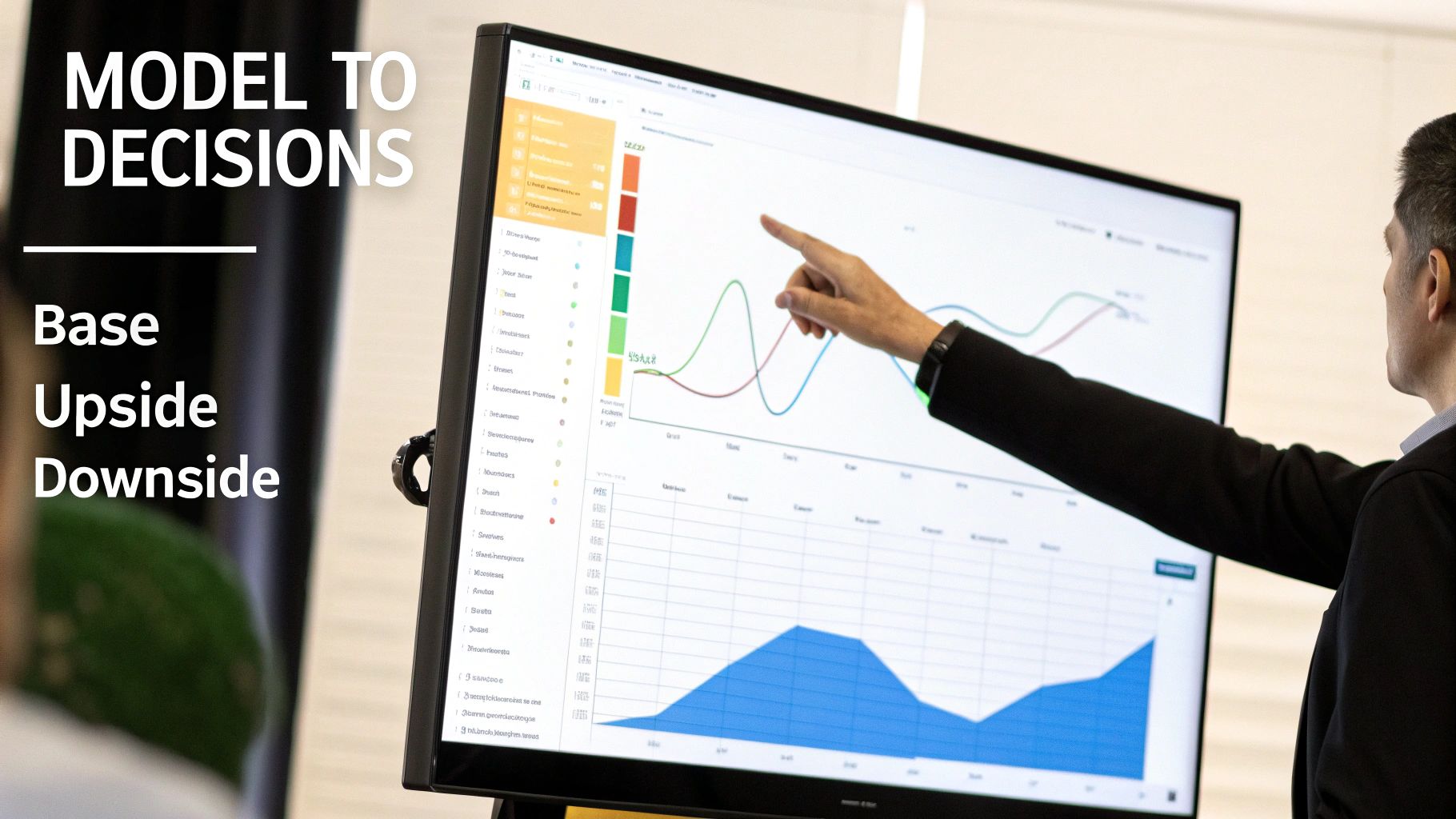
From Numbers to Narrative with Power BI
Imagine presenting your findings not as a static, sleep-inducing spreadsheet, but as an interactive dashboard. This is where tools like Power BI come in, transforming your model from a calculation engine into a strategic conversation starter.
Instead of just presenting three separate P&L statements for your scenarios, you can build a single, dynamic view. With a simple toggle or filter, you can instantly switch between your 'Base,' 'Upside,' and 'Downside' scenarios. You can literally watch the charts for cash runway, profitability, and key operational metrics update in real-time. This dynamic approach lets you answer critical business questions on the fly, right in the meeting.
The real power of scenario analysis in finance is unlocked when it’s communicated effectively. A visual dashboard shifts the conversation from "What do these numbers mean?" to "What should we do next?"
This storytelling approach gets everyone on the same page and empowers your team to have focused, strategic conversations grounded in solid data.
Answering the Questions That Matter
When you present your scenarios visually, you’re not just showing data; you're providing immediate, clear answers to the tough questions that keep founders up at night.
- Financial Runway: "Under what specific conditions do we run out of cash? How does our runway change if sales dip by 15% for two consecutive quarters?"
- Strategic Investments: "What's the absolute earliest we can afford that key marketing hire in our Upside case? What’s the breakeven point on that new piece of equipment?"
- Risk Mitigation: "If our biggest supplier raises prices, what’s the immediate impact on our gross margin, and what pricing adjustments would we need to make to compensate?"
Presenting the outputs this way makes the implications of each scenario tangible and impossible to ignore. A key part of this is creating actionable financial reports derived directly from your scenarios to guide strategy. This level of clarity builds trust and alignment across your entire organisation, ensuring everyone is working from the same playbook.
Ultimately, this final step ensures your hard work doesn't just produce a model; it produces better, faster, and more data-backed decisions that actually move the business forward.
Want to turn your complex financial data into clear, actionable dashboards? Connect with us to design your financial dashboard in Power BI.
Frequently Asked Questions About Scenario Analysis
As founders start digging into scenario analysis, a lot of the same questions pop up. You're likely wrestling with the same initial hurdles. So, let's get straight to the point and answer the most common queries we hear from our clients to help you sidestep the usual pitfalls.
How Many Scenarios Should an SMB Create?
For most small and medium-sized businesses, the sweet spot is three to five scenarios. Any more than that and you risk overcomplicating things early on; any less, and you're not getting a full picture of your potential risks and opportunities.
Start with these three core pillars:
- Base Case: This is your "most likely" forecast. It should feel realistic and typically aligns with your annual budget.
- Upside Case: Think of this as your optimistic—but still achievable—outcome. What happens if that big marketing campaign really takes off?
- Downside Case: This is your stress test. It models what happens if significant headwinds hit, like losing a major client or a sudden market downturn.
This simple structure gives you a clear view of your potential financial runway. Once you have this foundation nailed down, you can start layering in more specific scenarios, like modelling a major capital expense or a new product launch.
Can I Do Scenario Analysis in Excel or Do I Need Power BI?
You can absolutely get started in Excel. Frankly, most businesses do. It's familiar and accessible. But as your company grows, the cracks in an Excel-based model start to show. It gets slow, becomes a minefield of potential errors, and is a nightmare to manage. We've all seen it: one broken formula can silently corrupt your entire forecast.
This is where a tool like Power BI really shines. It's a far more robust and scalable solution. Instead of manual data dumps, it connects directly to your live data sources—QuickBooks, Xero, you name it—and automates the updates.
This means your scenario analysis in finance is always running on the latest, most accurate numbers. It saves countless hours of tedious work and, more importantly, makes your forecasts far more reliable. This kind of automation is the bedrock of effective, data-driven decision-making.
How Often Should We Update Our Financial Scenarios?
To keep your scenarios from becoming stale, they need regular attention. We strongly recommend making it a quarterly habit. Bake it right into your strategic planning cycle. This rhythm ensures your plans for the future are always grounded in your recent performance.
But don't be rigid. A model is only useful if it reflects reality. If a major, game-changing event happens, you need to revisit your scenarios immediately—whether you just landed a massive new client, a supply chain issue pops up, or the market suddenly shifts.
When your model is built in a dynamic tool like Power BI, these ad-hoc updates are quick and painless. It transforms your model from a static, dusty report into a responsive, strategic tool. That agility is what allows you to navigate uncertainty with confidence, knowing your plans are always current.
Ready to move beyond fragile spreadsheets and build a resilient financial model that actually drives strategic growth? The team at Vizule specialises in connecting your data, automating your reporting stack, and building dynamic Power BI models that empower you to make smarter decisions, faster.
